Close Menu
TechCentralTechCentral

    Subscribe to the newsletter

    Get the best South African technology news and analysis delivered to your e-mail inbox every morning.

    Facebook X (Twitter) YouTube LinkedIn
    WhatsApp Facebook X (Twitter) LinkedIn YouTube
    TechCentralTechCentral
    • News

      Africa’s start-ups are building on Chinese AI

      23 September 2026
      London's IPO drought could be broken by an African fintech - Airtel Money

      London’s IPO drought could be broken by an African fintech

      23 September 2026
      Altron earnings climb as platforms carry the group

      Altron earnings climb as platforms carry the group

      23 September 2026
      The new battle over the desktop

      The new battle over the desktop

      23 September 2026
      Cell C boss buys into his own turnaround - Jorge Mendes

      Cell C boss buys into his own turnaround

      22 September 2026
    • World
      Anthropic weighs new model launch to blunt OpenAI's Astra surge - Anthropic CEO Dario Amodei and OpenAI CEO Sam Altman

      Anthropic weighs new model launch to blunt OpenAI’s Astra surge

      21 September 2026
      Hackers hack hackers: ShinyHunters seizes cl0p's dark web site

      Hackers hack hackers as dark web feud erupts

      21 September 2026
      Film piracy malware is reaching corporate machines

      Film piracy malware is reaching corporate machines

      21 September 2026
      Crypto's big bet fails as US senate sinks Clarity Act

      Crypto’s big bet fails as US senate sinks Clarity Act

      16 September 2026
      'This is not circular': Jensen Huang defends $3.5-billion MediaTek deal

      ‘This is not circular’: Jensen Huang defends $3.5-billion MediaTek deal

      2 September 2026
    • In-depth
      Meta to the AI industry: slow down without us - Mark Zuckerberg

      Meta to the AI industry: slow down without us

      16 September 2026
      Google DeepMind CEO Demis Hassabis. Image: John Sears

      The plan to stop AI from breaking the world

      16 July 2026
      The internet has a Strait of Hormuz problem

      The internet has a Strait of Hormuz problem

      15 July 2026
      AI boom sparks rally, frenzy and fear

      AI boom sparks rally, frenzy and fear

      11 June 2026
      Every plug-in hybrid on sale in South Africa, ranked by price - Lamborghini Temerario

      Every plug-in hybrid on sale in South Africa, ranked by price

      7 June 2026
    • TCS
      TCS | Octotel's Trevor van Zyl on the fibre merger question

      TCS | Octotel’s Trevor van Zyl on the MetroFibre merger question

      16 September 2026
      Meet the CIO | Shoprite's Chris Shortt on what a supermarket becomes

      Meet the CIO | Shoprite’s Chris Shortt on what a supermarket becomes

      9 September 2026
      Rubicon's EV charging network is profitable - and growing fast - Watts & Wheels

      Rubicon’s EV charging network is profitable – and growing fast

      8 September 2026
      Winstone Jordaan on building a national EV charging network

      Winstone Jordaan on building a national EV charging network

      2 September 2026
      Watts & Wheels S1E8: 'Tesla lands in Africa, just not here'

      Watts & Wheels S1E8: ‘Tesla lands in Africa, just not here’

      24 August 2026
    • Opinion
      Regulating AI: apply the laws we have first - Dirk de Vos

      Regulating AI: apply the laws we have first

      21 September 2026
      The end is nigh, and the shares go on sale in October - Duncan McLeod

      The end is nigh, and the shares go on sale in October

      14 September 2026
      The fragile joint in the Capitec machine - Pambos Soteriades

      The R197-billion market the banks can’t reach

      25 August 2026
      South African tech's compounding debt problem - Jannie van Zyl

      Management consulting as we know it is over

      21 August 2026
      South African tech's compounding debt problem - Jannie van Zyl

      The most dangerous customer is the quiet one

      10 August 2026
    • Company Hubs
      • 1Stream
      • Africa Data Centres
      • AfriGIS
      • Altron Digital Business
      • Altron Document Solutions
      • Altron Group
      • Arctic Wolf
      • Ascent Technology
      • AvertITD
      • BBD
      • Braintree
      • CallMiner
      • CambriLearn
      • CM.com
      • Contactable
      • CYBER1 Solutions
      • Digicloud Africa
      • Digimune
      • Domains.co.za
      • ESET
      • Euphoria Telecom
      • HOSTAFRICA
      • Incredible Business
      • iONLINE
      • IQbusiness
      • Iris Network Systems
      • Kaspersky
      • LSD Open
      • Mitel
      • NEC XON
      • Netstar
      • Network Platforms
      • Next DLP
      • Ovations
      • Paracon
      • Paratus
      • Q-KON
      • SevenC
      • SkyWire
      • Solid8 Technologies
      • Telit Cinterion
      • Telviva
      • Tenable
      • Vertiv
      • Videri Digital
      • Vodacom Business
      • Vox
      • Wipro
      • Workday
      • XLink
    • Sections
      • AI and machine learning
      • Banking
      • Broadcasting and Media
      • Cloud services
      • Contact centres and CX
      • Cryptocurrencies
      • Education and skills
      • Electronics and hardware
      • Energy and sustainability
      • Enterprise software
      • Financial services
      • HealthTech
      • Information security
      • Internet and connectivity
      • Internet of Things
      • Investment
      • IT services
      • Lifestyle
      • Policy and regulation
      • Public sector
      • Retail and e-commerce
      • Satellite communications
      • Science
      • SMEs and start-ups
      • Social media
      • Talent and leadership
      • Telecoms
      • Watts & Wheels
    • Events
    • Advertise
    TechCentralTechCentral
    Home » Sections » Electronics and hardware » Apple to target high-end PCs with next-gen silicon in 2021

    Apple to target high-end PCs with next-gen silicon in 2021

    By Agency Staff7 December 2020
    Twitter LinkedIn Facebook WhatsApp Email Telegram Copy Link
    Get breaking news on WhatsApp

    Apple M1 chip has been well received

    Apple is planning a series of new Mac processors for introduction as early as 2021 that are aimed at outperforming Intel’s fastest chips.

    Chip engineers at the Cupertino, California-based technology giant are working on several successors to the M1 custom chip, Apple’s first Mac main processor that debuted in November. If they live up to expectations, they will significantly outpace the performance of the latest machines running Intel chips, according to people familiar with the matter who asked not to be named because the plans aren’t yet public.

    Apple’s M1 chip was unveiled in a new entry-level MacBook Pro laptop, a refreshed Mac mini desktop and across the MacBook Air range. The company’s next series of chips, planned for release as early as the southern hemisohere autumn and later in the spring, are destined to be placed across upgraded versions of the MacBook Pro, both entry-level and high-end iMac desktops, and later a new Mac Pro workstation, the people said.

    The road map indicates Apple is taking decisive steps to design Intel components out of its devices

    The road map indicates Apple’s confidence that it can differentiate its products on the strength of its own engineering and is taking decisive steps to design Intel components out of its devices. The next two lines of Apple chips are also planned to be more ambitious than some industry watchers expected for next year. The company said it expects to finish the transition away from Intel and to its own silicon in 2022.

    While Intel gets less than 10% of its revenue from furnishing Apple with Mac chips, the rest of its PC business is liable to face turbulence if the iPhone maker is able to deliver demonstrably better-performing computers. It could accelerate a shake-up in an industry that has long been dependent on Intel’s pace of innovation. For Apple, the move sheds that dependency, deepens its distinction from the rest of the PC market and gives it a chance to add to its small but growing share in PCs.

    Complex

    An Apple spokesman declined to comment. Chip development and production is complex with changes being common throughout the development process. Apple could still choose to hold back these chips in favour of lesser versions for next year’s Macs, the people said, but the plans nonetheless indicate Apple’s vast ambitions.

    Apple’s Mac chips, like those in its iPhone, iPad and Apple Watch, use technology licensed from ARM, the chip design firm whose blueprints underpin much of the mobile industry and which Nvidia is in the process of acquiring. Apple designs the chips and outsources their production to Taiwan Semiconductor Manufacturing Co, which has taken the lead from Intel in chip manufacturing.

    The current M1 chip inherits a mobile-centric design built around four high-performance processing cores to accelerate tasks like video editing and four power-saving cores that can handle less intensive jobs like Web browsing. For its next-generation chip targeting MacBook Pro and iMac models, Apple is working on designs with as many as 16 power cores and four efficiency cores, the people said.
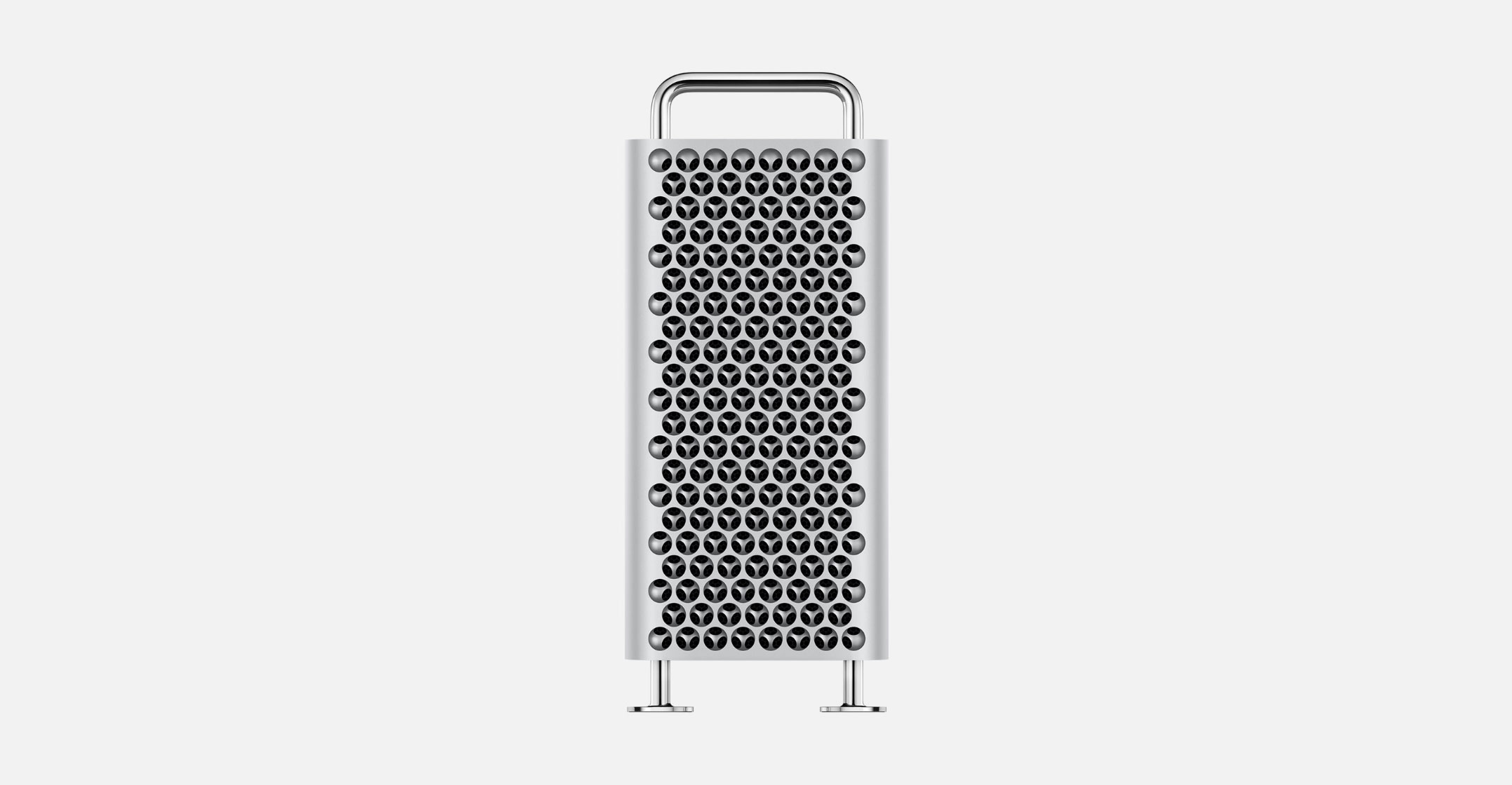
    Apple’s in-house chips are coming to the next Mac Pro

    While that component is in development, Apple could choose to first release variations with only eight or 12 of the high-performance cores enabled depending on production, they said. Chip makers are often forced to offer some models with lower specifications than they originally intended because of problems that emerge during fabrication.

    For higher-end desktop computers, planned for later in 2021 and a new half-sized Mac Pro planned to launch by 2022, Apple is testing a chip design with as many as 32 high-performance cores.

    With today’s Intel systems, Apple’s highest-end laptops offer a maximum of eight cores, a high-end iMac Pro is available with as many as 18 and the priciest Mac Pro desktop features as much as a 28-core system. Though architecturally different, Apple and Intel chips rely on the segmentation of workloads into smaller, serialised tasks that several processing cores can work on at once.

    While the M1 silicon has been well received, the Macs using it are Apple’s lower-end systems with less memory

    AMD, which has been gaining market share at Intel’s expense, offers standard desktop parts with as many as 16 cores, with some of its high-end chips for gaming PCs going as high as 64 cores.

    While the M1 silicon has been well received, the Macs using it are Apple’s lower-end systems with less memory and fewer ports. The company still sells higher-end, Intel-based versions of some of the lines that received M1 updates. The M1 chip is a variation of a new iPad processor destined to be included in a new iPad Pro arriving next year.

    More ambitious

    Apple engineers are also developing more ambitious graphics processors. Today’s M1 processors are offered with a custom Apple graphics engine that comes in either 7- or 8-core variations. For its future high-end laptops and midrange desktops, Apple is testing 16-core and 32-core graphics parts.

    For later in 2021 or potentially 2022, Apple is working on pricier graphics upgrades with 64 and 128 dedicated cores aimed at its highest-end machines, the people said. Those graphics chips would be several times faster than the current graphics modules Apple uses from Nvidia and AMD in its Intel-powered hardware.  — Reported by Mark Gurman and Ian King, (c) 2020 Bloomberg LP

    Add TechCentral as a preferred source on GoogleFollow TechCentral on Google NewsGet breaking news on WhatsApp


    AMD Apple Intel Nvidia top TSMC
    WhatsApp YouTube
    Share. Facebook Twitter LinkedIn WhatsApp Telegram Email Copy Link
    Previous ArticleLG overhauls its struggling smartphone business
    Next Article US is poised to sue Facebook for monopoly abuse

    Related Posts

    The new battle over the desktop

    The new battle over the desktop

    23 September 2026
    AMD is now worth a trillion dollars - Lisa Su

    AMD is now worth a trillion dollars

    22 September 2026

    10 days that changed the course of AI

    21 September 2026
    Company News
    Why true customer enablement starts on the inside - Backspace Technologies COO Graeme Thomson

    Why true customer enablement starts on the inside

    23 September 2026
    Barcode printing: Argox changes the game - Kemtek

    Barcode printing: Argox changes the game

    23 September 2026
    How agentic AI is transforming South African security operations - Maidar Secure Strike48

    How agentic AI is transforming South African security operations

    22 September 2026
    Opinion
    Regulating AI: apply the laws we have first - Dirk de Vos

    Regulating AI: apply the laws we have first

    21 September 2026
    The end is nigh, and the shares go on sale in October - Duncan McLeod

    The end is nigh, and the shares go on sale in October

    14 September 2026
    The fragile joint in the Capitec machine - Pambos Soteriades

    The R197-billion market the banks can’t reach

    25 August 2026

    Subscribe to Updates

    Get the best South African technology news and analysis delivered to your e-mail inbox every morning.

    Latest Posts

    Africa’s start-ups are building on Chinese AI

    23 September 2026
    Why true customer enablement starts on the inside - Backspace Technologies COO Graeme Thomson

    Why true customer enablement starts on the inside

    23 September 2026
    London's IPO drought could be broken by an African fintech - Airtel Money

    London’s IPO drought could be broken by an African fintech

    23 September 2026
    Barcode printing: Argox changes the game - Kemtek

    Barcode printing: Argox changes the game

    23 September 2026
    © 2009 - 2026 NewsCentral Media
    Built and maintained by Chronon
    • Cookie policy (ZA)
    • TechCentral – privacy and Popia

    Type above and press Enter to search. Press Esc to cancel.

    Manage consent

    TechCentral uses cookies to enhance its offerings. Consenting to these technologies allows us to serve you better. Not consenting or withdrawing consent may adversely affect certain features and functions of the website.

    Functional Always active
    The technical storage or access is strictly necessary for the legitimate purpose of enabling the use of a specific service explicitly requested by the subscriber or user, or for the sole purpose of carrying out the transmission of a communication over an electronic communications network.
    Preferences
    The technical storage or access is necessary for the legitimate purpose of storing preferences that are not requested by the subscriber or user.
    Statistics
    The technical storage or access that is used exclusively for statistical purposes. The technical storage or access that is used exclusively for anonymous statistical purposes. Without a subpoena, voluntary compliance on the part of your Internet Service Provider, or additional records from a third party, information stored or retrieved for this purpose alone cannot usually be used to identify you.
    Marketing
    The technical storage or access is required to create user profiles to send advertising, or to track the user on a website or across several websites for similar marketing purposes.
    • Manage options
    • Manage services
    • Manage {vendor_count} vendors
    • Read more about these purposes
    View preferences
    • {title}
    • {title}
    • {title}