
Close Menu
TechCentralTechCentral

    Subscribe to the newsletter

    Get the best South African technology news and analysis delivered to your e-mail inbox every morning.

    Facebook X (Twitter) YouTube LinkedIn
    WhatsApp Facebook X (Twitter) LinkedIn YouTube
    TechCentralTechCentral
    • News
      Management consulting as we know it is over

      Management consulting as we know it is over

      21 August 2026
      South Africa to get a new national 5G broadband network - Iain Stevenson

      South Africa to get a new national 5G broadband network

      20 August 2026
      How Comsol turned 60MHz into a national 5G bet - Iain Stevenson

      How Comsol turned 60MHz into a national 5G bet

      20 August 2026
      South Africa's AI neutrality has not yet been tested - Solly Malatsi

      South Africa’s AI neutrality has not yet been tested

      20 August 2026
      Bitcoin roars back to life after Trump pushes Clarity Act - DOnald Trump

      Bitcoin roars back to life after Trump pushes Clarity Act

      20 August 2026
    • World
      Russia building its own Starlink - and faster than expected - Vadym Skibitskyi

      Russia building its own Starlink – and faster than expected

      11 August 2026
      Meta AI will now tell parents if their teen is in crisis

      Meta AI will now tell parents if their teen is in crisis

      17 July 2026
      IBM shares crash 25% as AI upends software spending - Arvind Krishna

      IBM shares crash 25% as AI upends software spending

      15 July 2026
      Jony Ive's first OpenAI device: an AI smart speaker - Jony Ive and Sam Altman

      Jony Ive’s first OpenAI device: an AI smart speaker

      15 July 2026
      Stripe, Advent in talks to buy PayPal for $53-billion

      Stripe, Advent in talks to buy PayPal for $53-billion

      15 July 2026
    • In-depth
      Google DeepMind CEO Demis Hassabis. Image: John Sears

      The plan to stop AI from breaking the world

      16 July 2026
      The internet has a Strait of Hormuz problem

      The internet has a Strait of Hormuz problem

      15 July 2026
      AI boom sparks rally, frenzy and fear

      AI boom sparks rally, frenzy and fear

      11 June 2026
      Every plug-in hybrid on sale in South Africa, ranked by price - Lamborghini Temerario

      Every plug-in hybrid on sale in South Africa, ranked by price

      7 June 2026
      What Wi-Fi 8 will mean for wireless networks

      What Wi-Fi 8 will mean for wireless networks

      1 June 2026
    • TCS
      Meet the CIO | Discovery's Derek Wilcocks on AI, guardrails and growth

      Meet the CIO | Derek Wilcocks on how AI personalised Vitality

      13 August 2026
      TCS | Money just became native to the internet - Steven Boykey Sidley

      TCS | Money just became native to the internet – Steven Boykey Sidley

      12 August 2026
      TCS+ | Specops' Darren James on continuous trust in an AI world

      TCS+ | Specops’ Darren James on continuous trust in an AI world

      7 August 2026
      TCS+ | How AI is turning hardware into a subscription service - Shane van der Merwe Merchant West

      TCS+ | How AI is turning hardware into a subscription service

      6 August 2026
      TCS+ | Why South African workers must become supervisors of digital labour - Accelera Digital Group Cliff de Wit

      TCS+ | Why South African workers must become supervisors of digital labour

      31 July 2026
    • Opinion
      The author, Jannie van Zyl

      Selling vapour is corporate suicide in slow motion

      16 July 2026
      Brazil's online gambling crackdown is a lesson for South Africa

      How Amazon outmanoeuvred Starlink in South Africa

      15 July 2026
      The Popia problem with agentic AI - Herman Haasbroek

      The Popia problem with agentic AI

      14 July 2026
      The author, Fanie van Rooyen

      South Africa can still catch the AI wave – here’s how

      7 July 2026
      The author, Fanie van Rooyen

      The AI utopia South Africa can’t afford

      1 July 2026
    • Company Hubs
      • 1Stream
      • Africa Data Centres
      • AfriGIS
      • Altron Digital Business
      • Altron Document Solutions
      • Altron Group
      • Arctic Wolf
      • Ascent Technology
      • AvertITD
      • BBD
      • Braintree
      • CallMiner
      • CambriLearn
      • CM Telecom
      • Contactable
      • CYBER1 Solutions
      • Digicloud Africa
      • Digimune
      • Domains.co.za
      • ESET
      • Euphoria Telecom
      • HOSTAFRICA
      • Incredible Business
      • iONLINE
      • IQbusiness
      • Iris Network Systems
      • Kaspersky
      • LSD Open
      • Mitel
      • NEC XON
      • Netstar
      • Network Platforms
      • Next DLP
      • Ovations
      • Paracon
      • Paratus
      • Q-KON
      • SevenC
      • SkyWire
      • Solid8 Technologies
      • Telit Cinterion
      • Telviva
      • Tenable
      • Vertiv
      • Videri Digital
      • Vodacom Business
      • Vox
      • Wipro
      • Workday
      • XLink
    • Sections
      • AI and machine learning
      • Banking
      • Broadcasting and Media
      • Cloud services
      • Contact centres and CX
      • Cryptocurrencies
      • Education and skills
      • Electronics and hardware
      • Energy and sustainability
      • Enterprise software
      • Financial services
      • HealthTech
      • Information security
      • Internet and connectivity
      • Internet of Things
      • Investment
      • IT services
      • Lifestyle
      • Policy and regulation
      • Public sector
      • Retail and e-commerce
      • Satellite communications
      • Science
      • SMEs and start-ups
      • Social media
      • Talent and leadership
      • Telecoms
      • Watts & Wheels
    • Events
    • Advertise
    TechCentralTechCentral
    Home » Sections » IT services » Management consulting as we know it is over

    Management consulting as we know it is over

    The big consulting firms inflated every hype cycle and left before the crash. AI ends the chicanery.
    By Jannie van Zyl21 August 2026
    Twitter LinkedIn Facebook WhatsApp Email Telegram Copy Link
    News Alerts
    WhatsApp
    Management consulting as we know it is over
    The machine writes the slides now

    Management consulting, as we have known it for half a century, is finished. The great slide-making, hype-selling, invoice-by-the-kilogram machine is being dismantled by the very technology its own practitioners are busy overhyping, and it could not happen to a more deserving industry. I have earned the right to be blunt about this, having spent nearly 40 years on the receiving end of it.

    In 2010, I ran the company that built one of South Africa’s first commercial WiMax networks. The technology was genuinely ahead of its time and in the field it outran the mobile networks of the day by a wide margin. It should have been an easy, honest story to tell. Instead, I watched a parade of consultants inflate its capabilities past anything the physics allowed, selling the peak speed and the maximum range as though both arrived at once. I knew how it would end. The gap between the brochure and the experience landed on real customers as disappointment. The technology did not fail them; the hype did.

    That script has run for most of my career, and I can tell you who writes it.

    The client rides the full rollercoaster. The consultant sells the tickets and leaves before the drop

    Every executive has seen the Gartner Hype Cycle: the “peak of inflated expectations”, the “trough of disillusionment”, the long climb to a “plateau of productivity”. Beneath it sits an honest observation, usually credited to the futurist Roy Amara – we overestimate a technology in the short run and underestimate it in the long run. Amara was right.

    But look at who is standing on the peak with the megaphone. It is almost always the big advisory firms, and the peak does not simply happen to a technology. Someone inflates it, with a forecast in the trillions and a date far enough away that nobody will check, then sells the readiness work the panic creates. When reality cannot match the number and the thing slides into the trough, the consultants have already re-badged onto the next wave.

    A fortune-teller on a retainer

    When the venture investor Michael Mullany went back through 20 years of Gartner’s emerging-technology cycles, he found that most technologies never followed the curve at all; dozens appeared once and vanished. One of them was WiMax, the very technology I was building while the slideware promised the impossible. Gartner even keeps a category, “obsolete before plateau”, for the ones that die on the way up.

    Read honestly, the curve does not forecast anything. It is a story supple enough to be right whatever happens: a boom confirms the peak, a crash confirms the trough, a quiet death was “obsolete before plateau”, a late recovery proves the plateau. An adviser who cannot be wrong is a fortune-teller on a retainer.

    In 2022, McKinsey valued the metaverse at up to US$5-trillion by 2030 and called it “too big to ignore”. Citi went to $8-trillion to $13-trillion. Gartner predicted that by 2026 a quarter of us would spend at least an hour a day in the metaverse. It is 2026, and we do not. Meta – the company so sure of this future that it renamed itself after it – has since absorbed something north of $60-billion in losses at its Reality Labs division and quietly redirected the language, and the capital, to artificial intelligence.
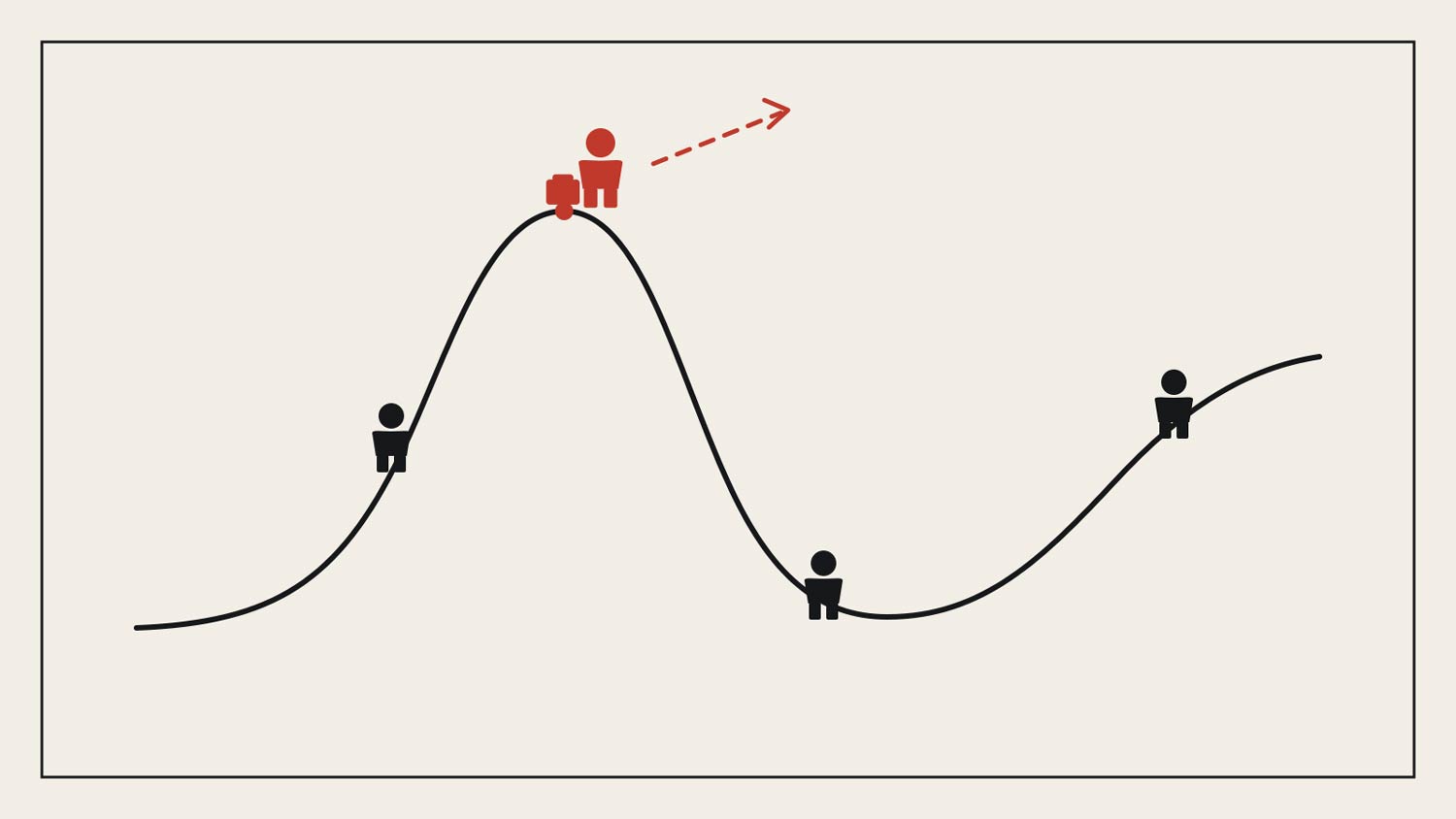
    Gartner hype cycle

    I have seen that conviction up close. A few years ago I was given the tour of a consultancy’s innovation hub in Europe, an entire floor of it surrendered to the metaverse: the headsets, the virtual showrooms, the earnest young evangelists. When I ventured that I could not see the business value beyond a handful of niches, I was all but shown the lift. That floor still exists. Only now every desk on it “does AI”. The sign on the door was changed and nothing was learned.

    These things were not all worthless. Big data is real. AI, unlike the NFT circus, is plainly consequential – I watch it do useful work in industrial settings every day, and it helped me write this article. What matters is that the firms were exactly as confident about the duds as they were about the real shifts. Their certainty about the metaverse was indistinguishable from their certainty about the cloud. Like any gambler, they guess.

    The confidence carries no information because, as a rule, the firm that sold “deep industry experience” does not have it for your business. The large-firm model is a pyramid of bright graduates on an “up or out” clock, and deep domain knowledge is the one thing such a model cannot keep.

    A signal that fires identically for the true and the false is not a signal. It is noise with a logo on it

    So consultants do the thing that reliably works. They interview your own people – the engineers and operators who flagged the problem years ago – and repackage what they hear into a confident narrative and a beautiful deck.

    Mariana Mazzucato, in her study of the industry, puts it bluntly: the big firms often have “no expertise in the areas they’re advising in”. Clayton Christensen noted years ago that consulting had resisted scrutiny precisely because its work happens in “the black box of the team room”, where the client cannot see what it is paying for.

    The model borrows its name from cloud computing: lift and shift. Lift the knowledge out of the client’s own staff, shift it onto a slide. The value added is polish, and a logo expensive enough to make a pre-known decision safe to sign. What the client buys is cover – accountability rented by the hour.

    The machine writes the slides now

    There are exceptions, and the most instructive is the man I have just quoted. Christensen began his career as a consultant at Boston Consulting Group and became the rare one who got it right, the thinker who foresaw earlier and more clearly than anyone that even consulting would one day be disrupted from below. I was fortunate to spend time with him. The Innovator’s Dilemma remains required reading, the one business book Steve Jobs said had genuinely shaped his thinking. Christensen’s authority came from a theory that kept proving right, not from the confidence with which it was delivered. Salesmanship the machine can fake. That, it cannot.

    Synthesise a pile of documents and interviews and turn them into a confident, well-structured story: that is the single task generative AI does best. The firms know it, because they have built the tools themselves. McKinsey’s internal assistant, Lilli, will draft a presentation from a prompt and match the house tone. BCG has a tool, Deckster, that produces and polishes slides on command. By some estimates, these already do up to 80% of a junior analyst’s work, in seconds rather than weeks.

    From left, the author, Jannie van Zyl, with the late Clayton Christensen - the one adviser who saw it coming
    From left, the author, Jannie van Zyl, with the late Clayton Christensen – the one adviser who saw it coming

    The pyramid is thinning from the bottom, because packaging is the part the machine learned first. This is not the end of all advice. When effort becomes cheap, judgment becomes the scarce and valuable thing, and the advisers genuinely worth their fee – the ones with real, scarred, industry-deep experience, who have built the thing and not merely presented it – will become rarer and more valuable.

    Accountability cannot be delegated to a model either; a human still has to answer for the decision. It is the clever generalist whose only edge was a nicer font for whom the arithmetic no longer works. Such advisers will enjoy a brief surge as they wield the tools themselves, right up until their clients notice the same tools sitting on their own desks, and that the knowledge in the deck was theirs to begin with.

    The bill industry chose to pay

    None of this was done to us. It was done with us. For decades, industry invited the firms in, feted them and paid the fare, frequently to rediscover what its own people already knew and occasionally at a cost far higher than money.

    South Africa knows the extreme version: prestige firms were found by our own commissions of inquiry to have helped hollow out the institutions that hired them. The cost is the one Mazzucato names best – every time an organisation rents its thinking, it forgets a little more how to think for itself.

    There is a test I would hand any executive facing the next inevitable revolution. Ask the person pitching it to define the central idea without the buzzword or the trillion-dollar number. Ask what they were certain of three years ago, and how it aged. Then ask for skin in the game: tie the fee to the outcome, and watch the certainty drain from the room.

    They have automated their own graduates – and, in doing so, told us exactly what those graduates were for

    The buzzword will change again in about two years; it always does. What is different this time is that the machine can do the packaging, which leaves the uncomfortable truth that the only thing the client ever really needed was to listen to its own people. Management consulting as we have known it is over, killed by the last wave it tried to sell. Having watched it sell disappointment for 40 years, I can only say: not a moment too soon.

    • Jannie van Zyl is an electronics engineer and ICT veteran of four decades. He founded several technology companies, was instrumental in launching 3G, 4G and 5G in South Africa, was group CEO of the company that built one of the country’s first commercial WiMax networks, and led Vodacom’s innovation function for more than a decade. He writes in his personal capacity
    • Read more articles by Van Zyl on TechCentral
    • Subscribe to TechCentral’s daily newsletter
    • Get breaking news alerts on WhatsApp

    Follow TechCentral on Google News Add TechCentral as your preferred source on Google


    BCG Citi Clayton Christensen Gartner Jannie van Zyl Mariana Mazzucato McKinsey Meta Michael Mullany Roy Amara Steve Jobs
    WhatsApp YouTube
    Share. Facebook Twitter LinkedIn WhatsApp Telegram Email Copy Link
    Previous ArticleSouth Africa to get a new national 5G broadband network

    Related Posts

    AI's hunger for capital is the next big risk to the global economy

    AI’s hunger for capital is the next big risk to the global economy

    14 August 2026
    The most dangerous customer is the quiet one - Jannie van Zyl

    The most dangerous customer is the quiet one

    10 August 2026
    Meta cash flow collapses as AI bill hits $145-billion - Mark Zuckerberg

    Meta cash flow collapses as AI bill hits $145-billion

    30 July 2026
    Company News
    Smarter operations take centre stage at Electra Mining Africa 2026

    Smarter operations take centre stage at Electra Mining Africa 2026

    20 August 2026
    Fidelity turns to Sigfox to spot fires before they start

    Fidelity turns to Sigfox to spot fires before they start

    19 August 2026
    Paratus Rwanda marks first year with AfPIF opening reception

    Paratus Rwanda marks first year with AfPIF opening reception

    18 August 2026
    Opinion
    The author, Jannie van Zyl

    Selling vapour is corporate suicide in slow motion

    16 July 2026
    Brazil's online gambling crackdown is a lesson for South Africa

    How Amazon outmanoeuvred Starlink in South Africa

    15 July 2026
    The Popia problem with agentic AI - Herman Haasbroek

    The Popia problem with agentic AI

    14 July 2026

    Subscribe to Updates

    Get the best South African technology news and analysis delivered to your e-mail inbox every morning.

    Latest Posts
    Management consulting as we know it is over

    Management consulting as we know it is over

    21 August 2026
    South Africa to get a new national 5G broadband network - Iain Stevenson

    South Africa to get a new national 5G broadband network

    20 August 2026
    How Comsol turned 60MHz into a national 5G bet - Iain Stevenson

    How Comsol turned 60MHz into a national 5G bet

    20 August 2026
    South Africa's AI neutrality has not yet been tested - Solly Malatsi

    South Africa’s AI neutrality has not yet been tested

    20 August 2026
    © 2009 - 2026 NewsCentral Media
    Built and maintained by Chronon
    • Cookie policy (ZA)
    • TechCentral – privacy and Popia

    Type above and press Enter to search. Press Esc to cancel.

    Manage consent

    TechCentral uses cookies to enhance its offerings. Consenting to these technologies allows us to serve you better. Not consenting or withdrawing consent may adversely affect certain features and functions of the website.

    Functional Always active
    The technical storage or access is strictly necessary for the legitimate purpose of enabling the use of a specific service explicitly requested by the subscriber or user, or for the sole purpose of carrying out the transmission of a communication over an electronic communications network.
    Preferences
    The technical storage or access is necessary for the legitimate purpose of storing preferences that are not requested by the subscriber or user.
    Statistics
    The technical storage or access that is used exclusively for statistical purposes. The technical storage or access that is used exclusively for anonymous statistical purposes. Without a subpoena, voluntary compliance on the part of your Internet Service Provider, or additional records from a third party, information stored or retrieved for this purpose alone cannot usually be used to identify you.
    Marketing
    The technical storage or access is required to create user profiles to send advertising, or to track the user on a website or across several websites for similar marketing purposes.
    • Manage options
    • Manage services
    • Manage {vendor_count} vendors
    • Read more about these purposes
    View preferences
    • {title}
    • {title}
    • {title}