
Telecommunications operators have clearer AI strategies than any other industry detailed in a new global study, yet report some of the smallest gains from it, according to Boston Consulting Group’s Applied AI Index 2026, published on Wednesday.
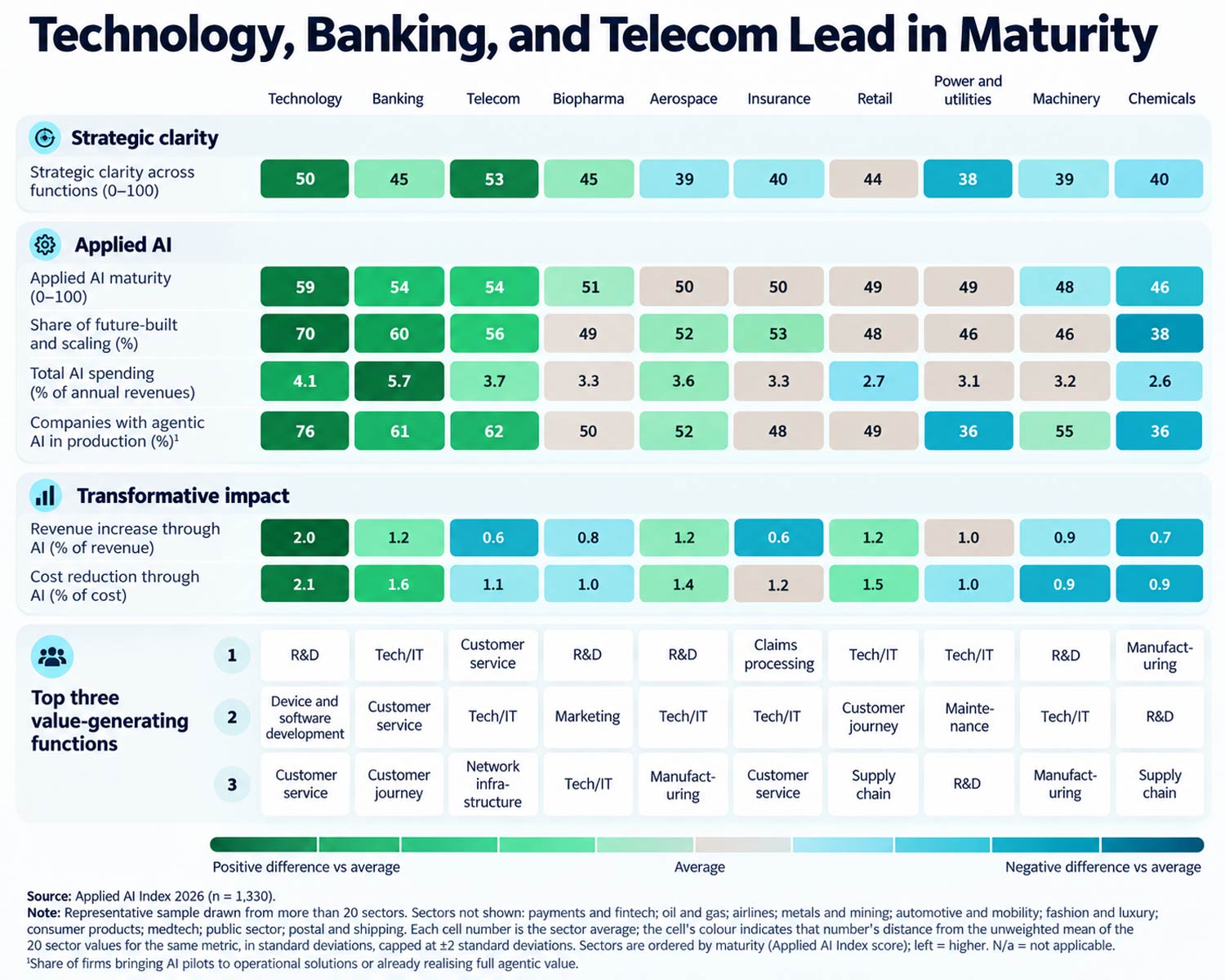
The report has no South African or African breakdown, but it does break out 10 sectors. Telecoms scored 53 out of 100 for strategic clarity, the highest of them, ahead of technology (50) and banking (45). But telcos reported an average revenue uplift from AI of just 0.6%, joint lowest with insurance, and a cost reduction of 1.1%. Technology companies reported 2% and 2.1%, respectively.
Banks spend the most of the sectors shown, putting 5.7% of annual revenue into AI against 4.1% for technology companies and 3.7% for telcos. That buys them a 1.2% revenue uplift and a 1.6% cost reduction.
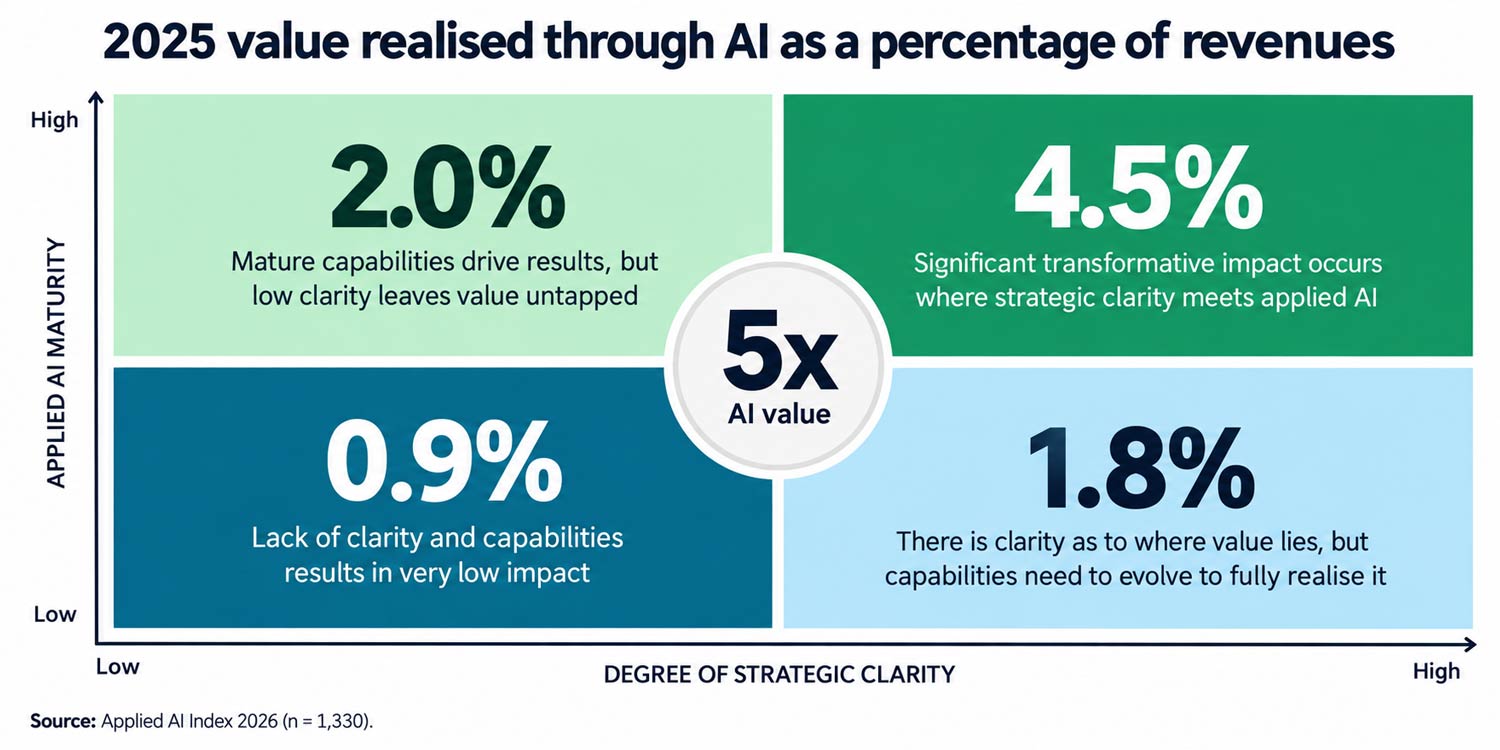
A year ago, BCG’s 2025 study found only 5% of companies were “future-built” and generating substantial value from AI, while 35% were scaling and 60% reaped little. The future-built group has now grown to 7.5%, and a further 41% are scaling AI and outperforming. Together they account for nearly half of the companies in BCG’s survey of 1 330 senior executives.
Future-built companies delivered 2.3 times the three-year shareholder return of laggards, 2.4 times the revenue growth and 2.8 times the growth in Ebitda (earnings before interest, tax, depreciation and amortisation).
“The perception is that AI isn’t delivering,” said Nicolas De Bellefonds, BCG’s global AI leader and a co-author of the report. “Our data says the picture is more nuanced: nearly half of companies are already creating real value from it, while many others are still struggling to translate investment into impact.”
IT cost category
BCG puts AI spending at 3.3% of revenue and calls it a doubling, measured against the 1.7% that executives surveyed for its AI Radar, published in January, expected to spend in 2026. The two surveys drew on different samples. More than 80% of AI spending now sits outside enterprise IT budgets, in areas such as AI in products, talent and governance.
“Companies that still treat AI solely as an IT cost category are underestimating both what they’re spending and what it could return,” said Michael Grebe, an MD and senior partner at BCG.
Standard Bank may be a case in point: 72% of its employees are active generative AI users, yet its headline banking IT bill rose just 2% in the six months to June, with software and cloud costs up 6%.
Gartner expects South African IT spending to climb 19.8% this year to US$28.1-billion, well ahead of the global 14.2%. On BCG’s reasoning, IT forecasts of this kind are likely to understate total AI spend.
The bigger problem, BCG says, is control. Some 42% of companies expect AI agents to act autonomously by 2030, but only 5% have in place all six agent controls the consultancy identifies. These include rollback gates, audit trails and rules on how agents handle memory.
“That gap is the defining challenge of the next two years,” said Jeff Walters, an MD and senior partner at BCG. “It won’t be solved by regulators or technology vendors. The responsibility sits with the companies deploying these systems.”
That puts the onus on companies here, too. South Africa has no dedicated AI law, and government is redrafting its national AI policy with a lighter, sector-led approach, after the first draft was withdrawn in April over fictitious citations.
Controls pay off
BCG argues that controls add value rather than slow companies down: those with all six in place across the enterprise generate roughly three times as much value from agentic AI as those with only one. Agentic AI’s share of total AI value rose to 22% this year from 17% in 2025, and BCG projects it will reach 39% by 2030.
Agents are already at work locally. At Absa, a multilingual support agent resolves about 40% of queries without human intervention, Absa Business Banking CIO Lindelani Ramukumba wrote in TechCentral in April.
Companies in the survey expect to cut their workforces by roughly 10% to 15% by 2030, with the cuts concentrated in middle management and frontline leadership. BCG’s South African AI at Work results in June showed 79% of local frontline white-collar staff use AI regularly, against 74% globally.
“How you redesign work and reskill your workforce matters far more than how many jobs you cut,” said Amanda Luther, an MD and senior partner at BCG.
The findings come with caveats. The maturity and AI value figures are self-reported, which BCG acknowledges may introduce perception bias, and more than half the companies surveyed have annual revenue above $5-billion. Respondents came from more than 60 countries in Asia-Pacific, Europe and North America. BCG also sells the AI transformation services its research recommends. — © 2026 NewsCentral Media