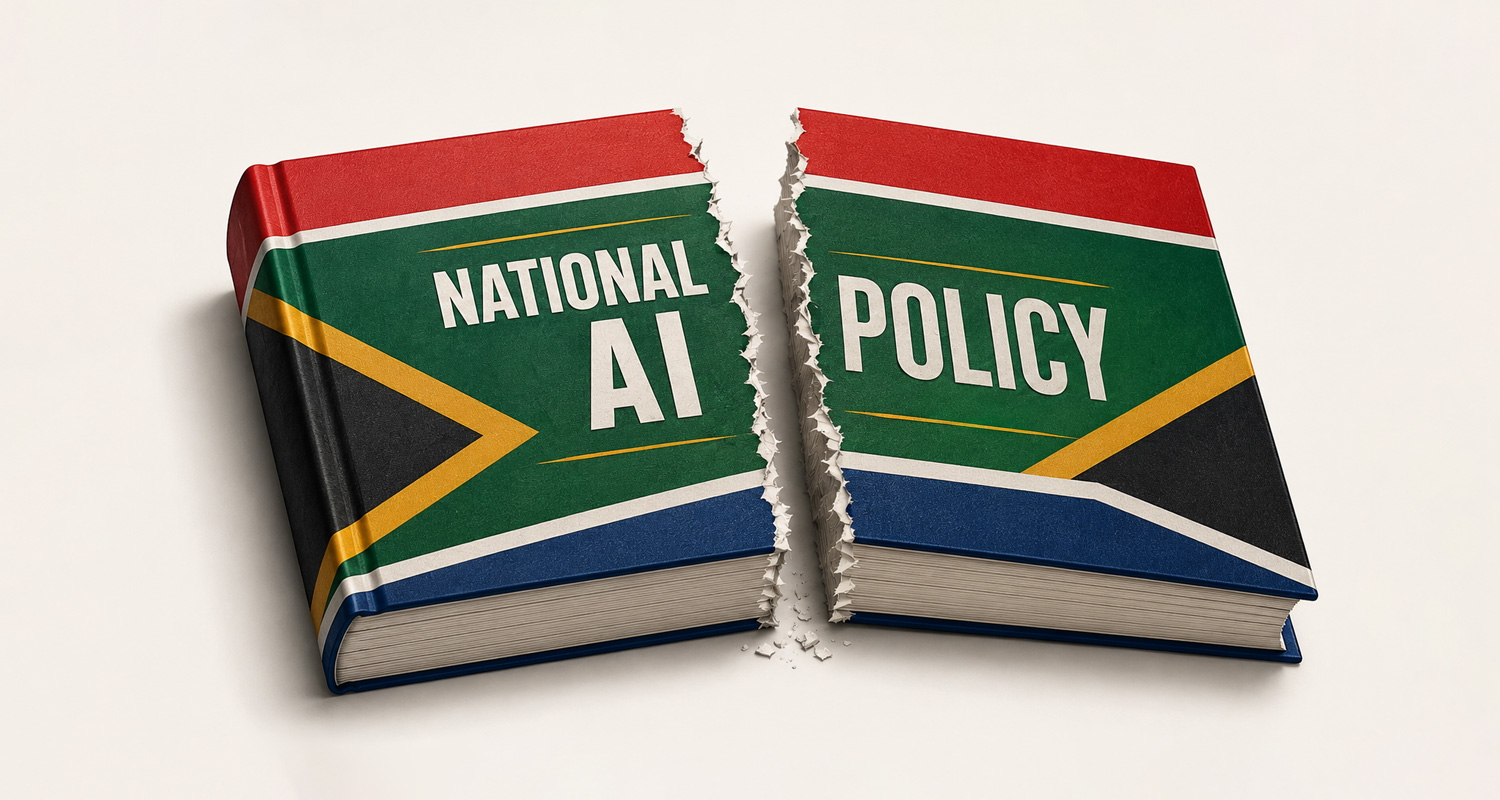
South Africa’s redrafted national AI policy will not prescribe rules to industry. Instead, individual sectors will be left to write their own AI strategies off a set of national guidelines.
That is according to department of communications & digital technologies acting deputy director-general Jeanette Morwane, who told TechCentral on the sidelines of the inaugural Naspers/Prosus AI Governance & Policy Symposium in Sandton on Wednesday that the redraft would take a deliberately light-touch approach.
“The whole idea is for the policy to provide guidance and then to get the sectors to start developing their own sectoral AI strategies. We don’t want to prescribe to sectors because they understand the architecture of their sectors. We just want to provide national policy guidelines that they can use,” Morwane said.
One of the most contentious features of the withdrawn draft – its proposal to create seven new institutions, including a National AI Commission, an AI Ethics Board, an AI Insurance Superfund and a National AI Safety Institute – is also being reconsidered. Asked whether that architecture would survive the redraft, Morwane said: “We are really looking at that, but I obviously can’t say anything about that now.”
Parliament has already made its preference clear. Khusela Diko, chair of the portfolio committee on communications & digital technologies, told TechCentral that MPs want a leaner design built on the regulators South Africa already has.
‘More streamlined’
“We don’t necessarily need to create a plethora of new institutions. Strengthen the institutions we currently have and be very specific on their mandates,” Diko said, pointing to regulators including Icasa, the Information Regulator, the Competition Commission and the National Consumer Commission. She singled out the Information, Communication Technologies and Media Regulators Forum, launched in 2024, as a crucial coordination vehicle.
“We are hoping for a policy that is perhaps a little more streamlined than the initial one, especially around the institutions,” she said. “It needs to go beyond principles; we understand the principles. We have the constitutional architecture that already grounds it. What we want to see are rules governing AI that make it easy for businesses to innovate and for our economy to thrive.”
Read: The plan to stop AI from breaking the world
The revised policy remains on track to reach cabinet in November, with January 2027 as a fallback – the timeline communicated to parliament in May.
“The actual timeline is we will introduce it to the cabinet in November. But considering all the holidays, we are just trying to be safe and say the latest will be January. So, it might happen sooner, depending on the cabinet schedule,” Morwane said. Broader consultations will follow once the policy is in place.

The original draft was withdrawn by communications minister Solly Malatsi in April after at least six of the 67 entries in its reference list were found to be fictitious – most plausibly generated by an AI tool and included without verification. An independent expert panel chaired by Wits University AI researcher Benjamin Rosman was subsequently appointed to rebuild the document.
“We are currently working with the experts that he appointed. That work is under way, and then we will be presenting something to him soon for consideration,” Morwane said.
Despite the withdrawal, the substance of the original survives, she told a panel discussion later in the day. “The principles and vision of the policy remains intact. For instance, that AI should be trained in our indigenous languages to avoid exclusion,” she said. The task, she added, is to “set up governance structures to mitigate risks of AI, but also to make sure we use AI optimally to enhance the economy and national productivity”.
Morwane also said South Africa has signed the agreement establishing the World Artificial Intelligence Cooperation Organization, the China-led intergovernmental body proposed by President Xi Jinping and established in Shanghai in mid-July. The pact, she said, will “focus on creating native AI innovations and tools, rather than just using tools from other countries”.
In an address at Wednesday’s event, Diko said the committee’s analysis of international AI regulation had identified a gap South Africa’s own policy should confront: the space between the data going into AI systems and the decisions coming out of them.
Unregulated
“We are not effectively governing the reasoning process of AI systems: how AI connects the dots or how it gets from data to a decision,” she said. The goal, she said, is a system in which “AI is not a black box but a glass box, open to scrutiny”, warning that “the discriminatory laws of our past must not emerge in digital form”.
Malatsi, who was scheduled to open the symposium with a keynote on South Africa’s evolving AI governance landscape, tendered apologies and did not attend. Diko said the committee has had no further engagement with him on the redraft since the expert panel was announced.
Read: Beijing warns of retaliation over US threats to Chinese AI firms
Until the revised policy is gazetted, South Africa remains without a formal national framework to govern AI – at a time when the technology is increasingly woven into hiring, lending and public administration, and when the consequences of ungoverned deployment have already been felt inside government itself. — © 2026 NewsCentral Media
- Subscribe to TechCentral’s daily newsletter
- Get breaking news alerts on WhatsApp