Close Menu
TechCentralTechCentral

    Subscribe to the newsletter

    Get the best South African technology news and analysis delivered to your e-mail inbox every morning.

    Facebook X (Twitter) YouTube LinkedIn
    WhatsApp Facebook X (Twitter) LinkedIn YouTube
    TechCentralTechCentral
    • News
      Radical rethink for South Africa's national AI policy

      Radical rethink for South Africa’s national AI policy

      29 July 2026
      South African tech's compounding debt problem

      South African tech’s compounding debt problem

      29 July 2026
      Russia charges Telegram founder with terrorism - Pavel Durov

      Russia charges Telegram founder with terrorism

      29 July 2026
      Green light for massive new Cape Town data centres

      Green light for massive new Cape Town data centres

      29 July 2026
      DStv's subscriber count has gone dark

      DStv’s subscriber count has gone dark

      28 July 2026
    • World
      Meta AI will now tell parents if their teen is in crisis

      Meta AI will now tell parents if their teen is in crisis

      17 July 2026
      IBM shares crash 25% as AI upends software spending - Arvind Krishna

      IBM shares crash 25% as AI upends software spending

      15 July 2026
      Jony Ive's first OpenAI device: an AI smart speaker - Jony Ive and Sam Altman

      Jony Ive’s first OpenAI device: an AI smart speaker

      15 July 2026
      Stripe, Advent in talks to buy PayPal for $53-billion

      Stripe, Advent in talks to buy PayPal for $53-billion

      15 July 2026
      Memory crisis sends smartphone market into steep decline

      Memory crisis sends smartphone market into steep decline

      13 July 2026
    • In-depth
      The plan to stop AI from breaking the world - Google DeepMind CEO Demis Hassabis. Image: John Sears

      The plan to stop AI from breaking the world

      16 July 2026
      The internet has a Strait of Hormuz problem

      The internet has a Strait of Hormuz problem

      15 July 2026
      AI boom sparks rally, frenzy and fear

      AI boom sparks rally, frenzy and fear

      11 June 2026
      Every plug-in hybrid on sale in South Africa, ranked by price - Lamborghini Temerario

      Every plug-in hybrid on sale in South Africa, ranked by price

      7 June 2026
      What Wi-Fi 8 will mean for wireless networks

      What Wi-Fi 8 will mean for wireless networks

      1 June 2026
    • TCS
      TCS+ | A smarter approach to cloud for South African businesses - Joel Chacko and Jonathan Oaker

      TCS+ | A smarter approach to cloud for South African businesses

      28 July 2026
      TCS | How Optasia lends billions to people banks can't see - Salvador Anglada

      TCS | How Optasia lends billions to people banks can’t see

      23 July 2026
      The rands-and-cents case for electric trucks - William Kelly Watts & Wheels with Wills

      The rands-and-cents case for electric trucks

      20 July 2026
      Watts & Wheels S1E7: 'Ferrari's EV breaks the internet'

      Watts & Wheels S1E7: ‘Ferrari’s EV breaks the internet’

      8 July 2026
      TCS | Pick n Pay's Enrico Ferigolli on Penny, the AI that shops for you

      TCS | Pick n Pay’s Enrico Ferigolli on Penny, the AI that shops for you

      2 July 2026
    • Opinion
      The author, Jannie van Zyl

      Selling vapour is corporate suicide in slow motion

      16 July 2026
      Brazil's online gambling crackdown is a lesson for South Africa

      How Amazon outmanoeuvred Starlink in South Africa

      15 July 2026
      The Popia problem with agentic AI - Herman Haasbroek

      The Popia problem with agentic AI

      14 July 2026
      The author, Fanie van Rooyen

      South Africa can still catch the AI wave – here’s how

      7 July 2026
      The author, Fanie van Rooyen

      The AI utopia South Africa can’t afford

      1 July 2026
    • Company Hubs
      • 1Stream
      • Africa Data Centres
      • AfriGIS
      • Altron Digital Business
      • Altron Document Solutions
      • Altron Group
      • Arctic Wolf
      • Ascent Technology
      • AvertITD
      • BBD
      • Braintree
      • CallMiner
      • CambriLearn
      • CM Telecom
      • Contactable
      • CYBER1 Solutions
      • Digicloud Africa
      • Digimune
      • Domains.co.za
      • ESET
      • Euphoria Telecom
      • HOSTAFRICA
      • Incredible Business
      • iONLINE
      • IQbusiness
      • Iris Network Systems
      • Kaspersky
      • LSD Open
      • Mitel
      • NEC XON
      • Netstar
      • Network Platforms
      • Next DLP
      • Ovations
      • Paracon
      • Paratus
      • Q-KON
      • SevenC
      • SkyWire
      • Solid8 Technologies
      • Telit Cinterion
      • Telviva
      • Tenable
      • Vertiv
      • Videri Digital
      • Vodacom Business
      • Vox
      • Wipro
      • Workday
      • XLink
    • Sections
      • AI and machine learning
      • Banking
      • Broadcasting and Media
      • Cloud services
      • Contact centres and CX
      • Cryptocurrencies
      • Education and skills
      • Electronics and hardware
      • Energy and sustainability
      • Enterprise software
      • Financial services
      • HealthTech
      • Information security
      • Internet and connectivity
      • Internet of Things
      • Investment
      • IT services
      • Lifestyle
      • Policy and regulation
      • Public sector
      • Retail and e-commerce
      • Satellite communications
      • Science
      • SMEs and start-ups
      • Social media
      • Talent and leadership
      • Telecoms
      • Watts & Wheels
    • Events
    • Advertise
    TechCentralTechCentral
    Home » Sections » IT services » South African tech’s compounding debt problem

    South African tech’s compounding debt problem

    It’s the biggest liability on the South African tech balance sheet – and it keeps compounding.
    By Jannie van Zyl29 July 2026
    Twitter LinkedIn Facebook WhatsApp Email Telegram Copy Link
    News Alerts
    WhatsApp

    South African tech's compounding debt problem

    Every shortcut a tech company takes is a loan. That’s the whole idea behind “technical debt”, a phrase programmer Ward Cunningham coined more than 30 years ago and the smartest bit of financial language software ever borrowed.

    In my last column, I argued that we sell products before we build them. This is what happens to those shortcuts after the deal closes: they don’t go away. They sit in the system, charging interest, until you can’t make the repayments.

    This is the second of three columns on the short-termism trap: how one habit – picking the quick win over the durable one – works its way through a tech business until it reaches the one place you can’t afford to lose ground: your customers.

    Technical debt is the cost of choosing the quick fix over the right one: the code written to hit a demo date, the architecture nobody revisited once it “worked”, the system never upgraded because the people who understood it left, the integration bolted on instead of designed in, the culture of “let’s just do something quick”.

    Each shortcut buys you time today. Each one taxes every job that touches it tomorrow. And the tax is real even when you can’t see it – which is most of the time, because it never shows up as a line item. It shows up as everything slowly getting harder. It’s the only debt you can carry for years without recording it. Right up until it records everything else.

    A messy system is hard to change, so the next change gets done quick and dirty, too

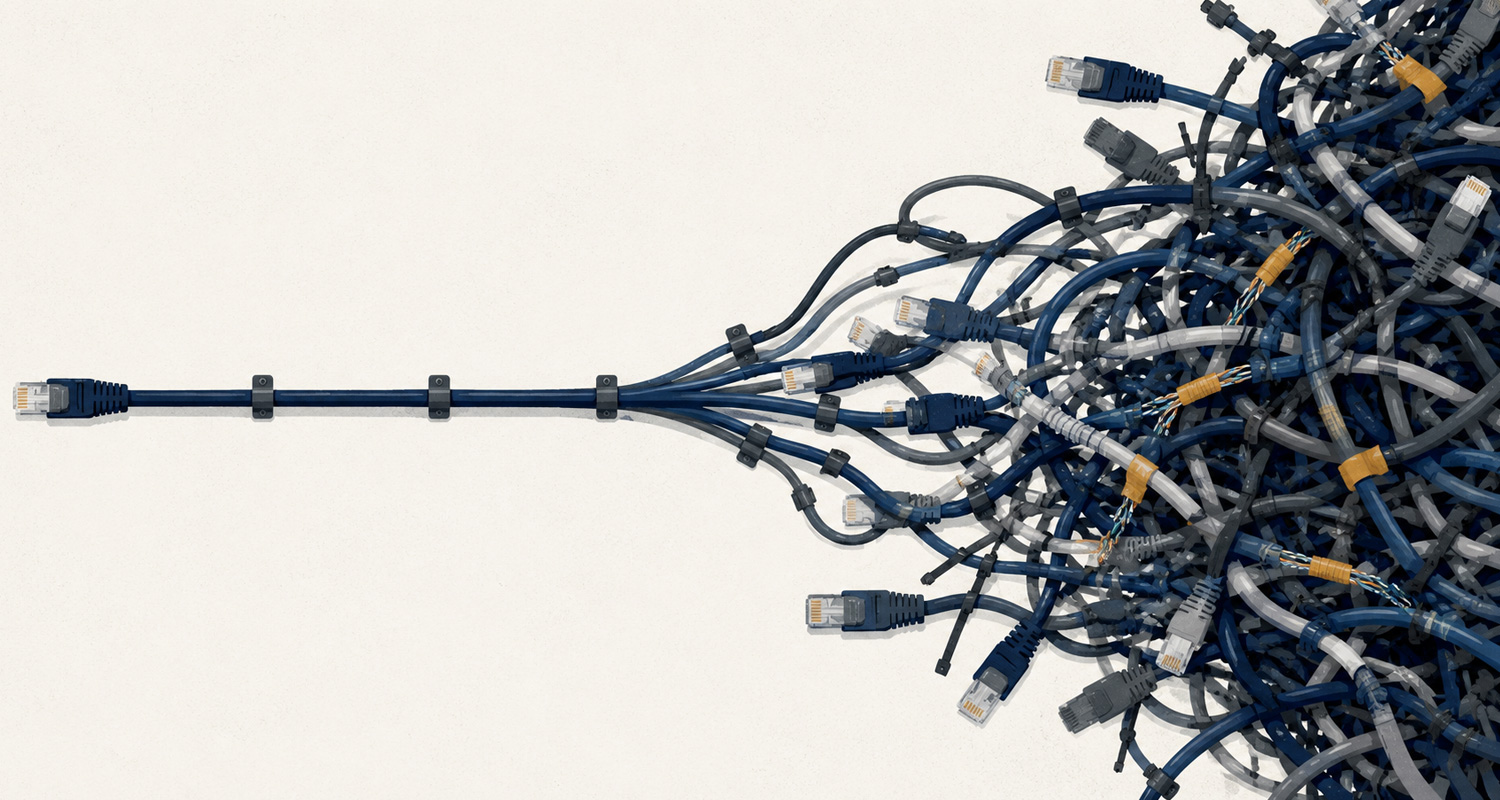
    It feeds itself. A messy system is hard to change, so the next change gets done quick and dirty, too – because doing it properly means untangling the last mess first. Complexity breeds complexity, and every new feature needs another hack piled on the last.

    The engineers who could fix it are too busy keeping it alive. A team can burn most of its time just stopping a fragile system from falling over, with almost nothing left for the work that grows the business. That’s the compounding. The debt doesn’t only grow. It eats your ability to pay it back.

    How to spot it

    You can read a company’s technical debt in its symptoms long before anyone says the words. Costs that should drop with scale go up instead. Simple features take absurdly long. Releases become things people dread, not routines they trust. Good engineers leave – nobody enjoys spending their days cleaning up shortcuts they didn’t take – and they walk out with the only memory of why the system is the way it is. Which makes the debt worse.

    South Africa has a rich collection:

    • Our banks run some of the most advanced digital services anywhere on top of core systems written in Cobol decades ago – proof you can service debt for a very long time, at enormous and permanent cost.
    • Our public sector IT is a museum of the same disease: systems that can’t talk to each other, budgets that fund the build but never the upkeep, and the same lesson every time – the cheapest bid carried the most expensive debt.
    • Telecoms billing is some of the most debt-laden software on Earth, because we kept bolting on new ways to bill for things the network was never built to sell.

    A leadership problem, not an engineering one

    Technical debt is a leadership problem wearing an engineering costume. It builds up because the incentives that create it sit above the engineers, who solve the problem in front of them. Debt is invisible on the financials, so it’s easy to defer. The executive who defers it usually gets promoted before the bill arrives. The one who insists on paying it down has to defend a quiet quarter with nothing shiny to show for it.

    As a result, taking on debt gets rewarded. Paying it down gets you blamed for going too slowly. That asymmetry – not a shortage of good engineers – is why there’s so much of it about.

    To be fair, some debt is smart. Taking a deliberate shortcut to test whether anyone even wants the thing is good business – building it perfectly first would be waste. Not all debt should be paid off, just like not all financial debt should. The trick is knowing which is which.

    Taking on technical debt gets you promoted. Paying it down gets you blamed for going slow

    The problem isn’t debt. It’s unmanaged debt – taken without a decision, tracked by nobody and serviced by accident. Smart debt is a choice you can see on a list, with a plan to pay it back. Most technical debt is neither. It’s the residue of a hundred small panics nobody wrote down.

    The fix isn’t a heroic rewrite. Those usually just refinance the debt on worse terms. Rather, it’s the dull discipline of treating quality as a standing commitment, not a phase:

    • Put real capacity into refactoring and upgrades every cycle;
    • Make the cost of the debt visible to the people holding the budget; and
    • Refuse the shortcut at the point of sale, where – as I argued last time – most of it is born.

    Defending the long term against the quarter is leadership’s job, because nobody else in the building is paid to.

    Sometimes the discipline is just walking away. When it’s clear a customer only wants a quick fix – and will blame you for the mess those hacks leave behind – the right answer is a polite “no thanks”. Business is a partnership. If one side is only looking to get one over on the other, there’s no deal worth taking.

    The author, Jannie van Zyl
    The author, Jannie van Zyl

    And here’s the sting. The final bill for technical debt is rarely paid by the company alone. It’s paid by the customer – a product that’s slow to improve, quick to break and expensive to trust. Customers don’t send reminders the way creditors do. They just, quietly, start to leave. Which is where this series goes next.

    • The author, Jannie van Zyl, has spent more than three decades in technology – founding several companies and holding senior positions in some of the industry’s largest. He’s a leading voice on innovation and the future, and writes here under his own name
    • Read more pieces by Van Zyl on TechCentral
    • Subscribe to TechCentral’s daily newsletter
    • Get breaking news alerts on WhatsApp

    Follow TechCentral on Google News Add TechCentral as your preferred source on Google


    Jannie van Zyl
    WhatsApp YouTube
    Share. Facebook Twitter LinkedIn WhatsApp Telegram Email Copy Link
    Previous ArticleRussia charges Telegram founder with terrorism
    Next Article Radical rethink for South Africa’s national AI policy

    Related Posts

    The author, Jannie van Zyl

    Selling vapour is corporate suicide in slow motion

    16 July 2026
    The author, Jannie van Zyl

    South Africa’s broadband future is being decided in orbit, not in Pretoria

    30 June 2026
    Starlink plans to lower satellite orbit to enhance safety

    Is satellite really a threat to mobile operators?

    13 September 2023
    Company News
    The infrastructure behind smart account-based recurring payments in South Africa - Pay@ Capitec Pay

    The infrastructure behind smart account-based recurring payments in South Africa

    29 July 2026
    Acer at 50: how local assembly keeps prices down

    Acer at 50: how local assembly keeps prices down

    29 July 2026
    Altron appoints Collin Govender as MD of Altron HealthTech

    Altron appoints Collin Govender as MD of Altron HealthTech

    29 July 2026
    Opinion
    The author, Jannie van Zyl

    Selling vapour is corporate suicide in slow motion

    16 July 2026
    Brazil's online gambling crackdown is a lesson for South Africa

    How Amazon outmanoeuvred Starlink in South Africa

    15 July 2026
    The Popia problem with agentic AI - Herman Haasbroek

    The Popia problem with agentic AI

    14 July 2026

    Subscribe to Updates

    Get the best South African technology news and analysis delivered to your e-mail inbox every morning.

    Latest Posts
    Radical rethink for South Africa's national AI policy

    Radical rethink for South Africa’s national AI policy

    29 July 2026
    South African tech's compounding debt problem

    South African tech’s compounding debt problem

    29 July 2026
    Russia charges Telegram founder with terrorism - Pavel Durov

    Russia charges Telegram founder with terrorism

    29 July 2026
    The infrastructure behind smart account-based recurring payments in South Africa - Pay@ Capitec Pay

    The infrastructure behind smart account-based recurring payments in South Africa

    29 July 2026
    © 2009 - 2026 NewsCentral Media
    Built and maintained by Chronon
    • Cookie policy (ZA)
    • TechCentral – privacy and Popia

    Type above and press Enter to search. Press Esc to cancel.

    Manage consent

    TechCentral uses cookies to enhance its offerings. Consenting to these technologies allows us to serve you better. Not consenting or withdrawing consent may adversely affect certain features and functions of the website.

    Functional Always active
    The technical storage or access is strictly necessary for the legitimate purpose of enabling the use of a specific service explicitly requested by the subscriber or user, or for the sole purpose of carrying out the transmission of a communication over an electronic communications network.
    Preferences
    The technical storage or access is necessary for the legitimate purpose of storing preferences that are not requested by the subscriber or user.
    Statistics
    The technical storage or access that is used exclusively for statistical purposes. The technical storage or access that is used exclusively for anonymous statistical purposes. Without a subpoena, voluntary compliance on the part of your Internet Service Provider, or additional records from a third party, information stored or retrieved for this purpose alone cannot usually be used to identify you.
    Marketing
    The technical storage or access is required to create user profiles to send advertising, or to track the user on a website or across several websites for similar marketing purposes.
    • Manage options
    • Manage services
    • Manage {vendor_count} vendors
    • Read more about these purposes
    View preferences
    • {title}
    • {title}
    • {title}