Close Menu
TechCentralTechCentral

    Subscribe to the newsletter

    Get the best South African technology news and analysis delivered to your e-mail inbox every morning.

    Facebook X (Twitter) YouTube LinkedIn
    WhatsApp Facebook X (Twitter) LinkedIn YouTube
    TechCentralTechCentral
    • News
      Outa warns homeowners against rushing to register rooftop solar

      Outa warns homeowners against rushing to register rooftop solar

      27 January 2026
      DStv cuts decoder prices and adds cost-sharing feature

      DStv cuts decoder prices and adds cost-sharing feature

      27 January 2026
      Investors can't get enough of ASML

      Investors can’t get enough of ASML

      27 January 2026
      Meta, TikTok, YouTube to stand trial on youth addiction claims

      Meta, TikTok, YouTube to stand trial on youth addiction claims

      27 January 2026
      Starlink hype vs reality in South Africa

      Starlink hype vs reality in South Africa

      26 January 2026
    • World
      Nvidia throws AI at the weather

      Nvidia throws AI at weather forecasting

      27 January 2026
      Debate erupts over value of in-flight Wi-Fi

      Debate erupts over value of in-flight Wi-Fi

      26 January 2026
      Intel takes another hit - Intel CEO Lip-Bu Tan. Laure Andrillon/Reuters

      Intel takes another hit

      23 January 2026
      ByteDance clinches US TikTok deal

      ByteDance clinches US TikTok deal

      23 January 2026
      New details emerge about Apple's big Siri overhaul

      New details emerge about Apple’s big Siri overhaul

      22 January 2026
    • In-depth
      How liberalisation is rewiring South Africa's power sector

      How liberalisation is rewiring South Africa’s power sector

      21 January 2026
      The top-performing South African tech shares of 2025

      The top-performing South African tech shares of 2025

      12 January 2026
      Digital authoritarianism grows as African states normalise internet blackouts

      Digital authoritarianism grows as African states normalise internet blackouts

      19 December 2025
      TechCentral's South African Newsmakers of 2025

      TechCentral’s South African Newsmakers of 2025

      18 December 2025
      Black Friday goes digital in South Africa as online spending surges to record high

      Black Friday goes digital in South Africa as online spending surges to record high

      4 December 2025
    • TCS
      Watts & Wheels S1E2: 'China attacks, BMW digs in, Toyota's sublime supercar'

      Watts & Wheels S1E2: ‘China attacks, BMW digs in, Toyota’s sublime supercar’

      23 January 2026

      TCS+ | Why cybersecurity is becoming a competitive advantage for SA businesses

      20 January 2026
      Watts & Wheels S1E2: 'China attacks, BMW digs in, Toyota's sublime supercar'

      Watts & Wheels: S1E1 – ‘William, Prince of Wheels’

      8 January 2026
      TCS+ | Africa's digital transformation - unlocking AI through cloud and culture - Cliff de Wit Accelera Digital Group

      TCS+ | Cloud without culture won’t deliver AI: Accelera’s Cliff de Wit

      12 December 2025
      TCS+ | How Cloud on Demand helps partners thrive in the AWS ecosystem - Odwa Ndyaluvane and Xenia Rhode

      TCS+ | How Cloud On Demand helps partners thrive in the AWS ecosystem

      4 December 2025
    • Opinion
      Why Elon Musk's Starlink is a 'hard no' for me - Songezo Zibi

      Why Elon Musk’s Starlink is a ‘hard no’ for me

      26 January 2026
      AI moves from pilots to production in South African companies - Nazia Pillay SAP

      AI moves from pilots to production in South African companies

      20 January 2026
      Netflix, Warner Bros deal raises fresh headaches for MultiChoice - Duncan McLeod

      ANC’s attack on Solly Malatsi shows how BEE dogma trumps economic reality

      14 December 2025
      Netflix, Warner Bros deal raises fresh headaches for MultiChoice - Duncan McLeod

      Netflix, Warner Bros deal raises fresh headaches for MultiChoice

      5 December 2025
      BIN scans, DDoS and the next cybercrime wave hitting South Africa's banks - Entersekt Gerhard Oosthuizen

      BIN scans, DDoS and the next cybercrime wave hitting South Africa’s banks

      3 December 2025
    • Company Hubs
      • Africa Data Centres
      • AfriGIS
      • Altron Digital Business
      • Altron Document Solutions
      • Altron Group
      • Arctic Wolf
      • AvertITD
      • Braintree
      • CallMiner
      • CambriLearn
      • CYBER1 Solutions
      • Digicloud Africa
      • Digimune
      • Domains.co.za
      • ESET
      • Euphoria Telecom
      • Incredible Business
      • iONLINE
      • IQbusiness
      • Iris Network Systems
      • LSD Open
      • NEC XON
      • Netstar
      • Network Platforms
      • Next DLP
      • Ovations
      • Paracon
      • Paratus
      • Q-KON
      • SevenC
      • SkyWire
      • Solid8 Technologies
      • Telit Cinterion
      • Tenable
      • Vertiv
      • Videri Digital
      • Vodacom Business
      • Wipro
      • Workday
      • XLink
    • Sections
      • AI and machine learning
      • Banking
      • Broadcasting and Media
      • Cloud services
      • Contact centres and CX
      • Cryptocurrencies
      • Education and skills
      • Electronics and hardware
      • Energy and sustainability
      • Enterprise software
      • Financial services
      • Information security
      • Internet and connectivity
      • Internet of Things
      • Investment
      • IT services
      • Lifestyle
      • Motoring
      • Public sector
      • Retail and e-commerce
      • Satellite communications
      • Science
      • SMEs and start-ups
      • Social media
      • Talent and leadership
      • Telecoms
    • Events
    • Advertise
    TechCentralTechCentral
    Home » In-depth » Automation could lead to a jobs bloodbath in SA

    Automation could lead to a jobs bloodbath in SA

    By The Conversation25 July 2018
    Twitter LinkedIn Facebook WhatsApp Email Telegram Copy Link
    News Alerts
    WhatsApp

    Businesses around the world are cottoning on to the value of transferring labour from human workers to machines. Automation can increase efficiency and decrease labour costs. It helps employers to avoid complex challenges such as wage increase demands, labour protests and strikes. Consumers also benefit from automation when products and services become cheaper because of reduced input costs.

    But while there are numerous benefits to automation, recent economic trends in the developed world suggest that it may also be a key driver of economic inequality.

    A growing body of scholars and thought leaders has warned that this new wave of the technological revolution could change the relationship between labour and capital in an unprecedented manner.

    The country appears ill-prepared for this reality. There is little discussion at policy level. Hardly any research has been done to investigate possible future scenarios

    Importantly, these modern Luddites are not necessarily anti-technology. Their concern is with the way in which increasingly smart technologies exacerbate economic inequality. It does this by devaluing low-skilled labour and hollowing out the middle class, as is evidenced by trends in productivity and median household income in the US.

    Limited work has been done to study the potential impact of automation on economies in the developing world. That’s what prompted me to investigate the situation in South Africa. I used data collected by Statistics South Africa for its Quarterly Labour Force Survey and an automation index produced by academics from the University of Oxford. From this, I was able to estimate that occupations performed by almost 35% of South African workers — roughly 4.5 million people — are potentially automatable soon.

    But the country appears ill-prepared for this reality. There is little discussion at policy level. Hardly any research has been done to investigate possible future scenarios. There’s also a great deal of uncertainty about how the uptake of automation technology may further drive inequality and preserve the asymmetry in the country’s economy.

    South Africa is already one of the world’s most unequal economies. Its unemployment rate hovers at around 27%. It is also no stranger to labour protests and strikes, making automation an attractive option for managers and capital owners.

    Automatable

    The data I worked with indicate that roughly 14 million South Africans work in around 380 different occupation types. Sixty-four of these occupations, employing an estimated 3.6 million workers, have a 90% or greater probability of being automatable in the near future. These occupations include, for example, cashiers, tellers, secretaries and telephone salesmen.

    The occupations of another 2.6 million workers, of whom 900 000 are employed as farmhands and labourers, have an 80-89% probability of being automatable.

    Workers of all skills levels are at risk. Accountants, auditors and dental technicians are all highly skilled and their jobs are extremely susceptible to automation. In the US, a number of automated tax services are already available.

    But trends suggest that people in low- and medium-skilled occupations are generally more at risk than those who require extensive education.
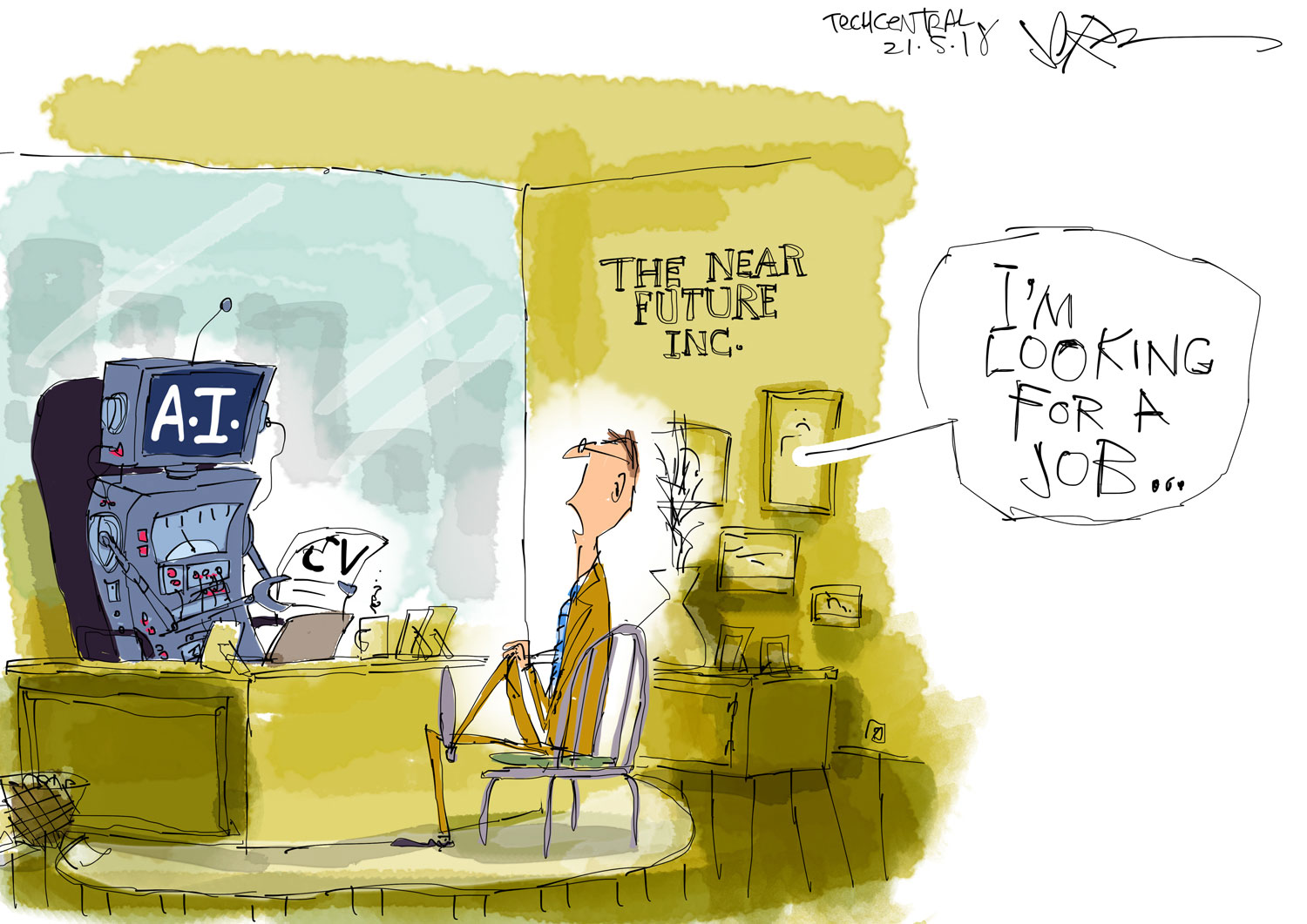
    So, it is not surprising that the country’s previously disadvantaged population groups are more exposed to job losses due to automation than their white counterparts. Half of all black South Africa workers are in occupations with an 80% or greater probability of automation; so are 47% of coloured workers. For white employees, however, the proportion is only around 30%.

    These differences are indicative of the way technological advancement upholds the status quo by favouring skilled workers and those who can afford higher education.

    Despite these risks, it seems likely that as an ever-expanding range of automation technologies enter the market, many South African business owners will seize the opportunity to limit their dependency on human labour. This will have a negative effect in an economy that is already struggling to grow and create jobs.

    There seems to be very limited high-level discourse about how South Africa plans to navigate this

    But there seems to be very limited high-level discourse about how South Africa plans to navigate this wave of technological advancement.

    Elsewhere in the world, US presidential candidate for 2020 Andrew Yang is building his entire campaign around this issue. He is promising to introduce Universal Basic Income, through which every American over the age of 18 years will receive US$1 000/month from the government. This, he believes, will provide security and enable mobility for workers displaced by automation.

    Several European countries are also running large-scale Universal Basic Income experiments to investigate its potential as a response to automation.

    For South Africa, with its large number of low-skilled workers, a dramatically improved education system is an obvious and critical concern. Despite high unemployment, there remains a scarcity of skills in a wide variety of areas. This suggests a mismatch between supply and demand in the labour market.

    It is also important to understand how technologies will displace work in future. This understanding can help to better inform young South Africans’ career choices.The Conversation

      • Written by Daniel B le Roux, senior lecturer, Stellenbosch University
    • This article was originally published on The Conversation


    top
    WhatsApp YouTube Follow on Google News Add as preferred source on Google
    Share. Facebook Twitter LinkedIn WhatsApp Telegram Email Copy Link
    Previous ArticleInstagram to power Facebook earnings
    Next Article Interview: Teraco CFO Jan Hnizdo

    Related Posts

    18GW in unplanned breakdowns cripple Eskom

    2 November 2021

    Nersa kicks the Karpowership can down the road

    13 September 2021

    If you think South African load shedding is bad, try Zimbabwe’s

    13 September 2021
    Company News
    Arctic Wolf expands leading Security Operations Warranty to South Africa

    Arctic Wolf expands leading Security Operations Warranty to South Africa

    27 January 2026
    The changing state of fintech - from disruption to infrastructure - BBD Software

    The changing state of fintech – from disruption to infrastructure

    27 January 2026
    Iris vPoller: a new edge in network visibility for service providers

    Iris vPoller: a new edge in network visibility for service providers

    26 January 2026
    Opinion
    Why Elon Musk's Starlink is a 'hard no' for me - Songezo Zibi

    Why Elon Musk’s Starlink is a ‘hard no’ for me

    26 January 2026
    AI moves from pilots to production in South African companies - Nazia Pillay SAP

    AI moves from pilots to production in South African companies

    20 January 2026
    Netflix, Warner Bros deal raises fresh headaches for MultiChoice - Duncan McLeod

    ANC’s attack on Solly Malatsi shows how BEE dogma trumps economic reality

    14 December 2025

    Subscribe to Updates

    Get the best South African technology news and analysis delivered to your e-mail inbox every morning.

    Latest Posts
    Arctic Wolf expands leading Security Operations Warranty to South Africa

    Arctic Wolf expands leading Security Operations Warranty to South Africa

    27 January 2026
    Outa warns homeowners against rushing to register rooftop solar

    Outa warns homeowners against rushing to register rooftop solar

    27 January 2026
    The changing state of fintech - from disruption to infrastructure - BBD Software

    The changing state of fintech – from disruption to infrastructure

    27 January 2026
    DStv cuts decoder prices and adds cost-sharing feature

    DStv cuts decoder prices and adds cost-sharing feature

    27 January 2026
    © 2009 - 2026 NewsCentral Media
    • Cookie policy (ZA)
    • TechCentral – privacy and Popia

    Type above and press Enter to search. Press Esc to cancel.

    Manage consent

    TechCentral uses cookies to enhance its offerings. Consenting to these technologies allows us to serve you better. Not consenting or withdrawing consent may adversely affect certain features and functions of the website.

    Functional Always active
    The technical storage or access is strictly necessary for the legitimate purpose of enabling the use of a specific service explicitly requested by the subscriber or user, or for the sole purpose of carrying out the transmission of a communication over an electronic communications network.
    Preferences
    The technical storage or access is necessary for the legitimate purpose of storing preferences that are not requested by the subscriber or user.
    Statistics
    The technical storage or access that is used exclusively for statistical purposes. The technical storage or access that is used exclusively for anonymous statistical purposes. Without a subpoena, voluntary compliance on the part of your Internet Service Provider, or additional records from a third party, information stored or retrieved for this purpose alone cannot usually be used to identify you.
    Marketing
    The technical storage or access is required to create user profiles to send advertising, or to track the user on a website or across several websites for similar marketing purposes.
    • Manage options
    • Manage services
    • Manage {vendor_count} vendors
    • Read more about these purposes
    View preferences
    • {title}
    • {title}
    • {title}