In a world driven by data (and what companies can do with it), organisations are chasing the elusive single view of the customer, a comprehensive, unified understanding of each client across products, channels and touchpoints.
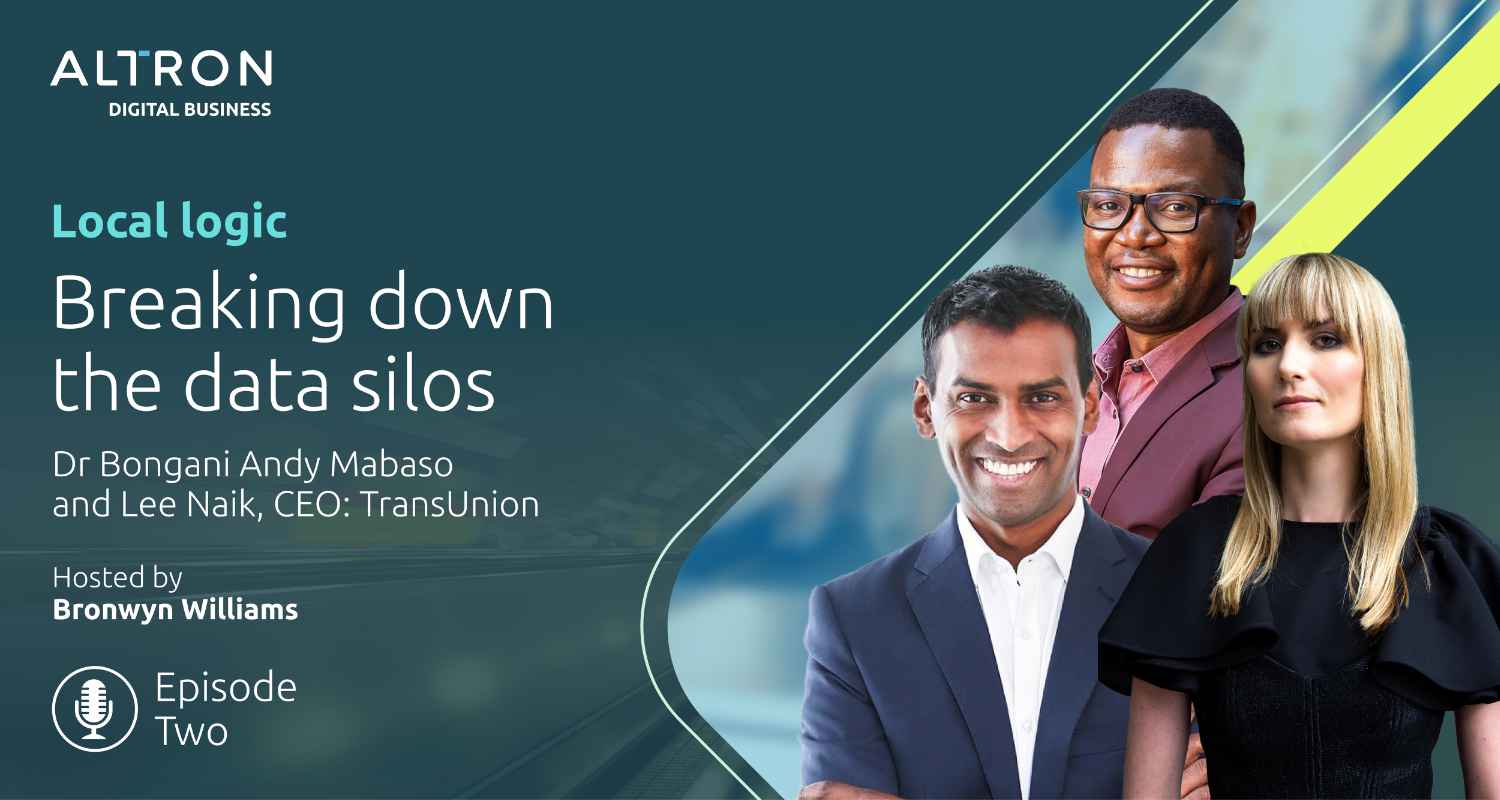
This was a key theme that emerged through Altron’s Local Logic podcast series, where technology leaders discussed how South African businesses can use artificial intelligence, data and digital innovation to create value for their customers. Local Logic covers topics such as enterprise AI, innovation frameworks and data-driven decision-making, featuring guests including corporate chief technology officers and technology entrepreneurs.
Listen to the full podcast here
In the podcast’s second episode, Bongani Andy Mabaso, chief technology officer of Altron Group, highlighted a fundamental limitation in the single-view pursuit: “There’s no single organisation in this country that has 100% view of me as a customer.”
Customers move between financial institutions, telecommunications operators, retail companies and digital channels, meaning that while internal consolidation is important, it only represents part of the whole picture.
This has real-world implications, for example, as Lee Naik, CEO of TransUnion South Africa noted, 16 million South Africans are financially excluded, a challenge that cannot be addressed by any one company alone.
Solving this challenge requires more than internal data engineering; it demands cross-organisational collaboration and shared insight. As Naik explained, organisations must assess their own strengths and weaknesses.
“What am I good at doing as an organisation versus what am I bad at doing? If we share and we come together, some of these parts are greater than the ingredient in itself.”
Internal silos: the first barrier
The journey towards a holistic customer view often starts with internal silos. Mabaso cited an internal initiative to create a single view of enterprise customers across multiple operating companies.
“Previous attempts, spanning 18 months, yielded limited results, so we switched the approach to go, can we use AI to recognise patterns: to see, perhaps this is actually the same customer, there’s just one thing here that’s been changed or is captured slightly differently,” he said.
This is an example of the difficulties companies face: different systems, inconsistent data and disconnected operational data can lead to an inability to see the wheat from the chaff. Technologies can help, but the basic problem still exists. One company’s point of view is not enough to understand the whole truth about a customer, and understanding this limitation is the beginning of cooperation.
The sharing economy applied to data
Breaking down silos requires embracing a sharing economy mindset, where organisations combine their complementary capabilities rather than striving for self-sufficiency.
Naik highlighted the power of partnership: TransUnion’s mobile phone data solution for the financially excluded involved mobile operators, banks and regulators working together to connect millions of underserved citizens to financial services.
“Step up and step out of your organisation, go to your biggest customer and say, let’s identify a joint challenge. Let’s put the best of what you have with the best of what we have and figure out where we can concoct a recipe to drive value,” he advised.
Mabaso emphasised co-creation: “We’d like to do it with our customers. So, we always want to start innovation at our customer base and then work backwards… It’s the same coin for your employees and your customers’ employees. That combination of magic is generally what leads to innovations.”

Musa Kalenga, CEO of Brave Group, who appeared on another episode of Local Logic, also highlighted the dangers of narrow, siloed thinking: “The more time you’re spending with people that are talking the same language and solving exactly the same problems … your probability of innovation starts to get lower and lower. Exposure outside of different sectors and industries becomes important … that’s where you spark new types of thought.”
By sharing knowledge and engaging across organisational and industry boundaries, companies can access insights and creativity that would otherwise remain out of reach.
Outcome-focused thinking breaks silos
Perhaps the most powerful force for dismantling silos is a relentless focus on outcomes. When organisations align around customer results (such as revenue, margin or access) they naturally look beyond internal territories and defences. Naik said: “Every customer in South Africa, from a business perspective, only really has two problems, revenue and margin. If you think it’s not that, then it’s wrong.”
TransUnion’s work with excluded African consumers illustrates this principle. The team began with the outcome (financial inclusion for 500 million underserved individuals) and then spent 18 months identifying the data sources needed, including mobile records and cross-sector datasets.
Outcomes-driven thinking forced them to seek partnerships and data that no single entity possessed.
Mabaso reinforced the same idea from a corporate perspective: “The fundamentals of business haven’t changed. You are solving or delivering value to a customer. What is that? We innovate at the customer. We’re not here to fall in love with this idea over that idea.”
When the focus is on delivering tangible customer outcomes, organisational boundaries shift from being territories to defend to obstacles to remove. Collaboration, data sharing and co-creation become natural imperatives rather than optional strategies.
Three converging approaches
To break down these data silos, three key areas need to converge: the recognition of the limitations of internal views, the adoption of a sharing economy approach to data and the maintenance of an outcome-based approach that focuses organisations on the customer rather than internal metrics and measurements. AI and analytics are certainly key enablers, but these technologies have limits in providing a 360-degree view without human judgment and collaboration.
As both Naik and Kalenga said, exposure beyond the walls of a single organisation (whether through partnerships, industry cross-pollination or customer co-creation) is not just a tactic for innovation; it is necessary for survival in an interconnected, data-rich world.
Only by breaking down silos, sharing knowledge and keeping outcomes front and centre can organisations transform fragmented data into actionable insight, sustainable growth, and meaningful impact.
Listen to the full podcast here
- Read more articles by Altron Digital Business on TechCentral
- This promoted content was paid for by the party concerned