Close Menu
TechCentralTechCentral

    Subscribe to the newsletter

    Get the best South African technology news and analysis delivered to your e-mail inbox every morning.

    Facebook X (Twitter) YouTube LinkedIn
    WhatsApp Facebook X (Twitter) LinkedIn YouTube
    TechCentralTechCentral
    • News
      Vuyani Jarana: Mobile coverage masks a deeper broadband failure

      Vuyani Jarana: Mobile coverage masks a deeper broadband failure

      30 January 2026
      SABC Plus to flight Microsoft AI training videos

      SABC Plus to flight Microsoft AI training videos

      30 January 2026
      Fibre ducts

      Fibre industry consolidation in KZN

      30 January 2026
      Watts & Wheels S1E3: 'BYD's Corolla Cross challenger'

      Watts & Wheels S1E3: ‘BYD’s Corolla Cross challenger’

      30 January 2026
      What ordinary South Africans really think of AI

      What ordinary South Africans really think of AI

      30 January 2026
    • World
      Apple acquires audio AI start-up Q.ai

      Apple acquires audio AI start-up Q.ai

      30 January 2026
      SpaceX IPO may be largest in history

      SpaceX IPO may be largest in history

      28 January 2026
      Nvidia throws AI at the weather

      Nvidia throws AI at weather forecasting

      27 January 2026
      Debate erupts over value of in-flight Wi-Fi

      Debate erupts over value of in-flight Wi-Fi

      26 January 2026
      Intel takes another hit - Intel CEO Lip-Bu Tan. Laure Andrillon/Reuters

      Intel takes another hit

      23 January 2026
    • In-depth
      How liberalisation is rewiring South Africa's power sector

      How liberalisation is rewiring South Africa’s power sector

      21 January 2026
      The top-performing South African tech shares of 2025

      The top-performing South African tech shares of 2025

      12 January 2026
      Digital authoritarianism grows as African states normalise internet blackouts

      Digital authoritarianism grows as African states normalise internet blackouts

      19 December 2025
      TechCentral's South African Newsmakers of 2025

      TechCentral’s South African Newsmakers of 2025

      18 December 2025
      Black Friday goes digital in South Africa as online spending surges to record high

      Black Friday goes digital in South Africa as online spending surges to record high

      4 December 2025
    • TCS
      TCS+ | How Cloud On Demand is helping SA businesses succeed in the cloud - Xhenia Rhode, Dion Kalicharan

      TCS+ | Cloud On Demand and Consnet: inside a real-world AWS partner success story

      30 January 2026
      Watts & Wheels S1E3: 'BYD's Corolla Cross challenger'

      Watts & Wheels S1E2: ‘China attacks, BMW digs in, Toyota’s sublime supercar’

      23 January 2026

      TCS+ | Why cybersecurity is becoming a competitive advantage for SA businesses

      20 January 2026
      Watts & Wheels S1E3: 'BYD's Corolla Cross challenger'

      Watts & Wheels: S1E1 – ‘William, Prince of Wheels’

      8 January 2026
      TCS+ | Africa's digital transformation - unlocking AI through cloud and culture - Cliff de Wit Accelera Digital Group

      TCS+ | Cloud without culture won’t deliver AI: Accelera’s Cliff de Wit

      12 December 2025
    • Opinion
      South Africa's skills advantage is being overlooked at home - Richard Firth

      South Africa’s skills advantage is being overlooked at home

      29 January 2026
      Why Elon Musk's Starlink is a 'hard no' for me - Songezo Zibi

      Why Elon Musk’s Starlink is a ‘hard no’ for me

      26 January 2026
      South Africa's new fibre broadband battle - Duncan McLeod

      South Africa’s new fibre broadband battle

      20 January 2026
      AI moves from pilots to production in South African companies - Nazia Pillay SAP

      AI moves from pilots to production in South African companies

      20 January 2026
      South Africa's new fibre broadband battle - Duncan McLeod

      ANC’s attack on Solly Malatsi shows how BEE dogma trumps economic reality

      14 December 2025
    • Company Hubs
      • Africa Data Centres
      • AfriGIS
      • Altron Digital Business
      • Altron Document Solutions
      • Altron Group
      • Arctic Wolf
      • AvertITD
      • Braintree
      • CallMiner
      • CambriLearn
      • CYBER1 Solutions
      • Digicloud Africa
      • Digimune
      • Domains.co.za
      • ESET
      • Euphoria Telecom
      • Incredible Business
      • iONLINE
      • IQbusiness
      • Iris Network Systems
      • LSD Open
      • NEC XON
      • Netstar
      • Network Platforms
      • Next DLP
      • Ovations
      • Paracon
      • Paratus
      • Q-KON
      • SevenC
      • SkyWire
      • Solid8 Technologies
      • Telit Cinterion
      • Tenable
      • Vertiv
      • Videri Digital
      • Vodacom Business
      • Wipro
      • Workday
      • XLink
    • Sections
      • AI and machine learning
      • Banking
      • Broadcasting and Media
      • Cloud services
      • Contact centres and CX
      • Cryptocurrencies
      • Education and skills
      • Electronics and hardware
      • Energy and sustainability
      • Enterprise software
      • Financial services
      • Information security
      • Internet and connectivity
      • Internet of Things
      • Investment
      • IT services
      • Lifestyle
      • Motoring
      • Public sector
      • Retail and e-commerce
      • Satellite communications
      • Science
      • SMEs and start-ups
      • Social media
      • Talent and leadership
      • Telecoms
    • Events
    • Advertise
    TechCentralTechCentral
    Home » In-depth » Can electric cars save Eskom?

    Can electric cars save Eskom?

    By Editor13 February 2018
    Twitter LinkedIn Facebook WhatsApp Email Telegram Copy Link
    News Alerts
    WhatsApp

    Eskom’s new board of directors and executive team should embrace the electric car as one long-term solution to the challenge of falling demand that is the most fundamental obstacle the state utility grapples with as it struggles to remain a going concern.

    In the next five to 10 years, electric vehicles (EVs) have the potential to grow electricity demand and provide a new source of revenue and profit for the beleaguered company. Reduced demand from the mining and industrial sectors, partly as a result of the steep increases in the price of electricity over the last decade, has seen the national power producer face declining unit sales and an increase in excess capacity. As many parts of the world stride ahead in the adoption of electric cars, we ask the question, how quickly can they be adopted here?
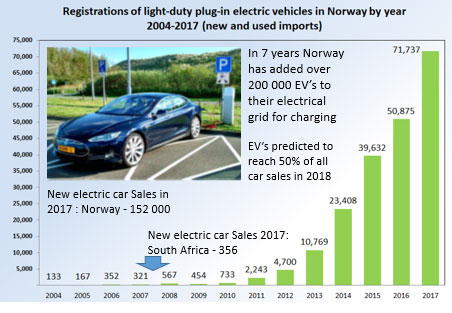
    Source: Wikipedia

    The above graph demonstrates how quickly vehicle sales can be adopted when given an enabling environment by government. Between 2004 and 2017 (a period of 13 years), EV sales in Norway grew at a compound annual growth rate of 62%. By 2017, EV’s market share grew to 21% of all new cars sold in 2017. (When combined with the sale of hybrid cars, powered by electricity and petrol or diesel, the market share rose to almost 50% of new car sales in 2017.)

    By contrast, South Africa’s EV sales in 2017 accounted for just 356 of 368 000 passenger vehicle sales — not even 0.1%. The local market is roughly double the size of the Norwegian market. The cumulative number of EVs sold in Norway over the last seven years amounts to 200 000 vehicles, all of which need regular charging. The growth in sales was driven by improvements in electric cars and focused incentives from government to encourage individuals to switch over from petrol/diesel cars to EVs. A similar growth pattern can be seen in EV sales in the US, Japan and the Netherlands.

    Investment and innovation by EV manufacturers has addressed three key areas of customer concern of the early adopters, namely choice of exciting cars, total cost of ownership and driving range

    On the supply side, investment and innovation by EV manufacturers has addressed three key areas of customer concern of the early adopters, namely choice of exciting cars, total cost of ownership and driving range.

    South African standards allow for two chargers.

    Direct current (DC) fast-charging stations are an option for setting up commercial facilities. Estimated costs per unit come in at approximately R350 000 and current can be drawn at a rate of 75A. These stations have the capacity to charge a Nissan Leaf battery in just 25 minutes.

    The cheaper, alternating current (AC) charging stations can draw 8A, 16A or 32A and will charge a Nissan Leaf in eight hours if set at 16A. To drive the roll-out of the different parties, it will be crucial that the private sector and government get involved to roll out as many chargers as possible.

    Adoption of EVs by the public will see the addition of the largest energy-consuming “white appliance” ever known to man, driving up the home energy bill by 40-100%. The beauty of this for Eskom is that the current target market at are grid-connected customers, who pay their monthly accounts loyally.

    If the taxi industry gets involved, along with other light commercial vehicle (van/truck) users, then these energy consumption and sales numbers will most likely double or treble. International companies are working hard at finding the right vehicles for these markets, as travel figures of 5 000-8 000km/month significantly improve the economics of owning these vehicles.

    R3bn/year

    Now one has to ask: should Eskom ignore potential sales of over R3bn/year? Let us consider some basic numbers: what difference could a fleet of EVs make to Eskom over time?

    Drawing off the Norwegian case study, and assuming within seven to 19 years South Africa could have around 200 000 passenger EVs on the road, electrical energy consumption can be calculated, drawing from the experience of a Nissan Leaf. For example, assume the owner drives 2 000km/month, and has an electricity consumption figure of 21.25kWh/100km plus a marginal 15% for charging losses. Eskom would need to provide around 1 159GWh of electricity per year to keep a fleet of 200 000 Nissan Leafs running. At an electricity price of R1.25/kWh, Eskom together with the municipalities could see potential electricity sales of R1.5bn/year in this market at current prices.

    But what should really pique Eskom’s interest is that recharging a passenger vehicle can be done during off-peak periods. For the average user that parks the EV in a garage or carport overnight, Eskom could incentivise users to charge the car between 10pm and 5am, during a period where demand for electricity is typically at its lowest. This would allow the utility to work its assets more efficiently and flatten the demand profile which exists at traditional peak periods.
    Not only is Eskom currently producing excess power, it is already paid for as part of the operating model for coal-fired power stations, as the costs for Eskom are sunk — they have built the power stations already.

    Fortunately, EV charging technology can now incorporate prepaid electricity, and implement time-of-use tariffs. EV charging stations can be installed with software that can be used to help Eskom shape customer behaviour in order to promote EV charging in off-peak periods.

    But it gets better. Customers will not only buy their power from Eskom in off-peak periods, but they will self-fund the batteries used in their cars, and their private charging stations. EV manufacturers like Tesla envisage that in the future, EVs will form part of the home energy system allowing consumers to adjust their grid consumption energy patterns. On the back of these sales, municipalities will see a growth in their incomes from electricity distribution.

    Government needs to get involved, and roll out the necessary legislation to incentivise the growth of this market

    Government needs to get involved, and roll out the necessary legislation to incentivise the growth of this market. Along with the incentives, there needs to be significant capital investment into the roll-out of a charge station infrastructure for EVs, something that would be commercially feasible for many private operators.

    So what is the catch, you may ask. Simply put: time. Eskom needs to capitalise on this market, grow sales and keep electricity costs down and attractive, or it will lose this entire paying customer base. Solar power companies are lining up to supply these consumers with electricity, who with their EVs and battery systems can move off the grid and not have to purchase power generated by Eskom. This is why the off-peak tariff needs to at least match or be lower than the supplied cost of a consumer installing renewable energy at their homes and thereby moving off-grid.

    The combined impact of EVs and their demand for electricity, deserve the attention of Eskom and government as they are a big part of the answer to growing sales and using the surplus electricity currently available in the national grid. But the time to act is now.  — Written by David Steven Knight and Warren Thompson

    • David Steven Knight is a senior management consultant with over 25 years’ experience in the business and engineering management environment. He previously served as Eskom’s chief project quality engineer for three-and-a-half years
    • This piece was originally published on Moneyweb and is used here with permission

    David Steven Knight Eskom top
    WhatsApp YouTube Follow on Google News Add as preferred source on Google
    Share. Facebook Twitter LinkedIn WhatsApp Telegram Email Copy Link
    Previous Article5G makes debut at Winter Olympics
    Next Article Self-driving cars will kill the things you love (and a few you hate)

    Related Posts

    Outa warns homeowners against rushing to register rooftop solar

    Outa warns homeowners against rushing to register rooftop solar

    27 January 2026
    How liberalisation is rewiring South Africa's power sector

    How liberalisation is rewiring South Africa’s power sector

    21 January 2026
    No risk of load shedding after Koeberg output scaled back

    No risk of load shedding after Koeberg output scaled back

    21 January 2026
    Company News
    Huawei turns 25 in South Africa, celebrates with major device discounts

    Huawei turns 25 in South Africa, celebrates with major device discounts

    30 January 2026
    Phishing has not disappeared, but it has grown up - KnowBe4

    Phishing has not disappeared, but it has grown up

    30 January 2026
    Smartphone affordability: South Africa's new economic divide - PayJoy

    Smartphone affordability: South Africa’s new economic divide

    29 January 2026
    Opinion
    South Africa's skills advantage is being overlooked at home - Richard Firth

    South Africa’s skills advantage is being overlooked at home

    29 January 2026
    Why Elon Musk's Starlink is a 'hard no' for me - Songezo Zibi

    Why Elon Musk’s Starlink is a ‘hard no’ for me

    26 January 2026
    South Africa's new fibre broadband battle - Duncan McLeod

    South Africa’s new fibre broadband battle

    20 January 2026

    Subscribe to Updates

    Get the best South African technology news and analysis delivered to your e-mail inbox every morning.

    Latest Posts
    Vuyani Jarana: Mobile coverage masks a deeper broadband failure

    Vuyani Jarana: Mobile coverage masks a deeper broadband failure

    30 January 2026
    TCS+ | How Cloud On Demand is helping SA businesses succeed in the cloud - Xhenia Rhode, Dion Kalicharan

    TCS+ | Cloud On Demand and Consnet: inside a real-world AWS partner success story

    30 January 2026
    Huawei turns 25 in South Africa, celebrates with major device discounts

    Huawei turns 25 in South Africa, celebrates with major device discounts

    30 January 2026
    SABC Plus to flight Microsoft AI training videos

    SABC Plus to flight Microsoft AI training videos

    30 January 2026
    © 2009 - 2026 NewsCentral Media
    • Cookie policy (ZA)
    • TechCentral – privacy and Popia

    Type above and press Enter to search. Press Esc to cancel.

    Manage consent

    TechCentral uses cookies to enhance its offerings. Consenting to these technologies allows us to serve you better. Not consenting or withdrawing consent may adversely affect certain features and functions of the website.

    Functional Always active
    The technical storage or access is strictly necessary for the legitimate purpose of enabling the use of a specific service explicitly requested by the subscriber or user, or for the sole purpose of carrying out the transmission of a communication over an electronic communications network.
    Preferences
    The technical storage or access is necessary for the legitimate purpose of storing preferences that are not requested by the subscriber or user.
    Statistics
    The technical storage or access that is used exclusively for statistical purposes. The technical storage or access that is used exclusively for anonymous statistical purposes. Without a subpoena, voluntary compliance on the part of your Internet Service Provider, or additional records from a third party, information stored or retrieved for this purpose alone cannot usually be used to identify you.
    Marketing
    The technical storage or access is required to create user profiles to send advertising, or to track the user on a website or across several websites for similar marketing purposes.
    • Manage options
    • Manage services
    • Manage {vendor_count} vendors
    • Read more about these purposes
    View preferences
    • {title}
    • {title}
    • {title}