Close Menu
TechCentralTechCentral

    Subscribe to the newsletter

    Get the best South African technology news and analysis delivered to your e-mail inbox every morning.

    Facebook X (Twitter) YouTube LinkedIn
    WhatsApp Facebook X (Twitter) LinkedIn YouTube
    TechCentralTechCentral
    • News
      Blu Label takes R5.2-billion Cell C hit, touts clean slate ahead

      Blu Label takes R5.2-billion Cell C hit, touts clean slate ahead

      19 February 2026
      MeerKAT detects most powerful natural radio laser ever observed

      MeerKAT detects most powerful natural radio laser ever observed

      19 February 2026
      How AI is rewriting the rules of consulting - Mark Allderman

      How AI is rewriting the rules of consulting

      19 February 2026
      Crackdown on students gambling away Nsfas money online

      Crackdown on students gambling away Nsfas money online

      19 February 2026
      Meta may launch AI-powered smartwatch in 2026

      Meta may launch AI-powered smartwatch in 2026

      19 February 2026
    • World
      Prominent Southern African journalist targeted with Predator spyware

      Prominent Southern African journalist targeted with Predator spyware

      18 February 2026
      More drama in Warner Bros tug of war

      More drama in Warner Bros tug of war

      17 February 2026
      Russia bans WhatsApp

      Russia bans WhatsApp

      12 February 2026
      EU regulators take aim at WhatsApp

      EU regulators take aim at WhatsApp

      9 February 2026
      Musk hits brakes on Mars mission

      Musk hits brakes on Mars mission

      9 February 2026
    • In-depth
      How liberalisation is rewiring South Africa's power sector

      How liberalisation is rewiring South Africa’s power sector

      21 January 2026
      The top-performing South African tech shares of 2025

      The top-performing South African tech shares of 2025

      12 January 2026
      Digital authoritarianism grows as African states normalise internet blackouts

      Digital authoritarianism grows as African states normalise internet blackouts

      19 December 2025
      TechCentral's South African Newsmakers of 2025

      TechCentral’s South African Newsmakers of 2025

      18 December 2025
      Black Friday goes digital in South Africa as online spending surges to record high

      Black Friday goes digital in South Africa as online spending surges to record high

      4 December 2025
    • TCS
      Watts & Wheels S1E4: 'We drive an electric Uber'

      Watts & Wheels S1E4: ‘We drive an electric Uber’

      10 February 2026
      TCS+ | How Cloud On Demand is helping SA businesses succeed in the cloud - Xhenia Rhode, Dion Kalicharan

      TCS+ | Cloud On Demand and Consnet: inside a real-world AWS partner success story

      30 January 2026
      Watts & Wheels S1E4: 'We drive an electric Uber'

      Watts & Wheels S1E3: ‘BYD’s Corolla Cross challenger’

      30 January 2026
      Watts & Wheels S1E4: 'We drive an electric Uber'

      Watts & Wheels S1E2: ‘China attacks, BMW digs in, Toyota’s sublime supercar’

      23 January 2026

      TCS+ | Why cybersecurity is becoming a competitive advantage for SA businesses

      20 January 2026
    • Opinion
      A million reasons monopolies don't work - Duncan McLeod

      A million reasons monopolies don’t work

      10 February 2026
      The author, Business Leadership South Africa CEO Busi Mavuso

      Eskom unbundling U-turn threatens to undo hard-won electricity gains

      9 February 2026
      South Africa's skills advantage is being overlooked at home - Richard Firth

      South Africa’s skills advantage is being overlooked at home

      29 January 2026
      Why Elon Musk's Starlink is a 'hard no' for me - Songezo Zibi

      Why Elon Musk’s Starlink is a ‘hard no’ for me

      26 January 2026
      A million reasons monopolies don't work - Duncan McLeod

      South Africa’s new fibre broadband battle

      20 January 2026
    • Company Hubs
      • Africa Data Centres
      • AfriGIS
      • Altron Digital Business
      • Altron Document Solutions
      • Altron Group
      • Arctic Wolf
      • AvertITD
      • Braintree
      • CallMiner
      • CambriLearn
      • CYBER1 Solutions
      • Digicloud Africa
      • Digimune
      • Domains.co.za
      • ESET
      • Euphoria Telecom
      • Incredible Business
      • iONLINE
      • IQbusiness
      • Iris Network Systems
      • LSD Open
      • Mitel
      • NEC XON
      • Netstar
      • Network Platforms
      • Next DLP
      • Ovations
      • Paracon
      • Paratus
      • Q-KON
      • SevenC
      • SkyWire
      • Solid8 Technologies
      • Telit Cinterion
      • Tenable
      • Vertiv
      • Videri Digital
      • Vodacom Business
      • Wipro
      • Workday
      • XLink
    • Sections
      • AI and machine learning
      • Banking
      • Broadcasting and Media
      • Cloud services
      • Contact centres and CX
      • Cryptocurrencies
      • Education and skills
      • Electronics and hardware
      • Energy and sustainability
      • Enterprise software
      • Financial services
      • Information security
      • Internet and connectivity
      • Internet of Things
      • Investment
      • IT services
      • Lifestyle
      • Motoring
      • Public sector
      • Retail and e-commerce
      • Satellite communications
      • Science
      • SMEs and start-ups
      • Social media
      • Talent and leadership
      • Telecoms
    • Events
    • Advertise
    TechCentralTechCentral
    Home » Top » Google’s Go triumph a milestone for AI research

    Google’s Go triumph a milestone for AI research

    By The Conversation28 January 2016
    Twitter LinkedIn Facebook WhatsApp Email Telegram Copy Link
    News Alerts
    WhatsApp

    go-640

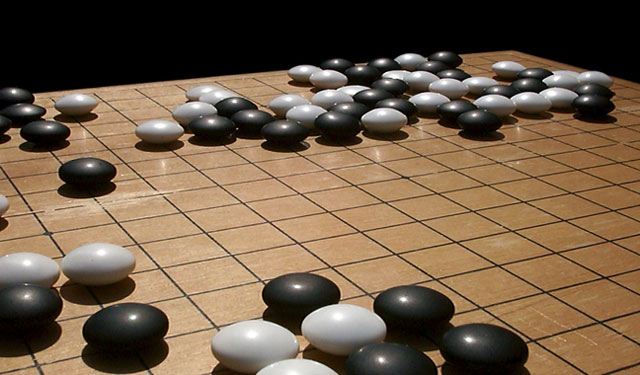
    Researchers from Google DeepMind have developed the first computer able to defeat a human champion at the board game Go. But why has the online giant invested millions of dollars and some of the finest minds in artificial intelligence (AI) research to create a computer board game player?

    Go is not just any board game. It’s more than 2 000 years old and is played by more than 60m people across the world — including a thousand professionals. Creating a superhuman computer Go player able to beat these top pros has been one of the most challenging targets of AI research for decades.

    The rules are deceptively simple: two players take turns to place white and black “stones” on an empty 19×19 board, each aiming to encircle the most territory. Yet these basics yield a game of extraordinary beauty and complexity, full of patterns and flow. Go has many more possible positions than even chess — in fact, there are more possibilities in a game of Go than we would get by considering a separate chess game played on every atom in the universe.

    AI researchers have therefore long regarded Go as a “grand challenge”. Whereas even the best human chess players had fallen to computers by the 1990s, Go remained unbeaten. This is a truly historic breakthrough.

    Since the term “artificial intelligence” was first coined in the 1950s, the range of problems which it can solve has been increasing at an accelerating rate. We take it for granted that Amazon has a pretty good idea of what we might want to buy, for instance, or that Google can complete our partially typed search term, though these are both due to recent advances in AI.

    Computer games have been a crucial test bed for developing and testing new AI techniques — the “lab rat” of our research. This has led to superhuman players in checkers, chess, Scrabble, backgammon and more recently, simple forms of poker.

    Games provide a fascinating source of tough problems — they have well-defined rules and a clear target: to win. To beat these games, the AIs were programmed to search forward into possible futures and choose the move which leads to the best outcome — which is similar to how good human players make decisions.

    Yet Go proved hardest to beat because of its enormous search space and the difficulty of working out who is winning from an unfinished game position. Back in 2001, Jonathan Schaeffer, a brilliant researcher who created a perfect AI checkers player, said it would “take many decades of research and development before world-championship-calibre Go programs exist”. Until now, even with recent advances, it still seemed at least 10 years out of reach.

    The breakthrough

    Google’s announcement, in the journal Nature, details how its machine “learnt” to play Go by analysing millions of past games by professional human players and simulating thousands of possible future game states per second. Specifically, the researchers at DeepMind trained “convolutional neural networks”, algorithms that mimic the high-level structure of the brain and visual system and which have recently seen an explosion in their effectiveness, to predict expert moves.

    This learning was combined with Monte Carlo tree search approaches which use randomness and machine learning to intelligently search the “tree” of possible future board states. These searches have massively increased the strength of computer Go players since their invention less than 10 years ago, as well as finding applications in many other domains.

    The resulting “player” significantly outperformed all existing state-of-the-art AI players and went on to beat the current European champion, Fan Hui, 5-0 under tournament conditions.

    AI passes ‘Go’

    Now that Go has seemingly been cracked, AI needs a new grand challenge — a new “lab rat” — and it seems likely that many of these challenges will come from the US$100bn digital games industry. The ability to play alongside or against millions of engaged human players provides unique opportunities for AI research. At York’s centre for Intelligent Games and Game Intelligence, we’re working on projects such as building an AI aimed at player fun (rather than playing strength), for instance, or using games to improve well-being of people with Alzheimer’s. Collaborations between multidisciplinary labs like ours, the games industry and big business are likely to yield the next big AI breakthroughs.

    However, the real world is a step up, full of ill-defined questions that are far more complex than even the trickiest of board games. The techniques which conquered Go can certainly be applied in medicine, education, science or any other domain where data is available and outcomes can be evaluated and understood.

    The big question is whether Google just helped us towards the next generation of artificial general intelligence, where machines learn to truly think like — and beyond — humans. Whether we’ll see AlphaGo as a step towards Hollywood’s dreams (and nightmares) of AI agents with self-awareness, emotion and motivation remains to be seen. However, the latest breakthrough points to a brave new future where AI will continue to improve our lives by helping us to make better-informed decisions in a world of ever-increasing complexity.The Conversation

    • Peter Cowling is professor of computer science, University of York; Sam Devlin is research fellow in artificial intelligence and digital games, University of York
    • This article was originally published on The Conversation


    DeepMind Go Google Google DeepMind Peter Cowling Sam Devlin
    WhatsApp YouTube Follow on Google News Add as preferred source on Google
    Share. Facebook Twitter LinkedIn WhatsApp Telegram Email Copy Link
    Previous ArticleVodacom, MTN want to break the Internet
    Next Article Fibre breaks in Egypt down Seacom again

    Related Posts

    Dr Google, meet Dr Chatbot - neither is ready to see you now

    Dr Google, meet Dr Chatbot – neither is ready to see you now

    10 February 2026
    AI chatbots are coming to Apple CarPlay

    AI chatbots are coming to Apple CarPlay

    8 February 2026
    From stocks to crypto, markets reel as AI doubts grow

    From stocks to crypto, markets reel as AI doubts grow

    6 February 2026
    Company News
    Customers have new expectations. Is your CX ready? 1Stream

    Customers have new expectations. Is your CX ready?

    19 February 2026
    South Africa's cybersecurity challenge is not a tool problem - Nicholas Applewhite, Trinexia South Africa

    South Africa’s cybersecurity challenge is not a tool problem

    19 February 2026
    The quiet infrastructure powering AI: why long-life IOT networks matter more than ever - Sigfox South Africa

    The quiet infrastructure powering AI: why long-life IoT networks matter more than ever

    18 February 2026
    Opinion
    A million reasons monopolies don't work - Duncan McLeod

    A million reasons monopolies don’t work

    10 February 2026
    The author, Business Leadership South Africa CEO Busi Mavuso

    Eskom unbundling U-turn threatens to undo hard-won electricity gains

    9 February 2026
    South Africa's skills advantage is being overlooked at home - Richard Firth

    South Africa’s skills advantage is being overlooked at home

    29 January 2026

    Subscribe to Updates

    Get the best South African technology news and analysis delivered to your e-mail inbox every morning.

    Latest Posts
    Blu Label takes R5.2-billion Cell C hit, touts clean slate ahead

    Blu Label takes R5.2-billion Cell C hit, touts clean slate ahead

    19 February 2026
    MeerKAT detects most powerful natural radio laser ever observed

    MeerKAT detects most powerful natural radio laser ever observed

    19 February 2026
    How AI is rewriting the rules of consulting - Mark Allderman

    How AI is rewriting the rules of consulting

    19 February 2026
    Crackdown on students gambling away Nsfas money online

    Crackdown on students gambling away Nsfas money online

    19 February 2026
    © 2009 - 2026 NewsCentral Media
    • Cookie policy (ZA)
    • TechCentral – privacy and Popia

    Type above and press Enter to search. Press Esc to cancel.

    Manage consent

    TechCentral uses cookies to enhance its offerings. Consenting to these technologies allows us to serve you better. Not consenting or withdrawing consent may adversely affect certain features and functions of the website.

    Functional Always active
    The technical storage or access is strictly necessary for the legitimate purpose of enabling the use of a specific service explicitly requested by the subscriber or user, or for the sole purpose of carrying out the transmission of a communication over an electronic communications network.
    Preferences
    The technical storage or access is necessary for the legitimate purpose of storing preferences that are not requested by the subscriber or user.
    Statistics
    The technical storage or access that is used exclusively for statistical purposes. The technical storage or access that is used exclusively for anonymous statistical purposes. Without a subpoena, voluntary compliance on the part of your Internet Service Provider, or additional records from a third party, information stored or retrieved for this purpose alone cannot usually be used to identify you.
    Marketing
    The technical storage or access is required to create user profiles to send advertising, or to track the user on a website or across several websites for similar marketing purposes.
    • Manage options
    • Manage services
    • Manage {vendor_count} vendors
    • Read more about these purposes
    View preferences
    • {title}
    • {title}
    • {title}