Close Menu
TechCentralTechCentral

    Subscribe to the newsletter

    Get the best South African technology news and analysis delivered to your e-mail inbox every morning.

    Facebook X (Twitter) YouTube LinkedIn
    WhatsApp Facebook X (Twitter) LinkedIn YouTube
    TechCentralTechCentral
    • News
      Big Microsoft 365 price increases coming next year

      Big Microsoft price increases coming next year

      5 December 2025
      Vodacom to take control of Safaricom in R36-billion deal - Shameel Joosub

      Vodacom to take control of Safaricom in R36-billion deal

      4 December 2025
      Black Friday goes digital in South Africa as online spending surges to record high

      Black Friday goes digital in South Africa as online spending surges to record high

      4 December 2025
      BYD takes direct aim at Toyota with launch of sub-R500 000 Sealion 5 PHEV

      BYD takes direct aim at Toyota with launch of sub-R500 000 Sealion 5 PHEV

      4 December 2025
      'Get it now': Takealot in new instant deliveries pilot

      ‘Get it now’: Takealot in new instant deliveries pilot

      4 December 2025
    • World
      Amazon and Google launch multi-cloud service for faster connectivity

      Amazon and Google launch multi-cloud service for faster connectivity

      1 December 2025
      Google makes final court plea to stop US breakup

      Google makes final court plea to stop US breakup

      21 November 2025
      Bezos unveils monster rocket: New Glenn 9x4 set to dwarf Saturn V

      Bezos unveils monster rocket: New Glenn 9×4 set to dwarf Saturn V

      21 November 2025
      Tech shares turbocharged by Nvidia's stellar earnings

      Tech shares turbocharged by stellar Nvidia earnings

      20 November 2025
      Config file blamed for Cloudflare meltdown that disrupted the web

      Config file blamed for Cloudflare meltdown that disrupted the web

      19 November 2025
    • In-depth
      Jensen Huang Nvidia

      So, will China really win the AI race?

      14 November 2025
      Valve's Linux console takes aim at Microsoft's gaming empire

      Valve’s Linux console takes aim at Microsoft’s gaming empire

      13 November 2025
      iOCO's extraordinary comeback plan - Rhys Summerton

      iOCO’s extraordinary comeback plan

      28 October 2025
      Why smart glasses keep failing - no, it's not the tech - Mark Zuckerberg

      Why smart glasses keep failing – it’s not the tech

      19 October 2025
      BYD to blanket South Africa with megawatt-scale EV charging network - Stella Li

      BYD to blanket South Africa with megawatt-scale EV charging network

      16 October 2025
    • TCS
      TCS+ | How Cloud on Demand helps partners thrive in the AWS ecosystem - Odwa Ndyaluvane and Xenia Rhode

      TCS+ | How Cloud On Demand helps partners thrive in the AWS ecosystem

      4 December 2025
      TCS | MTN Group CEO Ralph Mupita on competition, AI and the future of mobile

      TCS | Ralph Mupita on competition, AI and the future of mobile

      28 November 2025
      TCS | Dominic Cull on fixing South Africa's ICT policy bottlenecks

      TCS | Dominic Cull on fixing South Africa’s ICT policy bottlenecks

      21 November 2025
      TCS | BMW CEO Peter van Binsbergen on the future of South Africa's automotive industry

      TCS | BMW CEO Peter van Binsbergen on the future of South Africa’s automotive industry

      6 November 2025
      TCS | Why Altron is building an AI factory - Bongani Andy Mabaso

      TCS | Why Altron is building an AI factory in Johannesburg

      28 October 2025
    • Opinion
      Your data, your hardware: the DIY AI revolution is coming - Duncan McLeod

      Your data, your hardware: the DIY AI revolution is coming

      20 November 2025
      Zero Carbon Charge founder Joubert Roux

      The energy revolution South Africa can’t afford to miss

      20 November 2025
      It's time for a new approach to government IT spend in South Africa - Richard Firth

      It’s time for a new approach to government IT spend in South Africa

      19 November 2025
      How South Africa's broken Rica system fuels murder and mayhem - Farhad Khan

      How South Africa’s broken Rica system fuels murder and mayhem

      10 November 2025
      South Africa's AI data centre boom risks overloading a fragile grid - Paul Colmer

      South Africa’s AI data centre boom risks overloading a fragile grid

      30 October 2025
    • Company Hubs
      • Africa Data Centres
      • AfriGIS
      • Altron Digital Business
      • Altron Document Solutions
      • Altron Group
      • Arctic Wolf
      • AvertITD
      • Braintree
      • CallMiner
      • CambriLearn
      • CYBER1 Solutions
      • Digicloud Africa
      • Digimune
      • Domains.co.za
      • ESET
      • Euphoria Telecom
      • Incredible Business
      • iONLINE
      • IQbusiness
      • Iris Network Systems
      • LSD Open
      • NEC XON
      • Netstar
      • Network Platforms
      • Next DLP
      • Ovations
      • Paracon
      • Paratus
      • Q-KON
      • SevenC
      • SkyWire
      • Solid8 Technologies
      • Telit Cinterion
      • Tenable
      • Vertiv
      • Videri Digital
      • Vodacom Business
      • Wipro
      • Workday
      • XLink
    • Sections
      • AI and machine learning
      • Banking
      • Broadcasting and Media
      • Cloud services
      • Contact centres and CX
      • Cryptocurrencies
      • Education and skills
      • Electronics and hardware
      • Energy and sustainability
      • Enterprise software
      • Financial services
      • Information security
      • Internet and connectivity
      • Internet of Things
      • Investment
      • IT services
      • Lifestyle
      • Motoring
      • Public sector
      • Retail and e-commerce
      • Satellite communications
      • Science
      • SMEs and start-ups
      • Social media
      • Talent and leadership
      • Telecoms
    • Events
    • Advertise
    TechCentralTechCentral
    Home » Editor's pick » Gravitational waves found: the inside story

    Gravitational waves found: the inside story

    By The Conversation12 February 2016
    Twitter LinkedIn Facebook WhatsApp Email Telegram Copy Link
    News Alerts
    WhatsApp
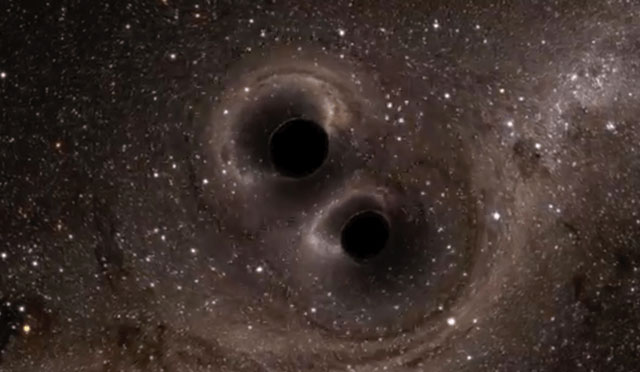
    Two black holes collide. University of Glasgow
    Two black holes collide. University of Glasgow

    One hundred years ago, Albert Einstein, in his general theory of relativity, predicted the existence of a dark side to the cosmos.

    He thought there were invisible “gravitational waves”, ripples in space-time produced by some of the most violent events in the cosmos — exploding stars, colliding black holes, perhaps even the Big Bang itself. For decades, astronomers have gathered strong corroborative evidence of the existence of these waves, but they have never been detected directly — until now. They were the last part of the general theory still to be verified.

    Astronomers have used light to study the universe with optical telescopes for hundreds of years. We have expanded that view hugely since the middle of the 20th century, by building detectors and instruments sensitive to all the forms of what physicists mean by light: the electromagnetic spectrum, from gamma rays to radio. Yet the discovery of gravitational waves represents our first steps into studying the universe through the gravitational-wave spectrum, which exists independently from light, probing directly the effects of gravity as it spreads across the cosmos. It is the first page in a whole new chapter for astronomy, and science.

    How we made the discovery

    The discovery dates back to last September, when two giant measuring devices in different parts of the US called LIGO (Laser Interferometer Gravitational-Wave Observatory) caught a passing gravitational wave from the collision of two massive black holes in a faraway galaxy. LIGO is what we call an interferometer, consisting of two 4km “arms” set at right angles to each other, protected by concrete tubes, and a laser beam which is shone and reflected back and forth by mirrors at each end.

    When a gravitational wave passes by, the stretching and squashing of space causes these arms alternately to lengthen and shrink, one getting longer while the other gets shorter and then vice versa. As the arms change lengths, the laser beams take a different time to travel through them. This means that the two beams are no longer “in step” and what we call an interference pattern is produced — hence the name interferometer.

    The changes in the length of the arms are actually tiny — roughly one million millionth the width of a human hair. This is because the signal from a gravitational wave from far out in the cosmos is mindbogglingly small by the time it reaches us. As if detecting this were not difficult enough, all manner of local disturbances on Earth make it worse, from the ground shaking to power-grid fluctuations; and instrumental “noises” that could mimic or indeed completely swamp a real signal from the cosmos.

    To achieve the astounding sensitivity required, almost every aspect of the LIGO detectors’ design has been upgraded over the past few years. We at the University of Glasgow led a consortium of UK institutions that played a key role — developing, constructing and installing the sensitive mirror suspensions at the heart of the LIGO detectors that were crucial to this first detection. The technology was based on our work on the earlier UK/German GEO600 detector. This turned LIGO into Advanced LIGO, arguably the most sensitive scientific instrument ever, to give us our first direct glimpse of the dark universe.

    What a glimpse it was. The two black holes that collided were respectively about 29 times and 36 times the mass of our sun (shown in the computer visualisation below). It is incidentally the first direct evidence that black holes exist, can exist in a pair, and can collide and merge. Comparing our data with Einstein’s predictions allowed us to test whether general relativity correctly describes such a collision — they passed with flying colours.

    Video: the black hole collision

    The merger occurred more than one billion light years from Earth, converting three times the mass of the sun into gravitational wave energy. In a fraction of a second, the power radiated through these waves was more than 10 times greater than the combined luminosity of every star and galaxy in the observable universe. This was a truly cataclysmic event a long time ago in a galaxy far, far away. In Star Wars, Darth Vader tells us not to “underestimate the power of the dark side”. This amazing discovery shows how right he was.

    Of course, our discovery isn’t just about checking if Einstein was right. Detecting gravitational waves will help us to probe the most extreme corners of the cosmos — the event horizon of a black hole, the innermost heart of a supernova, the internal structure of a neutron star: regions that are completely inaccessible to electromagnetic telescopes.

    Could we ever harness gravitational waves for practical applications here on Earth? Could new insights about the dark universe help us, perhaps in the far future, not just to measure gravitational fields but to manipulate them, as imagined in the space colonies and wormholes of Christopher Nolan’s Interstellar? That is much harder to predict, but the lesson of history is that new phenomena we discover and explore frequently lead to disruptive technologies that come to underpin our everyday lives. It might take a few centuries, but I am confident the same will be true with gravitational waves.The Conversation

    • Martin Hendry is professor of gravitational astrophysics and cosmology, University of Glasgow
    • This article was originally published on The Conversation


    Albert Einstein Martin Hendry
    Subscribe to TechCentral Subscribe to TechCentral
    Share. Facebook Twitter LinkedIn WhatsApp Telegram Email Copy Link
    Previous ArticleA giant leap for theoretical physics
    Next Article Telkom close to signing SA Connect deal: report

    Related Posts

    Scientists discover universe is awash in gravitational waves

    29 June 2023

    The standard model of particle physics may be broken

    11 May 2022

    Phenomenon that baffled Einstein is captured in photo for first time

    14 July 2019
    Company News
    AI is not a technology problem - iqbusiness

    AI is not a technology problem – iqbusiness

    5 December 2025
    Telcos are sitting on a data gold mine - but few know what do with it - Phillip du Plessis

    Telcos are sitting on a data gold mine – but few know what do with it

    4 December 2025
    Unlock smarter computing with your surface Copilot+ PC

    Unlock smarter computing with your Surface Copilot+ PC

    4 December 2025
    Opinion
    Your data, your hardware: the DIY AI revolution is coming - Duncan McLeod

    Your data, your hardware: the DIY AI revolution is coming

    20 November 2025
    Zero Carbon Charge founder Joubert Roux

    The energy revolution South Africa can’t afford to miss

    20 November 2025
    It's time for a new approach to government IT spend in South Africa - Richard Firth

    It’s time for a new approach to government IT spend in South Africa

    19 November 2025

    Subscribe to Updates

    Get the best South African technology news and analysis delivered to your e-mail inbox every morning.

    Latest Posts
    Big Microsoft 365 price increases coming next year

    Big Microsoft price increases coming next year

    5 December 2025
    AI is not a technology problem - iqbusiness

    AI is not a technology problem – iqbusiness

    5 December 2025
    Vodacom to take control of Safaricom in R36-billion deal - Shameel Joosub

    Vodacom to take control of Safaricom in R36-billion deal

    4 December 2025
    Black Friday goes digital in South Africa as online spending surges to record high

    Black Friday goes digital in South Africa as online spending surges to record high

    4 December 2025
    © 2009 - 2025 NewsCentral Media
    • Cookie policy (ZA)
    • TechCentral – privacy and Popia

    Type above and press Enter to search. Press Esc to cancel.

    Manage consent

    TechCentral uses cookies to enhance its offerings. Consenting to these technologies allows us to serve you better. Not consenting or withdrawing consent may adversely affect certain features and functions of the website.

    Functional Always active
    The technical storage or access is strictly necessary for the legitimate purpose of enabling the use of a specific service explicitly requested by the subscriber or user, or for the sole purpose of carrying out the transmission of a communication over an electronic communications network.
    Preferences
    The technical storage or access is necessary for the legitimate purpose of storing preferences that are not requested by the subscriber or user.
    Statistics
    The technical storage or access that is used exclusively for statistical purposes. The technical storage or access that is used exclusively for anonymous statistical purposes. Without a subpoena, voluntary compliance on the part of your Internet Service Provider, or additional records from a third party, information stored or retrieved for this purpose alone cannot usually be used to identify you.
    Marketing
    The technical storage or access is required to create user profiles to send advertising, or to track the user on a website or across several websites for similar marketing purposes.
    • Manage options
    • Manage services
    • Manage {vendor_count} vendors
    • Read more about these purposes
    View preferences
    • {title}
    • {title}
    • {title}