Close Menu
TechCentralTechCentral

    Subscribe to the newsletter

    Get the best South African technology news and analysis delivered to your e-mail inbox every morning.

    Facebook X (Twitter) YouTube LinkedIn
    WhatsApp Facebook X (Twitter) LinkedIn YouTube
    TechCentralTechCentral
    • News
      Namibia tells Starlink to take a hike - again

      Namibia tells Starlink to take a hike – again

      22 June 2026
      Joburg the epicentre of South Africa's tech brain drain

      Joburg the epicentre of South Africa’s tech brain drain

      22 June 2026
      South Africa went cashless - except for the millions who didn't

      South Africa went cashless – except for the millions who didn’t

      22 June 2026
      That drone over your house is almost certainly breaking the law

      That drone over your house is almost certainly breaking the law

      22 June 2026
      DStv Stream to come pre-installed on Samsung TVs across Africa

      DStv Stream to come pre-installed on Samsung TVs across Africa

      22 June 2026
    • World

      SK Hynix ends Samsung’s 26-year reign at the top

      22 June 2026
      Google on the hook for what its AI tells users, court rules

      Google on the hook for what its AI tells users, court rules

      15 June 2026
      How Russians juggle VPNs to outwit the Kremlin

      How Russians juggle VPNs to outwit the Kremlin

      15 June 2026
      Amazon CEO flagged Anthropic AI risks to Washington - Andy Jassy

      Amazon CEO flagged Anthropic AI risks to Washington

      14 June 2026
      Trouble at Xbox

      Trouble at Xbox

      11 June 2026
    • In-depth
      AI boom sparks rally, frenzy and fear

      AI boom sparks rally, frenzy and fear

      11 June 2026
      Every plug-in hybrid on sale in South Africa, ranked by price - Lamborghini Temerario

      Every plug-in hybrid on sale in South Africa, ranked by price

      7 June 2026
      What Wi-Fi 8 will mean for wireless networks

      What Wi-Fi 8 will mean for wireless networks

      1 June 2026
      Alfa's electric rebel - Alfa Romeo Junior Elettrica Veloce

      Alfa’s electric rebel

      29 April 2026
      Africa switches on as Europe dims the lights

      Africa switches on as Europe dims the lights

      9 April 2026
    • TCS
      Watts & Wheels S1E6: 'A flawless Alfa and a bakkie that divides'

      Watts & Wheels S1E6: ‘A flawless Alfa and a bakkie that divides’

      17 June 2026
      Watts & Wheels S1E6: 'A flawless Alfa and a bakkie that divides'

      Watts & Wheels S1E5: ‘A Bentley of the bush and a car that swims’

      8 June 2026
      TCS | Charge's R1.8-billion bet on an off-grid EV future - Charge chairman Joubert Roux

      TCS | Charge’s R1.8-billion bet on an off-grid EV future

      18 May 2026
      TCS+ | The Up&Up Group on the hidden cost of AI - Jason Harrison

      TCS+ | The Up&Up Group on the hidden cost of AI

      13 May 2026
      Michael Rossouw

      TCS+ | The retirement decision most South Africans get wrong

      6 May 2026
    • Opinion
      Finish the job Mandela started - Farzam Ehsani

      Finish the job Mandela started

      18 June 2026
      The author, Fanie van Rooyen

      The US just showed it can switch off our AI

      17 June 2026
      The clock is ticking on South African banks' biggest advantage - Pambos Soteriades

      The clock is ticking on South African banks’ biggest advantage

      9 June 2026

      Clashing judgments leave South Africa’s crypto law unsettled

      2 June 2026
      The clock is ticking on South African banks' biggest advantage - Pambos Soteriades

      The trap inside South Africa’s banking MVNO boom

      1 June 2026
    • Company Hubs
      • 1Stream
      • Africa Data Centres
      • AfriGIS
      • Altron Digital Business
      • Altron Document Solutions
      • Altron Group
      • Arctic Wolf
      • Ascent Technology
      • AvertITD
      • BBD
      • Braintree
      • CallMiner
      • CambriLearn
      • CM Telecom
      • Contactable
      • CYBER1 Solutions
      • Digicloud Africa
      • Digimune
      • Domains.co.za
      • ESET
      • Euphoria Telecom
      • HOSTAFRICA
      • Incredible Business
      • iONLINE
      • IQbusiness
      • Iris Network Systems
      • Kaspersky
      • LSD Open
      • Mitel
      • NEC XON
      • Netstar
      • Network Platforms
      • Next DLP
      • Ovations
      • Paracon
      • Paratus
      • Q-KON
      • SevenC
      • SkyWire
      • Solid8 Technologies
      • Telit Cinterion
      • Telviva
      • Tenable
      • Vertiv
      • Videri Digital
      • Vodacom Business
      • Wipro
      • Workday
      • XLink
    • Sections
      • AI and machine learning
      • Banking
      • Broadcasting and Media
      • Cloud services
      • Contact centres and CX
      • Cryptocurrencies
      • Education and skills
      • Electronics and hardware
      • Energy and sustainability
      • Enterprise software
      • Financial services
      • HealthTech
      • Information security
      • Internet and connectivity
      • Internet of Things
      • Investment
      • IT services
      • Lifestyle
      • Motoring
      • Policy and regulation
      • Public sector
      • Retail and e-commerce
      • Satellite communications
      • Science
      • SMEs and start-ups
      • Social media
      • Talent and leadership
      • Telecoms
    • Events
    • Advertise
    TechCentralTechCentral
    Home » In-depth » Growing worries over SA’s nuclear plans

    Growing worries over SA’s nuclear plans

    By The Conversation27 September 2016
    Twitter LinkedIn Facebook WhatsApp Email Telegram Copy Link
    News Alerts
    WhatsApp

    nuclear-640

    Nuclear energy in South Africa is a highly contentious issue. The decision on whether to proceed with the construction of a fleet of nuclear power plants is destined to become the financially most far-reaching and consequential defining moment of the Jacob Zuma presidency.

    There is widespread public mistrust of the nuclear expansion process. Its roots lie in the extraordinary announcement in 2014 that the Russian nuclear agency Rosatom had secured the rights to build the new South African nuclear plants. The South African government played down the announcement, claiming that it was inaccurate.

    But this precipitated a series of media investigations. These uncovered evidence that individuals close to the president and groups linked to the ruling ANC have significant financial interests in the matter.

    Civil society organisations are taking government to court in an attempt to have the deal declared illegal. Their attempts to have details of the Russian agreement released are being resisted. This is likely to strengthen their case, and sway public opinion further.

    It appears that those with a stake in the nuclear build are hoping to fast-track the process in the face of growing public opposition. This is evident from revelations that, bizarrely, contracts are being awarded, even though a formal process has not been set in motion by government.

    The most recent revelation was that a member of a business family with close links to President Jacob Zuma has been awarded a massive R171m tender for a nuclear build programme management system.

    The meaning of this is unclear. It has largely confirmed the fears that the nuclear build is being driven for the benefit of the politically connected rather than the national good.

    Burning questions

    The debate surrounding the nuclear project centres on three highly contested questions:

    • Is the country’s future energy generating potential and demand such that an expensive nuclear power station build is effectively unavoidable?
    • Can South Africa afford the associated costs and debt, especially in view of massive funding demands in other sectors such as education?
    • If approved, would the nuclear build lead to massive overspends, corruption and beneficiation of politically connected individuals?

    The development of new nuclear power plants with a generating capacity of 9,6GW was initially presented in the department of energy’s 2010-2030 Integrated Resource Plan for electricity. According to this roadmap, nuclear would amount to 13% of South Africa’s 2030 generating capacity. This is compared to 46% coal, 11% solar and 10% wind.

    But this plan is considered outdated, with many making a strong case that improvements in renewable energy technologies and lower future energy demand at the very least allow for the nuclear build to be postponed.

    Furthermore, given the widely acclaimed early successes of the Renewable Energy Independent Power Producer Procurement Programme, it is difficult to understand why the renewable fraction is not being increased further, and why the national power utility Eskom, under the leadership of Brian Molefe, a nuclear disciple, now opposes new renewable energy developments.

    The promotion of nuclear energy at the expense of renewables bucks global trends. An industrial nation like Germany is phasing out nuclear power, and has a much higher renewable energy investment than sunny, windy South Africa. Chinese renewables expansion currently exceeds nuclear development by far.
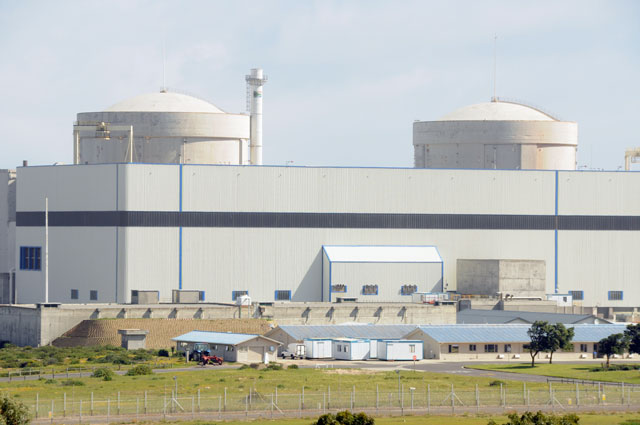
    Koeberg, north of Cape Town, is currently South Africa's only nuclear power station
    Koeberg, north of Cape Town, is currently South Africa’s only nuclear power station

    The nuclear option is expensive. The most realistic cost estimates range from R650bn – advanced by nuclear build proponents – to R1,2 trillion, as determined by the civic watchdog group Outa. The reported announcement by the CEO of the Nuclear Energy Corporation of South Africa that the nuclear build would merely cost the country R1bn is not considered to be serious.

    Opponents of the deal point out that no persuasive cost-benefit analysis has been done. It is furthermore worrying that many recent nuclear construction projects elsewhere in the world have run into huge cost overruns and delays.

    The ANC’s internal nuclear war

    The often obscure processes and overhasty developments require an insight into the present machinations within the governing party.

    Tensions within the ruling party have escalated to the point where calls for the president’s resignation are now made openly. And even party leaders acknowledge that factions in their ranks are thriving on corruption.

    The organisational fracture is equally evident in attitudes towards the nuclear build. Tensions over the issue have been cited as the major reason for Zuma’s dismissal of the financially prudent former finance minister Nhlanhla Nene in December 2015.

    Earlier this year Zuma announced that the nuclear build would proceed on a scale and pace the country can afford. This position has been reiterated in recent weeks by both deputy President Cyril Ramaphosa and energy minister Tina Joemat-Petterson. But it is not clear what this means in practice, given that scale and pace can be defined in many different ways.

    The official process envisages a request for proposals to be issued on 30 September. This was set out in a ministry of energy press release issued on 26 December 2015. It states that:

    Any decision to proceed further with a nuclear new build programme will therefore only take place after the RFP (request for proposals) process has been completed and a final funding model has been developed, and then referred back to cabinet for consideration and approval.

    The request for proposals invites nuclear plant constructors to issue concrete building and (hopefully) associated costing plans.

    If this process is handled in a transparent way, the public will be able to scrutinise the financial and other implications, including potential pitfalls. This would enable a far more meaningful analysis of the necessity and affordability of the nuclear build. In particular, the following needs to be clarified:

    • The technical details of the proposed reactors. Are they optimal, tested and considered safe?
    • Are there signs of associated developments amounting to wasteful expenditure? Alternatively, have critical additional aspects been considered like nuclear waste disposal and plant decommissioning, for example?
    • How will cost overruns and delays be dealt with?
    • What are the true costs and how will the development be funded? What are the long-term fiscal implications?

    But no one is certain that this ideal scenario will play itself out because the legitimacy of the procurement process has already been undermined.

    Looking ahead, actual construction would need to be preceded by the closure of funding agreements, the settling of legal disputes and further public engagement. This takes time.

    In the unlikely event that the nuclear build actually does come to fruition, it will not commence any time soon.The Conversation

    • Hartmut Winkler is professor of physics, University of Johannesburg
    • This article was originally published on The Conversation

    Follow TechCentral on Google News Add TechCentral as your preferred source on Google


    Hartmut Winkler Jacob Zuma Koeberg Nhlanhla Nene Tina Joemat-Pettersson
    WhatsApp YouTube
    Share. Facebook Twitter LinkedIn WhatsApp Telegram Email Copy Link
    Previous ArticlePinnacle plunges on new bribery allegations
    Next Article Hlaudi’s ‘bonanza’ must be explained: SOS

    Related Posts

    Treasury's crypto crackdown is a betrayal of Mandela's promise - Duncan McLeod

    Hold the doom: the case for a South African comeback

    26 February 2026
    No risk of load shedding after Koeberg output scaled back

    No risk of load shedding after Koeberg output scaled back

    21 January 2026
    Television at 50 | How the SABC lost its way - and what it must become

    Television at 50 | How the SABC lost its way – and what it must become

    5 January 2026
    Company News
    A smarter way to buy or renew your Red Hat subscriptions - LSD Open

    A smarter way to buy or renew your Red Hat subscriptions

    22 June 2026
    Moving past the pilot: inside the CloudZA and AWS closed-door AI executive roundtable

    CloudZA and AWS chart the road from AI pilots to production

    19 June 2026
    The role of edge infrastructure in South Africa's AI leap - OADC Open Access Data Centres

    The role of edge infrastructure in South Africa’s AI leap

    19 June 2026
    Opinion
    Finish the job Mandela started - Farzam Ehsani

    Finish the job Mandela started

    18 June 2026
    The author, Fanie van Rooyen

    The US just showed it can switch off our AI

    17 June 2026
    The clock is ticking on South African banks' biggest advantage - Pambos Soteriades

    The clock is ticking on South African banks’ biggest advantage

    9 June 2026

    Subscribe to Updates

    Get the best South African technology news and analysis delivered to your e-mail inbox every morning.

    Latest Posts
    Namibia tells Starlink to take a hike - again

    Namibia tells Starlink to take a hike – again

    22 June 2026
    Joburg the epicentre of South Africa's tech brain drain

    Joburg the epicentre of South Africa’s tech brain drain

    22 June 2026
    South Africa went cashless - except for the millions who didn't

    South Africa went cashless – except for the millions who didn’t

    22 June 2026
    That drone over your house is almost certainly breaking the law

    That drone over your house is almost certainly breaking the law

    22 June 2026
    © 2009 - 2026 NewsCentral Media
    • Cookie policy (ZA)
    • TechCentral – privacy and Popia

    Type above and press Enter to search. Press Esc to cancel.

    Manage consent

    TechCentral uses cookies to enhance its offerings. Consenting to these technologies allows us to serve you better. Not consenting or withdrawing consent may adversely affect certain features and functions of the website.

    Functional Always active
    The technical storage or access is strictly necessary for the legitimate purpose of enabling the use of a specific service explicitly requested by the subscriber or user, or for the sole purpose of carrying out the transmission of a communication over an electronic communications network.
    Preferences
    The technical storage or access is necessary for the legitimate purpose of storing preferences that are not requested by the subscriber or user.
    Statistics
    The technical storage or access that is used exclusively for statistical purposes. The technical storage or access that is used exclusively for anonymous statistical purposes. Without a subpoena, voluntary compliance on the part of your Internet Service Provider, or additional records from a third party, information stored or retrieved for this purpose alone cannot usually be used to identify you.
    Marketing
    The technical storage or access is required to create user profiles to send advertising, or to track the user on a website or across several websites for similar marketing purposes.
    • Manage options
    • Manage services
    • Manage {vendor_count} vendors
    • Read more about these purposes
    View preferences
    • {title}
    • {title}
    • {title}