
Close Menu
TechCentralTechCentral

    Subscribe to the newsletter

    Get the best South African technology news and analysis delivered to your e-mail inbox every morning.

    Facebook X (Twitter) YouTube LinkedIn
    WhatsApp Facebook X (Twitter) LinkedIn YouTube
    TechCentralTechCentral
    • News
      Africa's most popular phones have a tracking problem

      Africa’s most popular phones have a tracking problem

      24 July 2026
      Vodacom taps UJ, AWS to build its AI talent pipeline - Vodacom Group CEO Shameel Joosub

      Vodacom taps UJ, AWS to build its AI talent pipeline

      24 July 2026
      Intel is back in the game - Intel CEO Lip-Bu Tan. Laure Andrillon/Reuters

      Intel is back in the game

      24 July 2026
      Fat bonuses at Telkom despite group missing own targets - Serame Taukobong

      Fat bonuses at Telkom despite group missing own targets

      23 July 2026
      Massive changes coming to Amazon Prime Video - Jeff Bezos

      Massive changes coming to Amazon Prime Video

      23 July 2026
    • World
      Meta AI will now tell parents if their teen is in crisis

      Meta AI will now tell parents if their teen is in crisis

      17 July 2026
      IBM shares crash 25% as AI upends software spending - Arvind Krishna

      IBM shares crash 25% as AI upends software spending

      15 July 2026
      Jony Ive's first OpenAI device: an AI smart speaker - Jony Ive and Sam Altman

      Jony Ive’s first OpenAI device: an AI smart speaker

      15 July 2026
      Stripe, Advent in talks to buy PayPal for $53-billion

      Stripe, Advent in talks to buy PayPal for $53-billion

      15 July 2026
      Memory crisis sends smartphone market into steep decline

      Memory crisis sends smartphone market into steep decline

      13 July 2026
    • In-depth
      The plan to stop AI from breaking the world - Google DeepMind CEO Demis Hassabis. Image: John Sears

      The plan to stop AI from breaking the world

      16 July 2026
      The internet has a Strait of Hormuz problem

      The internet has a Strait of Hormuz problem

      15 July 2026
      AI boom sparks rally, frenzy and fear

      AI boom sparks rally, frenzy and fear

      11 June 2026
      Every plug-in hybrid on sale in South Africa, ranked by price - Lamborghini Temerario

      Every plug-in hybrid on sale in South Africa, ranked by price

      7 June 2026
      What Wi-Fi 8 will mean for wireless networks

      What Wi-Fi 8 will mean for wireless networks

      1 June 2026
    • TCS
      TCS | How Optasia lends billions to people banks can't see - Salvador Anglada

      TCS | How Optasia lends billions to people banks can’t see

      23 July 2026
      The rands-and-cents case for electric trucks - William Kelly Watts & Wheels with Wills

      The rands-and-cents case for electric trucks

      20 July 2026
      Watts & Wheels S1E7: 'Ferrari's EV breaks the internet'

      Watts & Wheels S1E7: ‘Ferrari’s EV breaks the internet’

      8 July 2026
      TCS | Pick n Pay's Enrico Ferigolli on Penny, the AI that shops for you

      TCS | Pick n Pay’s Enrico Ferigolli on Penny, the AI that shops for you

      2 July 2026
      TCS+ | How Tracker is turning vehicle data into business strategy - Silvia Schollenberger

      TCS+ | How Tracker is turning vehicle data into business strategy

      1 July 2026
    • Opinion
      Selling vapour is corporate suicide in slow motion - Jannie van Zyl

      Selling vapour is corporate suicide in slow motion

      16 July 2026
      Brazil's online gambling crackdown is a lesson for South Africa

      How Amazon outmanoeuvred Starlink in South Africa

      15 July 2026
      The Popia problem with agentic AI - Herman Haasbroek

      The Popia problem with agentic AI

      14 July 2026
      The author, Fanie van Rooyen

      South Africa can still catch the AI wave – here’s how

      7 July 2026
      The author, Fanie van Rooyen

      The AI utopia South Africa can’t afford

      1 July 2026
    • Company Hubs
      • 1Stream
      • Africa Data Centres
      • AfriGIS
      • Altron Digital Business
      • Altron Document Solutions
      • Altron Group
      • Arctic Wolf
      • Ascent Technology
      • AvertITD
      • BBD
      • Braintree
      • CallMiner
      • CambriLearn
      • CM Telecom
      • Contactable
      • CYBER1 Solutions
      • Digicloud Africa
      • Digimune
      • Domains.co.za
      • ESET
      • Euphoria Telecom
      • HOSTAFRICA
      • Incredible Business
      • iONLINE
      • IQbusiness
      • Iris Network Systems
      • Kaspersky
      • LSD Open
      • Mitel
      • NEC XON
      • Netstar
      • Network Platforms
      • Next DLP
      • Ovations
      • Paracon
      • Paratus
      • Q-KON
      • SevenC
      • SkyWire
      • Solid8 Technologies
      • Telit Cinterion
      • Telviva
      • Tenable
      • Vertiv
      • Videri Digital
      • Vodacom Business
      • Vox
      • Wipro
      • Workday
      • XLink
    • Sections
      • AI and machine learning
      • Banking
      • Broadcasting and Media
      • Cloud services
      • Contact centres and CX
      • Cryptocurrencies
      • Education and skills
      • Electronics and hardware
      • Energy and sustainability
      • Enterprise software
      • Financial services
      • HealthTech
      • Information security
      • Internet and connectivity
      • Internet of Things
      • Investment
      • IT services
      • Lifestyle
      • Policy and regulation
      • Public sector
      • Retail and e-commerce
      • Satellite communications
      • Science
      • SMEs and start-ups
      • Social media
      • Talent and leadership
      • Telecoms
      • Watts & Wheels
    • Events
    • Advertise
    TechCentralTechCentral
    Home » Company News » How CISOs can capitalise on their seat at the table

    How CISOs can capitalise on their seat at the table

    By Gidi Cohen21 January 2021
    Twitter LinkedIn Facebook WhatsApp Email Telegram Copy Link
    News Alerts
    WhatsApp

    According to Gartner’s recent Board of Directors Survey, 69% of directors confirmed that the effects of the Covid-19 pandemic and the economic crisis dramatically accelerated digital business initiatives in 2020.

    However, necessity does not always breed success.

    New risk has been introduced, new access points have emerged, and new technologies need to be secured. As a result, the chief information security officer (CISO) has gained new-found influence within the organisation. This is influence that leading CISOs are using to build stronger security programmes. By doing so, they are actively improving their organisations’ security posture while delivering increased business value.

    Business-critical role in the new normal

    Covid-19 lockdowns have raised the visibility of security as a business issue. CISOs, at the helm of security strategy, now have an unprecedented seat at the boardroom table. According to PwC research, a “majority of CISOs have interacted more frequently with their CEOs (65%) and the boards (50%) during the crisis. In 2019, only 33% of all business and IT executives said that their cyber team communicates effectively with the board and senior executives about cyber risks and adjacent risks”.
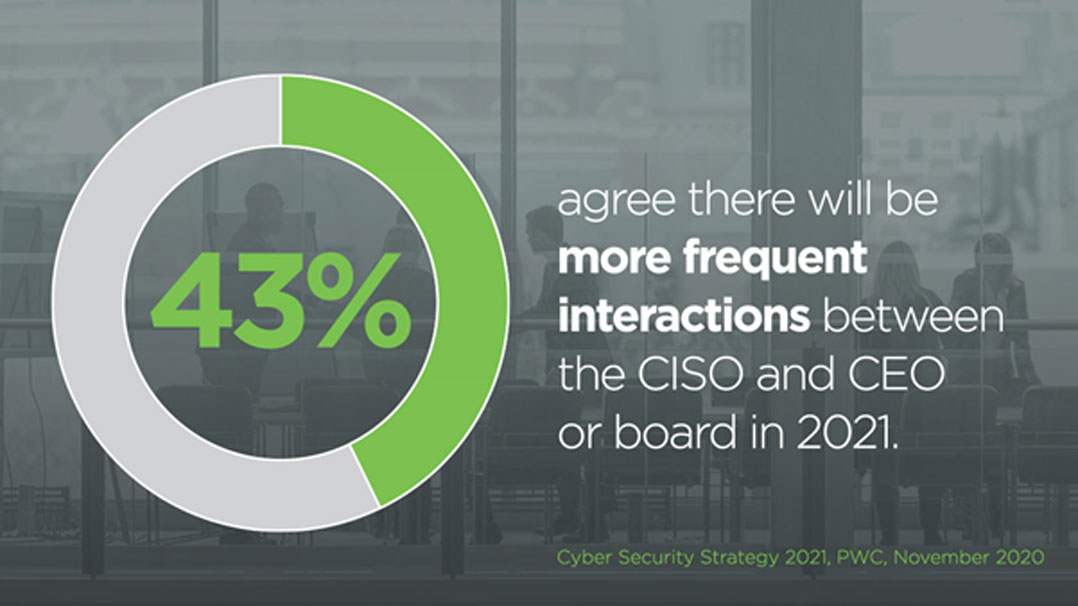
    A further PwC report points to two-fifths of C-level executives agreeing that there will be more frequent interactions between the CISO and CEO or board in 2021. The opportunity has arrived for CISOs to embed security into the fabric of the organisation’s business strategy.

    Six priorities held by forward-leaning CISOs

    To make the best use of their newfound seat at the table, CISOs must proactively address the new normal by advocating for the changes necessary to reduce risk. This is a significant task that requires radical security transformation. As well as managing the new complexities and risk introduced by accelerated digital transformation initiatives, organisations need to gain a handle on existing and pervasive risk within their environment. Organisations that are ambitious about the speed and scale of their digitisation plans will be more successful if they collaborate with their security chiefs from the start.

    To support business-critical digital transformation initiatives while addressing legacy security issues and improving security posture, CISOs have six key priorities.

    1. Retain talent
    Digital transformation requires an organisation to attract and retain the security industry’s best and brightest talent. With Cybersecurity Ventures predicting that there are likely going to be 3.5 million unfilled cybersecurity positions globally by 2021, the competition for top talent is incredibly fierce and the challenges associated with retaining staff are pronounced. There are opportunities to turn the tide. Covid-19 is an opportunity for organisations to utilise the new normal of “work-from-anywhere” to provide the flexibility that many employees want and compete for those finite resources.

    2. Build resilience
    No cybersecurity solution is capable of protecting against every possible form of cyberthreat. Therefore, security programmes need to be able to effectively mitigate damage to systems, processes and reputation, and continue operating once those systems or data have been compromised. They need to address both adversarial threats as well as simple human error.

    This includes determining who gains access to the network and how, pinpointing what are the most important assets and services, making sure all critical data is protected, and identifying what controls must be updated to function in a predominately remote workforce.

    3. Accelerate cloud adoption
    Cloud services are now a prerequisite for operational agility and business continuity. While the CISO must continue to accelerate cloud adoption to support an ecosystem approach to business operations, they must also ensure that connections are safe, secure and compliant, and aligned with data governance policies. Connecting suppliers, customers, shippers and employees is more important than ever to allow all parties to work collaboratively and improve decisions. Now is the time to make hard decisions around replacing legacy technologies, expanding cloud infrastructure and assessing new technologies.

    4. Adopt a zero-trust framework
    Accelerated digital transformation has also paved the way for an accelerated transformation to a zero-trust framework. In a recent Deloitte poll, over a third of security professionals said that the pandemic has sped up their organisations’ zero trust adoption efforts. Prior to the pandemic, interest in zero-trust architectures was primarily being driven by a recognition that the traditional perimeter-centric security model is not compatible with the way businesses are working today. Now, zero-trust has come to the forefront due to the massive volume of remote workers, putting stress on the infrastructure, particularly VPNs.

    5. Increase operational efficiencies
    Digital initiatives provide prime ways to improve operational efficiencies. Chief among these is automation, which is fast becoming a hallmark of the smartest and most visionary organisations’ approach to cybersecurity. Companies that can automate routine tasks can free up time for other work that adds more value.

    6. Build effective governance
    The most resilient organisations have frameworks for consistent prioritisation and mitigation of risk so security teams can stay focused on what matters most. They model and validate compliance requirements across hybrid networks, including those in a business’s supply chain, where data subject to compliance requirements is stored and processed in multiple environments. If improperly managed, the interchange of data between these networks can create an additional opportunity for a compliance failure.

    Read about how digitisation is reshaping the role and priorities of the CISO in the report, “Accelerated digital transformation in the post-pandemic era: A catalyst for security transformation”. Download your copy now.

    About Gidi Cohen
    The author, Gidi Cohen, co-founded Skybox Security in 2002 and has guided the company’s vision and development as the leader in cybersecurity analytics. A respected innovator in the security analytics space, he is a popular speaker at industry conferences worldwide, demonstrating how sophisticated analytics, modelling and simulation, as well as unprecedented network visibility, are used to reduce an enterprise’s attack surface. For more than 10 years he has been committed to empowering security leaders to quickly and accurately prioritise and address vulnerabilities and threats with cutting-edge Skybox solutions.

    About Skybox Security
    Skybox provides the industry’s broadest cybersecurity management platform to address security challenges within large, complex networks. By integrating with more than 120 networking and security technologies, the Skybox Security Suite gives comprehensive attack surface visibility and the context needed to quickly identify and fix vulnerabilities and security weaknesses. Our analytics, automation and intelligence improve the efficiency and performance of security operations in vulnerability and threat management and firewall and security policy management for the world’s largest organisations. For more information, please visit www.skyboxsecurity.com.

    • This promoted content was paid for by the company concerned

    Follow TechCentral on Google News Add TechCentral as your preferred source on Google


    Deloitte Gartner Gidi Cohen PwC Skybox Skybox Secuity
    WhatsApp YouTube
    Share. Facebook Twitter LinkedIn WhatsApp Telegram Email Copy Link
    Previous ArticleFight fire with fire: The services key to knocking out sophisticated cyberattacks
    Next Article In hidden message on White House website, Biden calls for coders

    Related Posts

    Customers prefer ChatGPT to your company's AI chatbot

    Customers prefer ChatGPT to your company’s AI chatbot

    10 July 2026
    When the AI costs more than the coder

    When the AI costs more than the coder

    25 June 2026
    African AI: lots of pilots, few payoffs

    African AI: lots of pilots, few payoffs

    27 May 2026
    Company News
    Why Europe is turning to South Africa for cross-border innovation - BBD Software

    Why Europe is turning to South Africa for cross-border innovation

    24 July 2026
    Green dashboards, stalled change: the CIO's blind spot - Change Logic Marchant van den Heever

    Green dashboards, stalled change: the CIO’s blind spot

    24 July 2026
    Why Africa's cloud needs more than one path - Africa Data Centres

    Why Africa’s cloud needs more than one path

    23 July 2026
    Opinion
    Selling vapour is corporate suicide in slow motion - Jannie van Zyl

    Selling vapour is corporate suicide in slow motion

    16 July 2026
    Brazil's online gambling crackdown is a lesson for South Africa

    How Amazon outmanoeuvred Starlink in South Africa

    15 July 2026
    The Popia problem with agentic AI - Herman Haasbroek

    The Popia problem with agentic AI

    14 July 2026

    Subscribe to Updates

    Get the best South African technology news and analysis delivered to your e-mail inbox every morning.

    Latest Posts
    Africa's most popular phones have a tracking problem

    Africa’s most popular phones have a tracking problem

    24 July 2026
    Vodacom taps UJ, AWS to build its AI talent pipeline - Vodacom Group CEO Shameel Joosub

    Vodacom taps UJ, AWS to build its AI talent pipeline

    24 July 2026
    Intel is back in the game - Intel CEO Lip-Bu Tan. Laure Andrillon/Reuters

    Intel is back in the game

    24 July 2026
    Why Europe is turning to South Africa for cross-border innovation - BBD Software

    Why Europe is turning to South Africa for cross-border innovation

    24 July 2026
    © 2009 - 2026 NewsCentral Media
    Built and maintained by Chronon
    • Cookie policy (ZA)
    • TechCentral – privacy and Popia

    Type above and press Enter to search. Press Esc to cancel.

    Manage consent

    TechCentral uses cookies to enhance its offerings. Consenting to these technologies allows us to serve you better. Not consenting or withdrawing consent may adversely affect certain features and functions of the website.

    Functional Always active
    The technical storage or access is strictly necessary for the legitimate purpose of enabling the use of a specific service explicitly requested by the subscriber or user, or for the sole purpose of carrying out the transmission of a communication over an electronic communications network.
    Preferences
    The technical storage or access is necessary for the legitimate purpose of storing preferences that are not requested by the subscriber or user.
    Statistics
    The technical storage or access that is used exclusively for statistical purposes. The technical storage or access that is used exclusively for anonymous statistical purposes. Without a subpoena, voluntary compliance on the part of your Internet Service Provider, or additional records from a third party, information stored or retrieved for this purpose alone cannot usually be used to identify you.
    Marketing
    The technical storage or access is required to create user profiles to send advertising, or to track the user on a website or across several websites for similar marketing purposes.
    • Manage options
    • Manage services
    • Manage {vendor_count} vendors
    • Read more about these purposes
    View preferences
    • {title}
    • {title}
    • {title}