Close Menu
TechCentralTechCentral

    Subscribe to the newsletter

    Get the best South African technology news and analysis delivered to your e-mail inbox every morning.

    Facebook X (Twitter) YouTube LinkedIn
    WhatsApp Facebook X (Twitter) LinkedIn YouTube
    TechCentralTechCentral
    • News
      Big Microsoft 365 price increases coming next year

      Big Microsoft price increases coming next year

      5 December 2025
      Vodacom to take control of Safaricom in R36-billion deal - Shameel Joosub

      Vodacom to take control of Safaricom in R36-billion deal

      4 December 2025
      Black Friday goes digital in South Africa as online spending surges to record high

      Black Friday goes digital in South Africa as online spending surges to record high

      4 December 2025
      BYD takes direct aim at Toyota with launch of sub-R500 000 Sealion 5 PHEV

      BYD takes direct aim at Toyota with launch of sub-R500 000 Sealion 5 PHEV

      4 December 2025
      'Get it now': Takealot in new instant deliveries pilot

      ‘Get it now’: Takealot in new instant deliveries pilot

      4 December 2025
    • World
      Amazon and Google launch multi-cloud service for faster connectivity

      Amazon and Google launch multi-cloud service for faster connectivity

      1 December 2025
      Google makes final court plea to stop US breakup

      Google makes final court plea to stop US breakup

      21 November 2025
      Bezos unveils monster rocket: New Glenn 9x4 set to dwarf Saturn V

      Bezos unveils monster rocket: New Glenn 9×4 set to dwarf Saturn V

      21 November 2025
      Tech shares turbocharged by Nvidia's stellar earnings

      Tech shares turbocharged by stellar Nvidia earnings

      20 November 2025
      Config file blamed for Cloudflare meltdown that disrupted the web

      Config file blamed for Cloudflare meltdown that disrupted the web

      19 November 2025
    • In-depth
      Jensen Huang Nvidia

      So, will China really win the AI race?

      14 November 2025
      Valve's Linux console takes aim at Microsoft's gaming empire

      Valve’s Linux console takes aim at Microsoft’s gaming empire

      13 November 2025
      iOCO's extraordinary comeback plan - Rhys Summerton

      iOCO’s extraordinary comeback plan

      28 October 2025
      Why smart glasses keep failing - no, it's not the tech - Mark Zuckerberg

      Why smart glasses keep failing – it’s not the tech

      19 October 2025
      BYD to blanket South Africa with megawatt-scale EV charging network - Stella Li

      BYD to blanket South Africa with megawatt-scale EV charging network

      16 October 2025
    • TCS
      TCS+ | How Cloud on Demand helps partners thrive in the AWS ecosystem - Odwa Ndyaluvane and Xenia Rhode

      TCS+ | How Cloud On Demand helps partners thrive in the AWS ecosystem

      4 December 2025
      TCS | MTN Group CEO Ralph Mupita on competition, AI and the future of mobile

      TCS | Ralph Mupita on competition, AI and the future of mobile

      28 November 2025
      TCS | Dominic Cull on fixing South Africa's ICT policy bottlenecks

      TCS | Dominic Cull on fixing South Africa’s ICT policy bottlenecks

      21 November 2025
      TCS | BMW CEO Peter van Binsbergen on the future of South Africa's automotive industry

      TCS | BMW CEO Peter van Binsbergen on the future of South Africa’s automotive industry

      6 November 2025
      TCS | Why Altron is building an AI factory - Bongani Andy Mabaso

      TCS | Why Altron is building an AI factory in Johannesburg

      28 October 2025
    • Opinion
      Your data, your hardware: the DIY AI revolution is coming - Duncan McLeod

      Your data, your hardware: the DIY AI revolution is coming

      20 November 2025
      Zero Carbon Charge founder Joubert Roux

      The energy revolution South Africa can’t afford to miss

      20 November 2025
      It's time for a new approach to government IT spend in South Africa - Richard Firth

      It’s time for a new approach to government IT spend in South Africa

      19 November 2025
      How South Africa's broken Rica system fuels murder and mayhem - Farhad Khan

      How South Africa’s broken Rica system fuels murder and mayhem

      10 November 2025
      South Africa's AI data centre boom risks overloading a fragile grid - Paul Colmer

      South Africa’s AI data centre boom risks overloading a fragile grid

      30 October 2025
    • Company Hubs
      • Africa Data Centres
      • AfriGIS
      • Altron Digital Business
      • Altron Document Solutions
      • Altron Group
      • Arctic Wolf
      • AvertITD
      • Braintree
      • CallMiner
      • CambriLearn
      • CYBER1 Solutions
      • Digicloud Africa
      • Digimune
      • Domains.co.za
      • ESET
      • Euphoria Telecom
      • Incredible Business
      • iONLINE
      • IQbusiness
      • Iris Network Systems
      • LSD Open
      • NEC XON
      • Netstar
      • Network Platforms
      • Next DLP
      • Ovations
      • Paracon
      • Paratus
      • Q-KON
      • SevenC
      • SkyWire
      • Solid8 Technologies
      • Telit Cinterion
      • Tenable
      • Vertiv
      • Videri Digital
      • Vodacom Business
      • Wipro
      • Workday
      • XLink
    • Sections
      • AI and machine learning
      • Banking
      • Broadcasting and Media
      • Cloud services
      • Contact centres and CX
      • Cryptocurrencies
      • Education and skills
      • Electronics and hardware
      • Energy and sustainability
      • Enterprise software
      • Financial services
      • Information security
      • Internet and connectivity
      • Internet of Things
      • Investment
      • IT services
      • Lifestyle
      • Motoring
      • Public sector
      • Retail and e-commerce
      • Satellite communications
      • Science
      • SMEs and start-ups
      • Social media
      • Talent and leadership
      • Telecoms
    • Events
    • Advertise
    TechCentralTechCentral
    Home » Science » How robots ‘see’ the world

    How robots ‘see’ the world

    By The Conversation22 December 2015
    Twitter LinkedIn Facebook WhatsApp Email Telegram Copy Link
    News Alerts
    WhatsApp
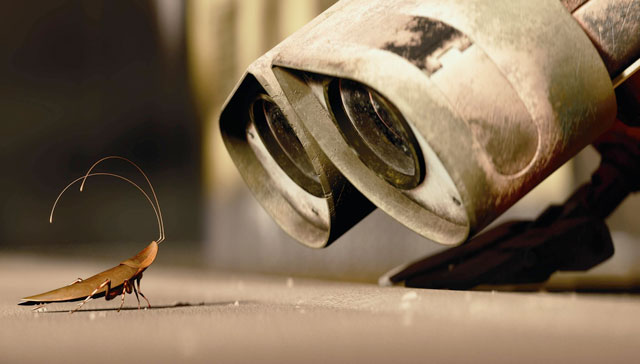
    Disney's Wall-E
    Disney’s Wall-E

    The world has gone mad for robots with articles talking almost every day about the coming of the robot revolution. But is all the hype, excitement and sometimes fear justified? Is the robot revolution really coming?

    The answer is probably that in some areas of our lives we will see more robots soon. But realistically, we are not going to see dozens of robots out and about in our streets or wandering around our offices in the very near future.

    One of the main reasons is simply that robots do not yet have the ability to really see the world. But before talking about how robots of the future might see, first we should consider what we actually mean by seeing.

    Most of us have two eyes and we use those eyes to collect light that reflects off the objects around us. Our eyes convert that light it into electrical signals that are sent down our optic nerves, which are immediately processed by our brain.

    Our brain somehow works out what is around us from all of those electrical impulses and from our experiences. It builds up a representation of the world and we use that to navigate, to help us pick things up, to enable us to see one another’s faces, and to do a million other things we take for granted.

    That whole activity, from collecting the light in our eyes, to having an understanding of the world around us, is what is meant by seeing.

    Researchers have estimated that up to 50% of our brain is involved in the process of seeing. Nearly all of the world’s animals have eyes and can see in some way. Most of these animals, insects in particular, have far simpler brains than humans and they function well.

    This shows that some forms of seeing can be achieved without the massive computer power of our mammal brains. Seeing has clearly been determined to be quite useful by evolution.

    It is therefore unsurprising that many robotics researchers predict that if a robot can see, we are likely to actually see a boom in robotics and robots may finally become the helpers of humans that so many people have desired.

    How then do we get a robot to see? The first part is straightforward. We use a video camera, just like the one in your smartphone, to collect a constant stream of images. Camera technology for robots is a large research field in itself but for now just think of a standard video camera. We pass those images to a computer and then we have options.

    Since the 1970s, robot vision engineers have thought about features in images. These might be lines, or interesting points like corners or certain textures. The engineers write algorithms to find these features and track them from image frame to image frame in the video stream.

    This step is essentially reducing the amount of data from the millions of pixels in an image to a few hundred or thousand features.

    In the recent past when computing power was limited, this was an essential step in the process. The engineers then think about what the robot is likely to see and what it will need to do. They write software that will recognise patterns in the world to help the robot understand what is around it.

    The software may create a very basic map of the environment as the robot operates or it may try to match the features that it finds with a library of features that the software is looking for.

    In essence the robots are being programmed by a human to see things that a human thinks the robot is going to need to see. There have been many successful examples of this type of robot vision system, but practically no robot that you find today is capable of navigating in the world using vision alone.

    Such systems are not yet reliable enough to keep a robot from bumping or falling long enough to give the robot a practical use. The driverless cars that are talked about in the media either use lasers or radar to supplement their vision systems.

    In the past five to 10 years, a new robot vision research community has started to take shape. These researchers have demonstrated systems that are not programmed as such but instead learn how to see.

    They have developed robot vision systems whose structure is inspired by how scientists think animals see — that is, they use the concept of layers of neurons, just like in an animal brain. The engineers program the structure of the system but they do not develop the algorithm that runs on that system. That is left to the robot to work out for itself.

    This technique is known as machine learning and because we now have easy access to significant computer power at a reasonable cost, these techniques are beginning to work! Investment in these technologies is accelerating fast.

    The hive mind
    The significance of having robots learn is that they can easily share their learning. One robot will not have to learn from scratch like a newborn animal. A new robot can be given the experiences of other robots and can build upon those.

    One robot may learn what a cat looks like and transfer that knowledge to thousands of other robots. More significantly, one robot may solve a complex task such as navigating its way around a part of a city and instantly share that with all the other robots.

    Equally important is that robots which share experiences may learn together. For example, one thousand robots may each observe a different cat, share that data with one another via the internet and together learn to classify all cats. This is an example of distributed learning.

    The fact that robots of the future will be capable of shared and distributed learning has profound implications and is scaring some, while exciting others.

    It is quite possible that your credit card transactions are being checked for fraud right now by a data centre self-learning machine. These systems can spot possible fraud that no human could ever detect. A hive mind being used for good.

    There are numerous applications for robots that can see. It’s hard not to think of a part of our life where such a robot could not help.

    The first uses of robots that can see are likely to be in industries that either have labour shortage issues, such as agriculture, or are inherently unattractive to humans and maybe hazardous.

    Examples include searching through rubble after disasters, evacuating people from dangerous situations or working in confined and difficult to access spaces.

    Applications that require very long period of attention, something humans find hard, will also be ripe to be done by a robot that can see. Our future home-based robot companions will be far more useful if they can see us.

    And in an operating theatre near you, it is soon likely that a seeing robot will be assisting surgeons. The robot’s superior vision and super precise and steady arms and hands will allow surgeons to focus on what they are best at — deciding what to do.

    Even that decision-making ability may be superseded by a hive mind of robot doctors. The robots will have it all stitched up!The Conversation

    • Jonathan Roberts is professor in robotics at Queensland University of Technology
    • This article was originally published on The Conversation

    Jonathan Roberts
    Subscribe to TechCentral Subscribe to TechCentral
    Share. Facebook Twitter LinkedIn WhatsApp Telegram Email Copy Link
    Previous ArticleHuawei shifts 100m smartphones
    Next Article Backspace: ‘SA’s top 5 searches’

    Related Posts

    My robot Valentine

    11 February 2016

    Windows 95 turns 20

    23 August 2015
    Company News
    AI is not a technology problem - iqbusiness

    AI is not a technology problem – iqbusiness

    5 December 2025
    Telcos are sitting on a data gold mine - but few know what do with it - Phillip du Plessis

    Telcos are sitting on a data gold mine – but few know what do with it

    4 December 2025
    Unlock smarter computing with your surface Copilot+ PC

    Unlock smarter computing with your Surface Copilot+ PC

    4 December 2025
    Opinion
    Your data, your hardware: the DIY AI revolution is coming - Duncan McLeod

    Your data, your hardware: the DIY AI revolution is coming

    20 November 2025
    Zero Carbon Charge founder Joubert Roux

    The energy revolution South Africa can’t afford to miss

    20 November 2025
    It's time for a new approach to government IT spend in South Africa - Richard Firth

    It’s time for a new approach to government IT spend in South Africa

    19 November 2025

    Subscribe to Updates

    Get the best South African technology news and analysis delivered to your e-mail inbox every morning.

    Latest Posts
    Big Microsoft 365 price increases coming next year

    Big Microsoft price increases coming next year

    5 December 2025
    AI is not a technology problem - iqbusiness

    AI is not a technology problem – iqbusiness

    5 December 2025
    Vodacom to take control of Safaricom in R36-billion deal - Shameel Joosub

    Vodacom to take control of Safaricom in R36-billion deal

    4 December 2025
    Black Friday goes digital in South Africa as online spending surges to record high

    Black Friday goes digital in South Africa as online spending surges to record high

    4 December 2025
    © 2009 - 2025 NewsCentral Media
    • Cookie policy (ZA)
    • TechCentral – privacy and Popia

    Type above and press Enter to search. Press Esc to cancel.

    Manage consent

    TechCentral uses cookies to enhance its offerings. Consenting to these technologies allows us to serve you better. Not consenting or withdrawing consent may adversely affect certain features and functions of the website.

    Functional Always active
    The technical storage or access is strictly necessary for the legitimate purpose of enabling the use of a specific service explicitly requested by the subscriber or user, or for the sole purpose of carrying out the transmission of a communication over an electronic communications network.
    Preferences
    The technical storage or access is necessary for the legitimate purpose of storing preferences that are not requested by the subscriber or user.
    Statistics
    The technical storage or access that is used exclusively for statistical purposes. The technical storage or access that is used exclusively for anonymous statistical purposes. Without a subpoena, voluntary compliance on the part of your Internet Service Provider, or additional records from a third party, information stored or retrieved for this purpose alone cannot usually be used to identify you.
    Marketing
    The technical storage or access is required to create user profiles to send advertising, or to track the user on a website or across several websites for similar marketing purposes.
    • Manage options
    • Manage services
    • Manage {vendor_count} vendors
    • Read more about these purposes
    View preferences
    • {title}
    • {title}
    • {title}