


Close Menu
TechCentralTechCentral

    Subscribe to the newsletter

    Get the best South African technology news and analysis delivered to your e-mail inbox every morning.

    Facebook X (Twitter) YouTube LinkedIn
    WhatsApp Facebook X (Twitter) LinkedIn YouTube
    TechCentralTechCentral
    • News
      Netflix, Warner Bros talks raise fresh headaches for MultiChoice

      Netflix, Warner Bros talks raise fresh headaches for MultiChoice

      5 December 2025
      Big Microsoft 365 price increases coming next year

      Big Microsoft price increases coming next year

      5 December 2025
      Vodacom to take control of Safaricom in R36-billion deal - Shameel Joosub

      Vodacom to take control of Safaricom in R36-billion deal

      4 December 2025
      Black Friday goes digital in South Africa as online spending surges to record high

      Black Friday goes digital in South Africa as online spending surges to record high

      4 December 2025
      BYD takes direct aim at Toyota with launch of sub-R500 000 Sealion 5 PHEV

      BYD takes direct aim at Toyota with launch of sub-R500 000 Sealion 5 PHEV

      4 December 2025
    • World
      Amazon and Google launch multi-cloud service for faster connectivity

      Amazon and Google launch multi-cloud service for faster connectivity

      1 December 2025
      Google makes final court plea to stop US breakup

      Google makes final court plea to stop US breakup

      21 November 2025
      Bezos unveils monster rocket: New Glenn 9x4 set to dwarf Saturn V

      Bezos unveils monster rocket: New Glenn 9×4 set to dwarf Saturn V

      21 November 2025
      Tech shares turbocharged by Nvidia's stellar earnings

      Tech shares turbocharged by stellar Nvidia earnings

      20 November 2025
      Config file blamed for Cloudflare meltdown that disrupted the web

      Config file blamed for Cloudflare meltdown that disrupted the web

      19 November 2025
    • In-depth
      Jensen Huang Nvidia

      So, will China really win the AI race?

      14 November 2025
      Valve's Linux console takes aim at Microsoft's gaming empire

      Valve’s Linux console takes aim at Microsoft’s gaming empire

      13 November 2025
      iOCO's extraordinary comeback plan - Rhys Summerton

      iOCO’s extraordinary comeback plan

      28 October 2025
      Why smart glasses keep failing - no, it's not the tech - Mark Zuckerberg

      Why smart glasses keep failing – it’s not the tech

      19 October 2025
      BYD to blanket South Africa with megawatt-scale EV charging network - Stella Li

      BYD to blanket South Africa with megawatt-scale EV charging network

      16 October 2025
    • TCS
      TCS+ | How Cloud on Demand helps partners thrive in the AWS ecosystem - Odwa Ndyaluvane and Xenia Rhode

      TCS+ | How Cloud On Demand helps partners thrive in the AWS ecosystem

      4 December 2025
      TCS | MTN Group CEO Ralph Mupita on competition, AI and the future of mobile

      TCS | Ralph Mupita on competition, AI and the future of mobile

      28 November 2025
      TCS | Dominic Cull on fixing South Africa's ICT policy bottlenecks

      TCS | Dominic Cull on fixing South Africa’s ICT policy bottlenecks

      21 November 2025
      TCS | BMW CEO Peter van Binsbergen on the future of South Africa's automotive industry

      TCS | BMW CEO Peter van Binsbergen on the future of South Africa’s automotive industry

      6 November 2025
      TCS | Why Altron is building an AI factory - Bongani Andy Mabaso

      TCS | Why Altron is building an AI factory in Johannesburg

      28 October 2025
    • Opinion
      Your data, your hardware: the DIY AI revolution is coming - Duncan McLeod

      Your data, your hardware: the DIY AI revolution is coming

      20 November 2025
      Zero Carbon Charge founder Joubert Roux

      The energy revolution South Africa can’t afford to miss

      20 November 2025
      It's time for a new approach to government IT spend in South Africa - Richard Firth

      It’s time for a new approach to government IT spend in South Africa

      19 November 2025
      How South Africa's broken Rica system fuels murder and mayhem - Farhad Khan

      How South Africa’s broken Rica system fuels murder and mayhem

      10 November 2025
      South Africa's AI data centre boom risks overloading a fragile grid - Paul Colmer

      South Africa’s AI data centre boom risks overloading a fragile grid

      30 October 2025
    • Company Hubs
      • Africa Data Centres
      • AfriGIS
      • Altron Digital Business
      • Altron Document Solutions
      • Altron Group
      • Arctic Wolf
      • AvertITD
      • Braintree
      • CallMiner
      • CambriLearn
      • CYBER1 Solutions
      • Digicloud Africa
      • Digimune
      • Domains.co.za
      • ESET
      • Euphoria Telecom
      • Incredible Business
      • iONLINE
      • IQbusiness
      • Iris Network Systems
      • LSD Open
      • NEC XON
      • Netstar
      • Network Platforms
      • Next DLP
      • Ovations
      • Paracon
      • Paratus
      • Q-KON
      • SevenC
      • SkyWire
      • Solid8 Technologies
      • Telit Cinterion
      • Tenable
      • Vertiv
      • Videri Digital
      • Vodacom Business
      • Wipro
      • Workday
      • XLink
    • Sections
      • AI and machine learning
      • Banking
      • Broadcasting and Media
      • Cloud services
      • Contact centres and CX
      • Cryptocurrencies
      • Education and skills
      • Electronics and hardware
      • Energy and sustainability
      • Enterprise software
      • Financial services
      • Information security
      • Internet and connectivity
      • Internet of Things
      • Investment
      • IT services
      • Lifestyle
      • Motoring
      • Public sector
      • Retail and e-commerce
      • Satellite communications
      • Science
      • SMEs and start-ups
      • Social media
      • Talent and leadership
      • Telecoms
    • Events
    • Advertise
    TechCentralTechCentral
    Home » In-depth » It’s China vs US in new computing arms race

    It’s China vs US in new computing arms race

    By Agency Staff9 April 2018
    Twitter LinkedIn Facebook WhatsApp Email Telegram Copy Link
    News Alerts
    WhatsApp

    As the US and China threaten to impose tariffs on goods from aluminium to wine, the two nations are waging a separate economic battle that could determine who owns the next wave of computing.

    Chinese universities and US technology companies such as IBM and Microsoft are racing to develop quantum computers, a type of processing that’s forecast to be so powerful it can transform how drug makers, agriculture companies and car manufacturers discover compounds and materials.

    Quantum computing uses the movement of subatomic particles to process data in amounts that modern computers can’t handle. Mostly theoretical now, the technology is expected to be able to perform calculations that make today’s computers look akin to an abacus.

    Mostly theoretical now, the technology is expected to be able to perform calculations that make today’s computers look akin to an abacus

    While overall spending by China is unknown, its government is building a US$10bn National Laboratory for Quantum Information Sciences in Hefei, Anhui Province, which is slated to open in 2020. US-funded research in quantum is about $200m/year, according to a July 2016 government report, and some researchers and companies don’t believe that’s enough.

    One “killer app” may be encryption, the code scrambling technology that secures modern global commerce and communications. China, Chinese universities and Western financial institutions are rushing to patent more ways to use quantum technology for encryption, a study by research firm Patinformatics found.

    “We’re talking about encrypting data so it can’t be broken, certainly not by a classical computer,” said Tony Trippe, MD of Dublin, Ohio-based Patinformatics. “It would be an unhackable system.”

    At the same time, it could break encryption that was on a classical computer. “An organisation or a nation that had quantum computer technologies would have a significantly easier time of wreaking havoc on other systems,” he said.

    Trump

    US President Donald Trump accused the Chinese government in March of stealing intellectual property by forcing American companies to share their most valuable secrets and sign joint venture agreements with local firms if they want to operate in China, although there are no specific allegations regarding quantum computers.

    China has also been aggressive in pushing homegrown innovation as it supports companies in obtaining patents and trademarks around the world, and has increased its research funding. In its annual scorecard, the Organisation for Economic Cooperation and Development called China “the second largest scientific powerhouse”, behind the US.

    Technology companies from Microsoft to IBM to Google view quantum computing as the next revolution.
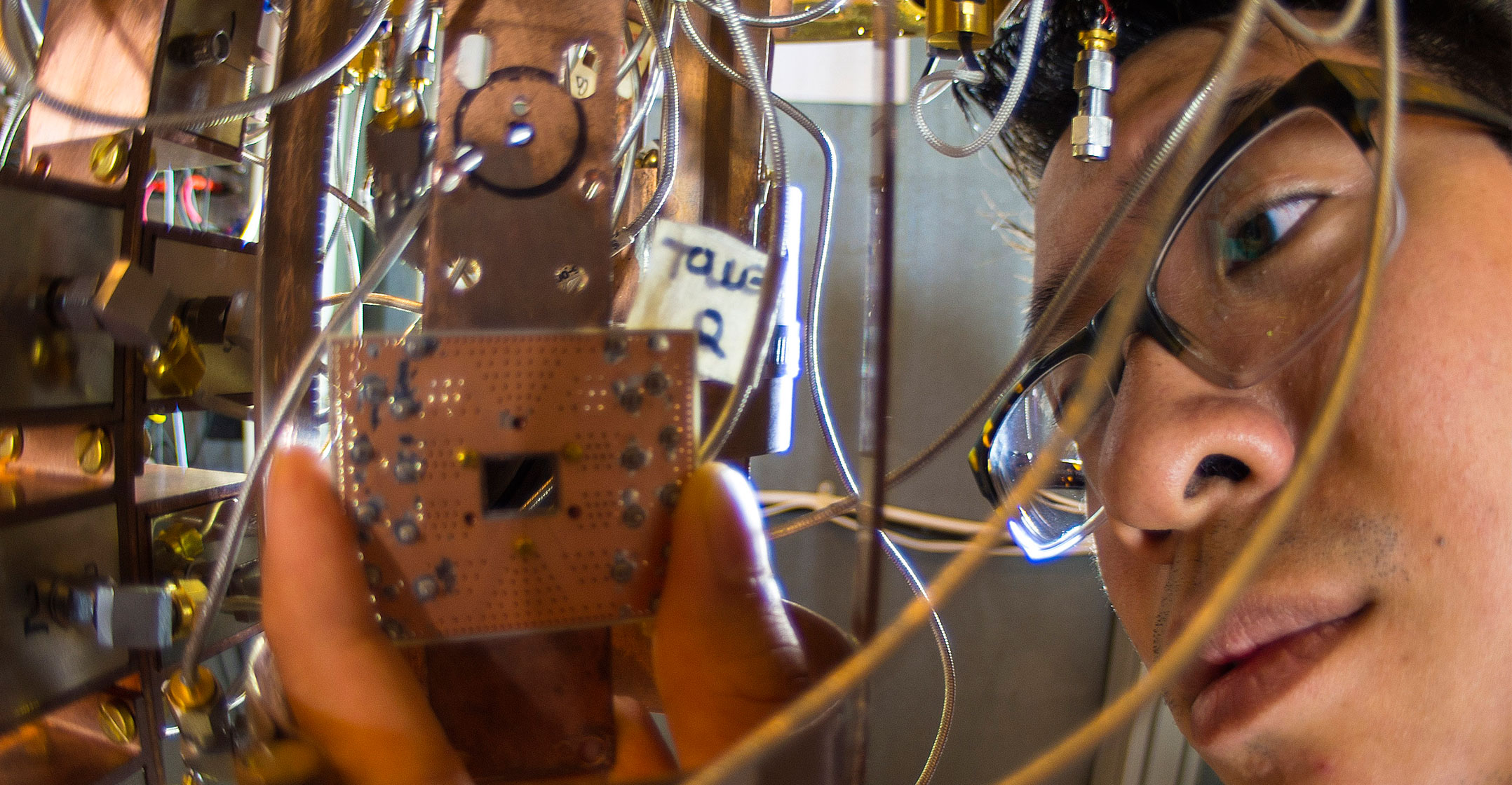
    IBM Research scientist Jerry Chow conducts a quantum computing experiment at IBM’s Thomas J Watson Research Centre

    “Over time, quantum in the field of computation is so important is that it will redefine the category of computers themselves,” said Dario Gil, vice president of IBM’s Artificial Intelligence research. “It is the future of computing.”

    IBM’s inventions may be having the most impact on the nascent field, when judged by the number of times its research has been cited by others in their patent applications. The Armonk, New York-based company already has developed computers being tested by customers, including Oak Ridge National Laboratory in Tennessee, the US energy department’s biggest lab, as well as finance companies like JPMorgan Chase & Co and Barclays, Gil said.

    Intel, which started its own programme two years ago, said the technology promises to be “transformational”.

    There are many tough problems to solve before quantum computing is a commercial reality. Some of these problems involve materials science, quantum chip design and manufacturing

    “There are many tough problems to solve before quantum computing is a commercial reality,” said Jim Clarke, director of quantum hardware at Intel. “Some of these problems involve materials science, quantum chip design and manufacturing — those are sweet-spot problems for Intel.”

    Clarke said Intel is competitive in the number of patents it’s seeking, though many aren’t yet public. Applications are made public after 18 months.

    While there will still be a place for what’s being called “classical computers” — a category that includes modern smartphones and even super computers — the quantum computers could have “an infinite number of applications” in the fields of life sciences, chemistry and agriculture, said IBM’s Gil.

    It’s too early to say which company or country will be the leader in quantum computers, though at this stage it looks like US companies will excel in hardware while Chinese and Japanese ones are focused on the software and applications, Patinformatics’ Trippe said.

    “Japanese and Chinese companies aren’t as concerned about building them as they are about how they’ll be used,” Trippe said. “They’ve started to patent the potential. The next five years are going to be pretty fascinating.”

    The US China Economic and Security Review Commission, created by the US congress in 2000 to assess national security implications of bilateral trade between the countries, said in its most recent report that China “has closed the technological gap” with the US in quantum information science, a sector Americans have long dominated, “due to a concerted strategy by the Chinese government and inconsistent and unstable levels of R&D funding and limited government coordination by the United States”.

    Closing in

    Studies by the US Chamber of Commerce and Bloomberg have independently shown that China is rising in its overall score for innovation, which includes education, government research and the number of patents. The World Intellectual Property Organisation reported on 21 March that China is closing in on the US in filing international patent applications.

    Quantum physics is one area in which the Chinese government, through its ministry of science & technology, is beefing up its technological prowess, according to a report by the US trade representative that laid the groundwork for Trump’s tariff plans. The China Academy of Sciences and Beijing University are among the Chinese research firms seeking more patents on quantum IT, according to Patinformatics.

    The Chinese government invested by giving a lot of money to companies and researchers to “replicate what we did in the US and elsewhere”, said Carl J Williams, deputy director of the Physical Measurement Laboratory at the US National Institute of Standards and Technology. “They’ve come a long way.”

    The Chinese researchers are focused on encryption, based on their patent applications. In August 2016, China’s state news agency said the government had launched the world’s first quantum communications satellite, and a year later claimed to have sent the first “unbreakable” code from space.

    “That should be very scary,” said Jonathan Dowling, co-director of Louisiana State University’s Hearne Institute for Theoretical Physics, “at least to the intelligence agencies.”

    In the US, the department of energy, Naval Research Lab and defence contractor Northrop Grumman are among the government entities or contractors researching quantum computers. Overall, though, the US government has cut back on its own funding of computing and cryptography hardware, Dowling said.

    A July 2016 report by the National Science and Technology Council under former President Barack Obama recommended it be “considered a priority for federal coordination and investment”.

    In the coming age of quantum, it’s an open question whether federal funding will enable the US to maintain the edge it’s had during the PC era and smartphone wars. Scott Crowder, IBM’s chief technology officer for quantum computing, told a house panel in October that “the US government investment in driving this critical technology is not sufficient to stay competitive”.

    LSU’s Dowling said it could mean the US comes out the loser in the quantum race.

    “What we’re seeing is a bunch of different things going on at once with no overall organisation,” LSU’s Dowling said, “unlike in China, where they are exactly sure what they’re doing.”  — Reported by Susan Decker and Christopher Yasiejko, with assistance from Dina Bass, Jeremy Kahn and Ian King, (c) 2018 Bloomberg LP



    Donald Trump Google IBM Microsoft Patinformatics top
    Subscribe to TechCentral Subscribe to TechCentral
    Share. Facebook Twitter LinkedIn WhatsApp Telegram Email Copy Link
    Previous ArticleGlobal tech boom isn’t done, SA experts say
    Next Article How to stop haemorrhaging your data on Facebook

    Related Posts

    Big Microsoft 365 price increases coming next year

    Big Microsoft price increases coming next year

    5 December 2025
    What South Africans searched for most in 2025

    What South Africans searched for most in 2025, according to Google

    4 December 2025
    Unlock smarter computing with your surface Copilot+ PC

    Unlock smarter computing with your Surface Copilot+ PC

    4 December 2025
    Company News
    Beat the summer heat with Samsung's WindFree air conditioners

    Beat the summer heat with Samsung’s WindFree air conditioners

    5 December 2025
    AI is not a technology problem - iqbusiness

    AI is not a technology problem – iqbusiness

    5 December 2025
    Telcos are sitting on a data gold mine - but few know what do with it - Phillip du Plessis

    Telcos are sitting on a data gold mine – but few know what do with it

    4 December 2025
    Opinion
    Your data, your hardware: the DIY AI revolution is coming - Duncan McLeod

    Your data, your hardware: the DIY AI revolution is coming

    20 November 2025
    Zero Carbon Charge founder Joubert Roux

    The energy revolution South Africa can’t afford to miss

    20 November 2025
    It's time for a new approach to government IT spend in South Africa - Richard Firth

    It’s time for a new approach to government IT spend in South Africa

    19 November 2025

    Subscribe to Updates

    Get the best South African technology news and analysis delivered to your e-mail inbox every morning.

    Latest Posts
    Beat the summer heat with Samsung's WindFree air conditioners

    Beat the summer heat with Samsung’s WindFree air conditioners

    5 December 2025
    Netflix, Warner Bros talks raise fresh headaches for MultiChoice

    Netflix, Warner Bros talks raise fresh headaches for MultiChoice

    5 December 2025
    Big Microsoft 365 price increases coming next year

    Big Microsoft price increases coming next year

    5 December 2025
    AI is not a technology problem - iqbusiness

    AI is not a technology problem – iqbusiness

    5 December 2025
    © 2009 - 2025 NewsCentral Media
    • Cookie policy (ZA)
    • TechCentral – privacy and Popia

    Type above and press Enter to search. Press Esc to cancel.

    Manage consent

    TechCentral uses cookies to enhance its offerings. Consenting to these technologies allows us to serve you better. Not consenting or withdrawing consent may adversely affect certain features and functions of the website.

    Functional Always active
    The technical storage or access is strictly necessary for the legitimate purpose of enabling the use of a specific service explicitly requested by the subscriber or user, or for the sole purpose of carrying out the transmission of a communication over an electronic communications network.
    Preferences
    The technical storage or access is necessary for the legitimate purpose of storing preferences that are not requested by the subscriber or user.
    Statistics
    The technical storage or access that is used exclusively for statistical purposes. The technical storage or access that is used exclusively for anonymous statistical purposes. Without a subpoena, voluntary compliance on the part of your Internet Service Provider, or additional records from a third party, information stored or retrieved for this purpose alone cannot usually be used to identify you.
    Marketing
    The technical storage or access is required to create user profiles to send advertising, or to track the user on a website or across several websites for similar marketing purposes.
    • Manage options
    • Manage services
    • Manage {vendor_count} vendors
    • Read more about these purposes
    View preferences
    • {title}
    • {title}
    • {title}