
Close Menu
TechCentralTechCentral

    Subscribe to the newsletter

    Get the best South African technology news and analysis delivered to your e-mail inbox every morning.

    Facebook X (Twitter) YouTube LinkedIn
    WhatsApp Facebook X (Twitter) LinkedIn YouTube
    TechCentralTechCentral
    • News

      Hollard client data dumped on the dark web

      18 September 2026
      Vumatel operating profit jumps 57% as the Vodacom deal lands

      Vumatel operating profit jumps 57% as the Vodacom deal lands

      18 September 2026
      SA's two biggest MVNOs, two very different strategies - FNB Connect Capitec Connect

      Capitec and FNB are running the same MVNO playbook

      18 September 2026
      Solar and EVs in South Africa: what the numbers actually say

      Solar and EVs in South Africa: what the numbers actually say

      18 September 2026
      The AI that builds AI has gone from 1% to 26% in five months

      The AI that builds AI has gone from 1% to 26% in five months

      18 September 2026
    • World
      'This is not circular': Jensen Huang defends $3.5-billion MediaTek deal

      ‘This is not circular’: Jensen Huang defends $3.5-billion MediaTek deal

      2 September 2026
      AI-generated music banned from Australian charts

      AI-generated music banned from Australian charts

      26 August 2026
      Traders brace for a R4.5-trillion swing in Nvidia's value

      Traders brace for a R4.5-trillion swing in Nvidia’s value

      25 August 2026
      Russia building its own Starlink - and faster than expected - Vadym Skibitskyi

      Russia building its own Starlink – and faster than expected

      11 August 2026
      Meta AI will now tell parents if their teen is in crisis

      Meta AI will now tell parents if their teen is in crisis

      17 July 2026
    • In-depth
      Google DeepMind CEO Demis Hassabis. Image: John Sears

      The plan to stop AI from breaking the world

      16 July 2026
      The internet has a Strait of Hormuz problem

      The internet has a Strait of Hormuz problem

      15 July 2026
      AI boom sparks rally, frenzy and fear

      AI boom sparks rally, frenzy and fear

      11 June 2026
      Every plug-in hybrid on sale in South Africa, ranked by price - Lamborghini Temerario

      Every plug-in hybrid on sale in South Africa, ranked by price

      7 June 2026
      What Wi-Fi 8 will mean for wireless networks

      What Wi-Fi 8 will mean for wireless networks

      1 June 2026
    • TCS
      TCS | Octotel's Trevor van Zyl on the fibre merger question

      TCS | Octotel’s Trevor van Zyl on the MetroFibre merger question

      16 September 2026
      Meet the CIO | Shoprite's Chris Shortt on what a supermarket becomes

      Meet the CIO | Shoprite’s Chris Shortt on what a supermarket becomes

      9 September 2026
      Rubicon's EV charging network is profitable - and growing fast - Watts & Wheels

      Rubicon’s EV charging network is profitable – and growing fast

      8 September 2026
      Winstone Jordaan on building a national EV charging network

      Winstone Jordaan on building a national EV charging network

      2 September 2026
      Watts & Wheels S1E8: 'Tesla lands in Africa, just not here'

      Watts & Wheels S1E8: ‘Tesla lands in Africa, just not here’

      24 August 2026
    • Opinion
      The end is nigh, and the shares go on sale in October - Duncan McLeod

      The end is nigh, and the shares go on sale in October

      14 September 2026
      The fragile joint in the Capitec machine - Pambos Soteriades

      The R197-billion market the banks can’t reach

      25 August 2026
      South African tech's compounding debt problem - Jannie van Zyl

      Management consulting as we know it is over

      21 August 2026
      South African tech's compounding debt problem - Jannie van Zyl

      The most dangerous customer is the quiet one

      10 August 2026
      South African tech's compounding debt problem - Jannie van Zyl

      South African tech’s compounding debt problem

      29 July 2026
    • Company Hubs
      • 1Stream
      • Africa Data Centres
      • AfriGIS
      • Altron Digital Business
      • Altron Document Solutions
      • Altron Group
      • Arctic Wolf
      • Ascent Technology
      • AvertITD
      • BBD
      • Braintree
      • CallMiner
      • CambriLearn
      • CM.com
      • Contactable
      • CYBER1 Solutions
      • Digicloud Africa
      • Digimune
      • Domains.co.za
      • ESET
      • Euphoria Telecom
      • HOSTAFRICA
      • Incredible Business
      • iONLINE
      • IQbusiness
      • Iris Network Systems
      • Kaspersky
      • LSD Open
      • Mitel
      • NEC XON
      • Netstar
      • Network Platforms
      • Next DLP
      • Ovations
      • Paracon
      • Paratus
      • Q-KON
      • SevenC
      • SkyWire
      • Solid8 Technologies
      • Telit Cinterion
      • Telviva
      • Tenable
      • Vertiv
      • Videri Digital
      • Vodacom Business
      • Vox
      • Wipro
      • Workday
      • XLink
    • Sections
      • AI and machine learning
      • Banking
      • Broadcasting and Media
      • Cloud services
      • Contact centres and CX
      • Cryptocurrencies
      • Education and skills
      • Electronics and hardware
      • Energy and sustainability
      • Enterprise software
      • Financial services
      • HealthTech
      • Information security
      • Internet and connectivity
      • Internet of Things
      • Investment
      • IT services
      • Lifestyle
      • Policy and regulation
      • Public sector
      • Retail and e-commerce
      • Satellite communications
      • Science
      • SMEs and start-ups
      • Social media
      • Talent and leadership
      • Telecoms
      • Watts & Wheels
    • Events
    • Advertise
    TechCentralTechCentral
    Home » Company News » Keeping your organisation secure during the Covid-19 pandemic

    Keeping your organisation secure during the Covid-19 pandemic

    By Mimecast2 June 2020
    Twitter LinkedIn Facebook WhatsApp Email Telegram Copy Link
    Get breaking news on WhatsApp

    As the coronavirus continues its spread across the globe, the world has changed faster than most of us ever imagined it could. Organisations big and small are facing new realities, as they work to keep employees safe and serve customers and partners to the best of their abilities.

    Unfortunately, there are those who view this crisis as an opportunity, and they are proactively looking to exploit it. Cyberattacks targeting end users are the easiest way to take advantage of employees unaccustomed to working from home and stakeholders of all types who are simply looking for information and guidance.

    At Mimecast, we are seeing this scenario play out both across our global customer grid, where malicious e-mail-based attacks have increased dramatically, and on the Web, where fake websites are being spun up at an alarming rate. We are committed to helping our employees, customers, partners and the larger cybersecurity community successfully navigate these uncharted waters.

    The guide that follows is intended to provide IT and security teams with practical, actionable advice on how to help reduce risk and remain resilient during this unprecedented public health crisis. In addition, you can live chat with Mimecast’s cybersecurity experts and get information about how to manage rapidly changing security and data protection requirements by visiting our Coronavirus Response Page.

    Security for remote employees

    The most immediate challenge most IT and security teams are facing is ensuring employees can work securely from home. The following are some steps you can take to help reduce risk. Click here for a model of a standard communication you can send to employees to increase their awareness, as well as a training video to help reinforce the concepts.

    Secure Web-based activity — Without the protection of a network firewall and often limited endpoint Web controls, the likelihood of Web-based attacks succeeding goes up dramatically. Applying protection with a cloud-based Web security service that includes an agent on all devices allows you to block malicious Web-based content, while also enforcing acceptable use policies and tracking activity, regardless of where the user is physically located. Security checks happen seamlessly, in real time, and in the background, so end users can work securely from various types of devices with no impact on productivity. To help organisations address the Web security challenge, we are providing all Mimecast customers with access to our Web security service at no cost for 90 days. Click here for details and terms and conditions.

    Ask employees to update contact information — IT and security teams will need valid mobile phone numbers to confirm employees’ identities for activities like resetting passwords, notifying them if a security breach occurs, approving quarantined devices when adding e-mail to mobile phones, and of course, contacting them in case of emergency. This is a great time to encourage all employees to update their information.

    Simplify activities that lead to policy violations — The use of unsanctioned applications is likely to increase during this work from home period; so simplifying and speeding tasks, such as sending large files or sensitive data, with technology that integrates directly into the corporate e-mail system can significantly increase adherence to organisational standards. Policies like data loss prevention can also be automatically triggered. In addition, monitoring the use of unsanctioned apps can help you assess risk on an on-going basis and proactively address violations as needed.

    Continuously raise awareness about cybersecurity risks — Simply letting employees know about the increased risk and providing guidance about what to watch out for can go a long way toward helping mitigate risk. Mimecast will be providing updates on emerging attack types through our Coronavirus Response Page and regularly scheduled informational webinars, so you can stay informed and update your end-users as needed.

    Review your authentication processes to ensure they’re adequate in a work-from-home situation.

    Operational continuity and data protection

    As e-mail attack volumes grow in the wake of the pandemic, the likelihood of data being exposed or business services being disrupted goes up as well. The following steps can help you remain operational when disruptions occur, while also ensuring data is not lost.

    Institute an e-mail continuity plan — E-mail is a critical communications channel at the best of times, and current conditions make insulating your organisation against an outage even more critical. Continuity technologies can route your e-mail through a cloud-based service, whether e-mail is on-premise, in the cloud, or a combination, and give end users uninterrupted access to live and archive e-mail using the tools they already know. Continuity can be activated by administrators, who can be notified of issues and kept informed through various types of alerts.

    Review and reinforce data recovery capabilities — Many organisations have data recovery gaps that they are not aware of until they need to recover lost or stolen information. These gaps are often related to end user restoration limits, the need for multiple retention policies that conflict, and the lack of native backup. Now is a good time to review your capabilities and ensure you can easily provide granular, point-in-time recovery of e-mails, files, and contact data for all users.

    Brand protection

    Brand exploitation is extremely common in times of crisis, with criminals using a variety of tactics designed to trick unsuspecting and vulnerable people. These brand-based attacks can be difficult to detect and remediate, but there are some steps you can take to protect employees, customers and, partners, as well as your organisation’s reputation.

    Review and/or implement DMARC policies — Attackers will often use your legitimate domains to send fake e-mails that are incredibly hard to detect. DMARC is an e-mail authentication protocol that can help you prevent and shutdown this activity by controlling who’s able to send e-mail using domains your organisation owns, whether active or dormant. DMARC policies can also help you block inbound attacks by setting policies that instruct ISPs to delete or deliver e-mails. For more information, visit www.dmarcanalyzer.com/dmarc.

    Monitor the Web for lookalike websites — It is easy for cybercriminals to register fake domains and create websites that look like yours with the intention of spreading disinformation and tricking unsuspecting visitors into divulging sensitive data through phishing and other malware campaigns. These attacks are particularly dangerous and damaging in our current situation. Security technology can be used to scan the web for these attacks and either detect them in their early stages or have live sites quickly taken down.

    Coronavirus has resulted in an unprecedented level of global disruption, and the situation is evolving rapidly. Mimecast is committed to helping you stay informed about changes in the cybersecurity threat landscape and strategies you can use to help keep your organisation as secure as possible.
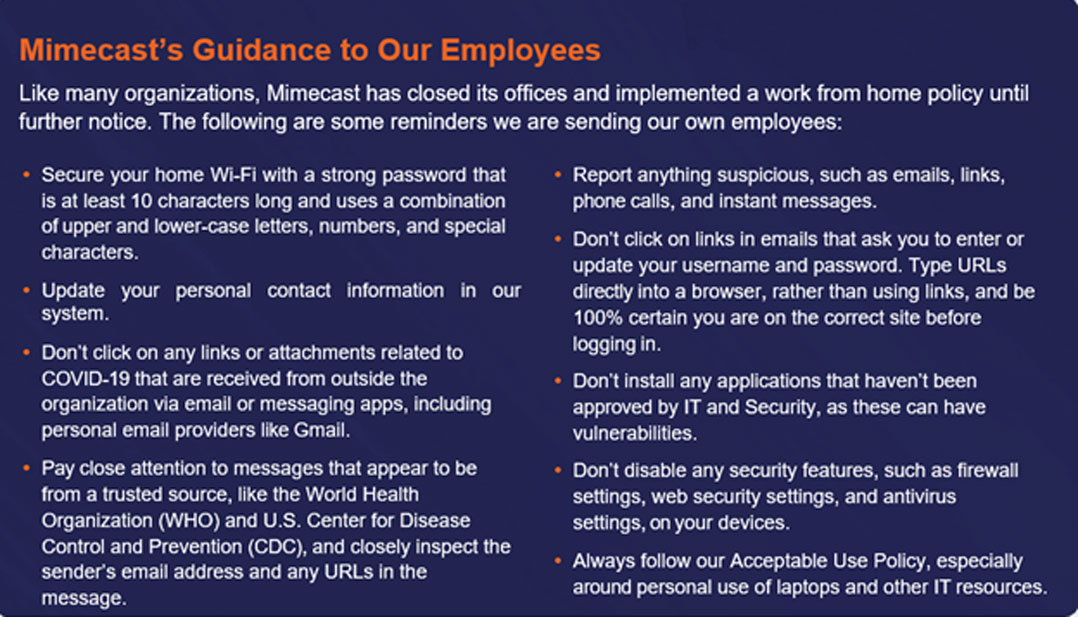
    Source: Mimecast

    Please reach out via the live chat feature on our Coronavirus Response Page with any questions you may have or ideas you’d like to share with our larger community. Our hearts go out to everyone who has been affected by Covid-19 in any way, and we wish all our customers and partners the very best in this difficult time.

    • This promoted content was paid for by the party concerned

    Add TechCentral as a preferred source on GoogleFollow TechCentral on Google NewsGet breaking news on WhatsApp


    Mimecast
    WhatsApp YouTube
    Share. Facebook Twitter LinkedIn WhatsApp Telegram Email Copy Link
    Previous ArticleA health catastrophe is brewing in Africa – and it’s not Covid-19
    Next Article ANC, business headed for showdown over post-virus policy

    Related Posts

    The payment ring winning over South Africa's banks - Vezopay

    The payment ring winning over South Africa’s banks

    12 August 2026
    Your biggest cyber threat is now sitting at the desk next to you - Heino Gevers Mimecast

    Your biggest cyber threat is now sitting at the desk next to you

    5 May 2026
    Malicious insider threats surging in South Africa, new study finds - Mimecast

    Malicious insider threats surging in South Africa, new study finds

    5 March 2026
    Company News
    Support ended for SQL Server 2016 - and so did the Microsoft subsidy

    Support ended for SQL Server 2016 – and so did the Microsoft subsidy

    18 September 2026
    GovTech turns 20 - and sets out to build South Africa's digital future - GovTech 2026

    GovTech turns 20 and sets out to build South Africa’s digital future

    18 September 2026
    ITA presents LEO satellite solutions for the oil and gas sector - From left, Suzanette Cruz, account manager, sales B2B; Nuno de Oliveira, sales operations analyst, sales; and Andrea Aragão, marketing manager

    ITA presents LEO satellite solutions for the oil and gas sector

    18 September 2026
    Opinion
    The end is nigh, and the shares go on sale in October - Duncan McLeod

    The end is nigh, and the shares go on sale in October

    14 September 2026
    The fragile joint in the Capitec machine - Pambos Soteriades

    The R197-billion market the banks can’t reach

    25 August 2026
    South African tech's compounding debt problem - Jannie van Zyl

    Management consulting as we know it is over

    21 August 2026

    Subscribe to Updates

    Get the best South African technology news and analysis delivered to your e-mail inbox every morning.

    Latest Posts

    Hollard client data dumped on the dark web

    18 September 2026
    Vumatel operating profit jumps 57% as the Vodacom deal lands

    Vumatel operating profit jumps 57% as the Vodacom deal lands

    18 September 2026
    SA's two biggest MVNOs, two very different strategies - FNB Connect Capitec Connect

    Capitec and FNB are running the same MVNO playbook

    18 September 2026
    Solar and EVs in South Africa: what the numbers actually say

    Solar and EVs in South Africa: what the numbers actually say

    18 September 2026
    © 2009 - 2026 NewsCentral Media
    Built and maintained by Chronon
    • Cookie policy (ZA)
    • TechCentral – privacy and Popia

    Type above and press Enter to search. Press Esc to cancel.

    Manage consent

    TechCentral uses cookies to enhance its offerings. Consenting to these technologies allows us to serve you better. Not consenting or withdrawing consent may adversely affect certain features and functions of the website.

    Functional Always active
    The technical storage or access is strictly necessary for the legitimate purpose of enabling the use of a specific service explicitly requested by the subscriber or user, or for the sole purpose of carrying out the transmission of a communication over an electronic communications network.
    Preferences
    The technical storage or access is necessary for the legitimate purpose of storing preferences that are not requested by the subscriber or user.
    Statistics
    The technical storage or access that is used exclusively for statistical purposes. The technical storage or access that is used exclusively for anonymous statistical purposes. Without a subpoena, voluntary compliance on the part of your Internet Service Provider, or additional records from a third party, information stored or retrieved for this purpose alone cannot usually be used to identify you.
    Marketing
    The technical storage or access is required to create user profiles to send advertising, or to track the user on a website or across several websites for similar marketing purposes.
    • Manage options
    • Manage services
    • Manage {vendor_count} vendors
    • Read more about these purposes
    View preferences
    • {title}
    • {title}
    • {title}