Close Menu
TechCentralTechCentral

    Subscribe to the newsletter

    Get the best South African technology news and analysis delivered to your e-mail inbox every morning.

    Facebook X (Twitter) YouTube LinkedIn
    WhatsApp Facebook X (Twitter) LinkedIn YouTube
    TechCentralTechCentral
    • News
      Vuyani Jarana: Mobile coverage masks a deeper broadband failure

      Vuyani Jarana: Mobile coverage masks a deeper broadband failure

      30 January 2026
      SABC Plus to flight Microsoft AI training videos

      SABC Plus to flight Microsoft AI training videos

      30 January 2026
      Fibre ducts

      Fibre industry consolidation in KZN

      30 January 2026
      Watts & Wheels S1E3: 'BYD's Corolla Cross challenger'

      Watts & Wheels S1E3: ‘BYD’s Corolla Cross challenger’

      30 January 2026
      What ordinary South Africans really think of AI

      What ordinary South Africans really think of AI

      30 January 2026
    • World
      Apple acquires audio AI start-up Q.ai

      Apple acquires audio AI start-up Q.ai

      30 January 2026
      SpaceX IPO may be largest in history

      SpaceX IPO may be largest in history

      28 January 2026
      Nvidia throws AI at the weather

      Nvidia throws AI at weather forecasting

      27 January 2026
      Debate erupts over value of in-flight Wi-Fi

      Debate erupts over value of in-flight Wi-Fi

      26 January 2026
      Intel takes another hit - Intel CEO Lip-Bu Tan. Laure Andrillon/Reuters

      Intel takes another hit

      23 January 2026
    • In-depth
      How liberalisation is rewiring South Africa's power sector

      How liberalisation is rewiring South Africa’s power sector

      21 January 2026
      The top-performing South African tech shares of 2025

      The top-performing South African tech shares of 2025

      12 January 2026
      Digital authoritarianism grows as African states normalise internet blackouts

      Digital authoritarianism grows as African states normalise internet blackouts

      19 December 2025
      TechCentral's South African Newsmakers of 2025

      TechCentral’s South African Newsmakers of 2025

      18 December 2025
      Black Friday goes digital in South Africa as online spending surges to record high

      Black Friday goes digital in South Africa as online spending surges to record high

      4 December 2025
    • TCS
      TCS+ | How Cloud On Demand is helping SA businesses succeed in the cloud - Xhenia Rhode, Dion Kalicharan

      TCS+ | Cloud On Demand and Consnet: inside a real-world AWS partner success story

      30 January 2026
      Watts & Wheels S1E3: 'BYD's Corolla Cross challenger'

      Watts & Wheels S1E2: ‘China attacks, BMW digs in, Toyota’s sublime supercar’

      23 January 2026

      TCS+ | Why cybersecurity is becoming a competitive advantage for SA businesses

      20 January 2026
      Watts & Wheels S1E3: 'BYD's Corolla Cross challenger'

      Watts & Wheels: S1E1 – ‘William, Prince of Wheels’

      8 January 2026
      TCS+ | Africa's digital transformation - unlocking AI through cloud and culture - Cliff de Wit Accelera Digital Group

      TCS+ | Cloud without culture won’t deliver AI: Accelera’s Cliff de Wit

      12 December 2025
    • Opinion
      South Africa's skills advantage is being overlooked at home - Richard Firth

      South Africa’s skills advantage is being overlooked at home

      29 January 2026
      Why Elon Musk's Starlink is a 'hard no' for me - Songezo Zibi

      Why Elon Musk’s Starlink is a ‘hard no’ for me

      26 January 2026
      South Africa's new fibre broadband battle - Duncan McLeod

      South Africa’s new fibre broadband battle

      20 January 2026
      AI moves from pilots to production in South African companies - Nazia Pillay SAP

      AI moves from pilots to production in South African companies

      20 January 2026
      South Africa's new fibre broadband battle - Duncan McLeod

      ANC’s attack on Solly Malatsi shows how BEE dogma trumps economic reality

      14 December 2025
    • Company Hubs
      • Africa Data Centres
      • AfriGIS
      • Altron Digital Business
      • Altron Document Solutions
      • Altron Group
      • Arctic Wolf
      • AvertITD
      • Braintree
      • CallMiner
      • CambriLearn
      • CYBER1 Solutions
      • Digicloud Africa
      • Digimune
      • Domains.co.za
      • ESET
      • Euphoria Telecom
      • Incredible Business
      • iONLINE
      • IQbusiness
      • Iris Network Systems
      • LSD Open
      • NEC XON
      • Netstar
      • Network Platforms
      • Next DLP
      • Ovations
      • Paracon
      • Paratus
      • Q-KON
      • SevenC
      • SkyWire
      • Solid8 Technologies
      • Telit Cinterion
      • Tenable
      • Vertiv
      • Videri Digital
      • Vodacom Business
      • Wipro
      • Workday
      • XLink
    • Sections
      • AI and machine learning
      • Banking
      • Broadcasting and Media
      • Cloud services
      • Contact centres and CX
      • Cryptocurrencies
      • Education and skills
      • Electronics and hardware
      • Energy and sustainability
      • Enterprise software
      • Financial services
      • Information security
      • Internet and connectivity
      • Internet of Things
      • Investment
      • IT services
      • Lifestyle
      • Motoring
      • Public sector
      • Retail and e-commerce
      • Satellite communications
      • Science
      • SMEs and start-ups
      • Social media
      • Talent and leadership
      • Telecoms
    • Events
    • Advertise
    TechCentralTechCentral
    Home » Sections » Energy and sustainability » Load shedding: South Africa faces a grim winter

    Load shedding: South Africa faces a grim winter

    There’s a growing fear that the national electricity grid could, at some point, collapse entirely.
    By Hartmut Winkler19 April 2023
    Twitter LinkedIn Facebook WhatsApp Email Telegram Copy Link
    News Alerts
    WhatsApp

    Over the past 15 years, South Africa has been experiencing a gradually worsening number of electricity cuts. This state of affairs has prompted frustration among citizens, negative international economic sentiment and financial hardship for many businesses.

    Public pressure has grown more intense, leading to the extraordinary presidential decision by President Cyril Ramaphosa to proclaim a state of disaster as well as to appoint a minister of electricity.

    The year 2022 was marked by the worst power outages in the country’s history. Electricity generation deficits reached up to 6GW on occasion, necessitating up to 10 hours of rolling electricity blackouts.

    High outages have persisted through the warmer early months of 2023, and since early January the country has experienced power cuts every day.

    It’s widely expected to get worse as electricity consumption peaks in the winter months of June and July. And there’s a growing fear that the national electricity grid could, at some point, collapse entirely. This would lead to blackouts lasting many days or even weeks.

    Based on an analysis of trends and recent events in the power sector, the following factors are expected to lead to power outages reaching critical proportions this winter. (I also assess the likelihood of record electricity shortages and catastrophic scenarios such as a complete grid collapse.)

    1. Coal-fired power stations

    Eskom has an installed maximum generating capacity of 55GW. Of this, a massive 74% (40GW) is generated from coal power stations.

    These are mostly older plants approaching – or already exceeding – their projected 40-year life spans. In recent years, and partly due to persistent power shortages, the power stations have been used excessively. They have also been insufficiently serviced. The result is that the plants break down far too frequently, accounting for the bulk of Eskom’s lost capacity.

    There are two much newer coal plants – Medupi and Kusile – that together should provide 9.6GW. These builds were initiated in 2007 to mitigate against power shortages that were predicted a decade down the line.

    But the two plants ended up costing more than double the sum initially projected. They were also hamstrung by huge construction delays and technical design flaws.

    One of Medupi’s units (800MW) suffered a massive explosion, and repairs are only expected to be completed in 2024.

    In October last year, Kusile experienced a catastrophic chimney collapse. Full repairs would require two years.

    To allow the units to operate sooner Eskom applied for and received special permission to exceed normal pollution limits. Even so, the affected units will only be ready to produce power again at the end of this year at the earliest.
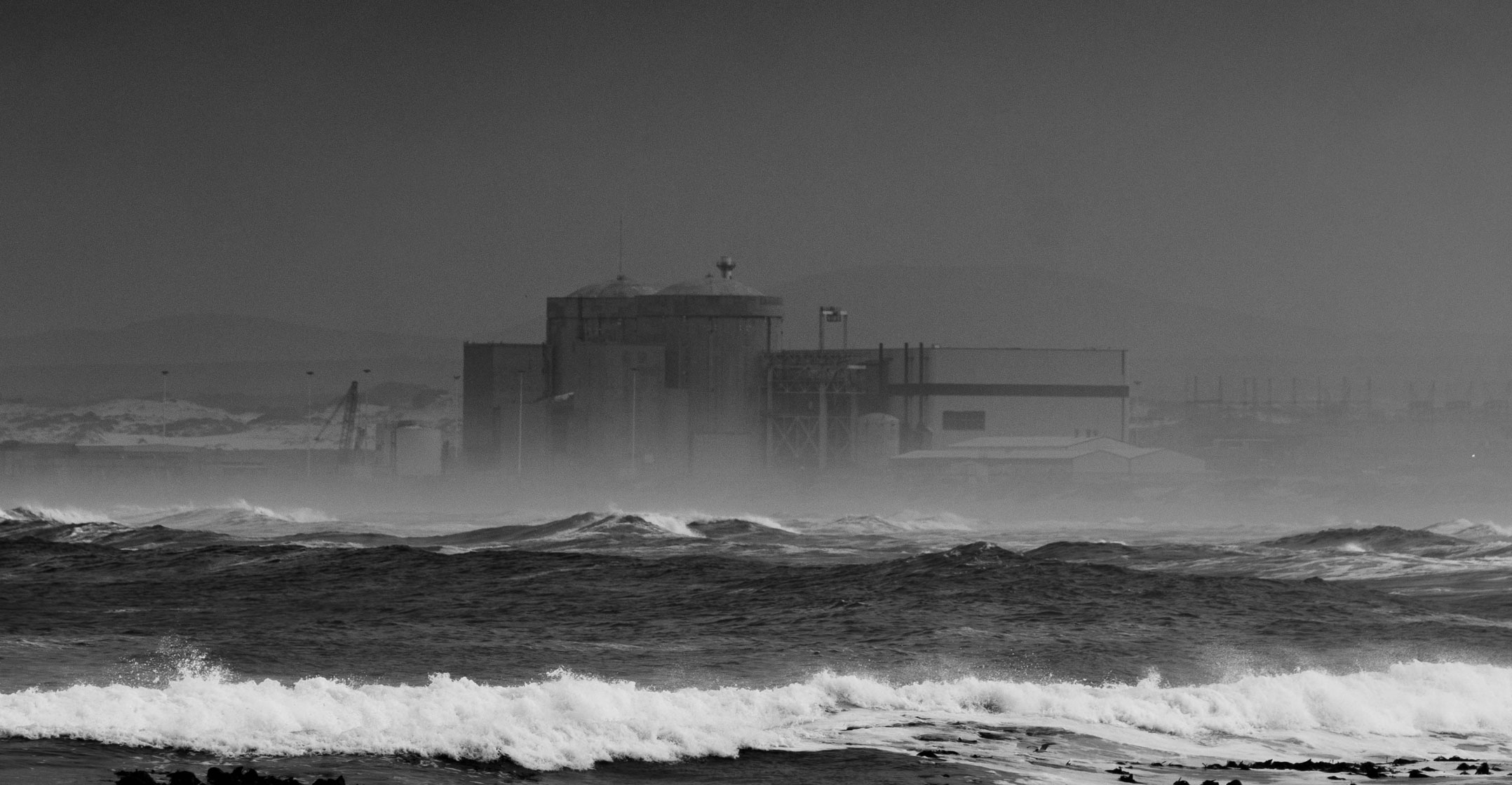
    The Koeberg nuclear power station. Image: 6000.co.za licensed under Creative Commons BY-NC-ND 2.0

    2. Nuclear

    This accounts for 3% of the national generation capacity. Two units at the Koeberg power station in the Western Cape have a total capacity of 1.8GW. To continue operating beyond the end of its currently approved 40-year lifespan in 2024, Eskom is making major upgrades that had been projected to need six months per unit.

    But the exercise is already well behind schedule. This means that one unit that would normally generate 900GW will be unavailable during this year’s winter months.

    3. Gas, hydro, wind and solar

    The remaining 13GW (23%) of the South African power generating capacity is roughly equally shared by gas, hydro, wind and solar. These typically only produce 25-50% of their nominal maximum power.

    The constraints include:

    • The intermittent nature of sunshine and wind and the irregularity of water flow due to water management requirements.
    • Gas is a very expensive electricity-producing technology that is only intended to be used in emergencies. Overuse last winter resulted in Eskom being unable to make fuller use of this resource later, leading to power shortage over the last summer as well.
    • Renewable power plants currently only have a small footprint in the South African energy mix. This has meant that they can’t for now play a major role in mitigating power shortages. The significant upswing in domestic solar installations in the past year as well as the projected completion of many new solar and wind farms in late 2024 is not yet sufficient to overcome the power deficit.

    The winter spike

    No major relief to the power shortfall in the form of large new power generating units is due to happen before next year. South Africans therefore have to brace for winter power shortages.

    South Africa’s electricity daily peak consumption rises from a summer average of 32GW to 36GW in winter. This is caused by the increased use of electrical heating devices, as well as the longer use of lights and increased geyser consumption.

    Eskom has tried to maximise the operation of its power plants in the colder months by scheduling plant maintenance during the warmer seasons. This strategy is being adopted again in 2023 and will provide some relief. But there are too many plants that are going to be out of operation for the entire winter season.

    My estimations suggest that the mid-winter power shortfall will be of the order of 2GW greater than it was in 2022. Deficits of 8GW (stage-8 load shedding) can therefore be expected on some days.

    Grid collapse

    A national blackout triggered by the current oscillating frequency of the grid drifting too far from the prescribed 50Hz would raise the danger of the power grid collapsing. This would happen if points along the grid – including power plants – tripped one after the other, resulting in zero electricity everywhere.

    Re-energising the grid would be a slow process achieved one station at a time. Many days of economic activity would be lost before full electricity supply is recovered. The consequences would be far reaching, and would include possible looting and vandalism. It could also lead to fuel shortages, which in turn would affect transport and industry and a host of facilities that use backup generators such as hospitals, laboratories and morgues.

    Rolling power cuts are the best practical way to prevent a grid collapse and total blackout. Eskom is therefore at pains to always keep the generated power higher than the power used. It does this by cutting access to electricity to some users.

    A prompt reduction in power usage through the speedy implementation of tougher electricity cuts would always prevent a grid collapse. Nonetheless, a grid collapse cannot be ruled out if, for example, a set of poorly performing coal plants all break down in quick succession.

    As South Africa’s new electricity minister has warned, the winter of 2023 is going to be challenging.The Conversation

    • The author, Hartmut Winkler, is professor of physics, University of Johannesburg
    • This article is republished from The Conversation under a Creative Commons licence

    Eskom Hartmut Winkler
    WhatsApp YouTube Follow on Google News Add as preferred source on Google
    Share. Facebook Twitter LinkedIn WhatsApp Telegram Email Copy Link
    Previous ArticleEskom’s plan to bypass pollution controls ‘could kill hundreds’
    Next Article The best Android phones money can buy in South Africa

    Related Posts

    Outa warns homeowners against rushing to register rooftop solar

    Outa warns homeowners against rushing to register rooftop solar

    27 January 2026
    How liberalisation is rewiring South Africa's power sector

    How liberalisation is rewiring South Africa’s power sector

    21 January 2026
    No risk of load shedding after Koeberg output scaled back

    No risk of load shedding after Koeberg output scaled back

    21 January 2026
    Company News
    Huawei turns 25 in South Africa, celebrates with major device discounts

    Huawei turns 25 in South Africa, celebrates with major device discounts

    30 January 2026
    Phishing has not disappeared, but it has grown up - KnowBe4

    Phishing has not disappeared, but it has grown up

    30 January 2026
    Smartphone affordability: South Africa's new economic divide - PayJoy

    Smartphone affordability: South Africa’s new economic divide

    29 January 2026
    Opinion
    South Africa's skills advantage is being overlooked at home - Richard Firth

    South Africa’s skills advantage is being overlooked at home

    29 January 2026
    Why Elon Musk's Starlink is a 'hard no' for me - Songezo Zibi

    Why Elon Musk’s Starlink is a ‘hard no’ for me

    26 January 2026
    South Africa's new fibre broadband battle - Duncan McLeod

    South Africa’s new fibre broadband battle

    20 January 2026

    Subscribe to Updates

    Get the best South African technology news and analysis delivered to your e-mail inbox every morning.

    Latest Posts
    Vuyani Jarana: Mobile coverage masks a deeper broadband failure

    Vuyani Jarana: Mobile coverage masks a deeper broadband failure

    30 January 2026
    TCS+ | How Cloud On Demand is helping SA businesses succeed in the cloud - Xhenia Rhode, Dion Kalicharan

    TCS+ | Cloud On Demand and Consnet: inside a real-world AWS partner success story

    30 January 2026
    Huawei turns 25 in South Africa, celebrates with major device discounts

    Huawei turns 25 in South Africa, celebrates with major device discounts

    30 January 2026
    SABC Plus to flight Microsoft AI training videos

    SABC Plus to flight Microsoft AI training videos

    30 January 2026
    © 2009 - 2026 NewsCentral Media
    • Cookie policy (ZA)
    • TechCentral – privacy and Popia

    Type above and press Enter to search. Press Esc to cancel.

    Manage consent

    TechCentral uses cookies to enhance its offerings. Consenting to these technologies allows us to serve you better. Not consenting or withdrawing consent may adversely affect certain features and functions of the website.

    Functional Always active
    The technical storage or access is strictly necessary for the legitimate purpose of enabling the use of a specific service explicitly requested by the subscriber or user, or for the sole purpose of carrying out the transmission of a communication over an electronic communications network.
    Preferences
    The technical storage or access is necessary for the legitimate purpose of storing preferences that are not requested by the subscriber or user.
    Statistics
    The technical storage or access that is used exclusively for statistical purposes. The technical storage or access that is used exclusively for anonymous statistical purposes. Without a subpoena, voluntary compliance on the part of your Internet Service Provider, or additional records from a third party, information stored or retrieved for this purpose alone cannot usually be used to identify you.
    Marketing
    The technical storage or access is required to create user profiles to send advertising, or to track the user on a website or across several websites for similar marketing purposes.
    • Manage options
    • Manage services
    • Manage {vendor_count} vendors
    • Read more about these purposes
    View preferences
    • {title}
    • {title}
    • {title}