Close Menu
TechCentralTechCentral

    Subscribe to the newsletter

    Get the best South African technology news and analysis delivered to your e-mail inbox every morning.

    Facebook X (Twitter) YouTube LinkedIn
    WhatsApp Facebook X (Twitter) LinkedIn YouTube
    TechCentralTechCentral
    • News
      Xneelo breaks ground on second Samrand data centre

      Xneelo breaks ground on second Samrand data centre

      3 February 2026
      Heavyweights backing ZARU, a new rand-based stablecoin in South Africa

      Heavyweights backing ZARU, a new rand-based stablecoin

      3 February 2026
      China's Haier takes aim at Samsung, LG and Hisense in South Africa

      China’s Haier takes aim at Samsung, LG and Hisense in South Africa

      3 February 2026
      South African tech start-ups that sold big on the world stage

      South African tech start-ups that sold big on the world stage

      3 February 2026
      Standard Bank branches are going cashless - Kabelo Makeke

      Standard Bank branches are going cashless

      3 February 2026
    • World
      Apple acquires audio AI start-up Q.ai

      Apple acquires audio AI start-up Q.ai

      30 January 2026
      SpaceX IPO may be largest in history

      SpaceX IPO may be largest in history

      28 January 2026
      Nvidia throws AI at the weather

      Nvidia throws AI at weather forecasting

      27 January 2026
      Debate erupts over value of in-flight Wi-Fi

      Debate erupts over value of in-flight Wi-Fi

      26 January 2026
      Intel takes another hit - Intel CEO Lip-Bu Tan. Laure Andrillon/Reuters

      Intel takes another hit

      23 January 2026
    • In-depth
      How liberalisation is rewiring South Africa's power sector

      How liberalisation is rewiring South Africa’s power sector

      21 January 2026
      The top-performing South African tech shares of 2025

      The top-performing South African tech shares of 2025

      12 January 2026
      Digital authoritarianism grows as African states normalise internet blackouts

      Digital authoritarianism grows as African states normalise internet blackouts

      19 December 2025
      TechCentral's South African Newsmakers of 2025

      TechCentral’s South African Newsmakers of 2025

      18 December 2025
      Black Friday goes digital in South Africa as online spending surges to record high

      Black Friday goes digital in South Africa as online spending surges to record high

      4 December 2025
    • TCS
      TCS+ | How Cloud On Demand is helping SA businesses succeed in the cloud - Xhenia Rhode, Dion Kalicharan

      TCS+ | Cloud On Demand and Consnet: inside a real-world AWS partner success story

      30 January 2026
      Watts & Wheels S1E3: 'BYD's Corolla Cross challenger'

      Watts & Wheels S1E3: ‘BYD’s Corolla Cross challenger’

      30 January 2026
      Watts & Wheels S1E3: 'BYD's Corolla Cross challenger'

      Watts & Wheels S1E2: ‘China attacks, BMW digs in, Toyota’s sublime supercar’

      23 January 2026

      TCS+ | Why cybersecurity is becoming a competitive advantage for SA businesses

      20 January 2026
      Watts & Wheels S1E3: 'BYD's Corolla Cross challenger'

      Watts & Wheels: S1E1 – ‘William, Prince of Wheels’

      8 January 2026
    • Opinion
      South Africa's skills advantage is being overlooked at home - Richard Firth

      South Africa’s skills advantage is being overlooked at home

      29 January 2026
      Why Elon Musk's Starlink is a 'hard no' for me - Songezo Zibi

      Why Elon Musk’s Starlink is a ‘hard no’ for me

      26 January 2026
      South Africa's new fibre broadband battle - Duncan McLeod

      South Africa’s new fibre broadband battle

      20 January 2026
      AI moves from pilots to production in South African companies - Nazia Pillay SAP

      AI moves from pilots to production in South African companies

      20 January 2026
      South Africa's new fibre broadband battle - Duncan McLeod

      ANC’s attack on Solly Malatsi shows how BEE dogma trumps economic reality

      14 December 2025
    • Company Hubs
      • Africa Data Centres
      • AfriGIS
      • Altron Digital Business
      • Altron Document Solutions
      • Altron Group
      • Arctic Wolf
      • AvertITD
      • Braintree
      • CallMiner
      • CambriLearn
      • CYBER1 Solutions
      • Digicloud Africa
      • Digimune
      • Domains.co.za
      • ESET
      • Euphoria Telecom
      • Incredible Business
      • iONLINE
      • IQbusiness
      • Iris Network Systems
      • LSD Open
      • NEC XON
      • Netstar
      • Network Platforms
      • Next DLP
      • Ovations
      • Paracon
      • Paratus
      • Q-KON
      • SevenC
      • SkyWire
      • Solid8 Technologies
      • Telit Cinterion
      • Tenable
      • Vertiv
      • Videri Digital
      • Vodacom Business
      • Wipro
      • Workday
      • XLink
    • Sections
      • AI and machine learning
      • Banking
      • Broadcasting and Media
      • Cloud services
      • Contact centres and CX
      • Cryptocurrencies
      • Education and skills
      • Electronics and hardware
      • Energy and sustainability
      • Enterprise software
      • Financial services
      • Information security
      • Internet and connectivity
      • Internet of Things
      • Investment
      • IT services
      • Lifestyle
      • Motoring
      • Public sector
      • Retail and e-commerce
      • Satellite communications
      • Science
      • SMEs and start-ups
      • Social media
      • Talent and leadership
      • Telecoms
    • Events
    • Advertise
    TechCentralTechCentral
    Home » Editor's pick » Microsoft’s comeback plan: be everywhere

    Microsoft’s comeback plan: be everywhere

    By The Conversation10 May 2015
    Twitter LinkedIn Facebook WhatsApp Email Telegram Copy Link
    News Alerts
    WhatsApp

    windows-640

    Microsoft’s aim to make Windows 10 run on anything is key to its strategy of reasserting its dominance. Seemingly unassailable in the 1990s, Microsoft’s position has in many markets been eaten away by the explosive growth of phones and tablets, devices in which the firm has made little impact.

    To run Windows 10 on everything, Microsoft is opening up.

    Rather than requiring Office users to run Windows, now Office 365 is available for Android and Apple iOS mobile devices. A version of Visual Studio, Microsoft’s key application for programmers writing Windows software, now runs on Mac OS or Linux operating systems.

    Likewise, with tools released by Microsoft, developers can tweak their Android and iOS apps so that they run on Windows. The aim is to allow developers to create, with ease, the holy grail of a universal app that runs on anything. For a firm that has been unflinching in taking every opportunity to lock users into its platform, just as with Apple and many other tech firms, this is a major change of tack.

    So, why is Microsoft trying to become a general purpose, broadly compatible platform? Windows’ share of the operating system market has fallen steadily from 90% to 70% to 40%, depending on which survey you believe. This reflects customers moving to mobile, where the Windows Phone holds a mere 3% market share. In comparison Microsoft’s cloud infrastructure platform Azure, Office 365 and its Xbox games console have all experienced rising fortunes.

    Lumbered with a heritage of Windows PCs in a falling market, Microsoft’s strategy is to move its services — and so its users — inexorably toward the cloud. This divides into two necessary steps.

    First, for software developed for Microsoft products to run on all of them — write once, run on everything. As it is there are several different Microsoft platforms (Win32, WinRT, WinCE, Windows Phone) with various incompatibilities. This makes sense, for a uniform user experience and also to maximise revenue potential from reaching as many possible devices.

    Second, to implement a universal approach so that code runs on other operating systems other than Windows. This has historically been fraught, with differences in approach to communicating, with hardware and processor architecture making it difficult. In recent years, however, improving virtualisation has made it much easier to run code across platforms.
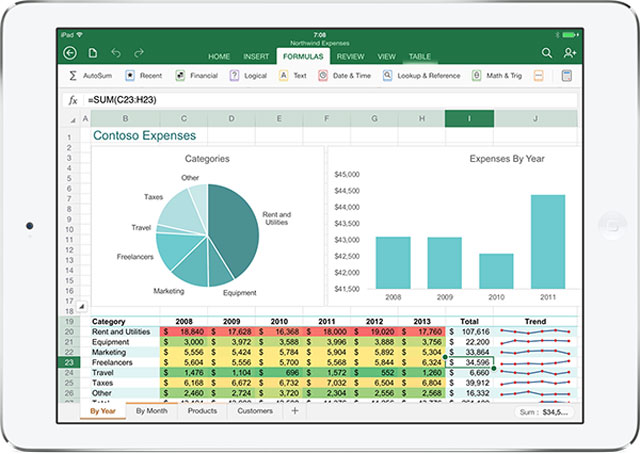
    Microsoft Office now runs on many more platforms, including iOS (pictured) and Android
    Microsoft Office now runs on many more platforms, including iOS (pictured) and Android

    It will be interesting to see whether competitors such as Google and Apple will follow suit, or further enshrine their products into tightly coupled, closed ecosystems. Platform exclusivity is no longer the way to attract and hold customers; instead the appeal is the applications and services that run on them. For Microsoft, it lies in subscriptions to Office 365 and Xbox Gold, in-app and in-game purchases, downloadable video, books and other revenue streams — so it makes sense for Microsoft to ensure these largely cloud-based services are accessible from operating systems other than just their own.

    Platform vs services
    Is there any longer any value in buying into a single service provider? Consider smartphones from Samsung, Google, Apple and Microsoft: prices may differ, but the functionality is much the same.

    The element of difference is the value of wearables and “Internet of things” devices (for example, Apple Watch), the devices they connect with (for example, an iPhone), the size of their user communities, and the network effect.

    From watches to fitness bands to Internet fridges, the benefits lie in how devices are interconnected and work together. This is a truly radical concept that demonstrates digital technology is driving a new economic model, with value associated with “in the moment” services when walking about, in the car, or at work. It’s this direction that Microsoft is aiming for with Windows 10, focusing on the next big thing that will drive the digital economy.

    Tech firms will try to grow ecosystems of sensors and services running on mobile devices, either tied to a specific platform or by driving traffic directly to their cloud infrastructure.

    Apple has already moved into the mobile health app market and connected home market. Google is moving in alongside manufacturers such as Intel, ARM and others. An interesting illustration of this effect is the growth of digital payments — with Apple, Facebook and others seeking ways to create revenue from the traffic passing through their ecosystems.

    However, the problem is that no single supplier like Google, Apple, Microsoft or Internet services such as Facebook or Amazon can hope to cover all the requirements of the Internet of things, which is predicted to scale to over 50bn devices worth US$7 trillion in five years. As we become more enmeshed with our devices, wearables and sensors, demand will rise for services driven by the personal data they create. Through “Windows 10 on everything”, Microsoft hopes to leverage not just the users of its own ecosystem, but those of its competitors, too.The Conversation

    • Mark Skilton is professor of practice at the University of Warwick
    • This article was originally published on The Conversation

    Mark Skilton Microsoft
    WhatsApp YouTube Follow on Google News Add as preferred source on Google
    Share. Facebook Twitter LinkedIn WhatsApp Telegram Email Copy Link
    Previous ArticleEskom seeks 25% price hike
    Next Article Why Elon Musk might just change the world

    Related Posts

    SABC Plus to flight Microsoft AI training videos

    SABC Plus to flight Microsoft AI training videos

    30 January 2026
    Cloud adoption the weak link in SA's digital government push: Microsoft - Vukani Mngxati

    Cloud adoption the weak link in SA’s digital government push: Microsoft

    29 January 2026
    Elon Musk

    Elon Musk demands billions from OpenAI in explosive lawsuit

    18 January 2026
    Company News
    Breaking silos with SAS: Agile insurance in an uncertain world

    Breaking silos with SAS: agile insurance in an uncertain world

    2 February 2026
    Stellar year expected for Digicloud Africa and its reseller partners - Gregory MacLennan

    Stellar year expected for Digicloud Africa and its reseller partners

    2 February 2026
    How to subscribe to South Africa's best tech podcasts - TechCentral

    How to subscribe to South Africa’s best tech podcasts

    2 February 2026
    Opinion
    South Africa's skills advantage is being overlooked at home - Richard Firth

    South Africa’s skills advantage is being overlooked at home

    29 January 2026
    Why Elon Musk's Starlink is a 'hard no' for me - Songezo Zibi

    Why Elon Musk’s Starlink is a ‘hard no’ for me

    26 January 2026
    South Africa's new fibre broadband battle - Duncan McLeod

    South Africa’s new fibre broadband battle

    20 January 2026

    Subscribe to Updates

    Get the best South African technology news and analysis delivered to your e-mail inbox every morning.

    Latest Posts
    Xneelo breaks ground on second Samrand data centre

    Xneelo breaks ground on second Samrand data centre

    3 February 2026
    Heavyweights backing ZARU, a new rand-based stablecoin in South Africa

    Heavyweights backing ZARU, a new rand-based stablecoin

    3 February 2026
    China's Haier takes aim at Samsung, LG and Hisense in South Africa

    China’s Haier takes aim at Samsung, LG and Hisense in South Africa

    3 February 2026
    South African tech start-ups that sold big on the world stage

    South African tech start-ups that sold big on the world stage

    3 February 2026
    © 2009 - 2026 NewsCentral Media
    • Cookie policy (ZA)
    • TechCentral – privacy and Popia

    Type above and press Enter to search. Press Esc to cancel.

    Manage consent

    TechCentral uses cookies to enhance its offerings. Consenting to these technologies allows us to serve you better. Not consenting or withdrawing consent may adversely affect certain features and functions of the website.

    Functional Always active
    The technical storage or access is strictly necessary for the legitimate purpose of enabling the use of a specific service explicitly requested by the subscriber or user, or for the sole purpose of carrying out the transmission of a communication over an electronic communications network.
    Preferences
    The technical storage or access is necessary for the legitimate purpose of storing preferences that are not requested by the subscriber or user.
    Statistics
    The technical storage or access that is used exclusively for statistical purposes. The technical storage or access that is used exclusively for anonymous statistical purposes. Without a subpoena, voluntary compliance on the part of your Internet Service Provider, or additional records from a third party, information stored or retrieved for this purpose alone cannot usually be used to identify you.
    Marketing
    The technical storage or access is required to create user profiles to send advertising, or to track the user on a website or across several websites for similar marketing purposes.
    • Manage options
    • Manage services
    • Manage {vendor_count} vendors
    • Read more about these purposes
    View preferences
    • {title}
    • {title}
    • {title}