Close Menu
TechCentralTechCentral

    Subscribe to the newsletter

    Get the best South African technology news and analysis delivered to your e-mail inbox every morning.

    Facebook X (Twitter) YouTube LinkedIn
    WhatsApp Facebook X (Twitter) LinkedIn YouTube
    TechCentralTechCentral
    • News
      Big Microsoft 365 price increases coming next year

      Big Microsoft price increases coming next year

      5 December 2025
      Vodacom to take control of Safaricom in R36-billion deal - Shameel Joosub

      Vodacom to take control of Safaricom in R36-billion deal

      4 December 2025
      Black Friday goes digital in South Africa as online spending surges to record high

      Black Friday goes digital in South Africa as online spending surges to record high

      4 December 2025
      BYD takes direct aim at Toyota with launch of sub-R500 000 Sealion 5 PHEV

      BYD takes direct aim at Toyota with launch of sub-R500 000 Sealion 5 PHEV

      4 December 2025
      'Get it now': Takealot in new instant deliveries pilot

      ‘Get it now’: Takealot in new instant deliveries pilot

      4 December 2025
    • World
      Amazon and Google launch multi-cloud service for faster connectivity

      Amazon and Google launch multi-cloud service for faster connectivity

      1 December 2025
      Google makes final court plea to stop US breakup

      Google makes final court plea to stop US breakup

      21 November 2025
      Bezos unveils monster rocket: New Glenn 9x4 set to dwarf Saturn V

      Bezos unveils monster rocket: New Glenn 9×4 set to dwarf Saturn V

      21 November 2025
      Tech shares turbocharged by Nvidia's stellar earnings

      Tech shares turbocharged by stellar Nvidia earnings

      20 November 2025
      Config file blamed for Cloudflare meltdown that disrupted the web

      Config file blamed for Cloudflare meltdown that disrupted the web

      19 November 2025
    • In-depth
      Jensen Huang Nvidia

      So, will China really win the AI race?

      14 November 2025
      Valve's Linux console takes aim at Microsoft's gaming empire

      Valve’s Linux console takes aim at Microsoft’s gaming empire

      13 November 2025
      iOCO's extraordinary comeback plan - Rhys Summerton

      iOCO’s extraordinary comeback plan

      28 October 2025
      Why smart glasses keep failing - no, it's not the tech - Mark Zuckerberg

      Why smart glasses keep failing – it’s not the tech

      19 October 2025
      BYD to blanket South Africa with megawatt-scale EV charging network - Stella Li

      BYD to blanket South Africa with megawatt-scale EV charging network

      16 October 2025
    • TCS
      TCS+ | How Cloud on Demand helps partners thrive in the AWS ecosystem - Odwa Ndyaluvane and Xenia Rhode

      TCS+ | How Cloud On Demand helps partners thrive in the AWS ecosystem

      4 December 2025
      TCS | MTN Group CEO Ralph Mupita on competition, AI and the future of mobile

      TCS | Ralph Mupita on competition, AI and the future of mobile

      28 November 2025
      TCS | Dominic Cull on fixing South Africa's ICT policy bottlenecks

      TCS | Dominic Cull on fixing South Africa’s ICT policy bottlenecks

      21 November 2025
      TCS | BMW CEO Peter van Binsbergen on the future of South Africa's automotive industry

      TCS | BMW CEO Peter van Binsbergen on the future of South Africa’s automotive industry

      6 November 2025
      TCS | Why Altron is building an AI factory - Bongani Andy Mabaso

      TCS | Why Altron is building an AI factory in Johannesburg

      28 October 2025
    • Opinion
      Your data, your hardware: the DIY AI revolution is coming - Duncan McLeod

      Your data, your hardware: the DIY AI revolution is coming

      20 November 2025
      Zero Carbon Charge founder Joubert Roux

      The energy revolution South Africa can’t afford to miss

      20 November 2025
      It's time for a new approach to government IT spend in South Africa - Richard Firth

      It’s time for a new approach to government IT spend in South Africa

      19 November 2025
      How South Africa's broken Rica system fuels murder and mayhem - Farhad Khan

      How South Africa’s broken Rica system fuels murder and mayhem

      10 November 2025
      South Africa's AI data centre boom risks overloading a fragile grid - Paul Colmer

      South Africa’s AI data centre boom risks overloading a fragile grid

      30 October 2025
    • Company Hubs
      • Africa Data Centres
      • AfriGIS
      • Altron Digital Business
      • Altron Document Solutions
      • Altron Group
      • Arctic Wolf
      • AvertITD
      • Braintree
      • CallMiner
      • CambriLearn
      • CYBER1 Solutions
      • Digicloud Africa
      • Digimune
      • Domains.co.za
      • ESET
      • Euphoria Telecom
      • Incredible Business
      • iONLINE
      • IQbusiness
      • Iris Network Systems
      • LSD Open
      • NEC XON
      • Netstar
      • Network Platforms
      • Next DLP
      • Ovations
      • Paracon
      • Paratus
      • Q-KON
      • SevenC
      • SkyWire
      • Solid8 Technologies
      • Telit Cinterion
      • Tenable
      • Vertiv
      • Videri Digital
      • Vodacom Business
      • Wipro
      • Workday
      • XLink
    • Sections
      • AI and machine learning
      • Banking
      • Broadcasting and Media
      • Cloud services
      • Contact centres and CX
      • Cryptocurrencies
      • Education and skills
      • Electronics and hardware
      • Energy and sustainability
      • Enterprise software
      • Financial services
      • Information security
      • Internet and connectivity
      • Internet of Things
      • Investment
      • IT services
      • Lifestyle
      • Motoring
      • Public sector
      • Retail and e-commerce
      • Satellite communications
      • Science
      • SMEs and start-ups
      • Social media
      • Talent and leadership
      • Telecoms
    • Events
    • Advertise
    TechCentralTechCentral
    Home » Sections » Telecoms » Mobile won’t fix the digital divide

    Mobile won’t fix the digital divide

    By The Conversation24 November 2019
    Twitter LinkedIn Facebook WhatsApp Email Telegram Copy Link
    News Alerts
    WhatsApp

    Mobile services have had an important and positive impact on developing countries where they are the main means of connecting to the Internet. However, mobile services have capacity constraints. They use limited radio frequency spectrum, which means that mobile data typically has usage limits. They also have high prices per unit (per gigabyte), which results in lower use per connection.

    Fixed-line broadband, on the other hand, has significantly lower prices per unit. It is often offered on an uncapped or unlimited basis, and therefore has higher usage per connection. This enables a wider range of services. Fixed lines are expensive to roll out, but these costs are falling.

    So, a question arises: is mobile enough for developing countries like South Africa?

    Overall, only 10% of households in South Africa report having access to the Internet at home. This compares to almost 50% across developing countries

    It’s an important question because there is a substantial “digital divide” between countries, as well as within countries like South Africa. This difference in access to digital technology also exists between households that have access to the Internet at home, and those that do not.

    In a recent paper, we looked at the question of substitution between fixed and mobile broadband services. Our results show that having a computer and access to an Internet connection at work or school are at least as important in driving broadband penetration as reducing mobile data prices.

    Our findings suggest that relying solely on mobile networks to bridge the “digital divide” is not enough. Policymakers and regulators should consider ways of expanding access to computers and the Internet at work and schools, together with expanding access to fixed-line broadband.

    Regional disparities

    Overall, only 10% of households in South Africa report having access to the Internet at home. This compares to almost 50% across developing countries. But even the low average Internet access in South Africa masks important regional disparities.

    In the Western Cape, for example, 26% of households have Internet access at home, compared to 2% in Limpopo. This suggests that access to the Internet in South Africa is very low overall, and highly skewed, reflecting the extreme levels of inequality.

    In our paper, we show that access to the means of using the Internet, such as owning a computer, plays an important role in household choices of fixed or mobile data services. Where a household has a computer, fixed and mobile are less likely to be substitutes.
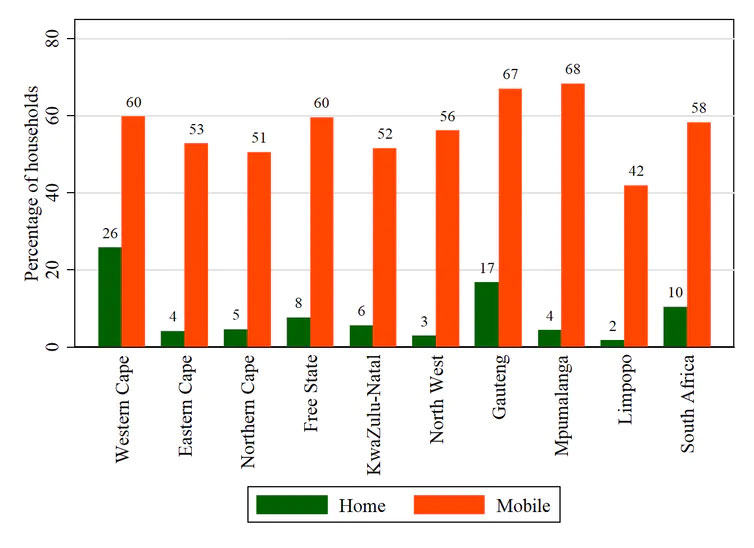
    Figure 1: Percentage of households with access to the Internet at home, or for which at least one member has access to, or used the Internet any place via a mobile cellular phone. Statistics South Africa, 2018, General Household Survey


    Our research shows that if fixed-line coverage was expanded to the entire population and computers were available to all, fixed-line broadband penetration would increase significantly by 9.6 percentage points, while mobile broadband penetration would increase by half of a percentage point.

    This is consistent with the positive relationship we observe between having a computer and home Internet access across countries (see figure 2).

    Our results also corroborate survey evidence in South Africa and other countries that identifies the high cost or lack of equipment, such as computers, as being a barrier to using the Internet at home. The price of subscribing to a service plays less of a role.
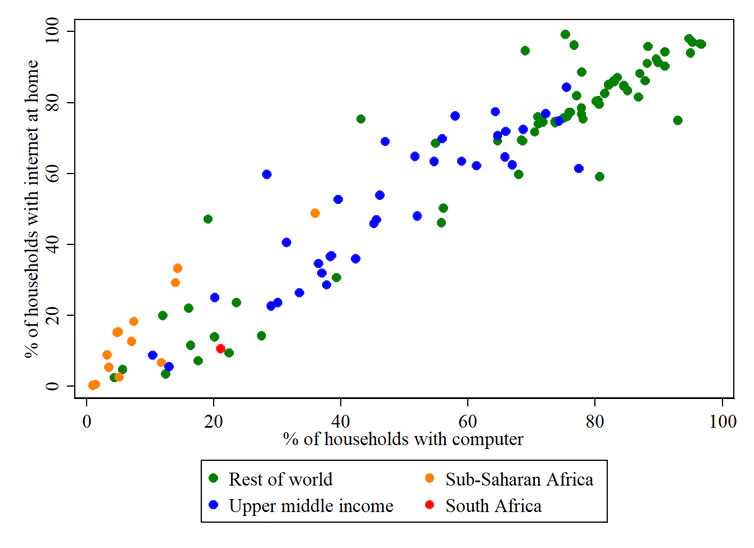
    Figure 2: Relationship between Internet access at home and having a computer (2012-2016). Figure produced from data from the International Telecommunication Union

    We also show that when consumers access the Internet at work or school, they are less likely to see fixed and mobile data services as substitutes. Having an Internet connection at work or school would add an additional 5.7 percentage points to fixed-line broadband penetration, and three percentage points to mobile broadband penetration. This is over and above the effect of expanding fixed-line coverage and providing households with computers.

    This may be due to “learning effects” where users of high-speed Internet at work and school learn applications for high-speed Internet at home.

    In addition, being employed, and being self-employed in particular, makes fixed and mobile data services weaker substitutes. Unemployment in South Africa is currently 38.5%. At higher levels of employment and particularly self-employment, more fixed-line services will be needed.

    At higher levels of employment and particularly self-employment, more fixed-line services will be needed

    This is important in view of a recent study. The study shows that the expansion of high-speed Internet access in African countries, including South Africa, results not only in greater employment but also in greater productivity.

    These results have several implications for regulators and policymakers in developing countries, particularly in Africa. Regulators have so far focused largely on interventions in respect of mobile data services. But our findings suggest that this is not enough to expand access to broadband.

    Firstly, it is important to stimulate demand for broadband services. This can be done by providing the tools, such as computers, for using such services. Furthermore, our results suggest that ensuring individuals have access to the Internet at work and educational facilities would likely increase broadband adoption.

    Secondly, our findings show that, for large groups of consumers, fixed and mobile complement one another. This means that greater fixed-line broadband adoption leads to greater mobile data adoption, and vice versa. The number of consumers that see fixed and mobile data as complementary is greater at higher levels of employment and self-employment. It is also higher among those who have more access to computers and greater connectivity at work and at schools.

    This suggests that relying solely on mobile networks to bridge the digital divide is not enough.The Conversation

    • Written by Ryan Hawthorne, economist, University of Cape Town, and Lukasz Grzybowski, associate professor, University of Cape Town
    • This article is republished from The Conversation under a Creative Commons licence


    Lukasz Grzybowski Ryan Hawthorne top
    Subscribe to TechCentral Subscribe to TechCentral
    Share. Facebook Twitter LinkedIn WhatsApp Telegram Email Copy Link
    Previous ArticleNaspers unlocks R150-billion of value with Prosus listing
    Next Article ‘Miner capitulation’: Bitcoin matches record losing run

    Related Posts

    18GW in unplanned breakdowns cripple Eskom

    2 November 2021

    Nersa kicks the Karpowership can down the road

    13 September 2021

    If you think South African load shedding is bad, try Zimbabwe’s

    13 September 2021
    Company News
    AI is not a technology problem - iqbusiness

    AI is not a technology problem – iqbusiness

    5 December 2025
    Telcos are sitting on a data gold mine - but few know what do with it - Phillip du Plessis

    Telcos are sitting on a data gold mine – but few know what do with it

    4 December 2025
    Unlock smarter computing with your surface Copilot+ PC

    Unlock smarter computing with your Surface Copilot+ PC

    4 December 2025
    Opinion
    Your data, your hardware: the DIY AI revolution is coming - Duncan McLeod

    Your data, your hardware: the DIY AI revolution is coming

    20 November 2025
    Zero Carbon Charge founder Joubert Roux

    The energy revolution South Africa can’t afford to miss

    20 November 2025
    It's time for a new approach to government IT spend in South Africa - Richard Firth

    It’s time for a new approach to government IT spend in South Africa

    19 November 2025

    Subscribe to Updates

    Get the best South African technology news and analysis delivered to your e-mail inbox every morning.

    Latest Posts
    Big Microsoft 365 price increases coming next year

    Big Microsoft price increases coming next year

    5 December 2025
    AI is not a technology problem - iqbusiness

    AI is not a technology problem – iqbusiness

    5 December 2025
    Vodacom to take control of Safaricom in R36-billion deal - Shameel Joosub

    Vodacom to take control of Safaricom in R36-billion deal

    4 December 2025
    Black Friday goes digital in South Africa as online spending surges to record high

    Black Friday goes digital in South Africa as online spending surges to record high

    4 December 2025
    © 2009 - 2025 NewsCentral Media
    • Cookie policy (ZA)
    • TechCentral – privacy and Popia

    Type above and press Enter to search. Press Esc to cancel.

    Manage consent

    TechCentral uses cookies to enhance its offerings. Consenting to these technologies allows us to serve you better. Not consenting or withdrawing consent may adversely affect certain features and functions of the website.

    Functional Always active
    The technical storage or access is strictly necessary for the legitimate purpose of enabling the use of a specific service explicitly requested by the subscriber or user, or for the sole purpose of carrying out the transmission of a communication over an electronic communications network.
    Preferences
    The technical storage or access is necessary for the legitimate purpose of storing preferences that are not requested by the subscriber or user.
    Statistics
    The technical storage or access that is used exclusively for statistical purposes. The technical storage or access that is used exclusively for anonymous statistical purposes. Without a subpoena, voluntary compliance on the part of your Internet Service Provider, or additional records from a third party, information stored or retrieved for this purpose alone cannot usually be used to identify you.
    Marketing
    The technical storage or access is required to create user profiles to send advertising, or to track the user on a website or across several websites for similar marketing purposes.
    • Manage options
    • Manage services
    • Manage {vendor_count} vendors
    • Read more about these purposes
    View preferences
    • {title}
    • {title}
    • {title}