Managed service providers (MSPs) have always dealt in complexity. What’s changed is how that complexity now behaves: it doesn’t merely slow delivery; it quietly multiplies cost and risk. Many providers are running more tools, more dashboards and more endpoint agents than ever, yet feel less certain about what’s happening across client environments – especially when something goes wrong.
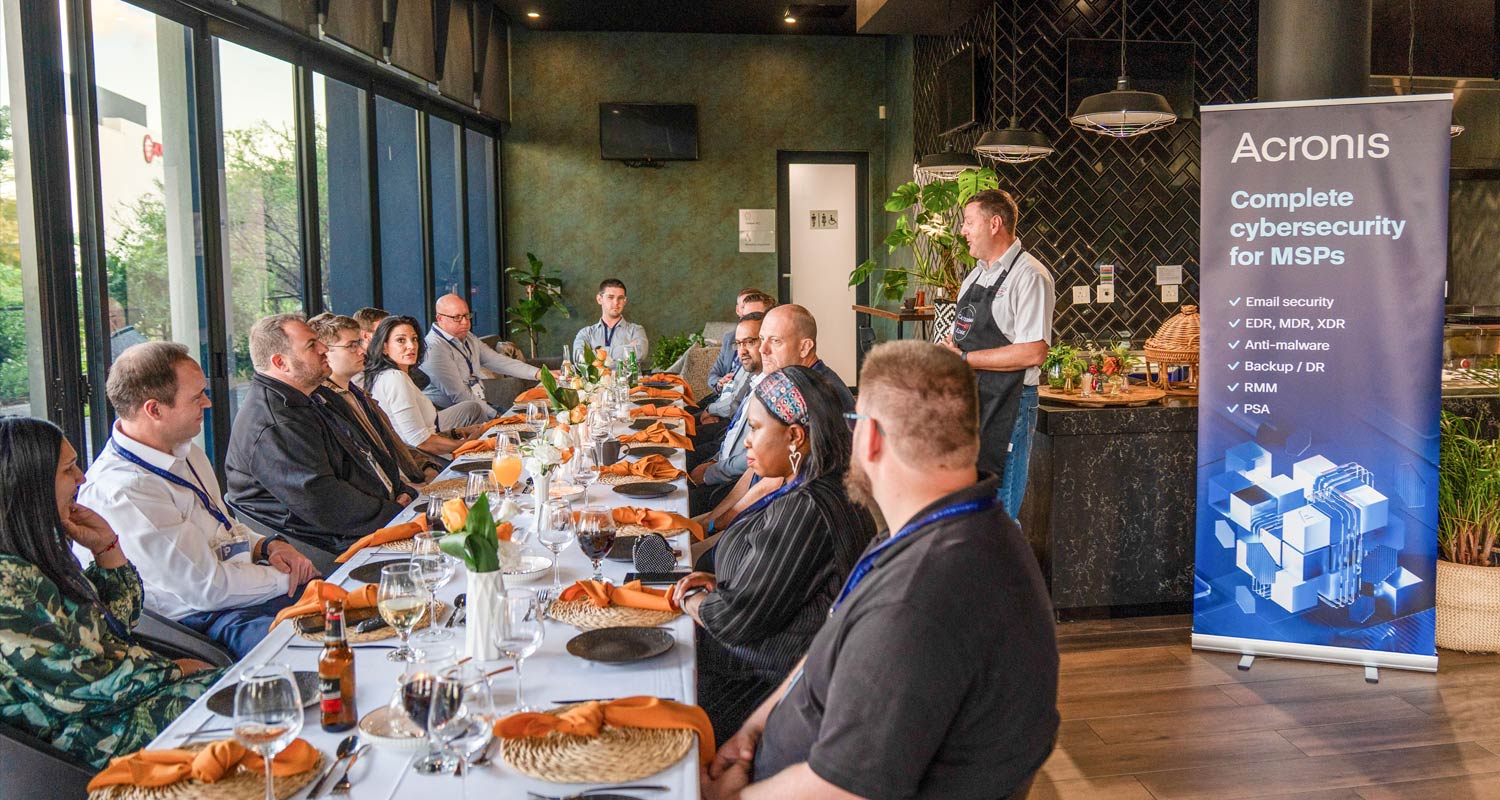
That tension shaped an executive dinner hosted by Acronis, where MSP leaders unpacked the operational, financial and security drag created by years of tool accumulation. The blunt takeaway: the stack itself has started to get in the way.
Clients want more certainty, not more tooling
Most MSPs are being pulled in two directions at once. Customers expect stronger security, faster response and evidence that resilience is improving, but they don’t want the price tag to rise in lockstep. Meanwhile, the environment MSPs have to protect has sprawled: cloud services, remote endpoints, SaaS sprawl, third parties and hybrid setups that don’t sit neatly under one roof.
In South Africa, those pressures sharpen because skilled people are scarce and stretched. When experienced technicians are hard to hire and harder to keep, complexity becomes expensive quickly. The old habit of meeting every new requirement by adding another product and another specialist starts to look less like progress and more like drift.
The hidden bill is technician time
Vendor sprawl is often treated as housekeeping: too many renewals, too many portals, too many logins. The dinner conversation focused on the cost that doesn’t show up clearly on an invoice – the time spent moving between systems, joining dots and proving what should already be obvious.
Every additional vendor introduces training overhead, integration work, troubleshooting noise and predictable gaps between products. Every extra endpoint agent adds resource contention, more failure points and yet another source of “urgent” alerts that aren’t urgent at all.
The result is a workday built around console-hopping and context-switching. Skilled people get pulled into glue work: stitching together timelines, reconciling contradictory views and translating tool output into something a client can act on. Even disciplined teams end up spending their best technicians on coordination rather than outcomes.
‘Integrated’ only counts when it changes how you operate
One of the sharper points in the discussion was the need to separate real integration from bolt-ons that merely look tidy in a slide deck. Many stacks appear connected but behave like separate products in day-to-day delivery: alerts don’t correlate cleanly, policies diverge, workflows require manual hand-offs and reporting turns into reconciliation.
This is where risk creeps in. Fragmentation can create a comforting illusion of coverage: the stack is busy, therefore the environment must be protected. But the gaps don’t announce themselves. They show up later – during recovery, incident response, or when someone needs a clean audit trail and discovers the truth is spread across three tools and one spreadsheet.
The decision point MSPs can’t dodge
Many MSPs are approaching a practical decision, and it’s less technical than it sounds.
One path is to keep stacking tools, accept rising operational drag and try to hire your way out of complexity. That tends to produce the same symptoms: more alerts, more hand-offs, more fatigue and margins that keep tightening.
The alternative is consolidation with discipline: fewer tools, deeper integration, standardised delivery and automation that removes manual handling where it adds no value. This is where AI becomes relevant in the only way that matters to an MSP – it reduces friction in the work. Not as a novelty feature, but as automation within guardrails that keeps routine processes moving, surfaces anomalies earlier and cuts the number of human touchpoints needed to deliver a consistent security and resilience outcome.
That’s also where Acronis’s positioning sits. The idea is not “another tool”. It’s a platform-centric approach that aims to unify backup, disaster recovery and cybersecurity controls so MSPs can standardise delivery, reduce duplication and scale without turning the stack into a patchwork that only the most senior technicians can navigate.
Consolidation is hard, even when everyone agrees
If the future is fewer tools, why do MSP stacks keep growing?
Because sprawl isn’t only technical. It’s contractual, historical and behavioural. MSPs inherit client environments, legacy agreements, embedded habits and specialist dependencies. Tools become part of delivery, and removing them can feel like introducing risk – even when keeping them creates risk of a different kind.
The most credible view in the room was also the most practical: consolidation rarely succeeds as a big-bang project. It’s a phased shift. Define a standard service blueprint, reduce duplication, migrate clients over time and avoid breaking delivery in the process.
The question MSP leaders should take back is simple and uncomfortable: how much of your team’s week exists purely to manage fragmentation, and what would disappear if the stack wasn’t stitched together by humans?
Learn more about Acronis’s approach to integrating backup, disaster recovery and cybersecurity for MSPs.
- Read more articles by Acronis on TechCentral
- This promoted content was paid for by the party concerned