

Close Menu
TechCentralTechCentral

    Subscribe to the newsletter

    Get the best South African technology news and analysis delivered to your e-mail inbox every morning.

    Facebook X (Twitter) YouTube LinkedIn
    WhatsApp Facebook X (Twitter) LinkedIn YouTube
    TechCentralTechCentral
    • News
      Big Microsoft 365 price increases coming next year

      Big Microsoft price increases coming next year

      5 December 2025
      Vodacom to take control of Safaricom in R36-billion deal - Shameel Joosub

      Vodacom to take control of Safaricom in R36-billion deal

      4 December 2025
      Black Friday goes digital in South Africa as online spending surges to record high

      Black Friday goes digital in South Africa as online spending surges to record high

      4 December 2025
      BYD takes direct aim at Toyota with launch of sub-R500 000 Sealion 5 PHEV

      BYD takes direct aim at Toyota with launch of sub-R500 000 Sealion 5 PHEV

      4 December 2025
      'Get it now': Takealot in new instant deliveries pilot

      ‘Get it now’: Takealot in new instant deliveries pilot

      4 December 2025
    • World
      Amazon and Google launch multi-cloud service for faster connectivity

      Amazon and Google launch multi-cloud service for faster connectivity

      1 December 2025
      Google makes final court plea to stop US breakup

      Google makes final court plea to stop US breakup

      21 November 2025
      Bezos unveils monster rocket: New Glenn 9x4 set to dwarf Saturn V

      Bezos unveils monster rocket: New Glenn 9×4 set to dwarf Saturn V

      21 November 2025
      Tech shares turbocharged by Nvidia's stellar earnings

      Tech shares turbocharged by stellar Nvidia earnings

      20 November 2025
      Config file blamed for Cloudflare meltdown that disrupted the web

      Config file blamed for Cloudflare meltdown that disrupted the web

      19 November 2025
    • In-depth
      Jensen Huang Nvidia

      So, will China really win the AI race?

      14 November 2025
      Valve's Linux console takes aim at Microsoft's gaming empire

      Valve’s Linux console takes aim at Microsoft’s gaming empire

      13 November 2025
      iOCO's extraordinary comeback plan - Rhys Summerton

      iOCO’s extraordinary comeback plan

      28 October 2025
      Why smart glasses keep failing - no, it's not the tech - Mark Zuckerberg

      Why smart glasses keep failing – it’s not the tech

      19 October 2025
      BYD to blanket South Africa with megawatt-scale EV charging network - Stella Li

      BYD to blanket South Africa with megawatt-scale EV charging network

      16 October 2025
    • TCS
      TCS+ | How Cloud on Demand helps partners thrive in the AWS ecosystem - Odwa Ndyaluvane and Xenia Rhode

      TCS+ | How Cloud On Demand helps partners thrive in the AWS ecosystem

      4 December 2025
      TCS | MTN Group CEO Ralph Mupita on competition, AI and the future of mobile

      TCS | Ralph Mupita on competition, AI and the future of mobile

      28 November 2025
      TCS | Dominic Cull on fixing South Africa's ICT policy bottlenecks

      TCS | Dominic Cull on fixing South Africa’s ICT policy bottlenecks

      21 November 2025
      TCS | BMW CEO Peter van Binsbergen on the future of South Africa's automotive industry

      TCS | BMW CEO Peter van Binsbergen on the future of South Africa’s automotive industry

      6 November 2025
      TCS | Why Altron is building an AI factory - Bongani Andy Mabaso

      TCS | Why Altron is building an AI factory in Johannesburg

      28 October 2025
    • Opinion
      Your data, your hardware: the DIY AI revolution is coming - Duncan McLeod

      Your data, your hardware: the DIY AI revolution is coming

      20 November 2025
      Zero Carbon Charge founder Joubert Roux

      The energy revolution South Africa can’t afford to miss

      20 November 2025
      It's time for a new approach to government IT spend in South Africa - Richard Firth

      It’s time for a new approach to government IT spend in South Africa

      19 November 2025
      How South Africa's broken Rica system fuels murder and mayhem - Farhad Khan

      How South Africa’s broken Rica system fuels murder and mayhem

      10 November 2025
      South Africa's AI data centre boom risks overloading a fragile grid - Paul Colmer

      South Africa’s AI data centre boom risks overloading a fragile grid

      30 October 2025
    • Company Hubs
      • Africa Data Centres
      • AfriGIS
      • Altron Digital Business
      • Altron Document Solutions
      • Altron Group
      • Arctic Wolf
      • AvertITD
      • Braintree
      • CallMiner
      • CambriLearn
      • CYBER1 Solutions
      • Digicloud Africa
      • Digimune
      • Domains.co.za
      • ESET
      • Euphoria Telecom
      • Incredible Business
      • iONLINE
      • IQbusiness
      • Iris Network Systems
      • LSD Open
      • NEC XON
      • Netstar
      • Network Platforms
      • Next DLP
      • Ovations
      • Paracon
      • Paratus
      • Q-KON
      • SevenC
      • SkyWire
      • Solid8 Technologies
      • Telit Cinterion
      • Tenable
      • Vertiv
      • Videri Digital
      • Vodacom Business
      • Wipro
      • Workday
      • XLink
    • Sections
      • AI and machine learning
      • Banking
      • Broadcasting and Media
      • Cloud services
      • Contact centres and CX
      • Cryptocurrencies
      • Education and skills
      • Electronics and hardware
      • Energy and sustainability
      • Enterprise software
      • Financial services
      • Information security
      • Internet and connectivity
      • Internet of Things
      • Investment
      • IT services
      • Lifestyle
      • Motoring
      • Public sector
      • Retail and e-commerce
      • Satellite communications
      • Science
      • SMEs and start-ups
      • Social media
      • Talent and leadership
      • Telecoms
    • Events
    • Advertise
    TechCentralTechCentral
    Home » Editor's pick » Nobel physicists could revolutionise computing

    Nobel physicists could revolutionise computing

    By Editor7 October 2016
    Twitter LinkedIn Facebook WhatsApp Email Telegram Copy Link
    News Alerts
    WhatsApp
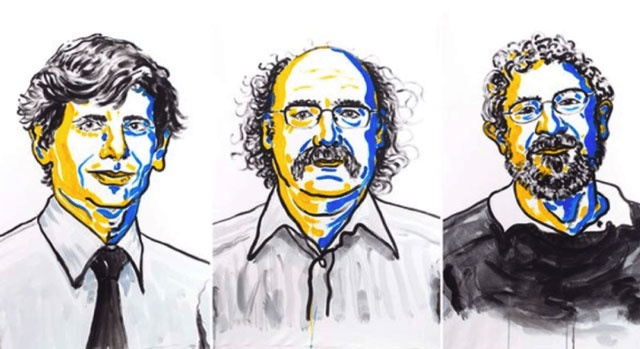
    David Thouless, Duncan Haldane and Michael Kosterlitz
    David Thouless, Duncan Haldane and Michael Kosterlitz

    British scientists David Thouless, Duncan Haldane and Michael Kosterlitz won this year’s Nobel Prize in Physics “for theoretical discoveries of topological phase transitions and topological phases of matter”. The reference to “theoretical discoveries” makes it tempting to think their work will not have practical applications or affect our lives someday. The opposite may well be true.

    To understand the potential, it helps to understand the theory. Most people know that an atom has a nucleus in the middle and electrons orbiting around it. These correspond to different energy levels. When atoms group into substances, all the energy levels of each atom combine into bands of electrons. Each of these so-called energy bands has space for a certain number of electrons. And between each band are gaps in which electrons can’t flow.

    If you apply an electrical charge (a flow of extra electrons) to a material, its conductivity is determined by whether the highest energy band has room for more electrons. If it does have room, the material will behave as a conductor. If not, you need extra energy to push the current of electrons into a new empty band and as a result the material behaves as an insulator. Understanding conductivity is vital to electronics, since electronic products ultimately rely on components that are electric conductors, semiconductors and insulators.

    What Thouless, Haldane and Kosterlitz began to predict in the 1970s and 1980s and other theorists have since taken forward is that certain materials break this rule. Instead of having a gap between bands in which electrons can’t flow, they have a special energy level between their bands where certain unexpected things are possible.

    This quality only exists on the surface or edge of these materials, and is very robust. It also depends to some extent on the shape of the material — the topology, as we say in physics. It behaves identically for a sphere and an egg, for example, but would be different for something shaped like a doughnut because of the hole in the middle. The first measurements of this kind of behaviour have been taken for a current along the boundary of a flat sheet.

    The properties of these so-called topological materials could potentially be extremely useful. Electrical currents can move without resistance across their surface, for example, even where a device is moderately damaged. Superconductors can already do this without having topological properties, but they only work at very low temperatures – meaning you use a lot of energy keeping them cool. Topological materials have the potential to do the same job at higher temperatures.

    Quantum computing has the potential to make artificial intelligence a reality

    This has important implications for computing: most of the energy computers currently use is to run ventilators to cool down the heat produced by electrical resistance in the circuits. Remove this heat problem and you potentially make them many times more energy efficient. This could massively reduce their carbon emissions, for instance. It could also lead to batteries with far longer lifespans. Researchers are already experimenting with topological materials like cadmium telluride and mercury telluride to bring this vision to life.

    There is also the potential for a major breakthrough in quantum computing. Classical computers encode information by either applying voltage or not applying voltage to a chip. The computer reads this as a 0 or 1 respectively for each “bit” of information. You put these bits together to build up more complex information. This is how the binary system works.

    With quantum computing, you deliver information to electrons instead of microchips. The energy levels of these electrons then correspond to zeros and ones just like in classical computers, but in quantum mechanics both can be true at the same time. Without getting into too much theory, this raises the possibility of computers that can process exceedingly large amounts of data in parallel and are therefore much faster.

    While the likes of Google and IBM are researching how to manipulate enough electrons to create quantum computers that are more powerful than classical computers, one big obstacle is that these computers are very fragile with respect to surrounding “noise”. Whereas classical computers can cope with interference, quantum computers end up producing intolerable numbers of errors because of shaky support frames, stray electrical fields or air molecules hitting the processor even if you hold it in a high vacuum. This is the main reason why we don’t yet use quantum computers in our everyday lives.

    One potential solution is to store information in more than one electron, since noise typically affects quantum processors at the level of single particles. Supposing you have five electrons all jointly storing the same bit of information, so long as the majority store it correctly, a disturbance to a single electron won’t undermine the system.

    Where the Nobel committee has recognised the importance of their work in 2016, we are likely to be thanking them many decades into the future.

    Researchers have been experimenting with this so-called majority voting, but topological engineering potentially offers an easier fix. In the same way as topological superconductors can carry a flow of electricity well enough that it doesn’t get hampered by resistance, topological quantum processors could be robust enough to be insensitive to noise problems. They could yet offer a major contribution to making quantum computing a reality. Researchers in the US are working on it.

    The future

    It might take between 10 and 30 years before scientists become sufficiently good at manipulating electrons to make quantum computing possible, but they open up exciting possibilities. They could simulate the formation of molecules, for example, which is numerically too complicated for today’s computers. This could revolutionise drug research by enabling us to predict what will happen during chemical processes in the body.

    To give just one other example, quantum computing has the potential to make artificial intelligence a reality. Quantum machines may be better at learning than classical computers, partly because they might be underpinned by much cleverer algorithms. Cracking AI could be a step change in human existence — for better or worse.

    In short, the predictions of Thouless, Haldane and Kosterlitz have the potential to help revolutionise 21st century computer technology. Where the Nobel committee has recognised the importance of their work in 2016, we are likely to be thanking them many decades into the future.The Conversation

    • Michael Hartmann is associate professor of photonics and quantum sciences, Heriot-Watt University
    • This article was originally published on The Conversation


    David Thouless Duncan Haldane Michael Hartmann Michael Kosterlitz
    Subscribe to TechCentral Subscribe to TechCentral
    Share. Facebook Twitter LinkedIn WhatsApp Telegram Email Copy Link
    Previous ArticleVox to connect SA towns
    Next Article Samsung could face second Note7 recall
    Company News
    AI is not a technology problem - iqbusiness

    AI is not a technology problem – iqbusiness

    5 December 2025
    Telcos are sitting on a data gold mine - but few know what do with it - Phillip du Plessis

    Telcos are sitting on a data gold mine – but few know what do with it

    4 December 2025
    Unlock smarter computing with your surface Copilot+ PC

    Unlock smarter computing with your Surface Copilot+ PC

    4 December 2025
    Opinion
    Your data, your hardware: the DIY AI revolution is coming - Duncan McLeod

    Your data, your hardware: the DIY AI revolution is coming

    20 November 2025
    Zero Carbon Charge founder Joubert Roux

    The energy revolution South Africa can’t afford to miss

    20 November 2025
    It's time for a new approach to government IT spend in South Africa - Richard Firth

    It’s time for a new approach to government IT spend in South Africa

    19 November 2025

    Subscribe to Updates

    Get the best South African technology news and analysis delivered to your e-mail inbox every morning.

    Latest Posts
    Big Microsoft 365 price increases coming next year

    Big Microsoft price increases coming next year

    5 December 2025
    AI is not a technology problem - iqbusiness

    AI is not a technology problem – iqbusiness

    5 December 2025
    Vodacom to take control of Safaricom in R36-billion deal - Shameel Joosub

    Vodacom to take control of Safaricom in R36-billion deal

    4 December 2025
    Black Friday goes digital in South Africa as online spending surges to record high

    Black Friday goes digital in South Africa as online spending surges to record high

    4 December 2025
    © 2009 - 2025 NewsCentral Media
    • Cookie policy (ZA)
    • TechCentral – privacy and Popia

    Type above and press Enter to search. Press Esc to cancel.

    Manage consent

    TechCentral uses cookies to enhance its offerings. Consenting to these technologies allows us to serve you better. Not consenting or withdrawing consent may adversely affect certain features and functions of the website.

    Functional Always active
    The technical storage or access is strictly necessary for the legitimate purpose of enabling the use of a specific service explicitly requested by the subscriber or user, or for the sole purpose of carrying out the transmission of a communication over an electronic communications network.
    Preferences
    The technical storage or access is necessary for the legitimate purpose of storing preferences that are not requested by the subscriber or user.
    Statistics
    The technical storage or access that is used exclusively for statistical purposes. The technical storage or access that is used exclusively for anonymous statistical purposes. Without a subpoena, voluntary compliance on the part of your Internet Service Provider, or additional records from a third party, information stored or retrieved for this purpose alone cannot usually be used to identify you.
    Marketing
    The technical storage or access is required to create user profiles to send advertising, or to track the user on a website or across several websites for similar marketing purposes.
    • Manage options
    • Manage services
    • Manage {vendor_count} vendors
    • Read more about these purposes
    View preferences
    • {title}
    • {title}
    • {title}