Close Menu
TechCentralTechCentral

    Subscribe to the newsletter

    Get the best South African technology news and analysis delivered to your e-mail inbox every morning.

    Facebook X (Twitter) YouTube LinkedIn
    WhatsApp Facebook X (Twitter) LinkedIn YouTube
    TechCentralTechCentral
    • News
      Nedbank hires MTN's former tech chief as group CIO - Nikos Angelopoulos

      Nedbank hires MTN’s former tech chief as group CIO

      31 July 2026
      Eskom's diesel bill falls 86% as breakdowns hit eight-year low

      Eskom’s diesel bill falls 86% as breakdowns hit eight-year low

      31 July 2026
      Ramaphosa signs off on taking the grid away from Eskom

      Ramaphosa signs off on taking the grid away from Eskom

      31 July 2026
      Microsoft just had the biggest day in stock market history

      Microsoft just had the biggest day in stock market history

      31 July 2026
      MTN Nigeria's growth engine stalled in second quarter - Karl Toriola

      MTN Nigeria’s growth engine stalled in second quarter

      31 July 2026
    • World
      Meta AI will now tell parents if their teen is in crisis

      Meta AI will now tell parents if their teen is in crisis

      17 July 2026
      IBM shares crash 25% as AI upends software spending - Arvind Krishna

      IBM shares crash 25% as AI upends software spending

      15 July 2026
      Jony Ive's first OpenAI device: an AI smart speaker - Jony Ive and Sam Altman

      Jony Ive’s first OpenAI device: an AI smart speaker

      15 July 2026
      Stripe, Advent in talks to buy PayPal for $53-billion

      Stripe, Advent in talks to buy PayPal for $53-billion

      15 July 2026
      Memory crisis sends smartphone market into steep decline

      Memory crisis sends smartphone market into steep decline

      13 July 2026
    • In-depth
      The plan to stop AI from breaking the world - Google DeepMind CEO Demis Hassabis. Image: John Sears

      The plan to stop AI from breaking the world

      16 July 2026
      The internet has a Strait of Hormuz problem

      The internet has a Strait of Hormuz problem

      15 July 2026
      AI boom sparks rally, frenzy and fear

      AI boom sparks rally, frenzy and fear

      11 June 2026
      Every plug-in hybrid on sale in South Africa, ranked by price - Lamborghini Temerario

      Every plug-in hybrid on sale in South Africa, ranked by price

      7 June 2026
      What Wi-Fi 8 will mean for wireless networks

      What Wi-Fi 8 will mean for wireless networks

      1 June 2026
    • TCS
      TCS+ | Why South African workers must become supervisors of digital labour - Accelera Digital Group Cliff de Wit

      TCS+ | Why South African workers must become supervisors of digital labour

      31 July 2026
      TCS | Rapid deployment rules can't work without municipalities: ACT - Nomvuyiso Batyi

      TCS | Icasa’s rules skip the real bottleneck: ACT

      30 July 2026
      TCS+ | iStore Business on why Apple makes sense for SMEs - Sudesh Pillay and Tamia Nontsikelelo

      TCS+ | iStore Business on why Apple makes sense for SMEs

      30 July 2026
      TCS+ | A smarter approach to cloud for South African businesses - Joel Chacko and Jonathan Oaker

      TCS+ | A smarter approach to cloud for South African businesses

      28 July 2026
      TCS | How Optasia lends billions to people banks can't see - Salvador Anglada

      TCS | How Optasia lends billions to people banks can’t see

      23 July 2026
    • Opinion
      The author, Jannie van Zyl

      Selling vapour is corporate suicide in slow motion

      16 July 2026
      Brazil's online gambling crackdown is a lesson for South Africa

      How Amazon outmanoeuvred Starlink in South Africa

      15 July 2026
      The Popia problem with agentic AI - Herman Haasbroek

      The Popia problem with agentic AI

      14 July 2026
      The author, Fanie van Rooyen

      South Africa can still catch the AI wave – here’s how

      7 July 2026
      The author, Fanie van Rooyen

      The AI utopia South Africa can’t afford

      1 July 2026
    • Company Hubs
      • 1Stream
      • Africa Data Centres
      • AfriGIS
      • Altron Digital Business
      • Altron Document Solutions
      • Altron Group
      • Arctic Wolf
      • Ascent Technology
      • AvertITD
      • BBD
      • Braintree
      • CallMiner
      • CambriLearn
      • CM Telecom
      • Contactable
      • CYBER1 Solutions
      • Digicloud Africa
      • Digimune
      • Domains.co.za
      • ESET
      • Euphoria Telecom
      • HOSTAFRICA
      • Incredible Business
      • iONLINE
      • IQbusiness
      • Iris Network Systems
      • Kaspersky
      • LSD Open
      • Mitel
      • NEC XON
      • Netstar
      • Network Platforms
      • Next DLP
      • Ovations
      • Paracon
      • Paratus
      • Q-KON
      • SevenC
      • SkyWire
      • Solid8 Technologies
      • Telit Cinterion
      • Telviva
      • Tenable
      • Vertiv
      • Videri Digital
      • Vodacom Business
      • Vox
      • Wipro
      • Workday
      • XLink
    • Sections
      • AI and machine learning
      • Banking
      • Broadcasting and Media
      • Cloud services
      • Contact centres and CX
      • Cryptocurrencies
      • Education and skills
      • Electronics and hardware
      • Energy and sustainability
      • Enterprise software
      • Financial services
      • HealthTech
      • Information security
      • Internet and connectivity
      • Internet of Things
      • Investment
      • IT services
      • Lifestyle
      • Policy and regulation
      • Public sector
      • Retail and e-commerce
      • Satellite communications
      • Science
      • SMEs and start-ups
      • Social media
      • Talent and leadership
      • Telecoms
      • Watts & Wheels
    • Events
    • Advertise
    TechCentralTechCentral
    Home » Sections » AI and machine learning » Nvidia H100: meet the chip powering an investor frenzy

    Nvidia H100: meet the chip powering an investor frenzy

    Computer components don't usually transform entire industries. The Nvidia H100 has done just that.
    By Ian King23 February 2024
    Twitter LinkedIn Facebook WhatsApp Email Telegram Copy Link
    News Alerts
    WhatsApp
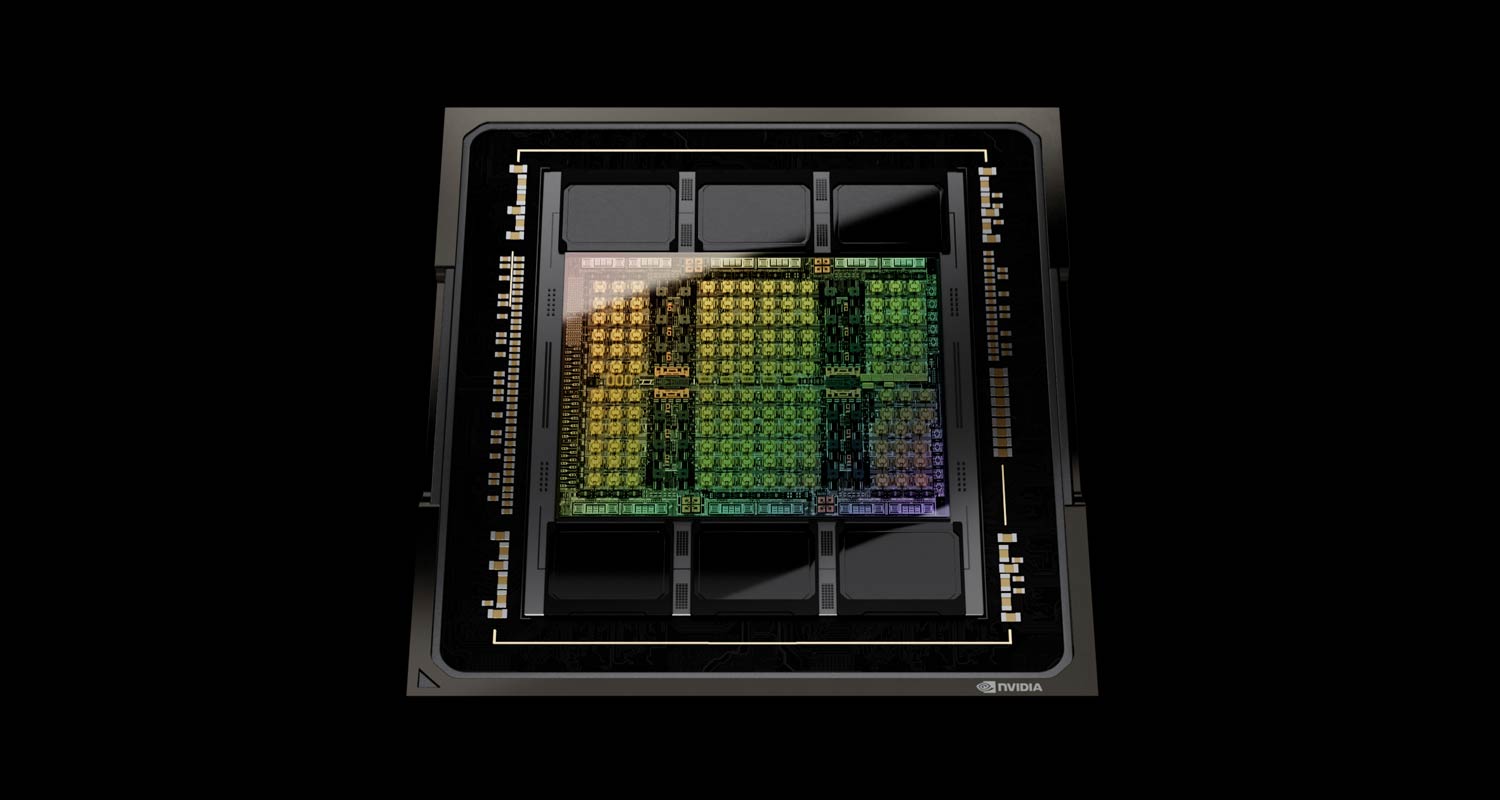
    Nvidia’s H100 has fuelled a boom in the company’s share price

    Computer components are not usually expected to transform entire businesses and industries, but a graphics processing unit Nvidia released in 2023 has done just that.

    The H100 data centre chip has added more than US$1-trillion to Nvidia’s value and turned the company into an AI kingmaker overnight. It’s shown investors that the buzz around generative artificial intelligence is translating into real revenue, at least for Nvidia and its most essential suppliers.

    Demand for the H100 is so great that some customers are having to wait as long as six months to receive it.

    1. What is the Nvidia H100 chip?

    The H100, whose name is a nod to computer science pioneer Grace Hopper, is a graphics processor. It’s a beefier version of a type of chip that normally lives in PCs and helps gamers get the most realistic visual experience. But it’s been optimised to process vast volumes of data and computation at high speeds, making it a perfect fit for the power-intensive task of training AI models. Nvidia, founded in 1993, pioneered this market with investments dating back almost two decades, when it bet that the ability to do work in parallel would one day make its chips valuable in applications outside of gaming.

    2. Why is the H100 so special?

    Generative AI platforms learn to complete tasks such as translating text, summarising reports and synthesising images by training on huge tomes of preexisting material. The more they see, the better they become at things like recognising human speech or writing job cover letters. They develop through trial and error, making billions of attempts to achieve proficiency and sucking up huge amounts of computing power in the process. Nvidia says the H100 is four times faster than the chip’s predecessor, the A100, at training these so-called large language models, or LLMs, and is 30 times faster replying to user prompts. For companies racing to train LLMs to perform new tasks, that performance edge can be critical.

    3. How did Nvidia become a leader in AI?

    The Santa Clara, California company is the world leader in graphics chips, the bits of a computer that generate the images you see on the screen. The most powerful of those are built with hundreds of processing cores that perform multiple simultaneous threads of computation, modelling complex physics like shadows and reflections. Nvidia’s engineers realised in the early 2000s that they could retool graphics accelerators for other applications, by dividing tasks up into smaller lumps and then working on them at the same time. Just over a decade ago, AI researchers discovered that their work could finally be made practical by using this type of chip.

    4. Does Nvidia have any real competitors?

    Nvidia controls about 80% of the market for accelerators in the AI data centres operated by Amazon.com’s AWS, Alphabet’s Google Cloud and Microsoft’s Azure. Those companies’ in-house efforts to build their own chips, and rival products from chip makers such as AMD and Intel, haven’t made much of an impression on the AI accelerator market so far.
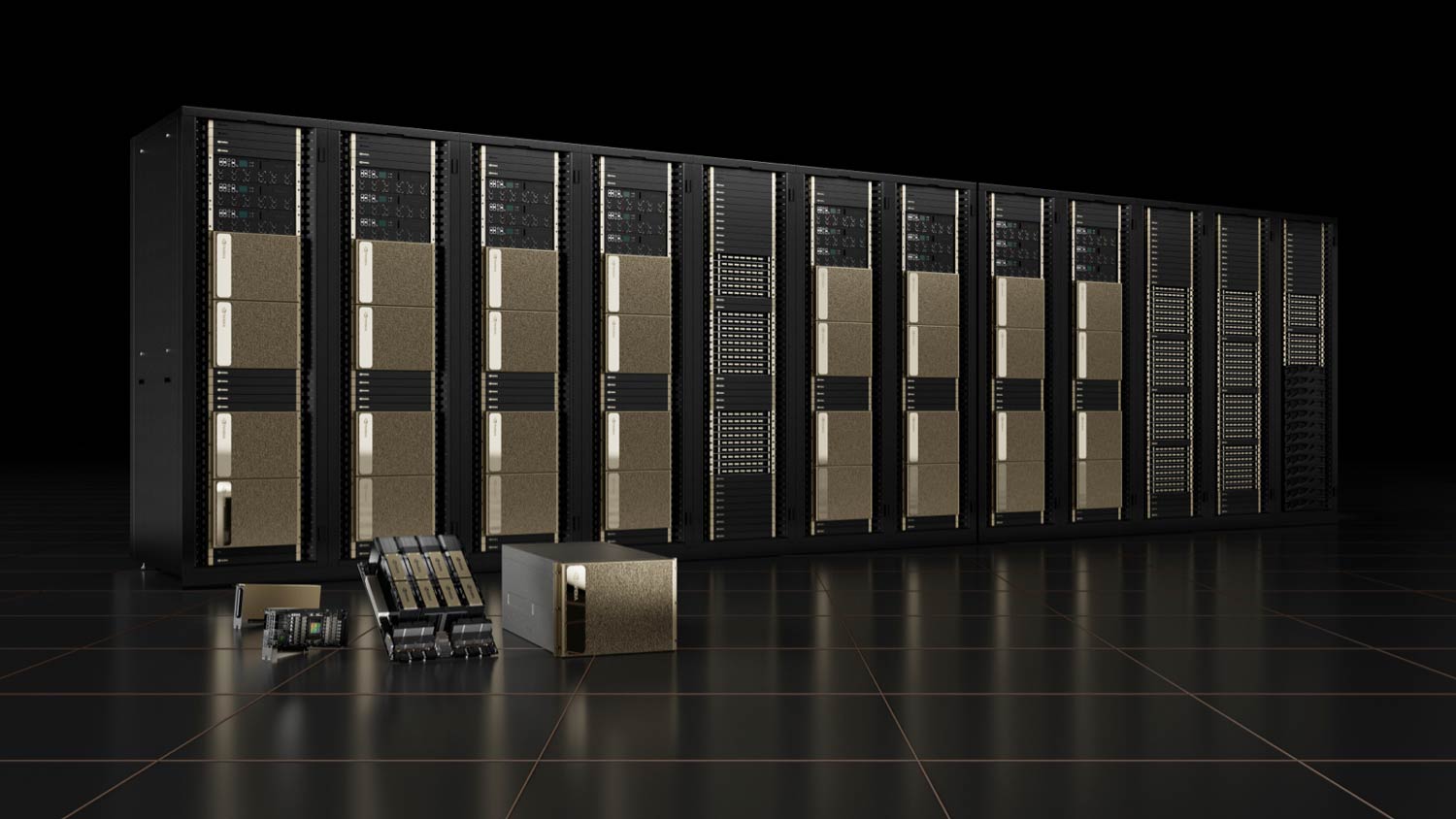
    The Nvidia H100 family of data centre products. Image: Nvidia

    5. How does Nvidia stay ahead of its competitors?

    Nvidia has rapidly updated its offerings, including software to support the hardware, at a pace that no other firm has yet been able to match. The company has also devised various cluster systems that help its customers buy H100s in bulk and deploy them quickly. Chips like Intel’s Xeon processors are capable of more complex data crunching, but they have fewer cores and are much slower at working through the mountains of information typically used to train AI software. Nvidia’s data centre division posted an 81% increase in revenue to $22-billion in the final quarter of 2023.

    6. How do AMD and Intel compare to Nvidia?

    AMD, the second largest maker of computer graphics chips, unveiled a version of its Instinct line in June aimed at the market that Nvidia’s products dominate. The chip, called MI300X, has more memory to handle workloads for generative AI, AMD CEO Lisa Su told the audience at an event in San Francisco. “We are still very, very early in the life cycle of AI,” she said in December. Intel is bringing specific chips for AI workloads to the market but acknowledged that, for now, demand for data centre graphics chips is growing faster than for the processor units that were traditionally its strength. Nvidia’s advantage isn’t just in the performance of its hardware. The company invented something called Cuda, a language for its graphics chips that allows them to be programmed for the type of work that underpins AI programs.

    7. What is Nvidia planning on releasing next?

    Later this year, the H100 will pass the torch to a successor, the H200, before Nvidia makes more substantial changes to the design with a B100 model further down the road. CEO Jensen Huang has acted as an ambassador for the technology and sought to get governments, as well as private enterprise, to buy early or risk being left behind by those who embrace AI. Nvidia also knows that once customers choose its technology for their generative AI projects, it’ll have a much easier time selling them upgrades than competitors hoping to draw users away.  — (c) 2024 Bloomberg LP

    Get breaking news alerts from TechCentral on WhatsApp

    Follow TechCentral on Google News Add TechCentral as your preferred source on Google


    AMD Grace Hopper Jensen Huang Lisa Su Nvidia Nvidia B100 Nvidia H100 Nvidia H200
    WhatsApp YouTube
    Share. Facebook Twitter LinkedIn WhatsApp Telegram Email Copy Link
    Previous ArticleCell C ready to pay outstanding spectrum bill
    Next Article Politicians spin wheels amid e-tolls shambles

    Related Posts

    Microsoft just had the biggest day in stock market history

    Microsoft just had the biggest day in stock market history

    31 July 2026
    Intel is back in the game - Intel CEO Lip-Bu Tan. Laure Andrillon/Reuters

    Intel is back in the game

    24 July 2026
    From care homes to production lines, the robots are coming

    From care homes to production lines, the robots are coming

    21 July 2026
    Company News
    Domains.co.za launches self-hosted n8n VPS hosting

    Domains.co.za launches self-hosted n8n VPS hosting

    31 July 2026
    Smarter.tech '26 shows why smarter technology begins with context - Obsidian Systems

    Context is the missing piece in enterprise AI: Obsidian

    31 July 2026
    Huawei launches 12 intelligent transport solutions in South Africa - Sam Tang

    Huawei launches 12 intelligent transport solutions in South Africa

    30 July 2026
    Opinion
    The author, Jannie van Zyl

    Selling vapour is corporate suicide in slow motion

    16 July 2026
    Brazil's online gambling crackdown is a lesson for South Africa

    How Amazon outmanoeuvred Starlink in South Africa

    15 July 2026
    The Popia problem with agentic AI - Herman Haasbroek

    The Popia problem with agentic AI

    14 July 2026

    Subscribe to Updates

    Get the best South African technology news and analysis delivered to your e-mail inbox every morning.

    Latest Posts
    Nedbank hires MTN's former tech chief as group CIO - Nikos Angelopoulos

    Nedbank hires MTN’s former tech chief as group CIO

    31 July 2026
    Eskom's diesel bill falls 86% as breakdowns hit eight-year low

    Eskom’s diesel bill falls 86% as breakdowns hit eight-year low

    31 July 2026
    Ramaphosa signs off on taking the grid away from Eskom

    Ramaphosa signs off on taking the grid away from Eskom

    31 July 2026
    TCS+ | Why South African workers must become supervisors of digital labour - Accelera Digital Group Cliff de Wit

    TCS+ | Why South African workers must become supervisors of digital labour

    31 July 2026
    © 2009 - 2026 NewsCentral Media
    Built and maintained by Chronon
    • Cookie policy (ZA)
    • TechCentral – privacy and Popia

    Type above and press Enter to search. Press Esc to cancel.

    Manage consent

    TechCentral uses cookies to enhance its offerings. Consenting to these technologies allows us to serve you better. Not consenting or withdrawing consent may adversely affect certain features and functions of the website.

    Functional Always active
    The technical storage or access is strictly necessary for the legitimate purpose of enabling the use of a specific service explicitly requested by the subscriber or user, or for the sole purpose of carrying out the transmission of a communication over an electronic communications network.
    Preferences
    The technical storage or access is necessary for the legitimate purpose of storing preferences that are not requested by the subscriber or user.
    Statistics
    The technical storage or access that is used exclusively for statistical purposes. The technical storage or access that is used exclusively for anonymous statistical purposes. Without a subpoena, voluntary compliance on the part of your Internet Service Provider, or additional records from a third party, information stored or retrieved for this purpose alone cannot usually be used to identify you.
    Marketing
    The technical storage or access is required to create user profiles to send advertising, or to track the user on a website or across several websites for similar marketing purposes.
    • Manage options
    • Manage services
    • Manage {vendor_count} vendors
    • Read more about these purposes
    View preferences
    • {title}
    • {title}
    • {title}