Close Menu
TechCentralTechCentral

    Subscribe to the newsletter

    Get the best South African technology news and analysis delivered to your e-mail inbox every morning.

    Facebook X (Twitter) YouTube LinkedIn
    WhatsApp Facebook X (Twitter) LinkedIn YouTube
    TechCentralTechCentral
    • News
      Big Microsoft 365 price increases coming next year

      Big Microsoft price increases coming next year

      5 December 2025
      Vodacom to take control of Safaricom in R36-billion deal - Shameel Joosub

      Vodacom to take control of Safaricom in R36-billion deal

      4 December 2025
      Black Friday goes digital in South Africa as online spending surges to record high

      Black Friday goes digital in South Africa as online spending surges to record high

      4 December 2025
      BYD takes direct aim at Toyota with launch of sub-R500 000 Sealion 5 PHEV

      BYD takes direct aim at Toyota with launch of sub-R500 000 Sealion 5 PHEV

      4 December 2025
      'Get it now': Takealot in new instant deliveries pilot

      ‘Get it now’: Takealot in new instant deliveries pilot

      4 December 2025
    • World
      Amazon and Google launch multi-cloud service for faster connectivity

      Amazon and Google launch multi-cloud service for faster connectivity

      1 December 2025
      Google makes final court plea to stop US breakup

      Google makes final court plea to stop US breakup

      21 November 2025
      Bezos unveils monster rocket: New Glenn 9x4 set to dwarf Saturn V

      Bezos unveils monster rocket: New Glenn 9×4 set to dwarf Saturn V

      21 November 2025
      Tech shares turbocharged by Nvidia's stellar earnings

      Tech shares turbocharged by stellar Nvidia earnings

      20 November 2025
      Config file blamed for Cloudflare meltdown that disrupted the web

      Config file blamed for Cloudflare meltdown that disrupted the web

      19 November 2025
    • In-depth
      Jensen Huang Nvidia

      So, will China really win the AI race?

      14 November 2025
      Valve's Linux console takes aim at Microsoft's gaming empire

      Valve’s Linux console takes aim at Microsoft’s gaming empire

      13 November 2025
      iOCO's extraordinary comeback plan - Rhys Summerton

      iOCO’s extraordinary comeback plan

      28 October 2025
      Why smart glasses keep failing - no, it's not the tech - Mark Zuckerberg

      Why smart glasses keep failing – it’s not the tech

      19 October 2025
      BYD to blanket South Africa with megawatt-scale EV charging network - Stella Li

      BYD to blanket South Africa with megawatt-scale EV charging network

      16 October 2025
    • TCS
      TCS+ | How Cloud on Demand helps partners thrive in the AWS ecosystem - Odwa Ndyaluvane and Xenia Rhode

      TCS+ | How Cloud On Demand helps partners thrive in the AWS ecosystem

      4 December 2025
      TCS | MTN Group CEO Ralph Mupita on competition, AI and the future of mobile

      TCS | Ralph Mupita on competition, AI and the future of mobile

      28 November 2025
      TCS | Dominic Cull on fixing South Africa's ICT policy bottlenecks

      TCS | Dominic Cull on fixing South Africa’s ICT policy bottlenecks

      21 November 2025
      TCS | BMW CEO Peter van Binsbergen on the future of South Africa's automotive industry

      TCS | BMW CEO Peter van Binsbergen on the future of South Africa’s automotive industry

      6 November 2025
      TCS | Why Altron is building an AI factory - Bongani Andy Mabaso

      TCS | Why Altron is building an AI factory in Johannesburg

      28 October 2025
    • Opinion
      Your data, your hardware: the DIY AI revolution is coming - Duncan McLeod

      Your data, your hardware: the DIY AI revolution is coming

      20 November 2025
      Zero Carbon Charge founder Joubert Roux

      The energy revolution South Africa can’t afford to miss

      20 November 2025
      It's time for a new approach to government IT spend in South Africa - Richard Firth

      It’s time for a new approach to government IT spend in South Africa

      19 November 2025
      How South Africa's broken Rica system fuels murder and mayhem - Farhad Khan

      How South Africa’s broken Rica system fuels murder and mayhem

      10 November 2025
      South Africa's AI data centre boom risks overloading a fragile grid - Paul Colmer

      South Africa’s AI data centre boom risks overloading a fragile grid

      30 October 2025
    • Company Hubs
      • Africa Data Centres
      • AfriGIS
      • Altron Digital Business
      • Altron Document Solutions
      • Altron Group
      • Arctic Wolf
      • AvertITD
      • Braintree
      • CallMiner
      • CambriLearn
      • CYBER1 Solutions
      • Digicloud Africa
      • Digimune
      • Domains.co.za
      • ESET
      • Euphoria Telecom
      • Incredible Business
      • iONLINE
      • IQbusiness
      • Iris Network Systems
      • LSD Open
      • NEC XON
      • Netstar
      • Network Platforms
      • Next DLP
      • Ovations
      • Paracon
      • Paratus
      • Q-KON
      • SevenC
      • SkyWire
      • Solid8 Technologies
      • Telit Cinterion
      • Tenable
      • Vertiv
      • Videri Digital
      • Vodacom Business
      • Wipro
      • Workday
      • XLink
    • Sections
      • AI and machine learning
      • Banking
      • Broadcasting and Media
      • Cloud services
      • Contact centres and CX
      • Cryptocurrencies
      • Education and skills
      • Electronics and hardware
      • Energy and sustainability
      • Enterprise software
      • Financial services
      • Information security
      • Internet and connectivity
      • Internet of Things
      • Investment
      • IT services
      • Lifestyle
      • Motoring
      • Public sector
      • Retail and e-commerce
      • Satellite communications
      • Science
      • SMEs and start-ups
      • Social media
      • Talent and leadership
      • Telecoms
    • Events
    • Advertise
    TechCentralTechCentral
    Home » In-depth » Observing the universe with a camera travelling near the speed of light

    Observing the universe with a camera travelling near the speed of light

    By The Conversation3 July 2018
    Twitter LinkedIn Facebook WhatsApp Email Telegram Copy Link
    News Alerts
    WhatsApp

    Astronomers strive to observe the universe via ever-more advanced techniques. Whenever researchers invent a new method, unprecedented information is collected, and people’s understanding of the cosmos deepens.

    An ambitious programme to blast cameras far beyond the solar system was announced in April 2016 by Internet investor and science philanthropist Yuri Milner, late physicist Stephen Hawking and Facebook CEO Mark Zuckerberg. Called Breakthrough Starshot, the idea is to send a bunch of tiny nano-spacecraft to the sun’s closest stellar neighbour, the three-star Alpha Centauri system. Travelling at around 20% the speed of light — so as fast as 160 million kilometres per hour — the craft and their tiny cameras would aim for the smallest but closest star in the system, Proxima Centari, and its planet Proxima b, 4.26 light years from Earth.

    The Breakthrough Starshot team’s goal will rely on a few as-yet-unproven technologies. The plan is to use light sails to get these spacecraft further and faster than anything that’s come before — lasers on Earth will push the tiny ships via their super-thin and reflective sails. I have another idea that could piggyback on this technology as the project is gearing up: researchers could get valuable data from these mobile observatories, even directly test Einstein’s theory of special relativity, long before they get anywhere close to Alpha Centauri.

    Achieving Breakthrough Starshot’s goal is by no means an easy task. The project relies on continuing technological development on three independent fronts.

    First, researchers will need to dramatically decrease the size and weight of microelectronic components to make a camera. Each nanocraft is planned to be no more than a few grams in total — and that will have to include not just the camera, but also other payloads including power supply and communication equipment.

    Another challenge will be to build thin, ultra-light and highly reflective materials to serve as the “sail” for the camera. One possibility is to have a single-layer graphene sail — just a molecule thick, only 0.345 nanometer.
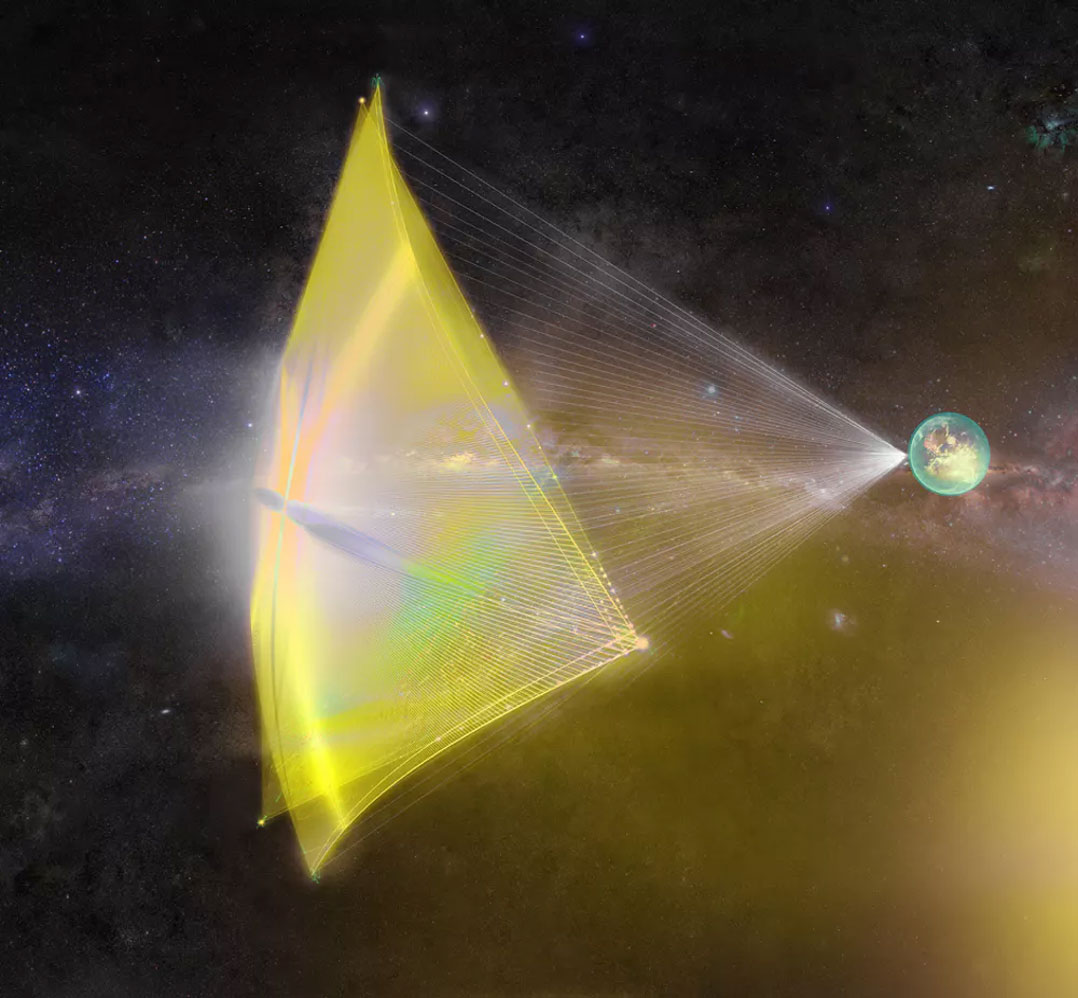
    Artist’s rendition of lasers pushing a craft through space via lightsail. Breakthrough Prize Foundation

    The Breakthrough Starshot team will benefit from the rising power and falling cost of laser beams. Lasers with 100GW power are needed to accelerate the cameras from the ground. Just as wind fills a sailboat’s sails and pushes it forward, the photons from a high-energy laser beam can propel an ultralight reflective sail forward as they bounce back.

    With the projected technology development rate, it will likely be at least two more decades before scientists can launch a camera travelling with a speed a significant fraction of the speed of light.

    Even if such a camera could be built and accelerated, several more challenges must be overcome to fulfil the dream of reaching the Alpha Centauri system. Can researchers aim the cameras correctly so they reach the stellar system? Can the camera even survive the near 20-year journey without being damaged? And if it beats the odds and the trip goes well, will it be possible to transmit the data — say, images — back to Earth over such a huge distance?

    My collaborator Kunyang Li, a graduate student at Georgia Institute of Technology, and I see potential in all these technologies even before they’re perfected and ready to head out for Alpha Centauri.

    When a camera travels in space at close to the speed of light — what could be called “relativistic speed” — Einstein’s special theory of relativity plays a role in how the images taken by the camera will be modified. Einstein’s theory states that in different “rest frames” observers have different measures of the lengths of space and time. That is, space and time are relative. How differently the two observers measure things depends on how fast they’re moving with respect to each other. If the relative speed is close to the speed of light, their observations can differ significantly.
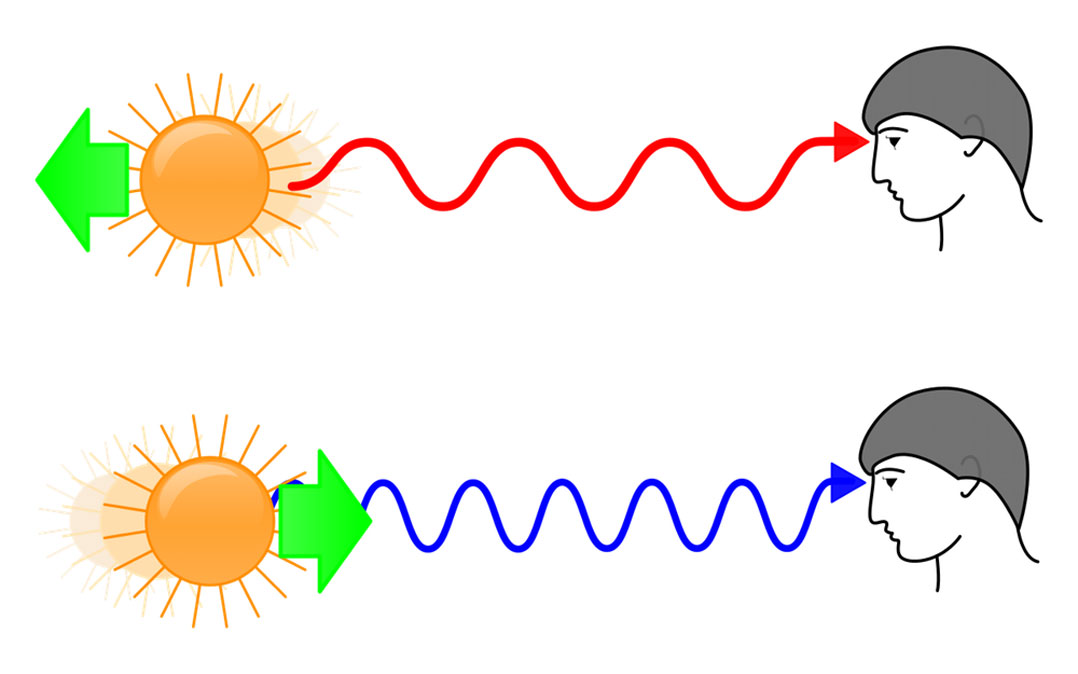
    The Doppler effect explains how a source moving away from you will stretch the wavelengths of its light and look redder, while if it’s moving closer the wavelengths will shorten and look bluer. Aleš Tošovský, CC BY-SA

    Special relativity also affects many other things physicists measure — for example, the frequency and intensity of light and also the size of an object’s appearance. In the rest frame of the camera, the entire universe is moving at a good fraction of the speed of light in the opposite direction of the camera’s own motion. To an imaginary person on board, thanks to the different spacetimes experienced by him and everyone back on Earth, the light from a star or galaxy would appear bluer, brighter and more compact, and the angular separation between two objects would look smaller.

    Our idea is to take advantage of these features of special relativity to observe familiar objects in the relativistic camera’s different spacetime rest frame. This can provide a new mode to study astronomy — what we’re calling “relativistic astronomy”.
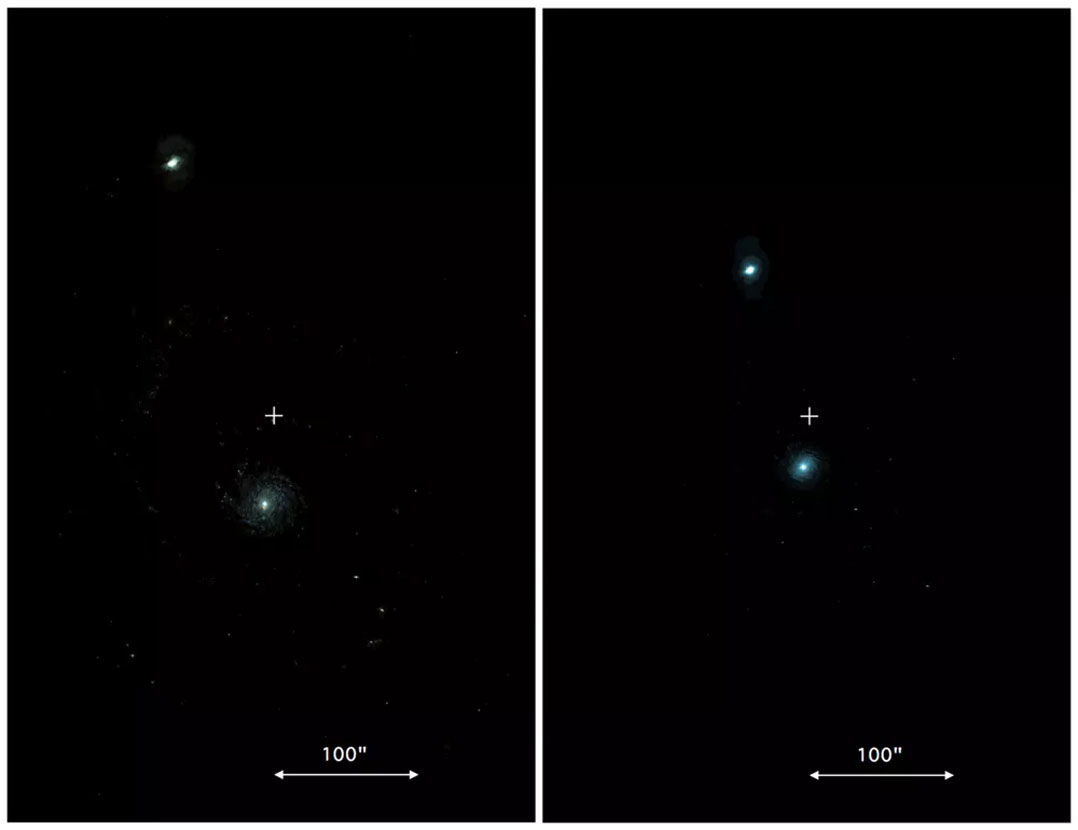
    Observed image of nearby galaxy M51 on the left. On the right, how the image would look through a camera moving at half the speed of light: brighter, bluer and with the stars in the galaxy closer together. Zhang & Li, 2018, The Astrophysical Journal, 854, 123, CC BY-ND

    What could the camera capture?

    So, a relativistic camera would naturally serve as a spectrograph, allowing researchers to look at an intrinsically redder band of light. It would act as a lens, magnifying the amount of light it collects. And it would be a wide-field camera, letting astronomers observe more objects within the same field of view of the camera.

    Here’s one example of the kind of data we could gather using the relativistic camera. Due to the expansion of the universe, the light from the early universe is redder by the time it reaches Earth than when it started. Physicists call this effect red-shifting: As the light travels, its wavelength stretches as it expands along with the universe. Red light has longer wavelengths than blue light. All this means that to see red-shifted light from the young universe, one must use the difficult-to-observe infrared wavelengths to collect it.
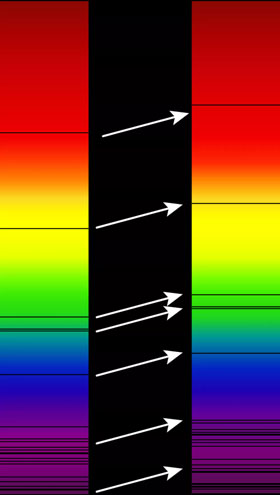
    An example of red-shift: On the right, absorption lines occur closer to the red end of the spectrum. Georg Wiora, CC BY-SA

    Enter the relativistic camera. To a camera moving at close to the speed of light, such red-shifted light becomes bluer — that is, it’s now blue-shifted. The effect of the camera’s motion counteracts the effect of the universe’s expansion. Now an astronomer could catch that light using the familiar visible light camera. The same Doppler boosting effect also allows the faint light from the early universe to be amplified, aiding detection. Observing the spectral features of distant objects can allow us to reveal the history of the early universe, especially how the universe evolved after it became transparent 380 000 years after the Big Bang.

    Another exciting aspect of relativistic astronomy is that humankind can directly test the principles of special relativity using macroscopic measurements for the first time. Comparing the observations collected on the relativistic camera and those collected from ground, astronomers could precisely test the fundamental predictions of Einstein’s relativity regarding change of frequency, flux and light travel direction in different rest frames.

    Compared to the ultimate goals of the Starshot project, observing the universe using relativistic cameras should be easier. Astronomers wouldn’t need to worry about aiming the camera, since it could get interesting results when sent in any direction. The data transmission problem is somewhat alleviated since the distances wouldn’t be as great. Same with the technical difficulty of protecting the camera.

    We propose that trying out relativistic cameras for astronomical observations could be a forerunner of the full Starshot project. And humankind will have a new astronomical “observatory” to study the universe in an unprecedented way. History suggests that opening a new window like this will unveil many previously undetected treasures.The Conversation

    • Written by Bing Zhang, professor of astrophysics, University of Nevada, Las Vegas
    • This article was originally published on The Conversation


    Mark Zuckerberg Stephen Hawking Yuri Milner
    Subscribe to TechCentral Subscribe to TechCentral
    Share. Facebook Twitter LinkedIn WhatsApp Telegram Email Copy Link
    Previous ArticleFibreCo to target smaller towns, starting with Kroonstad
    Next Article Is this the next big breakthrough in tech?

    Related Posts

    Why smart glasses keep failing - no, it's not the tech - Mark Zuckerberg

    Why smart glasses keep failing – it’s not the tech

    19 October 2025
    Mark Zuckerberg bets future of computing on AI-powered Ray-Bans

    Mark Zuckerberg bets future of computing on AI-powered Ray-Bans

    18 September 2025
    Meta created flirty chatbot of Taylor Swift without permission

    Meta created flirty chatbot of Taylor Swift without permission

    31 August 2025
    Company News
    AI is not a technology problem - iqbusiness

    AI is not a technology problem – iqbusiness

    5 December 2025
    Telcos are sitting on a data gold mine - but few know what do with it - Phillip du Plessis

    Telcos are sitting on a data gold mine – but few know what do with it

    4 December 2025
    Unlock smarter computing with your surface Copilot+ PC

    Unlock smarter computing with your Surface Copilot+ PC

    4 December 2025
    Opinion
    Your data, your hardware: the DIY AI revolution is coming - Duncan McLeod

    Your data, your hardware: the DIY AI revolution is coming

    20 November 2025
    Zero Carbon Charge founder Joubert Roux

    The energy revolution South Africa can’t afford to miss

    20 November 2025
    It's time for a new approach to government IT spend in South Africa - Richard Firth

    It’s time for a new approach to government IT spend in South Africa

    19 November 2025

    Subscribe to Updates

    Get the best South African technology news and analysis delivered to your e-mail inbox every morning.

    Latest Posts
    Big Microsoft 365 price increases coming next year

    Big Microsoft price increases coming next year

    5 December 2025
    AI is not a technology problem - iqbusiness

    AI is not a technology problem – iqbusiness

    5 December 2025
    Vodacom to take control of Safaricom in R36-billion deal - Shameel Joosub

    Vodacom to take control of Safaricom in R36-billion deal

    4 December 2025
    Black Friday goes digital in South Africa as online spending surges to record high

    Black Friday goes digital in South Africa as online spending surges to record high

    4 December 2025
    © 2009 - 2025 NewsCentral Media
    • Cookie policy (ZA)
    • TechCentral – privacy and Popia

    Type above and press Enter to search. Press Esc to cancel.

    Manage consent

    TechCentral uses cookies to enhance its offerings. Consenting to these technologies allows us to serve you better. Not consenting or withdrawing consent may adversely affect certain features and functions of the website.

    Functional Always active
    The technical storage or access is strictly necessary for the legitimate purpose of enabling the use of a specific service explicitly requested by the subscriber or user, or for the sole purpose of carrying out the transmission of a communication over an electronic communications network.
    Preferences
    The technical storage or access is necessary for the legitimate purpose of storing preferences that are not requested by the subscriber or user.
    Statistics
    The technical storage or access that is used exclusively for statistical purposes. The technical storage or access that is used exclusively for anonymous statistical purposes. Without a subpoena, voluntary compliance on the part of your Internet Service Provider, or additional records from a third party, information stored or retrieved for this purpose alone cannot usually be used to identify you.
    Marketing
    The technical storage or access is required to create user profiles to send advertising, or to track the user on a website or across several websites for similar marketing purposes.
    • Manage options
    • Manage services
    • Manage {vendor_count} vendors
    • Read more about these purposes
    View preferences
    • {title}
    • {title}
    • {title}