Close Menu
TechCentralTechCentral

    Subscribe to the newsletter

    Get the best South African technology news and analysis delivered to your e-mail inbox every morning.

    Facebook X (Twitter) YouTube LinkedIn
    WhatsApp Facebook X (Twitter) LinkedIn YouTube
    TechCentralTechCentral
    • News
      Blu Label takes R5.2-billion Cell C hit, touts clean slate ahead

      Blu Label takes R5.2-billion Cell C hit, touts clean slate ahead

      19 February 2026
      MeerKAT detects most powerful natural radio laser ever observed

      MeerKAT detects most powerful natural radio laser ever observed

      19 February 2026
      How AI is rewriting the rules of consulting - Mark Allderman

      How AI is rewriting the rules of consulting

      19 February 2026
      Crackdown on students gambling away Nsfas money online

      Crackdown on students gambling away Nsfas money online

      19 February 2026
      Meta may launch AI-powered smartwatch in 2026

      Meta may launch AI-powered smartwatch in 2026

      19 February 2026
    • World
      Prominent Southern African journalist targeted with Predator spyware

      Prominent Southern African journalist targeted with Predator spyware

      18 February 2026
      More drama in Warner Bros tug of war

      More drama in Warner Bros tug of war

      17 February 2026
      Russia bans WhatsApp

      Russia bans WhatsApp

      12 February 2026
      EU regulators take aim at WhatsApp

      EU regulators take aim at WhatsApp

      9 February 2026
      Musk hits brakes on Mars mission

      Musk hits brakes on Mars mission

      9 February 2026
    • In-depth
      How liberalisation is rewiring South Africa's power sector

      How liberalisation is rewiring South Africa’s power sector

      21 January 2026
      The top-performing South African tech shares of 2025

      The top-performing South African tech shares of 2025

      12 January 2026
      Digital authoritarianism grows as African states normalise internet blackouts

      Digital authoritarianism grows as African states normalise internet blackouts

      19 December 2025
      TechCentral's South African Newsmakers of 2025

      TechCentral’s South African Newsmakers of 2025

      18 December 2025
      Black Friday goes digital in South Africa as online spending surges to record high

      Black Friday goes digital in South Africa as online spending surges to record high

      4 December 2025
    • TCS
      Watts & Wheels S1E4: 'We drive an electric Uber'

      Watts & Wheels S1E4: ‘We drive an electric Uber’

      10 February 2026
      TCS+ | How Cloud On Demand is helping SA businesses succeed in the cloud - Xhenia Rhode, Dion Kalicharan

      TCS+ | Cloud On Demand and Consnet: inside a real-world AWS partner success story

      30 January 2026
      Watts & Wheels S1E4: 'We drive an electric Uber'

      Watts & Wheels S1E3: ‘BYD’s Corolla Cross challenger’

      30 January 2026
      Watts & Wheels S1E4: 'We drive an electric Uber'

      Watts & Wheels S1E2: ‘China attacks, BMW digs in, Toyota’s sublime supercar’

      23 January 2026

      TCS+ | Why cybersecurity is becoming a competitive advantage for SA businesses

      20 January 2026
    • Opinion
      A million reasons monopolies don't work - Duncan McLeod

      A million reasons monopolies don’t work

      10 February 2026
      The author, Business Leadership South Africa CEO Busi Mavuso

      Eskom unbundling U-turn threatens to undo hard-won electricity gains

      9 February 2026
      South Africa's skills advantage is being overlooked at home - Richard Firth

      South Africa’s skills advantage is being overlooked at home

      29 January 2026
      Why Elon Musk's Starlink is a 'hard no' for me - Songezo Zibi

      Why Elon Musk’s Starlink is a ‘hard no’ for me

      26 January 2026
      A million reasons monopolies don't work - Duncan McLeod

      South Africa’s new fibre broadband battle

      20 January 2026
    • Company Hubs
      • Africa Data Centres
      • AfriGIS
      • Altron Digital Business
      • Altron Document Solutions
      • Altron Group
      • Arctic Wolf
      • AvertITD
      • Braintree
      • CallMiner
      • CambriLearn
      • CYBER1 Solutions
      • Digicloud Africa
      • Digimune
      • Domains.co.za
      • ESET
      • Euphoria Telecom
      • Incredible Business
      • iONLINE
      • IQbusiness
      • Iris Network Systems
      • LSD Open
      • Mitel
      • NEC XON
      • Netstar
      • Network Platforms
      • Next DLP
      • Ovations
      • Paracon
      • Paratus
      • Q-KON
      • SevenC
      • SkyWire
      • Solid8 Technologies
      • Telit Cinterion
      • Tenable
      • Vertiv
      • Videri Digital
      • Vodacom Business
      • Wipro
      • Workday
      • XLink
    • Sections
      • AI and machine learning
      • Banking
      • Broadcasting and Media
      • Cloud services
      • Contact centres and CX
      • Cryptocurrencies
      • Education and skills
      • Electronics and hardware
      • Energy and sustainability
      • Enterprise software
      • Financial services
      • Information security
      • Internet and connectivity
      • Internet of Things
      • Investment
      • IT services
      • Lifestyle
      • Motoring
      • Public sector
      • Retail and e-commerce
      • Satellite communications
      • Science
      • SMEs and start-ups
      • Social media
      • Talent and leadership
      • Telecoms
    • Events
    • Advertise
    TechCentralTechCentral
    Home » Science » Hints of a giant planet beyond Pluto

    Hints of a giant planet beyond Pluto

    By The Conversation21 January 2016
    Twitter LinkedIn Facebook WhatsApp Email Telegram Copy Link
    News Alerts
    WhatsApp
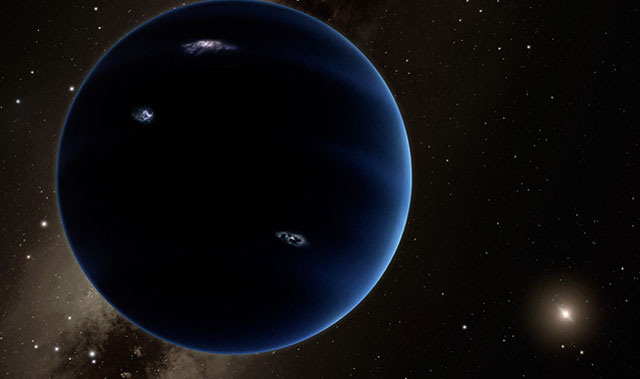
    Artist's rendition of the possible "Planet Nine" looking back towards the sun. Image: Caltech/R Hurt (IPAC)
    Artist’s rendition of the possible “Planet Nine” looking back towards the sun. Image: Caltech/R Hurt (IPAC)

    There’s plenty of excitement at the announcement overnight that a new planet is potentially waiting to be found at the extremes of our solar system.

    The possible ninth planet is thought to be quite substantial, with a mass around 10 times that of Earth and a radius that’s two to four times bigger. This characterises it as a Neptune-like object.

    What’s truly remarkable about Planet Nine, as it has been dubbed, is its very long orbit. It is estimated to take between 10 000 to 20 000 years to orbit our sun, on an elliptical orbit that stretches way beyond the Kuiper Belt.

    The Kuiper Belt is a ring of icy objects (which includes Pluto) that circles the sun beyond the orbit of Neptune. Neptune orbits about 30 times further from the sun than the Earth and astronomers refer to Neptune’s distance from the sun as being 30 astronomical units (au) (where one au is the Earth-sun distance). Pluto follows an elliptical orbit that brings it as close as 29,7au from the sun, then out to almost 50au at its most distant point.

    Planet Nine’s proposed elliptical orbit takes it from 200au at its closest to the sun (or perihelion) and between 500au to 1 200au at its furthest (aphelion). When it comes in close, it should be bright enough for high-spec backyard telescopes to pick it up.

    But unfortunately, most of the time the planet will be much more distant and that represents a greater challenge. It will require the world’s largest telescopes, such as the 10m diameter Keck telescopes and Japan’s 8,2m Subaru telescope (both located on Mauna Kea in Hawaii) to have a hope of seeing it.
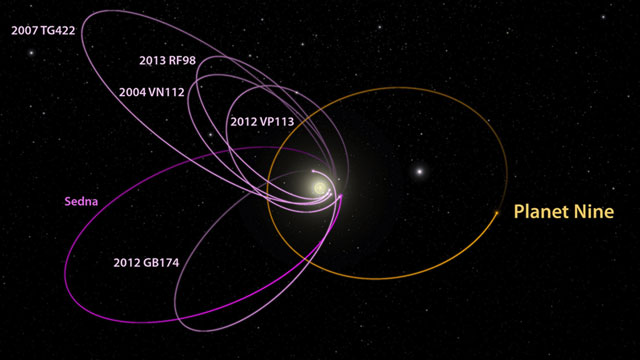
    The six most distant known objects in the solar system with orbits exclusively beyond Neptune (magenta) all mysteriously line up in a single direction. Also, when viewed in three dimensions, they all tilt nearly identically away from the plane of the solar system. Batygin and Brown show that a planet with 10 times the mass of the Earth in a distant eccentric orbit anti-aligned with the other six objects (orange) is required to maintain this configuration. The diagram was created using WorldWide Telescope. Caltech/R Hurt (IPAC)
    The six most distant known objects in the solar system with orbits exclusively beyond Neptune (magenta) all mysteriously line up in a single direction. Also, when viewed in three dimensions, they all tilt nearly identically away from the plane of the solar system. Batygin and Brown show that a planet with 10 times the mass of the Earth in a distant eccentric orbit anti-aligned with the other six objects (orange) is required to maintain this configuration. The diagram was created using WorldWide Telescope. Caltech/R Hurt (IPAC)

    But the planet has yet to be seen. So why is it thought to be out there? And how can we know so much about it? Planet Nine is the best fit to explain the orbits of six distant objects.

    What’s odd about these six objects is that they have peculiar but remarkably similar orbits. These objects have been nudged off kilter and yet they are all shepherded together in the same region of space.

    The first of these objects to be discovered was Sedna. It was observed in 2003, as it approached perihelion. When its 11 400-year orbit was calculated, the discovery team realised that this object was orbiting in a kind of “no-man’s land” (or more correctly “no-person’s land”).

    It was too distant to belong to the Kuiper Belt and not far enough away to be among the sphere of comets orbiting the sun in the Oort Cloud.
    Sedna was also beyond the gravitational pull of Neptune, so something else, perhaps a large planet or possibly even a passing star (one of the sun’s many siblings perhaps), might have nudged it off course. What makes Planet Nine feasible is that it can explain the orbit of Sedna along with the other five objects.

    At their closest approach to the sun, these six objects sit within the plane of the solar system. Planet Nine would have an orbit that is anti-aligned to the six objects and provides the gravitational tug needed to keep those planets in check.

    And there’s more. What makes good science is when a proposed model explains something above and beyond its original intention. Simulations of Planet Nine predict that there should also be objects in the Kuiper Belt that have orbits perpendicularly inclined to the plane of the solar system.

    Turns out, these objects exist. Five such objects have been known about since 2002, although their orbits have been unexplained until now.
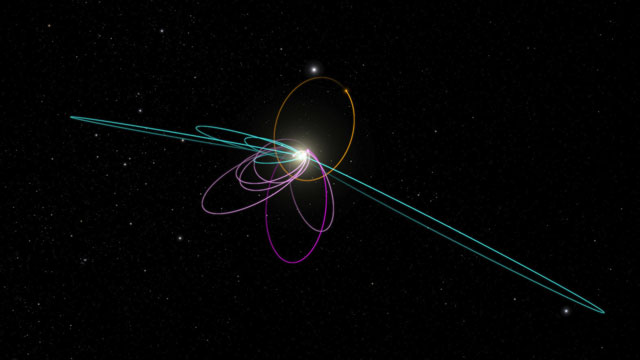
    A predicted consequence of Planet Nine is that a second set of confined objects should also exist. These objects are forced into positions at right angles to Planet Nine and into orbits that are perpendicular to the plane of the solar system. Five known objects (blue) fit this prediction precisely. This diagram was created using WorldWide Telescope. Caltech/R Hurt (IPAC)
    A predicted consequence of Planet Nine is that a second set of confined objects should also exist. These objects are forced into positions at right angles to Planet Nine and into orbits that are perpendicular to the plane of the solar system. Five known objects (blue) fit this prediction precisely. This diagram was created using WorldWide Telescope. Caltech/R Hurt (IPAC)

    Haven’t we seen this before?
    If Planet Nine does exist, it’s not the first time that a planet in our solar system has been discovered theoretically before being directly observed. In 1845, deviations in the orbit of Uranus suggested there might be an eighth planet to the solar system and in 1846, Neptune was observed exactly where it was predicted to be.

    There have also been predictions that haven’t stood the test of time. Back in the 1980s, scientists proposed that the sun might be a binary, with a dim undiscovered companion moving along on elongated orbit. Every 23m years (or so), this star named Nemesis would pass through the solar system causing a deluge of comets to impact Earth and produce mass extinctions.

    More recently, around the turn of the millennium, astronomers noticed an asymmetry in the distribution of new comets coming in from the Oort Cloud. In theory, comets should come evenly from all directions, but there was a slight excess distributed around a great circle on the sky. One of the explanations was that there could be a Jupiter-mass planet in the Oort cloud, known as Tyche.

    In 2014, Nasa’s Wide-Field Infrared Survey Explorer (WISE) examined the entire sky across infrared wavelengths. It was the perfect telescope to detect Nemesis or Tyche, but failed to find any evidence of either.

    Will we find Planet Nine?
    Scientists are sceptical by nature. It’s exciting to have a model that predicts the existence of Planet Nine, but this prediction must also be tested.

    Astronomers have begun searching through astronomical surveys, such as the WISE survey, the Catalina Sky Survey and the Pan STARRS surveys in the hope of making a sighting.

    So far, nothing has been seen. The conclusion, as described in a blog by astronomer Mike Brown (who proposed Planet Nine along with colleague Konstantin Batygin) is that if it exists, it is likely in the hardest place to find.

    It seems to currently be at its furthest point from the sun, at least 500au away; it’s probably fainter than 22nd magnitude (that’s 1 500 times fainter than Pluto); and very possibly it’s aligned with the plane of the Milky Way Galaxy (meaning that Planet Nine may currently be hidden against the background stars of our galaxy).

    Regardless, the hunt is on and there just may be a great discovery out there, waiting to happen.The Conversation

    • Tanya Hill is honorary fellow of the University of Melbourne and senior curator (astronomy) at Museum Victoria; Jonti Horner is vice chancellor’s senior research fellow at the University of Southern Queensland
    • This article was originally published on The Conversation

    Jonti Horner Mike Brown Nasa Planet Nine Tanya Hill
    WhatsApp YouTube Follow on Google News Add as preferred source on Google
    Share. Facebook Twitter LinkedIn WhatsApp Telegram Email Copy Link
    Previous ArticleMTN runs into trouble in Cameroon
    Next Article Post-PC era? Not even close

    Related Posts

    Musk hits brakes on Mars mission

    Musk hits brakes on Mars mission

    9 February 2026
    Breaking free from legacy thinking in banks: AI, automation and the agentic operating model - Steve Burke iqbusiness

    Breaking free from legacy thinking in banks: AI, automation and the agentic operating model

    15 January 2026
    Starlink satellite anomaly creates debris in rare orbital mishap

    Starlink satellite anomaly creates debris in rare orbital mishap

    19 December 2025
    Company News
    Customers have new expectations. Is your CX ready? 1Stream

    Customers have new expectations. Is your CX ready?

    19 February 2026
    South Africa's cybersecurity challenge is not a tool problem - Nicholas Applewhite, Trinexia South Africa

    South Africa’s cybersecurity challenge is not a tool problem

    19 February 2026
    The quiet infrastructure powering AI: why long-life IOT networks matter more than ever - Sigfox South Africa

    The quiet infrastructure powering AI: why long-life IoT networks matter more than ever

    18 February 2026
    Opinion
    A million reasons monopolies don't work - Duncan McLeod

    A million reasons monopolies don’t work

    10 February 2026
    The author, Business Leadership South Africa CEO Busi Mavuso

    Eskom unbundling U-turn threatens to undo hard-won electricity gains

    9 February 2026
    South Africa's skills advantage is being overlooked at home - Richard Firth

    South Africa’s skills advantage is being overlooked at home

    29 January 2026

    Subscribe to Updates

    Get the best South African technology news and analysis delivered to your e-mail inbox every morning.

    Latest Posts
    Blu Label takes R5.2-billion Cell C hit, touts clean slate ahead

    Blu Label takes R5.2-billion Cell C hit, touts clean slate ahead

    19 February 2026
    MeerKAT detects most powerful natural radio laser ever observed

    MeerKAT detects most powerful natural radio laser ever observed

    19 February 2026
    How AI is rewriting the rules of consulting - Mark Allderman

    How AI is rewriting the rules of consulting

    19 February 2026
    Crackdown on students gambling away Nsfas money online

    Crackdown on students gambling away Nsfas money online

    19 February 2026
    © 2009 - 2026 NewsCentral Media
    • Cookie policy (ZA)
    • TechCentral – privacy and Popia

    Type above and press Enter to search. Press Esc to cancel.

    Manage consent

    TechCentral uses cookies to enhance its offerings. Consenting to these technologies allows us to serve you better. Not consenting or withdrawing consent may adversely affect certain features and functions of the website.

    Functional Always active
    The technical storage or access is strictly necessary for the legitimate purpose of enabling the use of a specific service explicitly requested by the subscriber or user, or for the sole purpose of carrying out the transmission of a communication over an electronic communications network.
    Preferences
    The technical storage or access is necessary for the legitimate purpose of storing preferences that are not requested by the subscriber or user.
    Statistics
    The technical storage or access that is used exclusively for statistical purposes. The technical storage or access that is used exclusively for anonymous statistical purposes. Without a subpoena, voluntary compliance on the part of your Internet Service Provider, or additional records from a third party, information stored or retrieved for this purpose alone cannot usually be used to identify you.
    Marketing
    The technical storage or access is required to create user profiles to send advertising, or to track the user on a website or across several websites for similar marketing purposes.
    • Manage options
    • Manage services
    • Manage {vendor_count} vendors
    • Read more about these purposes
    View preferences
    • {title}
    • {title}
    • {title}