Close Menu
TechCentralTechCentral

    Subscribe to the newsletter

    Get the best South African technology news and analysis delivered to your e-mail inbox every morning.

    Facebook X (Twitter) YouTube LinkedIn
    WhatsApp Facebook X (Twitter) LinkedIn YouTube
    TechCentralTechCentral
    • News

      A leaner BCX positions itself as market consolidator

      11 December 2025
      Australia has banned kids from social media. Should South Africa follow suit?

      Australia has banned kids from social media. Should South Africa follow suit?

      11 December 2025
      Architects of AI named Time magazine's 'Person of the Year'

      Architects of AI named Time magazine’s ‘Person of the Year’

      11 December 2025
      Vodacom follows MTN with post-paid price hikes

      Vodacom follows MTN with post-paid price hikes

      11 December 2025
      Wi-Fi in minibus taxis to be scaled nationwide

      Wi-Fi in minibus taxis to be scaled nationwide

      11 December 2025
    • World
      Oracle’s AI ambitions face scrutiny on earnings miss

      Oracle’s AI ambitions face scrutiny on earnings miss

      11 December 2025
      China will get Nvidia H200 chips - but not without paying Washington first

      China will get Nvidia H200 chips – but not without paying Washington first

      9 December 2025
      IBM reportedly close to $11-billion deal to buy Confluent - Arvind Krishna

      IBM reportedly close to $11-billion deal to buy Confluent

      8 December 2025
      Amazon and Google launch multi-cloud service for faster connectivity

      Amazon and Google launch multi-cloud service for faster connectivity

      1 December 2025
      Google makes final court plea to stop US breakup

      Google makes final court plea to stop US breakup

      21 November 2025
    • In-depth
      Black Friday goes digital in South Africa as online spending surges to record high

      Black Friday goes digital in South Africa as online spending surges to record high

      4 December 2025
      Canal+ plays hardball - and DStv viewers feel the pain

      Canal+ plays hardball – and DStv viewers feel the pain

      3 December 2025
      Jensen Huang Nvidia

      So, will China really win the AI race?

      14 November 2025
      Valve's Linux console takes aim at Microsoft's gaming empire

      Valve’s Linux console takes aim at Microsoft’s gaming empire

      13 November 2025
      iOCO's extraordinary comeback plan - Rhys Summerton

      iOCO’s extraordinary comeback plan

      28 October 2025
    • TCS
      TCS+ | How Cloud on Demand helps partners thrive in the AWS ecosystem - Odwa Ndyaluvane and Xenia Rhode

      TCS+ | How Cloud On Demand helps partners thrive in the AWS ecosystem

      4 December 2025
      TCS | MTN Group CEO Ralph Mupita on competition, AI and the future of mobile

      TCS | Ralph Mupita on competition, AI and the future of mobile

      28 November 2025
      TCS | Dominic Cull on fixing South Africa's ICT policy bottlenecks

      TCS | Dominic Cull on fixing South Africa’s ICT policy bottlenecks

      21 November 2025
      TCS | BMW CEO Peter van Binsbergen on the future of South Africa's automotive industry

      TCS | BMW CEO Peter van Binsbergen on the future of South Africa’s automotive industry

      6 November 2025
      TCS | Why Altron is building an AI factory - Bongani Andy Mabaso

      TCS | Why Altron is building an AI factory in Johannesburg

      28 October 2025
    • Opinion
      Netflix, Warner Bros deal raises fresh headaches for MultiChoice - Duncan McLeod

      Netflix, Warner Bros deal raises fresh headaches for MultiChoice

      5 December 2025
      BIN scans, DDoS and the next cybercrime wave hitting South Africa's banks - Entersekt Gerhard Oosthuizen

      BIN scans, DDoS and the next cybercrime wave hitting South Africa’s banks

      3 December 2025
      Your data, your hardware: the DIY AI revolution is coming - Duncan McLeod

      Your data, your hardware: the DIY AI revolution is coming

      20 November 2025
      Zero Carbon Charge founder Joubert Roux

      The energy revolution South Africa can’t afford to miss

      20 November 2025
      It's time for a new approach to government IT spend in South Africa - Richard Firth

      It’s time for a new approach to government IT spend in South Africa

      19 November 2025
    • Company Hubs
      • Africa Data Centres
      • AfriGIS
      • Altron Digital Business
      • Altron Document Solutions
      • Altron Group
      • Arctic Wolf
      • AvertITD
      • Braintree
      • CallMiner
      • CambriLearn
      • CYBER1 Solutions
      • Digicloud Africa
      • Digimune
      • Domains.co.za
      • ESET
      • Euphoria Telecom
      • Incredible Business
      • iONLINE
      • IQbusiness
      • Iris Network Systems
      • LSD Open
      • NEC XON
      • Netstar
      • Network Platforms
      • Next DLP
      • Ovations
      • Paracon
      • Paratus
      • Q-KON
      • SevenC
      • SkyWire
      • Solid8 Technologies
      • Telit Cinterion
      • Tenable
      • Vertiv
      • Videri Digital
      • Vodacom Business
      • Wipro
      • Workday
      • XLink
    • Sections
      • AI and machine learning
      • Banking
      • Broadcasting and Media
      • Cloud services
      • Contact centres and CX
      • Cryptocurrencies
      • Education and skills
      • Electronics and hardware
      • Energy and sustainability
      • Enterprise software
      • Financial services
      • Information security
      • Internet and connectivity
      • Internet of Things
      • Investment
      • IT services
      • Lifestyle
      • Motoring
      • Public sector
      • Retail and e-commerce
      • Satellite communications
      • Science
      • SMEs and start-ups
      • Social media
      • Talent and leadership
      • Telecoms
    • Events
    • Advertise
    TechCentralTechCentral
    Home » Sections » Electronics and hardware » Samsung ratchets up chip war with TSMC

    Samsung ratchets up chip war with TSMC

    By Agency Staff17 November 2020
    Twitter LinkedIn Facebook WhatsApp Email Telegram Copy Link
    News Alerts
    WhatsApp
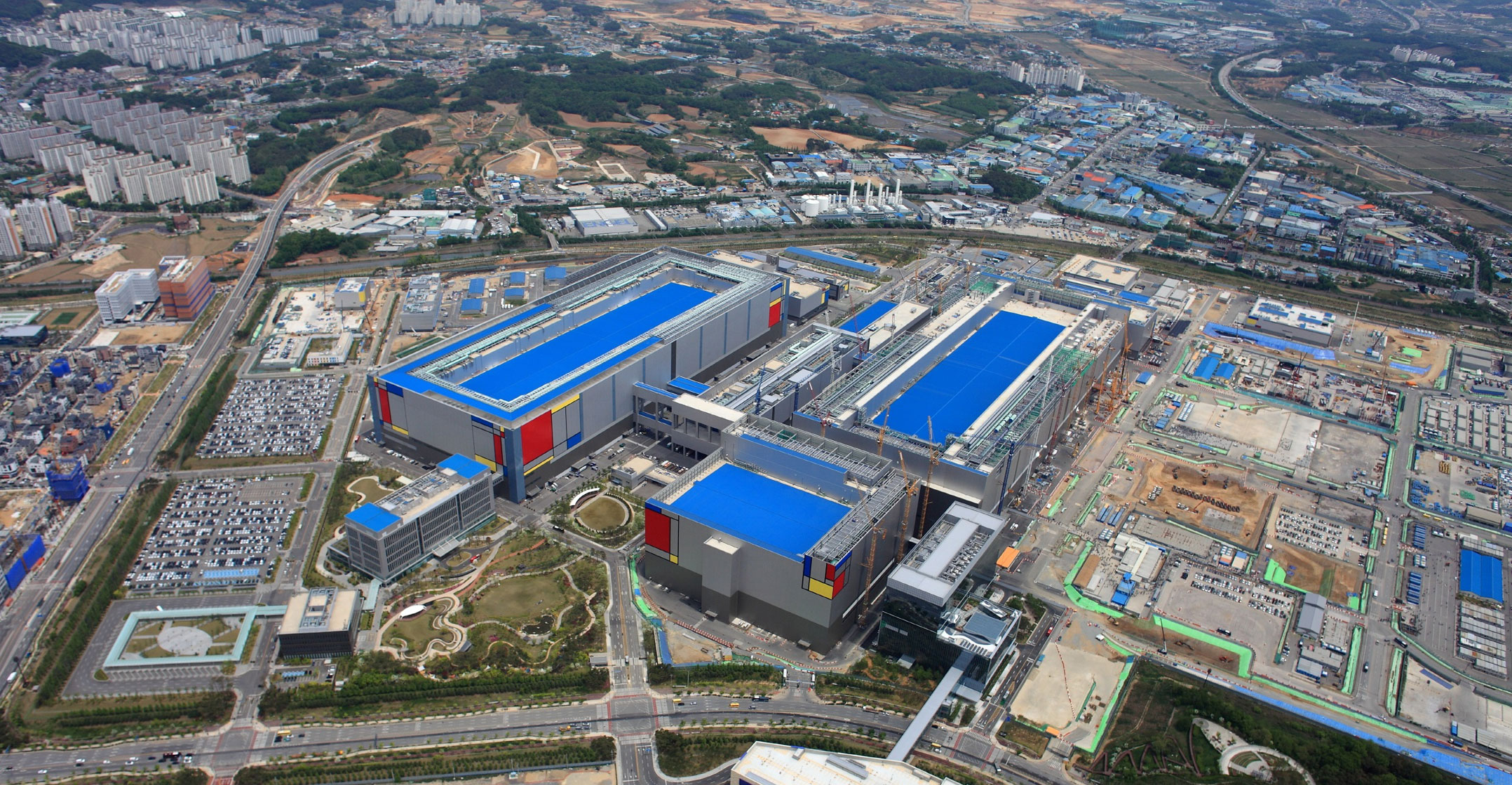
    Samsung Electronics chip facility in Pyeongtaek, South Korea

    Samsung Electronics is pouring US$116-billion into its next-generation chip business that includes fabricating silicon for external clients, betting it can finally close the gap on industry leader Taiwan Semiconductor Manufacturing Co as soon as two years from now.

    South Korea’s biggest company will mass produce 3nm chips in 2022, a senior executive at its foundry division told attendees at an invite-only event last month. That target, which hasn’t previously been reported, means it’s on a path to start churning out the industry’s most advanced semiconductors the same year as its Taiwanese rival expects to pass that milestone. Samsung is already developing initial design tools with key partners, Park Jae-hong, executive vice president of foundry design platform development, told conference delegates.

    If Samsung succeeds, that will be a breakthrough for its ambition to become the chip maker of choice for the likes of Apple and AMD that now rely on foundries like TSMC. The business isn’t new to Samsung, which was the first manufacturer of Apple’s A-series iPhone processors, but the company’s renewed push is now shepherded by billionaire heir Jay Y Lee, who wants to see it establish tech leadership across advanced sectors like chip making and 5G networking to power its next phase of growth. Park’s comments suggest Samsung is accelerating its bid to compete with iPhone chip maker TSMC, one of the biggest beneficiaries of this year’s wave of stay-at-home demand for personal electronics.

    We’ll keep innovating our cutting-edge process portfolio, while strengthening Samsung’s foundry ecosystem

    “To actively respond to market trends and lower the design barrier for competitive systems-on-chip development, we’ll keep innovating our cutting-edge process portfolio, while strengthening Samsung’s foundry ecosystem through close collaboration with partners,” Samsung’s Park told attendees, according to people at the event.

    Samsung’s aim is in line with TSMC’s target of offering volume production of 3nm chips in the second half of 2022. But the Korean company also hopes to go one better by adopting what’s known as the Gate-All-Around technique, regarded by some as game-changing technology that can more precisely control current flows across channels, shrink chip areas and lower power consumption. TSMC had opted for the more established FinFET structure for its 3nm lines.

    Catching up fast

    “Samsung is catching up to TSMC very fast and it seeks to achieve dominance over its competitor by adopting the new technology for the first time,” said Rino Choi, a professor of materials science and engineering at Inha University. “However, if Samsung can’t improve production yields of the advanced node fast in an initial stage, it may lose money.”

    Already the world’s largest maker of computer memory and displays, Samsung wants a bigger share of the $250-billion foundry and logic-chip industry that’s set for accelerated growth with the advent of artificial intelligence and 5G wireless technology. In 2019, TSMC controlled more than half of the contract chip-making market while Samsung had just 18%, according to TrendForce data.

    Lee has taken a close interest in the matter. He flew to ASML Holding’s headquarters in the Netherlands last month to discuss supply of its extreme ultraviolet lithography (EUV) machines, gear that’s indispensable to the creation of the most advanced semiconductors. Other top executives have toured major cities from San Jose to Munich and Shanghai, hosting foundry forums and negotiating deals.

    Samsung’s Jay Y Lee

    Some analysts question Samsung’s ability to carve out a significant share of a market dominated by TSMC, which spends some $17-billion annually to ensure it remains at the forefront of both technology and sheer capacity. For its part, Samsung’s semiconductor division plans to spend $26-billion on capital expenditure in 2020, but that’s been largely in support of its dominant memory business and not all of its expertise in making memory is directly relevant to creating advanced logic chips.

    Processors are more complex to manufacture than memory and their production yields are harder to control and scale up in the same way. Foundry customers also require bespoke solutions, imposing another barrier to rapid expansion and also making Samsung dependent on customers’ designs. But the Korean giant can draw confidence from its work with Nvidia, whose CEO sung the praises of collaborating with Samsung on customising the manufacturing process for its latest graphics card silicon.

    The risks and initial setup costs have whittled down the number of companies capable of even competing in the EUV-based chip-making industry. Intel this year announced it’ll consider outsourcing production of its most important chips for the first time, highlighting the complexities of the business and leaving Samsung and TSMC as the two major competitors. While Samsung has scored some marquee customers, TSMC’s long-standing relationships with clients allow for better coordination on design and manufacturing, leading to superior yields, said Sanjeev Rana, an analyst at CLSA Securities Korea.

    Most smartphone, high-performance computing and high-end server applications need leading-edge process fabrication for performance

    “In terms of chip performance, Samsung and TSMC are neck and neck,” Rana said. “Most smartphone, high-performance computing and high-end server applications need leading-edge process fabrication for performance and power efficiency reasons. This is where the competition between TSMC and Samsung comes into the picture.”

    The Korean company is making rapid advances, in part because even with TSMC’s deep pockets, the Taiwanese chip maker cannot expand capacity quickly enough to satisfy all demand. Customers also prefer to use more than one foundry, which also works to Samsung’s advantage. The Korean company has already secured enough orders from major clients to keep its currently most advanced 5nm process lines busy for the next few years, a company executive said. The electronics giant increased its roster of semiconductor clients by 30% last year, according to another official. In recent months, Nvidia and IBM are among those that turned to Samsung for some of their chip-making needs, while Qualcomm has reportedly awarded the company an $858-million contract to build its flagship mobile processors.

    Mass production

    Samsung started up its first dedicated plant for EUV-based fabrication in the southern city of Hwaseong this year, while a second facility in Pyeongtaek is slated for mass production in the second half of 2021. The growth rate of its foundry business is expected to significantly exceed that of the market, which is likely to be in the high single digits, Shawn Han, senior vice president of the semiconductor business, said during a recent earnings call. The GAA technology that Samsung’s chosen is expected to be adopt by TSMC for 2nm processes in 2024, but there’s a chance that schedule could be moved up to the second half of 2023, said Kim Young-soo, an analyst at SK Securities.

    “Technically, Samsung could turn the table in 2023 before TSMC kicks off the 2nm production,” Kim said. “There will be overflow orders of making application processor chips and edge computing devices. The key to expand the market share is how many EUV machines Samsung can secure.”

    Officials at Samsung believe the company has a competitive edge from its experience building both the chips and the devices that they go into, like Galaxy smartphones. It can foresee and address the engineering requirements of its clients. Samsung believes its other trump card is an ability to package memory and logic chips into a single module, improving power and space efficiency. But some companies may be wary about outsourcing production to a direct competitor. TSMC executives have from time to time highlighted the fact that the Taiwanese chip maker doesn’t compete with any of its customers, a clear jab at Samsung.  — Reported by Sohee Kim, (c) 2020 Bloomberg LP


    AMD Intel Jay Y Lee Nvidia Samsung top TSMC
    Subscribe to TechCentral Subscribe to TechCentral
    Share. Facebook Twitter LinkedIn WhatsApp Telegram Email Copy Link
    Previous ArticleBitcoin is gunning for a record – and no one is talking about it
    Next Article Backspace: ‘Bitcoin 2020’

    Related Posts

    China will get Nvidia H200 chips - but not without paying Washington first

    China will get Nvidia H200 chips – but not without paying Washington first

    9 December 2025
    The best seat in the house? It's behind your Samsung Galaxy smartphone

    The best seat in the house? It’s behind your Samsung Galaxy smartphone

    9 December 2025
    Samsung Galaxy Tab A11: a smarter, sharper companion for work and play

    Samsung Galaxy Tab A11: a smarter, sharper companion for work and play

    8 December 2025
    Company News
    Endless possibilities with Adapt IT Telecoms' unified VAS platform - Matthew Seabrook

    Endless possibilities with Adapt IT Telecoms’ unified VAS platform

    11 December 2025
    Securing IoT connectivity: how MSB Micro Systems keeps devices in check

    Securing IoT connectivity: how MSB Micro Systems keeps devices in check

    11 December 2025
    Rewiring productivity: the AI PC shift South African leaders are betting on - Dell Technologies Haidi Nossair

    Rewiring productivity: the AI PC shift South African leaders are betting on

    10 December 2025
    Opinion
    Netflix, Warner Bros deal raises fresh headaches for MultiChoice - Duncan McLeod

    Netflix, Warner Bros deal raises fresh headaches for MultiChoice

    5 December 2025
    BIN scans, DDoS and the next cybercrime wave hitting South Africa's banks - Entersekt Gerhard Oosthuizen

    BIN scans, DDoS and the next cybercrime wave hitting South Africa’s banks

    3 December 2025
    Your data, your hardware: the DIY AI revolution is coming - Duncan McLeod

    Your data, your hardware: the DIY AI revolution is coming

    20 November 2025

    Subscribe to Updates

    Get the best South African technology news and analysis delivered to your e-mail inbox every morning.

    Latest Posts

    A leaner BCX positions itself as market consolidator

    11 December 2025
    Australia has banned kids from social media. Should South Africa follow suit?

    Australia has banned kids from social media. Should South Africa follow suit?

    11 December 2025
    Architects of AI named Time magazine's 'Person of the Year'

    Architects of AI named Time magazine’s ‘Person of the Year’

    11 December 2025
    Vodacom follows MTN with post-paid price hikes

    Vodacom follows MTN with post-paid price hikes

    11 December 2025
    © 2009 - 2025 NewsCentral Media
    • Cookie policy (ZA)
    • TechCentral – privacy and Popia

    Type above and press Enter to search. Press Esc to cancel.

    Manage consent

    TechCentral uses cookies to enhance its offerings. Consenting to these technologies allows us to serve you better. Not consenting or withdrawing consent may adversely affect certain features and functions of the website.

    Functional Always active
    The technical storage or access is strictly necessary for the legitimate purpose of enabling the use of a specific service explicitly requested by the subscriber or user, or for the sole purpose of carrying out the transmission of a communication over an electronic communications network.
    Preferences
    The technical storage or access is necessary for the legitimate purpose of storing preferences that are not requested by the subscriber or user.
    Statistics
    The technical storage or access that is used exclusively for statistical purposes. The technical storage or access that is used exclusively for anonymous statistical purposes. Without a subpoena, voluntary compliance on the part of your Internet Service Provider, or additional records from a third party, information stored or retrieved for this purpose alone cannot usually be used to identify you.
    Marketing
    The technical storage or access is required to create user profiles to send advertising, or to track the user on a website or across several websites for similar marketing purposes.
    • Manage options
    • Manage services
    • Manage {vendor_count} vendors
    • Read more about these purposes
    View preferences
    • {title}
    • {title}
    • {title}