
Close Menu
TechCentralTechCentral

    Subscribe to the newsletter

    Get the best South African technology news and analysis delivered to your e-mail inbox every morning.

    Facebook X (Twitter) YouTube LinkedIn
    WhatsApp Facebook X (Twitter) LinkedIn YouTube
    TechCentralTechCentral
    • News
      Nedbank hires MTN's former tech chief as group CIO - Nikos Angelopoulos

      Nedbank hires MTN’s former tech chief as group CIO

      31 July 2026
      Eskom's diesel bill falls 86% as breakdowns hit eight-year low

      Eskom’s diesel bill falls 86% as breakdowns hit eight-year low

      31 July 2026
      Ramaphosa signs off on taking the grid away from Eskom

      Ramaphosa signs off on taking the grid away from Eskom

      31 July 2026
      Microsoft just had the biggest day in stock market history

      Microsoft just had the biggest day in stock market history

      31 July 2026
      MTN Nigeria's growth engine stalled in second quarter - Karl Toriola

      MTN Nigeria’s growth engine stalled in second quarter

      31 July 2026
    • World
      Meta AI will now tell parents if their teen is in crisis

      Meta AI will now tell parents if their teen is in crisis

      17 July 2026
      IBM shares crash 25% as AI upends software spending - Arvind Krishna

      IBM shares crash 25% as AI upends software spending

      15 July 2026
      Jony Ive's first OpenAI device: an AI smart speaker - Jony Ive and Sam Altman

      Jony Ive’s first OpenAI device: an AI smart speaker

      15 July 2026
      Stripe, Advent in talks to buy PayPal for $53-billion

      Stripe, Advent in talks to buy PayPal for $53-billion

      15 July 2026
      Memory crisis sends smartphone market into steep decline

      Memory crisis sends smartphone market into steep decline

      13 July 2026
    • In-depth
      The plan to stop AI from breaking the world - Google DeepMind CEO Demis Hassabis. Image: John Sears

      The plan to stop AI from breaking the world

      16 July 2026
      The internet has a Strait of Hormuz problem

      The internet has a Strait of Hormuz problem

      15 July 2026
      AI boom sparks rally, frenzy and fear

      AI boom sparks rally, frenzy and fear

      11 June 2026
      Every plug-in hybrid on sale in South Africa, ranked by price - Lamborghini Temerario

      Every plug-in hybrid on sale in South Africa, ranked by price

      7 June 2026
      What Wi-Fi 8 will mean for wireless networks

      What Wi-Fi 8 will mean for wireless networks

      1 June 2026
    • TCS
      TCS+ | Why South African workers must become supervisors of digital labour - Accelera Digital Group Cliff de Wit

      TCS+ | Why South African workers must become supervisors of digital labour

      31 July 2026
      TCS | Rapid deployment rules can't work without municipalities: ACT - Nomvuyiso Batyi

      TCS | Icasa’s rules skip the real bottleneck: ACT

      30 July 2026
      TCS+ | iStore Business on why Apple makes sense for SMEs - Sudesh Pillay and Tamia Nontsikelelo

      TCS+ | iStore Business on why Apple makes sense for SMEs

      30 July 2026
      TCS+ | A smarter approach to cloud for South African businesses - Joel Chacko and Jonathan Oaker

      TCS+ | A smarter approach to cloud for South African businesses

      28 July 2026
      TCS | How Optasia lends billions to people banks can't see - Salvador Anglada

      TCS | How Optasia lends billions to people banks can’t see

      23 July 2026
    • Opinion
      The author, Jannie van Zyl

      Selling vapour is corporate suicide in slow motion

      16 July 2026
      Brazil's online gambling crackdown is a lesson for South Africa

      How Amazon outmanoeuvred Starlink in South Africa

      15 July 2026
      The Popia problem with agentic AI - Herman Haasbroek

      The Popia problem with agentic AI

      14 July 2026
      The author, Fanie van Rooyen

      South Africa can still catch the AI wave – here’s how

      7 July 2026
      The author, Fanie van Rooyen

      The AI utopia South Africa can’t afford

      1 July 2026
    • Company Hubs
      • 1Stream
      • Africa Data Centres
      • AfriGIS
      • Altron Digital Business
      • Altron Document Solutions
      • Altron Group
      • Arctic Wolf
      • Ascent Technology
      • AvertITD
      • BBD
      • Braintree
      • CallMiner
      • CambriLearn
      • CM Telecom
      • Contactable
      • CYBER1 Solutions
      • Digicloud Africa
      • Digimune
      • Domains.co.za
      • ESET
      • Euphoria Telecom
      • HOSTAFRICA
      • Incredible Business
      • iONLINE
      • IQbusiness
      • Iris Network Systems
      • Kaspersky
      • LSD Open
      • Mitel
      • NEC XON
      • Netstar
      • Network Platforms
      • Next DLP
      • Ovations
      • Paracon
      • Paratus
      • Q-KON
      • SevenC
      • SkyWire
      • Solid8 Technologies
      • Telit Cinterion
      • Telviva
      • Tenable
      • Vertiv
      • Videri Digital
      • Vodacom Business
      • Vox
      • Wipro
      • Workday
      • XLink
    • Sections
      • AI and machine learning
      • Banking
      • Broadcasting and Media
      • Cloud services
      • Contact centres and CX
      • Cryptocurrencies
      • Education and skills
      • Electronics and hardware
      • Energy and sustainability
      • Enterprise software
      • Financial services
      • HealthTech
      • Information security
      • Internet and connectivity
      • Internet of Things
      • Investment
      • IT services
      • Lifestyle
      • Policy and regulation
      • Public sector
      • Retail and e-commerce
      • Satellite communications
      • Science
      • SMEs and start-ups
      • Social media
      • Talent and leadership
      • Telecoms
      • Watts & Wheels
    • Events
    • Advertise
    TechCentralTechCentral
    Home » Sections » Information security » Transforming security operations through AI-driven automation

    Transforming security operations through AI-driven automation

    Promoted | Attendees at a recent TechCentral and Palo Alto Networks round table agreed that an automated approach to security operations is essential.
    By Palo Alto Networks3 November 2023
    Twitter LinkedIn Facebook WhatsApp Email Telegram Copy Link
    News Alerts
    WhatsApp

    The modern cybersecurity landscape is a constantly shifting battlefields. Threat actors employ increasingly sophisticated techniques and the attack surface has expanded with the proliferation of devices and services connected to the internet.

    Traditional security practices, which largely rely on manual interventions and rule-based approaches, struggle to keep pace. In this scenario, security operations are overwhelmed with data, alerts and the sheer complexity of managing a wide array of security tools and platforms. Analysts are often left drowning in alerts, sifting through false positives and struggling to identify and respond to genuine threats in a timely manner.

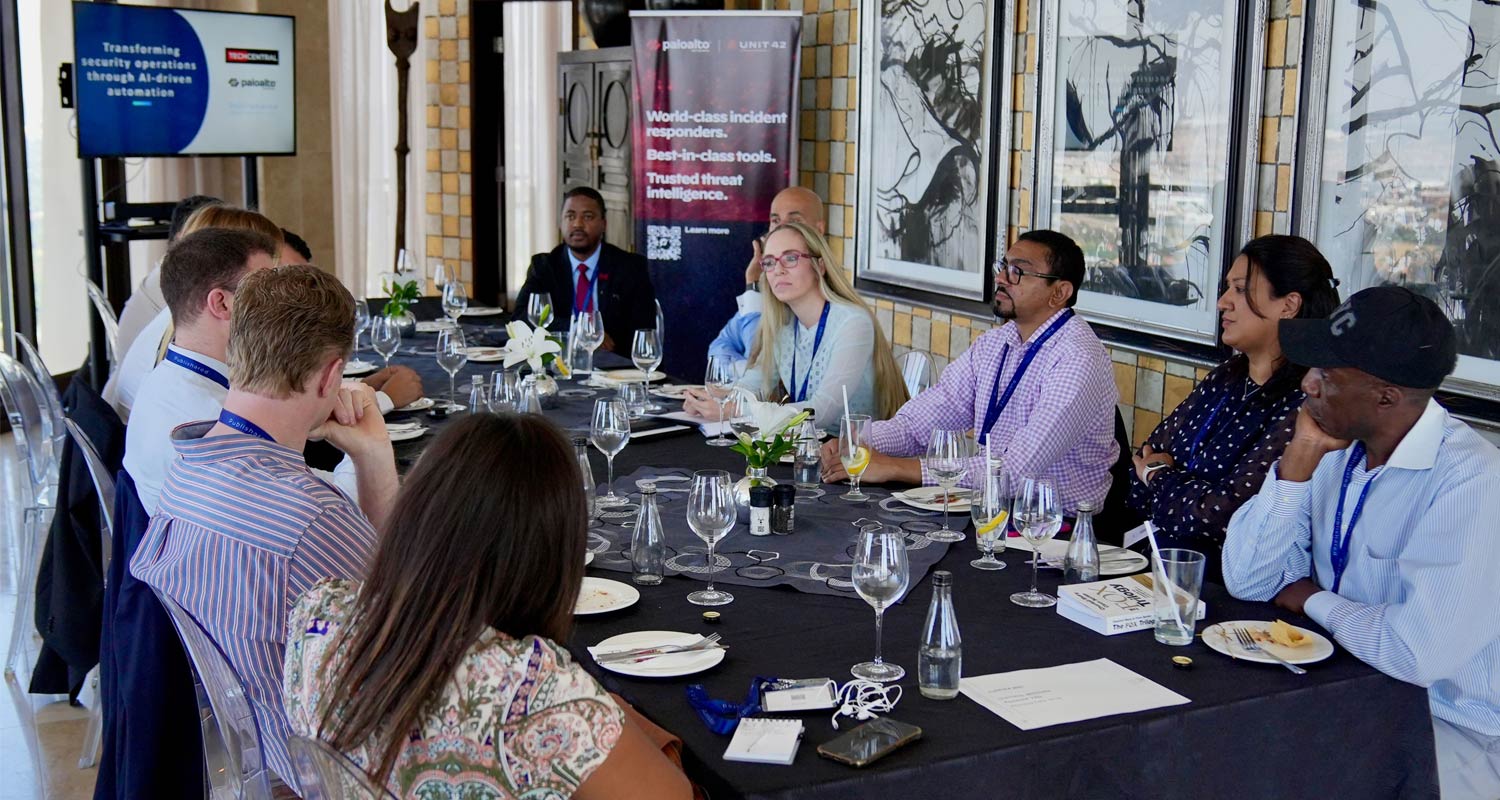
    To discuss the challenges experienced by security operations in today’s cybersecurity landscape, as well as the pivotal role artificial intelligence (AI), specifically machine learning, is playing in transforming these operations, TechCentral recently hosted a round-table conversation sponsored by Palo Alto Networks with some of the country’s leading executives.

    Social engineering tactics, such as phishing and spear-phishing, have grown in complexity

    All attendees agreed that in today’s dynamic and evolving threat landscape, where attackers are becoming increasingly sophisticated and attacks are growing in complexity, an integrated and automated approach to security operations is essential.

    This empowers organisations to respond more effectively to threats, reduce the risk of security incidents and improve the overall resilience of their digital assets and data. At the same time, while implementing AI in security operations offers significant benefits, there was consensus that it also presents several challenges that organisations need to address for successful integration.

    Modern cybersecurity challenges

    Attendees said, in their experience, the cybersecurity threat landscape has witnessed a rapid and relentless evolution in recent years, marked by increasingly sophisticated and diverse threats. Threat actors have expanded their arsenal to include advanced malware, ransomware, zero-day vulnerabilities and nation-state-sponsored attacks.

    Additionally, social engineering tactics, such as phishing and spear-phishing, have grown in complexity. The increasing complexity of modern IT infrastructure adds to the challenge. Businesses often operate in hybrid environments, combining on-premises systems, cloud services and third-party vendors.

    Each component introduces its own security risks and new attack surfaces, and managing this complexity demands comprehensive oversight. At the same time, the demand for skilled cybersecurity professionals has outstripped the available talent pool.

    Lack of skills

    Organisations often struggle to hire, train, and retain qualified security personnel, which can leave them vulnerable to threats. These evolving threats pose several key challenges to security operations, including the need for more rapid and precise threat detection, a surge in alert volumes leading to alert fatigue, the requirement for advanced threat intelligence and analytics and the necessity of maintaining compliance and privacy standards in the face of growing risks.

    Delegates also discussed the presence of silos in their current security operations centre (SOC) technology stack and the impacts they have on threat response. The biggest silos in the SOC technology stack include tool silos, data silos, human resource silos, vendor lock-in silos and the separation between on-premises and cloud security tools.
    These silos hinder the seamless flow of information, leading to disjointed data and alerts, making it challenging to correlate and contextualise information and resulting in missed threats. They also create obstacles in terms of communication and collaboration among SOC teams, which can lead to slower incident response times and difficulties in coordinating efforts during a security incident.

    There was consensus amongst attendees that, to stay one step ahead of these evolving challenges, security operations must adapt and companies must invest in innovative technologies to effectively counter these multifaceted threats, while ensuring resilience. It’s a situation that calls for a more intelligent and automated approach to security.

    A catalyst for transformation

    In response to these evolving challenges, entities are increasingly turning to AI-driven automation. AI helps by significantly enhancing threat detection, response and mitigation. With the ability to process vast amounts of data in real-time, AI systems can swiftly identify anomalies, patterns and potential threats that may evade traditional methods.

    Automation streamlines routine security tasks, reducing human intervention and enabling faster incident response. Moreover, AI helps in reducing false positives, allowing security analysts to focus on genuine threats.

    While the promise of AI-driven security automation is significant, attendees also agreed that there are challenges and considerations to be aware of. Companies must carefully manage sensitive data, ensuring it is used in compliance with data privacy regulations. Quality and quantity of data are key to AI’s effectiveness, and finding skilled professionals with expertise in both AI and security can be a challenge.

    The synergy between humans and AI creates a potent defence against increasingly sophisticated cyberthreats

    Many organisations also have complex and diverse security tools and platforms. Integrating AI-driven solutions seamlessly into existing security infrastructure can be a complex and time-consuming process.

    Human-machine collaboration

    In the ever-escalating arms race between cybercriminals and security professionals, AI represents a powerful ally. However, attendees stressed that it is crucial that AI-driven security solutions are implemented and managed with the human element in mind, where security analysts work alongside AI systems to enhance threat detection and response.

    This collaboration leverages the strengths of both humans and AI: human analysts bring contextual understanding, intuition, and domain expertise, while AI systems contribute their ability to process vast amounts of data in real-time, identify patterns, and swiftly detect anomalies. Security analysts can rely on AI to automate routine tasks such as initial triage and validation of alerts, thereby reducing the burden of mundane, repetitive work. This enables analysts to focus their valuable time and expertise on more complex tasks like incident investigation, threat hunting and strategic decision-making.

    The synergy between humans and AI creates a potent defence against increasingly sophisticated cyberthreats and empowers security teams to respond more effectively to emerging risks in the dynamic cybersecurity landscape.

    With these principles in place, attendees agreed that AI-driven automation promises to be a cornerstone of the future of cybersecurity.

    TechCentral and Palo Alto thank all of those who participated in the round-table discussion.

    • Read more articles by Palo Alto Networks on TechCentral
    • This promoted content was paid for by the party concerned

    Follow TechCentral on Google News Add TechCentral as your preferred source on Google


    Palo Alto Networks
    WhatsApp YouTube
    Share. Facebook Twitter LinkedIn WhatsApp Telegram Email Copy Link
    Previous ArticleGalaxy Z Flip5 and Z Fold5: five generations of innovation
    Next Article IT courses and specialisations to further your career

    Related Posts

    Frontier AI has broken the old rules of cyber defence, warns Palo Alto CIO

    Frontier AI has broken the old rules of cyber defence, warns Palo Alto Networks CIO

    1 July 2026
    South Africa's patching problem is about to get worse - Zaheer Ebrahim

    South Africa’s patching problem is about to get worse

    6 May 2026
    AI is rewriting the threat playbook - Justin Lee, Palo Alto Networks

    AI is rewriting the threat playbook

    6 May 2026
    Add A Comment

    Comments are closed.

    Company News
    Domains.co.za launches self-hosted n8n VPS hosting

    Domains.co.za launches self-hosted n8n VPS hosting

    31 July 2026
    Smarter.tech '26 shows why smarter technology begins with context - Obsidian Systems

    Context is the missing piece in enterprise AI: Obsidian

    31 July 2026
    Huawei launches 12 intelligent transport solutions in South Africa - Sam Tang

    Huawei launches 12 intelligent transport solutions in South Africa

    30 July 2026
    Opinion
    The author, Jannie van Zyl

    Selling vapour is corporate suicide in slow motion

    16 July 2026
    Brazil's online gambling crackdown is a lesson for South Africa

    How Amazon outmanoeuvred Starlink in South Africa

    15 July 2026
    The Popia problem with agentic AI - Herman Haasbroek

    The Popia problem with agentic AI

    14 July 2026

    Subscribe to Updates

    Get the best South African technology news and analysis delivered to your e-mail inbox every morning.

    Latest Posts
    Nedbank hires MTN's former tech chief as group CIO - Nikos Angelopoulos

    Nedbank hires MTN’s former tech chief as group CIO

    31 July 2026
    Eskom's diesel bill falls 86% as breakdowns hit eight-year low

    Eskom’s diesel bill falls 86% as breakdowns hit eight-year low

    31 July 2026
    Ramaphosa signs off on taking the grid away from Eskom

    Ramaphosa signs off on taking the grid away from Eskom

    31 July 2026
    TCS+ | Why South African workers must become supervisors of digital labour - Accelera Digital Group Cliff de Wit

    TCS+ | Why South African workers must become supervisors of digital labour

    31 July 2026
    © 2009 - 2026 NewsCentral Media
    Built and maintained by Chronon
    • Cookie policy (ZA)
    • TechCentral – privacy and Popia

    Type above and press Enter to search. Press Esc to cancel.

    Manage consent

    TechCentral uses cookies to enhance its offerings. Consenting to these technologies allows us to serve you better. Not consenting or withdrawing consent may adversely affect certain features and functions of the website.

    Functional Always active
    The technical storage or access is strictly necessary for the legitimate purpose of enabling the use of a specific service explicitly requested by the subscriber or user, or for the sole purpose of carrying out the transmission of a communication over an electronic communications network.
    Preferences
    The technical storage or access is necessary for the legitimate purpose of storing preferences that are not requested by the subscriber or user.
    Statistics
    The technical storage or access that is used exclusively for statistical purposes. The technical storage or access that is used exclusively for anonymous statistical purposes. Without a subpoena, voluntary compliance on the part of your Internet Service Provider, or additional records from a third party, information stored or retrieved for this purpose alone cannot usually be used to identify you.
    Marketing
    The technical storage or access is required to create user profiles to send advertising, or to track the user on a website or across several websites for similar marketing purposes.
    • Manage options
    • Manage services
    • Manage {vendor_count} vendors
    • Read more about these purposes
    View preferences
    • {title}
    • {title}
    • {title}