Close Menu
TechCentralTechCentral

    Subscribe to the newsletter

    Get the best South African technology news and analysis delivered to your e-mail inbox every morning.

    Facebook X (Twitter) YouTube LinkedIn
    WhatsApp Facebook X (Twitter) LinkedIn YouTube
    TechCentralTechCentral
    • News
      Another windfall for Datatec shareholders - Jens Montanana

      Another windfall for Datatec shareholders

      19 June 2026
      WhatsApp starts charging South Africans - for the extras

      WhatsApp starts charging South Africans – for the extras

      19 June 2026
      AI agents are coming to your Visa card

      AI agents are coming to your Visa card

      19 June 2026
      Naspers signals core earnings surge ahead of results

      Naspers signals core earnings surge ahead of results

      19 June 2026
      Home affairs bookings get a security overhaul

      Home affairs bookings get a security overhaul

      19 June 2026
    • World
      Google on the hook for what its AI tells users, court rules

      Google on the hook for what its AI tells users, court rules

      15 June 2026
      How Russians juggle VPNs to outwit the Kremlin

      How Russians juggle VPNs to outwit the Kremlin

      15 June 2026
      Amazon CEO flagged Anthropic AI risks to Washington - Andy Jassy

      Amazon CEO flagged Anthropic AI risks to Washington

      14 June 2026
      Trouble at Xbox

      Trouble at Xbox

      11 June 2026
      Meta declares war on Israeli spyware firm

      Meta declares war on Israeli spyware firm

      8 June 2026
    • In-depth
      AI boom sparks rally, frenzy and fear

      AI boom sparks rally, frenzy and fear

      11 June 2026
      Every plug-in hybrid on sale in South Africa, ranked by price - Lamborghini Temerario

      Every plug-in hybrid on sale in South Africa, ranked by price

      7 June 2026
      What Wi-Fi 8 will mean for wireless networks

      What Wi-Fi 8 will mean for wireless networks

      1 June 2026
      Alfa's electric rebel - Alfa Romeo Junior Elettrica Veloce

      Alfa’s electric rebel

      29 April 2026
      Africa switches on as Europe dims the lights

      Africa switches on as Europe dims the lights

      9 April 2026
    • TCS
      Watts & Wheels S1E6: 'A flawless Alfa and a bakkie that divides'

      Watts & Wheels S1E6: ‘A flawless Alfa and a bakkie that divides’

      17 June 2026
      Watts & Wheels S1E6: 'A flawless Alfa and a bakkie that divides'

      Watts & Wheels S1E5: ‘A Bentley of the bush and a car that swims’

      8 June 2026
      TCS | Charge's R1.8-billion bet on an off-grid EV future - Charge chairman Joubert Roux

      TCS | Charge’s R1.8-billion bet on an off-grid EV future

      18 May 2026
      TCS+ | The Up&Up Group on the hidden cost of AI - Jason Harrison

      TCS+ | The Up&Up Group on the hidden cost of AI

      13 May 2026
      Michael Rossouw

      TCS+ | The retirement decision most South Africans get wrong

      6 May 2026
    • Opinion
      Finish the job Mandela started - Farzam Ehsani

      Finish the job Mandela started

      18 June 2026
      The author, Fanie van Rooyen

      The US just showed it can switch off our AI

      17 June 2026
      The clock is ticking on South African banks' biggest advantage - Pambos Soteriades

      The clock is ticking on South African banks’ biggest advantage

      9 June 2026

      Clashing judgments leave South Africa’s crypto law unsettled

      2 June 2026
      The clock is ticking on South African banks' biggest advantage - Pambos Soteriades

      The trap inside South Africa’s banking MVNO boom

      1 June 2026
    • Company Hubs
      • 1Stream
      • Africa Data Centres
      • AfriGIS
      • Altron Digital Business
      • Altron Document Solutions
      • Altron Group
      • Arctic Wolf
      • Ascent Technology
      • AvertITD
      • BBD
      • Braintree
      • CallMiner
      • CambriLearn
      • CM Telecom
      • Contactable
      • CYBER1 Solutions
      • Digicloud Africa
      • Digimune
      • Domains.co.za
      • ESET
      • Euphoria Telecom
      • HOSTAFRICA
      • Incredible Business
      • iONLINE
      • IQbusiness
      • Iris Network Systems
      • Kaspersky
      • LSD Open
      • Mitel
      • NEC XON
      • Netstar
      • Network Platforms
      • Next DLP
      • Ovations
      • Paracon
      • Paratus
      • Q-KON
      • SevenC
      • SkyWire
      • Solid8 Technologies
      • Telit Cinterion
      • Telviva
      • Tenable
      • Vertiv
      • Videri Digital
      • Vodacom Business
      • Wipro
      • Workday
      • XLink
    • Sections
      • AI and machine learning
      • Banking
      • Broadcasting and Media
      • Cloud services
      • Contact centres and CX
      • Cryptocurrencies
      • Education and skills
      • Electronics and hardware
      • Energy and sustainability
      • Enterprise software
      • Financial services
      • HealthTech
      • Information security
      • Internet and connectivity
      • Internet of Things
      • Investment
      • IT services
      • Lifestyle
      • Motoring
      • Policy and regulation
      • Public sector
      • Retail and e-commerce
      • Satellite communications
      • Science
      • SMEs and start-ups
      • Social media
      • Talent and leadership
      • Telecoms
    • Events
    • Advertise
    TechCentralTechCentral
    Home » Editor's pick » SKA set to help solve tantalising radio mystery

    SKA set to help solve tantalising radio mystery

    By The Conversation10 March 2016
    Twitter LinkedIn Facebook WhatsApp Email Telegram Copy Link
    News Alerts
    WhatsApp
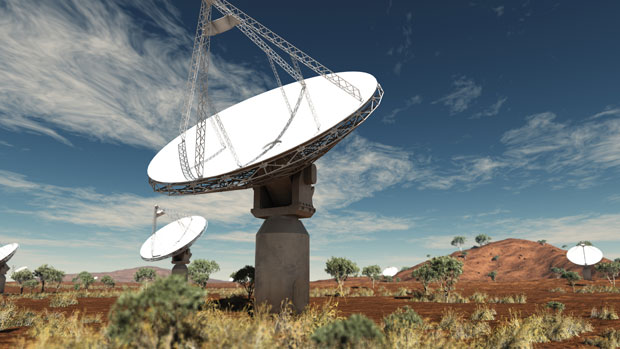
    Artist's impression of SKA dishes (image: SKA Organisation/Swinburne Astronomy Productions)
    Artist’s impression of SKA dishes (image: SKA Organisation/Swinburne Astronomy Productions)

    Astronomers are getting ever closer to understanding the origin of mysterious “fast radio bursts” — very brief but intense pulses of radio waves from outer space — after a series of recent contradictory findings. While the cause of these powerful blips is still unknown, scientists’ eagerness to find out is driving a renaissance in radio astronomy. Along with a revolution in our ability to map huge chunks of the sky in real time over the coming decade, this means the hunt for an answer is starting to look promising.

    The first discovery of a fast radio burst, lasting only 5ms, was announced in 2007 by scientists mining data from Australia’s Parkes radio telescope. Unfortunately, the burst did not repeat, so it couldn’t be independently confirmed by others. Several years passed before new bursts were found at different locations in the sky using independent telescopes in Arecibo, Puerto Rico and Greenbank, US.

    But astronomers failed to agree on what had caused the bursts. As they had been one-off blips, more like whistlers than repeating signals, it was suggested that they could come from catastrophic one-off events — such as a neutron star colliding with a black hole. Other explanations included huge flashes of brightness, similar to solar flares, from stars in our own galaxy, or simply contaminating signals from radio waves emitted on Earth. Some even speculated that the signals could be transmitted by distant alien civilisations.

    Bewildering results

    On 2 March, it seemed the mystery had finally been solved when scientists announced the detection of what they interpreted to be an afterglow — lasting six days — from a fast radio burst. For the first time, they were able to suggest the galaxy that the burst could have come from, roughly 6bn light years from Earth. The researchers suggested it likely originated when two compact objects such as a neutron star and a black hole collided.

    But astronomers’ excitement was short-lived. Just days later, new observations from the Very Large Array suggested these findings could be flawed. The array had seen the signal get stronger rather than fade, which would have been expected for an afterglow. The researchers therefore concluded it was not an afterglow from a fast radio burst at all, but rather radiation from a supermassive black hole at the heart of the galaxy gradually devouring material from its surroundings. This is a common phenomenon; even the centres of nearby galaxies show variable radio brightness.

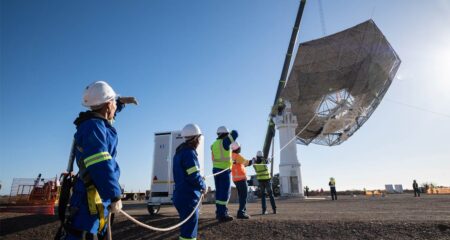
    Construction on the SKA Karoo site (image: SKA South Africa)
    Construction on the SKA Karoo site (image: SKA South Africa)

    To make matters even more confusing, astronomers using the Arecibo radio telescope have just announced the discovery of a collection of signals which they argue could be a repeating fast radio burst. This is a huge surprise as we had until now assumed that the bursts were one-off events. These signals are 10 times weaker than traditional fast radio bursts and seem to have different properties.

    There also remains uncertainty about the exact location of each burst on the sky, so they may not be related to one catastrophic event. It is clear that many more fast radio bursts need to be discovered and studied before generalisations about their nature and origin can be made.

    A technological revolution

    Trying to discover a burst and, at exactly the same time, pinpoint accurately where on the sky it comes from is still a major challenge for radio observatories, as their telescopes have relatively small fields of view. This is also challenging for astronomers working at wavelengths other than the radio bands who are searching for other kinds of electromagnetic radiation (such as X-rays or the kind of optical light that we can see). Such radiation may have been emitted in the same event that caused the fast radio bursts. If a radio signal could be backed up by discoveries in these other parts of the spectrum, we could measure the distance and understand the physics processes driving these events.

    This problem is not new to astronomers. Intense, short-lived flashes of high-energy gamma rays (radiation that is much more energetic than radio waves) — discovered by military satellites in the 1960s and named “gamma ray bursts” — remained a mystery until they could be pinpointed in the sky with sufficient accuracy to allow other telescopes (looking in different wavelengths) to help search. Scientists working with different telescopes could ultimately establish that they came from far beyond our own galaxy. A revolution in the understanding of the underlying physics of these bursts came with the launch of Nasa’s Swift satellite, which accurately locates new busts and automatically notifies ground-based robotic telescopes in real time so they can get a closer look.

    At radio wavelengths, new breakthroughs may come from upgrades of existing observatories, but the development of a new global radio facility — the Square Kilometer Array (SKA) — in the coming decade is set to revolutionise this field. SKA, a huge network of radio antennas, will combine the ability to see large parts of the sky with fast detection technology to create accurate radio maps of the sky at any given moment. This will give radio astronomers a super all-in-one search-and-locate machine. It could also deliver news of discoveries in real time to astronomers searching for light at other parts of the spectrum with other facilities, which will see a similar revolution in the ability to scan the sky in real time.

    But in the radio bands in particular, it will never be possible to store all of the data collected. Instead, astronomers will have to develop sophisticated hardware and software to sift through the data in real time to capture and identify fleeting events like fast radio bursts.

    It may seem like a lot of hurdles to overcome, but it is all happening at a rapid pace. So perhaps sometime in the next decade or two we will know whether “fast radio bursts” are created by aliens or cataclysmic events … or just from microwaves in our kitchens.The Conversation

    • Carole Mundell is head of astrophysics, University of Bath
    • This article was originally published on The Conversation

    Follow TechCentral on Google News Add TechCentral as your preferred source on Google


    Carole Mundell SKA Square Kilometre Array
    WhatsApp YouTube
    Share. Facebook Twitter LinkedIn WhatsApp Telegram Email Copy Link
    Previous ArticleDA heads back to court over Motsoeneng
    Next Article Revised ICT sector code: what you need to know

    Related Posts

    A MeerKAT antenna

    MeerKAT detects most powerful natural radio laser ever observed

    19 February 2026
    South Africa's giant SKA telescope clears major technical hurdle

    South Africa’s giant SKA telescope clears major technical hurdle

    8 January 2026
    SA scientists want Musk’s Starlink out of their space

    SA scientists want Musk’s Starlink out of their space

    2 June 2025
    Company News
    Moving past the pilot: inside the CloudZA and AWS closed-door AI executive roundtable

    CloudZA and AWS chart the road from AI pilots to production

    19 June 2026
    The role of edge infrastructure in South Africa's AI leap - OADC Open Access Data Centres

    The role of edge infrastructure in South Africa’s AI leap

    19 June 2026
    BBD's new FinOps white paper: your road map to kill cloud waste

    BBD’s new FinOps white paper: your road map to kill cloud waste

    19 June 2026
    Opinion
    Finish the job Mandela started - Farzam Ehsani

    Finish the job Mandela started

    18 June 2026
    The author, Fanie van Rooyen

    The US just showed it can switch off our AI

    17 June 2026
    The clock is ticking on South African banks' biggest advantage - Pambos Soteriades

    The clock is ticking on South African banks’ biggest advantage

    9 June 2026

    Subscribe to Updates

    Get the best South African technology news and analysis delivered to your e-mail inbox every morning.

    Latest Posts
    Another windfall for Datatec shareholders - Jens Montanana

    Another windfall for Datatec shareholders

    19 June 2026
    WhatsApp starts charging South Africans - for the extras

    WhatsApp starts charging South Africans – for the extras

    19 June 2026
    AI agents are coming to your Visa card

    AI agents are coming to your Visa card

    19 June 2026
    Naspers signals core earnings surge ahead of results

    Naspers signals core earnings surge ahead of results

    19 June 2026
    © 2009 - 2026 NewsCentral Media
    • Cookie policy (ZA)
    • TechCentral – privacy and Popia

    Type above and press Enter to search. Press Esc to cancel.

    Manage consent

    TechCentral uses cookies to enhance its offerings. Consenting to these technologies allows us to serve you better. Not consenting or withdrawing consent may adversely affect certain features and functions of the website.

    Functional Always active
    The technical storage or access is strictly necessary for the legitimate purpose of enabling the use of a specific service explicitly requested by the subscriber or user, or for the sole purpose of carrying out the transmission of a communication over an electronic communications network.
    Preferences
    The technical storage or access is necessary for the legitimate purpose of storing preferences that are not requested by the subscriber or user.
    Statistics
    The technical storage or access that is used exclusively for statistical purposes. The technical storage or access that is used exclusively for anonymous statistical purposes. Without a subpoena, voluntary compliance on the part of your Internet Service Provider, or additional records from a third party, information stored or retrieved for this purpose alone cannot usually be used to identify you.
    Marketing
    The technical storage or access is required to create user profiles to send advertising, or to track the user on a website or across several websites for similar marketing purposes.
    • Manage options
    • Manage services
    • Manage {vendor_count} vendors
    • Read more about these purposes
    View preferences
    • {title}
    • {title}
    • {title}