 As modern data centres continue to evolve towards software-defined networking (SDN), network planners have encountered new challenges during initial planning. In particular, SDN now has two possible development routes, with overlay control endpoints located either on physical switches or on virtual switches in servers. Consequently, hardware SDN (sometimes called hard SDN) and software-based SDN (soft SDN) solutions stem from each of these development options, which will be discussed in further detail.
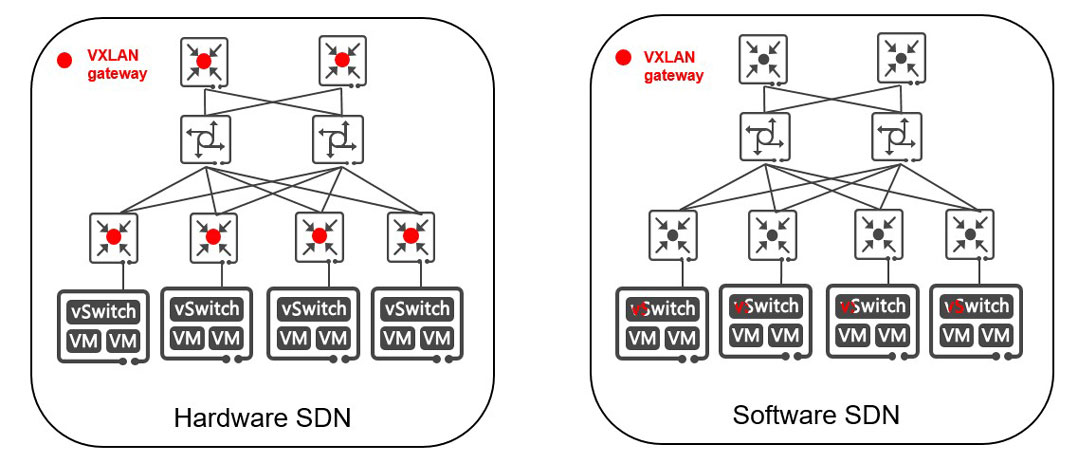 Before outlining the differences between the hardware and software SDN solutions, let us first review the problems that SDN has solved. Once we fully understand the advantages of software and hardware SDN solutions, as well as relevant project construction requirements, we will be better prepared to make educated decisions on their suitability.
Why use SDN?
The use of SDN is closely related to overlay technologies, mainly virtual extensible local-area network (VXLAN) technologies. As such, we will discuss them as a whole.
Before the introduction of SDN, networks were manually configured through the use of command lines, which is an inefficient, error-prone and expensive process, offering relatively slow time to market. During in-depth development of compute resources towards virtualisation, the layer-2 domain scale of data centre networks was insufficient. As a result, layer-2 networks could not be constructed across regions, restricting possible deployment locations and flexible migration of service virtual machines, while also hindering the improvement of large-scale data centre automation capabilities.
SDN introduces great changes to traditional command-line deployment, with many manufacturers providing intuitive graphical user interfaces. SDN integrates with VXLAN overlay technology to associate virtual network elements with compute resources after network virtualisation, providing service-orientated networks and removing the need for tedious configuration. The frequently used spine-leaf architecture also solves the problem of traditional tree topology being unable to adapt to the rapid growth of east-west traffic.
SDN has made significant contributions to the structural scalability of network and service automation. Looking forward, basic capabilities that network personnel must focus on — such as high reliability, high performance, open integration and more — must also be continuously strengthened.
How do we evaluate the advantages and disadvantages of software and hardware SDN solutions?
As SDN develops, two primary routes have emerged: the hardware SDN solution dominated by network device vendors and the software SDN solution driven by software vendors.
Characteristics
We will now compare and analyse the characteristics of software and hardware SDN solutions.
From the perspective of automation flexibility, the degree of automation depends on vendors’ understanding of network services and the logical abstraction level; it is not closely related to software and hardware modes. For example, in SDN service provisioning, North American vendors use multi-level forms to deliver service logic, while manufacturers in China have focused on graphical interaction with a higher level of abstraction and more direct logical understanding. This is where the attention of manufacturers in China should be focused. Currently, hardware SDN vendors can utilise the IT service language to automatically configure networks, even achieving higher automation levels such as pre-event and post-event verification, whereas software SDN vendors lag in these areas.
Software SDN relies on flexible and iterative software for service development, enabling capabilities to be quickly updated without depending on hardware. In actual commercial use, strict version policies are available, and features which severely affect performance — such as encryption and encapsulation — must be offloaded to network interface card. As such, while the software approach is more flexible, many constraints exist as it relies entirely on the CPU. Therefore, it is important to focus on the specific aims and techniques of different vendors in terms of automation capabilities, regardless of the software and hardware modes.
 Moving on, network scalability is identical across both solutions, as both support the construction of large-scale SDN networks, including multi-domain, multi-data centre cascading networks.
Software SDN can flexibly replace network resources by consuming server resources, while specifications such as tenants and virtual private clouds may exceed the hardware resource limitations of hardware SDN on switches. However, the specifications of mainstream switches do not have bottlenecks, so this advantage is not reflected in actual projects. Both solutions are evenly matched in this regard.
Reliability and stability are top priorities in actual network deployment, as an unstable network will not be tolerated. As such, hardware SDN has a stronger reputation within the industry, delivering commercial reliability advantages in the early stages. While the software SDN solution also provides failover capabilities through vSwitches, such features are dependent on software reliability. In addition, software SDN introduces new challenges to the network operations and maintenance (O&M) team. The O&M boundary must be extended to servers, which can lead to conflicts as it involves both network and service teams. As such, most Internet vendors who opt for software SDN possess the strong technical capabilities necessary to overcome this problem.
In terms of performance differences between the two solutions, the hardware SDN solution is superior thanks to switch hardware and the chips used for processing. However, the vSwitch — which software SDN depends on — is making continuous strides in the area of performance and has overcome some of the hurdles by adding a data plane development kit and offloading intelligent network interface cards, while increasing the data volume of each vendor to more than 10GB. Despite these improvements, the capabilities of the software SDN solution are still significantly lower than those of the hardware SDN solution.
Bottlenecks
The industry has not yet reached a consensus on whether some offload technologies can be put into large-scale commercial use, as many are still in the innovation and experimental phase. In addition, introducing such auxiliary technologies extends the boundary and increases the complexity and cost of software SDN. A number of insurance companies in China, having initially opted for the software SDN solution, ultimately switched to the hardware SDN solution after experiencing unacceptable performance bottlenecks.
Another point to consider is open integration capabilities. A large number of enterprise market segments exist, and based on their unique experiences, each enterprise has different preferences for specific components and suppliers, including server vendors and models, virtualisation platforms, and cloud platforms. The software SDN solution depends on server vSwitches and must be compatible with the underlying platform software or match the virtual server model. Due to the differences between various virtualisation-layer software solutions, a single vSwitch cannot match all virtualisation-layer platforms, necessitating independent products in some cases. In contrast, the hardware SDN solution avoids such lock-in. As the control point is on the physical switch, the hardware SDN solution can generally adapt to the IT resource ecosystem of lower-layer access, such as servers from individual vendors and different virtualisation and cloud platforms.
Finally, cost is hugely important, with unanimous agreement within the industry that the two most critical elements of software and hardware SDN solutions are reliability and cost.
 Performance problems are also considered a factor of the overall cost. The software SDN solution uses servers to implement network resources, increasing expenses due to performance overlay and scale management. Meanwhile, the hardware capabilities of network device vendors have improved to offset the hardware costs involved in the hardware SDN solution.
Currently, the hardware SDN solution has obvious advantages in terms of cost. According to information obtained from actual projects, switches in the hardware SDN solution have offset SDN costs, and can now be obtained at a price similar to non-SDN switches as a result of rapidly developing chip integration capabilities in recent years. In contrast, the software SDN solution remains significantly expensive due to the large number of vSwitches and annual O&M fees.
Despite the overall increased expense, software SDN remains flexible across a range of scenarios. For example, in a traditional service data centre with no service growth, customers do not intend to invest significantly in network reconstruction, and old switches do not support SDN. In this case, software SDN is a good choice to replace SDN capabilities with server resources, as it is unnecessary to waste time and resources on services that are not growing. However, if services are expected to grow, it is recommended that the hardware SDN solution be used for construction or gradual reconstruction. Of course, implementing the solution early results in a greater return on investment.
Typically, each vendor employs a different sales strategy, and the cost reduction and competition speed of servers and switches changes dynamically. As such, overall costs vary greatly with different scenarios and projects.
To summarise, we compared and analysed software and hardware SDN solutions in terms of flexibility, scalability, reliability, performance, open integration capability and cost. The following table lists the evaluation results:
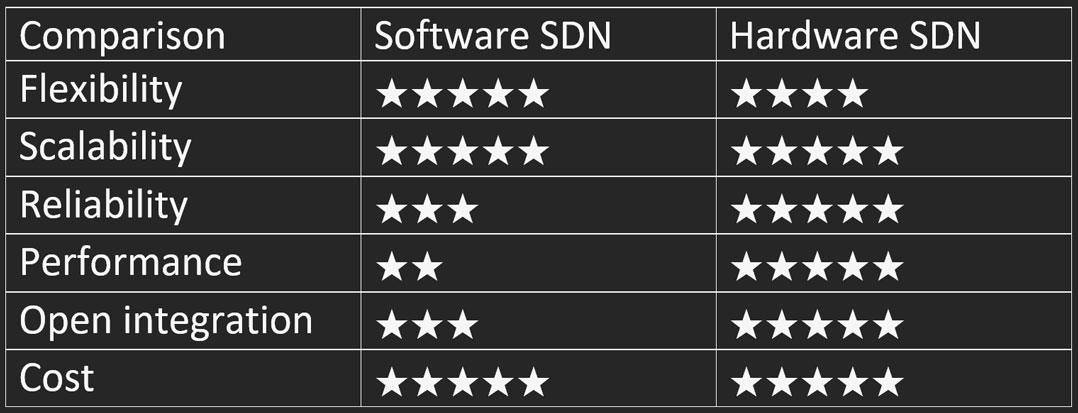 Generally speaking, software SDN offers unique value in certain segmented scenarios, while hardware SDN is the more commonly used option, as seen in current industry practices. In addition to the ultimate flexibility pursued by some Internet companies, most enterprises — including finance, government, and production and manufacturing industries — use hardware SDN to deploy networks in order to quickly obtain business value in their own fields.
Indeed, competition between software and hardware SDN solutions must be determined based on application scenarios and network planning elements. From a market scale perspective, the hardware SDN solution is more widely applicable.
- This article was written by Yang Xiaofeng, a Huawei data centre networking expert who has extensive experience in the IP field
- This promoted content was paid for by the party concerned