

Close Menu
TechCentralTechCentral

    Subscribe to the newsletter

    Get the best South African technology news and analysis delivered to your e-mail inbox every morning.

    Facebook X (Twitter) YouTube LinkedIn
    WhatsApp Facebook X (Twitter) LinkedIn YouTube
    TechCentralTechCentral
    • News
      Vuyani Jarana: Mobile coverage masks a deeper broadband failure

      Vuyani Jarana: Mobile coverage masks a deeper broadband failure

      30 January 2026
      SABC Plus to flight Microsoft AI training videos

      SABC Plus to flight Microsoft AI training videos

      30 January 2026
      Fibre ducts

      Fibre industry consolidation in KZN

      30 January 2026
      Watts & Wheels S1E3: 'BYD's Corolla Cross challenger'

      Watts & Wheels S1E3: ‘BYD’s Corolla Cross challenger’

      30 January 2026
      What ordinary South Africans really think of AI

      What ordinary South Africans really think of AI

      30 January 2026
    • World
      Apple acquires audio AI start-up Q.ai

      Apple acquires audio AI start-up Q.ai

      30 January 2026
      SpaceX IPO may be largest in history

      SpaceX IPO may be largest in history

      28 January 2026
      Nvidia throws AI at the weather

      Nvidia throws AI at weather forecasting

      27 January 2026
      Debate erupts over value of in-flight Wi-Fi

      Debate erupts over value of in-flight Wi-Fi

      26 January 2026
      Intel takes another hit - Intel CEO Lip-Bu Tan. Laure Andrillon/Reuters

      Intel takes another hit

      23 January 2026
    • In-depth
      How liberalisation is rewiring South Africa's power sector

      How liberalisation is rewiring South Africa’s power sector

      21 January 2026
      The top-performing South African tech shares of 2025

      The top-performing South African tech shares of 2025

      12 January 2026
      Digital authoritarianism grows as African states normalise internet blackouts

      Digital authoritarianism grows as African states normalise internet blackouts

      19 December 2025
      TechCentral's South African Newsmakers of 2025

      TechCentral’s South African Newsmakers of 2025

      18 December 2025
      Black Friday goes digital in South Africa as online spending surges to record high

      Black Friday goes digital in South Africa as online spending surges to record high

      4 December 2025
    • TCS
      TCS+ | How Cloud On Demand is helping SA businesses succeed in the cloud - Xhenia Rhode, Dion Kalicharan

      TCS+ | Cloud On Demand and Consnet: inside a real-world AWS partner success story

      30 January 2026
      Watts & Wheels S1E3: 'BYD's Corolla Cross challenger'

      Watts & Wheels S1E2: ‘China attacks, BMW digs in, Toyota’s sublime supercar’

      23 January 2026

      TCS+ | Why cybersecurity is becoming a competitive advantage for SA businesses

      20 January 2026
      Watts & Wheels S1E3: 'BYD's Corolla Cross challenger'

      Watts & Wheels: S1E1 – ‘William, Prince of Wheels’

      8 January 2026
      TCS+ | Africa's digital transformation - unlocking AI through cloud and culture - Cliff de Wit Accelera Digital Group

      TCS+ | Cloud without culture won’t deliver AI: Accelera’s Cliff de Wit

      12 December 2025
    • Opinion
      South Africa's skills advantage is being overlooked at home - Richard Firth

      South Africa’s skills advantage is being overlooked at home

      29 January 2026
      Why Elon Musk's Starlink is a 'hard no' for me - Songezo Zibi

      Why Elon Musk’s Starlink is a ‘hard no’ for me

      26 January 2026
      South Africa's new fibre broadband battle - Duncan McLeod

      South Africa’s new fibre broadband battle

      20 January 2026
      AI moves from pilots to production in South African companies - Nazia Pillay SAP

      AI moves from pilots to production in South African companies

      20 January 2026
      South Africa's new fibre broadband battle - Duncan McLeod

      ANC’s attack on Solly Malatsi shows how BEE dogma trumps economic reality

      14 December 2025
    • Company Hubs
      • Africa Data Centres
      • AfriGIS
      • Altron Digital Business
      • Altron Document Solutions
      • Altron Group
      • Arctic Wolf
      • AvertITD
      • Braintree
      • CallMiner
      • CambriLearn
      • CYBER1 Solutions
      • Digicloud Africa
      • Digimune
      • Domains.co.za
      • ESET
      • Euphoria Telecom
      • Incredible Business
      • iONLINE
      • IQbusiness
      • Iris Network Systems
      • LSD Open
      • NEC XON
      • Netstar
      • Network Platforms
      • Next DLP
      • Ovations
      • Paracon
      • Paratus
      • Q-KON
      • SevenC
      • SkyWire
      • Solid8 Technologies
      • Telit Cinterion
      • Tenable
      • Vertiv
      • Videri Digital
      • Vodacom Business
      • Wipro
      • Workday
      • XLink
    • Sections
      • AI and machine learning
      • Banking
      • Broadcasting and Media
      • Cloud services
      • Contact centres and CX
      • Cryptocurrencies
      • Education and skills
      • Electronics and hardware
      • Energy and sustainability
      • Enterprise software
      • Financial services
      • Information security
      • Internet and connectivity
      • Internet of Things
      • Investment
      • IT services
      • Lifestyle
      • Motoring
      • Public sector
      • Retail and e-commerce
      • Satellite communications
      • Science
      • SMEs and start-ups
      • Social media
      • Talent and leadership
      • Telecoms
    • Events
    • Advertise
    TechCentralTechCentral
    Home » In-depth » The radical future of the car

    The radical future of the car

    By The Conversation7 August 2015
    Twitter LinkedIn Facebook WhatsApp Email Telegram Copy Link
    News Alerts
    WhatsApp
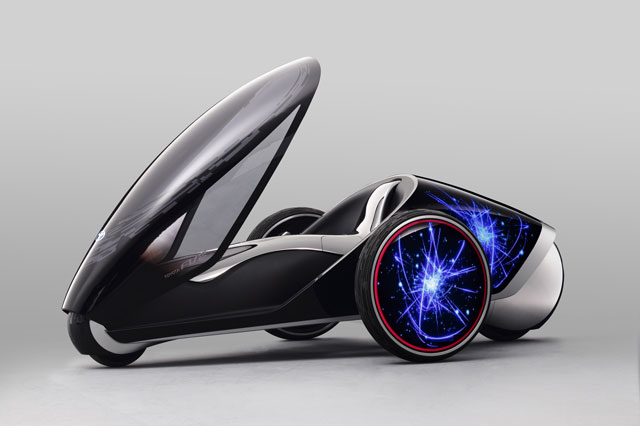
    Toyota's FV2 concept car
    Toyota’s FV2 concept car

    Passenger cars are still the most popular transportation mode. In 2014, nearly 68m were produced globally. They’re not only a vital part of our economy and our personal lives but also an important social and cultural tool, used to present a certain image and status — real or imagined.

    Our entrenched reliance on — and attachment to — this method of travel means that, even if we shift away from such widespread car ownership, we need to change our perception of what cars are if we want to mitigate their high environmental costs.

    This doesn’t just mean moving to electric vehicles. Just at the resource extraction level, roughly five tons of materials are needed to produce a 1,2 ton car, creating ten tons of effluents and 2,5 tons of emissions. Processing these materials into components, assembling and distributing the cars around the world — and then using, servicing and disposing of them generates even more emissions. In total, a typical mid-size car is responsible for around 17 tons of CO₂.

    The total embodied emissions for alternatively fuelled vehicles such as hybrids, electric and fuel-cell vehicles may even be higher than normal internal combustion engines — even when they produce no tail-pipe emissions (based on the as-yet unpublished Greet2 study). This is perhaps because such technologies are more energy intensive to produce due to the materials that compose them.

    So what is the alternative to the current system? If car travel is going to remain common, perhaps we need to be smarter about how we build and use them. Our cars currently spend 92% of their time parked — and, when driving, most of their weight is used only to carry one person most of the time.

    Cars could be produced in fewer numbers, to be smaller, longer-lasting and shared by more people. And instead of focusing on turning out as many new cars with relatively short lifespans as possible, manufacturers could provide more services to keep vehicles on the road for longer and deal with their disposal.

    The role of car designers could also change. First by designing simpler basic cars, without “gimmicks” such as mood lights or massaging seats. Timeless lines rather than subject to the fads of the day. Instead of working on one project after another, the designer could be involved in an upgrading process that would see each model evolve through re-manufacturing in a more direct interaction with consumers.

    Other changes in the features of the cars themselves could also produce more sustainable models. For example, safety standards today are driven by electronic systems such as collision-avoidance and pedestrian-detection systems. These could be upgraded during service life more easily than physical features. Based on my own (as yet unpublished) research, I believe that if these systems prove to be highly reliable, there will be no need for low-speed impact structures, reducing the use of materials.

    This model might be easier to move to than it first sounds. So-called millennials are less interested in cars than previous generations, applying for driver’s licences later in life and more likely to live in highly congested cities where access to public transport is easier. They are also used to sharing or renting services, for example with taxi-hailing or lift-sharing apps such as Uber. Owning a car, on the other hand, is seen as an expensive liability.

    Industry turning point
    The car manufacturing industry is also at a cross-roads. Powertrain options are multiplying, driverless technology is poised to make big changes and non-automotive companies including Google want a share of the market. As materials become more expensive, relying on cars with relatively shorter lifespans to flood the market is not in anyone’s interest. Not even the car makers, who at best can only make 5% annual profit.

    The current business model may not survive in the longer term. It may naturally make more sense for manufacturers to build and service cars as long-lasting rental products. Some electric vehicle manufacturers have already introduced rental schemes for their batteries, which are likely to need replacing far quicker than the rest of the car.

    Extending the lifespan and the product lifecycle will impact on production. Fewer cars means that the return on investment may take longer. But it could also mean less need to update costly manufacturing tools — and factories could be made more modular and flexible to produce different types of cars in one assembly line. Plants could be more localised to meet the different needs of the different megacities of the future. And redundant assembly workers could be retrained into servicing and maintenance or other car-related services.

    This model would require us to think differently about cars, redefining terms such as “old” and “used” and educating consumers, especially those from older generations who are unfamiliar with sharing systems. Not all cars will survive into the future, but if we are better stewards of what we have now and learn to cherish products in a more subjective way than the market does, cars can definitely last for longer.The Conversation

    • Alexandre Rodrigues is PhD candidate at Nottingham Trent University

    Alexandre Rodrigues
    WhatsApp YouTube Follow on Google News Add as preferred source on Google
    Share. Facebook Twitter LinkedIn WhatsApp Telegram Email Copy Link
    Previous ArticleMTN chops FrontRow VOD price
    Next Article Telecoms DG Rosey Sekese suspended

    Related Posts

    How Musk is winning the electric car race

    9 April 2016
    Company News
    Huawei turns 25 in South Africa, celebrates with major device discounts

    Huawei turns 25 in South Africa, celebrates with major device discounts

    30 January 2026
    Phishing has not disappeared, but it has grown up - KnowBe4

    Phishing has not disappeared, but it has grown up

    30 January 2026
    Smartphone affordability: South Africa's new economic divide - PayJoy

    Smartphone affordability: South Africa’s new economic divide

    29 January 2026
    Opinion
    South Africa's skills advantage is being overlooked at home - Richard Firth

    South Africa’s skills advantage is being overlooked at home

    29 January 2026
    Why Elon Musk's Starlink is a 'hard no' for me - Songezo Zibi

    Why Elon Musk’s Starlink is a ‘hard no’ for me

    26 January 2026
    South Africa's new fibre broadband battle - Duncan McLeod

    South Africa’s new fibre broadband battle

    20 January 2026

    Subscribe to Updates

    Get the best South African technology news and analysis delivered to your e-mail inbox every morning.

    Latest Posts
    Vuyani Jarana: Mobile coverage masks a deeper broadband failure

    Vuyani Jarana: Mobile coverage masks a deeper broadband failure

    30 January 2026
    TCS+ | How Cloud On Demand is helping SA businesses succeed in the cloud - Xhenia Rhode, Dion Kalicharan

    TCS+ | Cloud On Demand and Consnet: inside a real-world AWS partner success story

    30 January 2026
    Huawei turns 25 in South Africa, celebrates with major device discounts

    Huawei turns 25 in South Africa, celebrates with major device discounts

    30 January 2026
    SABC Plus to flight Microsoft AI training videos

    SABC Plus to flight Microsoft AI training videos

    30 January 2026
    © 2009 - 2026 NewsCentral Media
    • Cookie policy (ZA)
    • TechCentral – privacy and Popia

    Type above and press Enter to search. Press Esc to cancel.

    Manage consent

    TechCentral uses cookies to enhance its offerings. Consenting to these technologies allows us to serve you better. Not consenting or withdrawing consent may adversely affect certain features and functions of the website.

    Functional Always active
    The technical storage or access is strictly necessary for the legitimate purpose of enabling the use of a specific service explicitly requested by the subscriber or user, or for the sole purpose of carrying out the transmission of a communication over an electronic communications network.
    Preferences
    The technical storage or access is necessary for the legitimate purpose of storing preferences that are not requested by the subscriber or user.
    Statistics
    The technical storage or access that is used exclusively for statistical purposes. The technical storage or access that is used exclusively for anonymous statistical purposes. Without a subpoena, voluntary compliance on the part of your Internet Service Provider, or additional records from a third party, information stored or retrieved for this purpose alone cannot usually be used to identify you.
    Marketing
    The technical storage or access is required to create user profiles to send advertising, or to track the user on a website or across several websites for similar marketing purposes.
    • Manage options
    • Manage services
    • Manage {vendor_count} vendors
    • Read more about these purposes
    View preferences
    • {title}
    • {title}
    • {title}