
Close Menu
TechCentralTechCentral

    Subscribe to the newsletter

    Get the best South African technology news and analysis delivered to your e-mail inbox every morning.

    Facebook X (Twitter) YouTube LinkedIn
    WhatsApp Facebook X (Twitter) LinkedIn YouTube
    TechCentralTechCentral
    • News
      MTN and Vodacom dwarf South Africa's listed tech sector

      MTN and Vodacom dwarf South Africa’s listed tech sector

      20 March 2026
      SA firm opens Africa's largest space hardware factory

      SA firm opens Africa’s largest space hardware factory

      20 March 2026
      OpenClaw fever grips China

      OpenClaw fever grips China

      20 March 2026
      OpenAI plans desktop 'super app'

      OpenAI plans desktop ‘super app’

      20 March 2026
      How a WhatsApp bundle exposed a fault line in SA mobile

      How a WhatsApp bundle exposed a fault line in SA mobile

      19 March 2026
    • World
      Mystery Chinese AI model revealed to be Xiaomi's

      Mystery Chinese AI model revealed to be Xiaomi’s

      19 March 2026
      A mystery AI model has developers buzzing

      A mystery AI model has developers buzzing

      18 March 2026
      Samsung's trifold gamble ends in retreat

      Samsung’s trifold gamble ends in retreat

      17 March 2026
      Nvidia targets $1-trillion in AI chip sales as inference demand surges - Jensen Huang

      Nvidia targets $1-trillion in AI chip sales as inference demand surges

      17 March 2026
      Peter Thiel's secretive Rome conference draws Church attention

      Peter Thiel’s secretive Rome conference draws Church attention

      16 March 2026
    • In-depth
      The last generation of coders

      The last generation of coders

      18 February 2026
      Sentech is in dire straits

      Sentech is in dire straits

      10 February 2026
      How liberalisation is rewiring South Africa's power sector

      How liberalisation is rewiring South Africa’s power sector

      21 January 2026
      The top-performing South African tech shares of 2025

      The top-performing South African tech shares of 2025

      12 January 2026
      Digital authoritarianism grows as African states normalise internet blackouts

      Digital authoritarianism grows as African states normalise internet blackouts

      19 December 2025
    • TCS
      TCS+ | Arctic Wolf unpacks the evolving threat landscape for SA businesses - Clare Loveridge and Jason Oehley

      TCS+ | Arctic Wolf unpacks the evolving threat landscape for SA businesses

      19 March 2026
      TCS+ | Vox Kiwi: a wireless solution promising a fibre-like experience - Theo van Zyl

      TCS+ | Vox Kiwi: a wireless solution promising a fibre-like experience

      13 March 2026
      TCS+ | Flipping the narrative on AI in the Global South - Josefin Rosén

      TCS+ | Flipping the narrative on AI in the Global South

      13 March 2026
      TCS | Sink or swim? Antony Makins on how AI is rewriting the rules of work

      TCS | Sink or swim? Antony Makins on how AI is rewriting the rules of work

      5 March 2026
      TCS+ | Bolt ups the ante on platform safety - Simo Kalajdzic

      TCS+ | Bolt ups the ante on platform safety

      4 March 2026
    • Opinion
      South Africa's energy future hinges on getting wheeling right - Aishah Gire

      South Africa’s energy future hinges on getting wheeling right

      10 March 2026
      Hold the doom: the case for a South African comeback - Duncan McLeod

      Apple just dropped a bomb on the Windows world

      5 March 2026
      VC's centre of gravity is shifting - and South Africa is in the frame - Alison Collier

      VC’s centre of gravity is shifting – and South Africa is in the frame

      3 March 2026
      Hold the doom: the case for a South African comeback - Duncan McLeod

      Hold the doom: the case for a South African comeback

      26 February 2026
      The AI fraud crisis your bank is not ready for - Andries Maritz

      The AI fraud crisis your bank is not ready for

      18 February 2026
    • Company Hubs
      • 1Stream
      • Africa Data Centres
      • AfriGIS
      • Altron Digital Business
      • Altron Document Solutions
      • Altron Group
      • Arctic Wolf
      • AvertITD
      • Braintree
      • CallMiner
      • CambriLearn
      • CYBER1 Solutions
      • Digicloud Africa
      • Digimune
      • Domains.co.za
      • ESET
      • Euphoria Telecom
      • HOSTAFRICA
      • Incredible Business
      • iONLINE
      • IQbusiness
      • Iris Network Systems
      • LSD Open
      • Mitel
      • NEC XON
      • Netstar
      • Network Platforms
      • Next DLP
      • Ovations
      • Paracon
      • Paratus
      • Q-KON
      • SevenC
      • SkyWire
      • Solid8 Technologies
      • Telit Cinterion
      • Tenable
      • Vertiv
      • Videri Digital
      • Vodacom Business
      • Wipro
      • Workday
      • XLink
    • Sections
      • AI and machine learning
      • Banking
      • Broadcasting and Media
      • Cloud services
      • Contact centres and CX
      • Cryptocurrencies
      • Education and skills
      • Electronics and hardware
      • Energy and sustainability
      • Enterprise software
      • Financial services
      • HealthTech
      • Information security
      • Internet and connectivity
      • Internet of Things
      • Investment
      • IT services
      • Lifestyle
      • Motoring
      • Policy and regulation
      • Public sector
      • Retail and e-commerce
      • Satellite communications
      • Science
      • SMEs and start-ups
      • Social media
      • Talent and leadership
      • Telecoms
    • Events
    • Advertise
    TechCentralTechCentral
    Home » Editor's pick » The thrilling future of quantum computing

    The thrilling future of quantum computing

    By The Conversation21 September 2015
    Twitter LinkedIn Facebook WhatsApp Email Telegram Copy Link
    News Alerts
    WhatsApp
    quantum-computing-image-one-640
    Quantum circuitry. Paul Koenraad/TU Eindhoven

    The one thing everyone knows about quantum mechanics is its legendary weirdness, in which the basic tenets of the world it describes seem alien to the world we live in. Superposition, where things can be in two states simultaneously, a switch both on and off, a cat both dead and alive. Or entanglement, what Einstein called “spooky action-at-distance” in which objects are invisibly linked, even when separated by huge distances.

    But weird or not, quantum theory is approaching a century old and has found many applications in daily life. As John von Neumann once said: “You don’t understand quantum mechanics, you just get used to it.” Much of electronics is based on quantum physics, and the application of quantum theory to computing could open up huge possibilities for the complex calculations and data processing we see today.

    Imagine a computer processor able to harness super-position, to calculate the result of an arbitrarily large number of permutations of a complex problem simultaneously. Imagine how entanglement could be used to allow systems on different sides of the world to be linked and their efforts combined, despite their physical separation. Quantum computing has immense potential, making light work of some of the most difficult tasks, such as simulating the body’s response to drugs, predicting weather patterns or analysing big data sets.

    Such processing possibilities are needed. The first transistors could only just be held in the hand, while today they measure just 14nm — 500 times smaller than a red blood cell. This relentless shrinking, predicted by Intel founder Gordon Moore as Moore’s law, has held true for 50 years, but cannot hold indefinitely. Silicon can only be shrunk so far, and if we are to continue benefiting from the performance gains we have become used to, we need a different approach.

    Quantum fabrication
    Advances in semiconductor fabrication have made it possible to mass-produce quantum-scale semiconductors — electronic circuits that exhibit quantum effects such as super-position and entanglement.
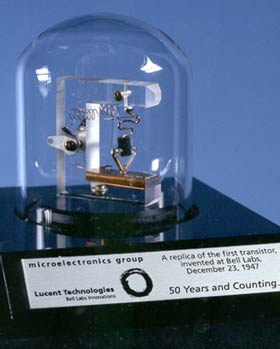
    Replica of the first ever transistor, manufactured at Bell Labs in 1947
    Replica of the first ever transistor, manufactured at Bell Labs in 1947

    The image at the top of this article, captured at the atomic scale, shows a cross-section through one potential candidate for the building blocks of a quantum computer, a semiconductor nano-ring. Electrons trapped in these rings exhibit the strange properties of quantum mechanics, and semiconductor fabrication processes are poised to integrate these elements required to build a quantum computer. While we may be able to construct a quantum computer using structures like these, there are still major challenges involved.

    In a classical computer processor, a huge number of transistors interact conditionally and predictably with one another. But quantum behaviour is highly fragile; for example, under quantum physics, even measuring the state of the system such as checking whether the switch is on or off, actually changes what is being observed. Conducting an orchestra of quantum systems to produce useful output that couldn’t easily by handled by a classical computer is extremely difficult.

    But there have been huge investments: the UK government announced £270m in funding for quantum technologies in 2014, for example, and the likes of Google, Nasa and Lockheed Martin are also working in the field. It’s difficult to predict the pace of progress, but a useful quantum computer could be 10 years away.

    The basic element of quantum computing is known as a qubit, the quantum equivalent to the bits used in traditional computers. To date, scientists have harnessed quantum systems to represent qubits in many different ways, ranging from defects in diamonds, to semiconductor nano-structures or tiny superconducting circuits. Each of these has its own advantages and disadvantages, but none yet has met all the requirements for a quantum computer, known as the DiVincenzo Criteria.

    The most impressive progress has come from D-Wave Systems, a firm that has managed to pack hundreds of qubits on to a small chip similar in appearance to a traditional processor.

    Quantum secrets
    The benefits of harnessing quantum technologies aren’t limited to computing, however. Whether or not quantum computing will extend or augment digital computing, the same quantum effects can be harnessed for other means. The most mature example is quantum communications.

    Quantum physics has been proposed as a means to prevent forgery of valuable objects, such as a banknote or diamond. Here, the unusual negative rules embedded within quantum physics prove useful; perfect copies of unknown states cannot be made and measurements change the systems they are measuring. These two limitations are combined in this quantum anti-counterfeiting scheme, making it impossible to copy the identity of the object they are stored in.

    The concept of quantum money is, unfortunately, highly impractical, but the same idea has been successfully extended to communications. The idea is straightforward: the act of measuring quantum super-position states alters what you try to measure, so it’s possible to detect the presence of an eavesdropper making such measurements. With the correct protocol, such as BB84, it is possible to communicate privately, with that privacy guaranteed by fundamental laws of physics.

    Quantum communication systems are commercially available today from firms such as Toshiba and ID Quantique. While the implementation is clunky and expensive now it will become more streamlined and miniaturised, just as transistors have miniaturised over the last 60 years.

    Improvements to nanoscale fabrication techniques will greatly accelerate the development of quantum-based technologies. And while useful quantum computing still appears to be some way off, it’s future is very exciting indeed.The Conversation

    • Robert Young is research fellow and lecturer at Lancaster University
    • This article was originally published on The Conversation

    Follow TechCentral on Google News Add TechCentral as your preferred source on Google


    Albert Einstein Gordon Moore Robert Young
    WhatsApp YouTube
    Share. Facebook Twitter LinkedIn WhatsApp Telegram Email Copy Link
    Previous ArticleSex with robots: reasons not to fear it
    Next Article SABC footing Motsoeneng’s legal bill

    Related Posts

    Out with the bean counters: the rise of the tech-savvy CEO

    Out with the bean counters: the rise of the tech-savvy CEO

    24 May 2024
    Schneider Electric

    How ARM chips could transform the data centre business

    20 November 2023

    Scientists discover universe is awash in gravitational waves

    29 June 2023
    Company News

    How South African executives can crack the AI ROI code

    20 March 2026
    Africa's first Nvidia RTX Pro GPU servers have landed

    Africa’s first Nvidia RTX Pro GPU servers have landed

    19 March 2026
    How Acer Africa is bridging the digital divide through local innovation

    How Acer Africa is bridging the digital divide through local innovation

    19 March 2026
    Opinion
    South Africa's energy future hinges on getting wheeling right - Aishah Gire

    South Africa’s energy future hinges on getting wheeling right

    10 March 2026
    Hold the doom: the case for a South African comeback - Duncan McLeod

    Apple just dropped a bomb on the Windows world

    5 March 2026
    VC's centre of gravity is shifting - and South Africa is in the frame - Alison Collier

    VC’s centre of gravity is shifting – and South Africa is in the frame

    3 March 2026

    Subscribe to Updates

    Get the best South African technology news and analysis delivered to your e-mail inbox every morning.

    Latest Posts
    MTN and Vodacom dwarf South Africa's listed tech sector

    MTN and Vodacom dwarf South Africa’s listed tech sector

    20 March 2026
    SA firm opens Africa's largest space hardware factory

    SA firm opens Africa’s largest space hardware factory

    20 March 2026
    OpenClaw fever grips China

    OpenClaw fever grips China

    20 March 2026
    OpenAI plans desktop 'super app'

    OpenAI plans desktop ‘super app’

    20 March 2026
    © 2009 - 2026 NewsCentral Media
    • Cookie policy (ZA)
    • TechCentral – privacy and Popia

    Type above and press Enter to search. Press Esc to cancel.

    Manage consent

    TechCentral uses cookies to enhance its offerings. Consenting to these technologies allows us to serve you better. Not consenting or withdrawing consent may adversely affect certain features and functions of the website.

    Functional Always active
    The technical storage or access is strictly necessary for the legitimate purpose of enabling the use of a specific service explicitly requested by the subscriber or user, or for the sole purpose of carrying out the transmission of a communication over an electronic communications network.
    Preferences
    The technical storage or access is necessary for the legitimate purpose of storing preferences that are not requested by the subscriber or user.
    Statistics
    The technical storage or access that is used exclusively for statistical purposes. The technical storage or access that is used exclusively for anonymous statistical purposes. Without a subpoena, voluntary compliance on the part of your Internet Service Provider, or additional records from a third party, information stored or retrieved for this purpose alone cannot usually be used to identify you.
    Marketing
    The technical storage or access is required to create user profiles to send advertising, or to track the user on a website or across several websites for similar marketing purposes.
    • Manage options
    • Manage services
    • Manage {vendor_count} vendors
    • Read more about these purposes
    View preferences
    • {title}
    • {title}
    • {title}