Close Menu
TechCentralTechCentral

    Subscribe to the newsletter

    Get the best South African technology news and analysis delivered to your e-mail inbox every morning.

    Facebook X (Twitter) YouTube LinkedIn
    WhatsApp Facebook X (Twitter) LinkedIn YouTube
    TechCentralTechCentral
    • News
      ASML announces chip manufacturing breakthrough

      ASML announces chip manufacturing breakthrough

      23 February 2026
      Home affairs to move all visa processing online - Leon Schreiber

      Home affairs to move all visa processing online

      23 February 2026
      Spar rethinks SAP roll-out amid franchise lawsuit and CEO exit

      Spar rethinks SAP roll-out amid franchise lawsuit and CEO exit

      23 February 2026
      Solar, wind and smart grids - the tech transforming South Africa's mining sector

      Solar, wind and smart grids – the tech transforming South Africa’s mining sector

      23 February 2026
      The real reason MTN is bringing its towers back in-house

      The real reason MTN is bringing its towers back in-house

      22 February 2026
    • World
      Xbox chief Phil Spencer retires from Microsoft

      Xbox chief Phil Spencer retires from Microsoft

      22 February 2026
      Prominent Southern African journalist targeted with Predator spyware

      Prominent Southern African journalist targeted with Predator spyware

      18 February 2026
      More drama in Warner Bros tug of war

      More drama in Warner Bros tug of war

      17 February 2026
      Russia bans WhatsApp

      Russia bans WhatsApp

      12 February 2026
      EU regulators take aim at WhatsApp

      EU regulators take aim at WhatsApp

      9 February 2026
    • In-depth
      The last generation of coders

      The last generation of coders

      18 February 2026
      Sentech is in dire straits

      Sentech is in dire straits

      10 February 2026
      How liberalisation is rewiring South Africa's power sector

      How liberalisation is rewiring South Africa’s power sector

      21 January 2026
      The top-performing South African tech shares of 2025

      The top-performing South African tech shares of 2025

      12 January 2026
      Digital authoritarianism grows as African states normalise internet blackouts

      Digital authoritarianism grows as African states normalise internet blackouts

      19 December 2025
    • TCS
      Watts & Wheels S1E4: 'We drive an electric Uber'

      Watts & Wheels S1E4: ‘We drive an electric Uber’

      10 February 2026
      TCS+ | How Cloud On Demand is helping SA businesses succeed in the cloud - Xhenia Rhode, Dion Kalicharan

      TCS+ | Cloud On Demand and Consnet: inside a real-world AWS partner success story

      30 January 2026
      Watts & Wheels S1E4: 'We drive an electric Uber'

      Watts & Wheels S1E3: ‘BYD’s Corolla Cross challenger’

      30 January 2026
      Watts & Wheels S1E4: 'We drive an electric Uber'

      Watts & Wheels S1E2: ‘China attacks, BMW digs in, Toyota’s sublime supercar’

      23 January 2026

      TCS+ | Why cybersecurity is becoming a competitive advantage for SA businesses

      20 January 2026
    • Opinion
      The AI fraud crisis your bank is not ready for - Andries Maritz

      The AI fraud crisis your bank is not ready for

      18 February 2026
      A million reasons monopolies don't work - Duncan McLeod

      A million reasons monopolies don’t work

      10 February 2026
      The author, Business Leadership South Africa CEO Busi Mavuso

      Eskom unbundling U-turn threatens to undo hard-won electricity gains

      9 February 2026
      South Africa's skills advantage is being overlooked at home - Richard Firth

      South Africa’s skills advantage is being overlooked at home

      29 January 2026
      Why Elon Musk's Starlink is a 'hard no' for me - Songezo Zibi

      Why Elon Musk’s Starlink is a ‘hard no’ for me

      26 January 2026
    • Company Hubs
      • Africa Data Centres
      • AfriGIS
      • Altron Digital Business
      • Altron Document Solutions
      • Altron Group
      • Arctic Wolf
      • AvertITD
      • Braintree
      • CallMiner
      • CambriLearn
      • CYBER1 Solutions
      • Digicloud Africa
      • Digimune
      • Domains.co.za
      • ESET
      • Euphoria Telecom
      • Incredible Business
      • iONLINE
      • IQbusiness
      • Iris Network Systems
      • LSD Open
      • Mitel
      • NEC XON
      • Netstar
      • Network Platforms
      • Next DLP
      • Ovations
      • Paracon
      • Paratus
      • Q-KON
      • SevenC
      • SkyWire
      • Solid8 Technologies
      • Telit Cinterion
      • Tenable
      • Vertiv
      • Videri Digital
      • Vodacom Business
      • Wipro
      • Workday
      • XLink
    • Sections
      • AI and machine learning
      • Banking
      • Broadcasting and Media
      • Cloud services
      • Contact centres and CX
      • Cryptocurrencies
      • Education and skills
      • Electronics and hardware
      • Energy and sustainability
      • Enterprise software
      • Financial services
      • Information security
      • Internet and connectivity
      • Internet of Things
      • Investment
      • IT services
      • Lifestyle
      • Motoring
      • Public sector
      • Retail and e-commerce
      • Satellite communications
      • Science
      • SMEs and start-ups
      • Social media
      • Talent and leadership
      • Telecoms
    • Events
    • Advertise
    TechCentralTechCentral
    Home » Sections » Electronics and hardware » Trump is dead wrong about Taiwan’s chip industry

    Trump is dead wrong about Taiwan’s chip industry

    Donald Trump’s comments that Taiwan hollowed out the US semiconductor industry are incorrect.
    By Lionel Laurent18 July 2024
    Twitter LinkedIn Facebook WhatsApp Email Telegram Copy Link
    News Alerts
    WhatsApp
    Trump is dead wrong about Taiwan's chip industry
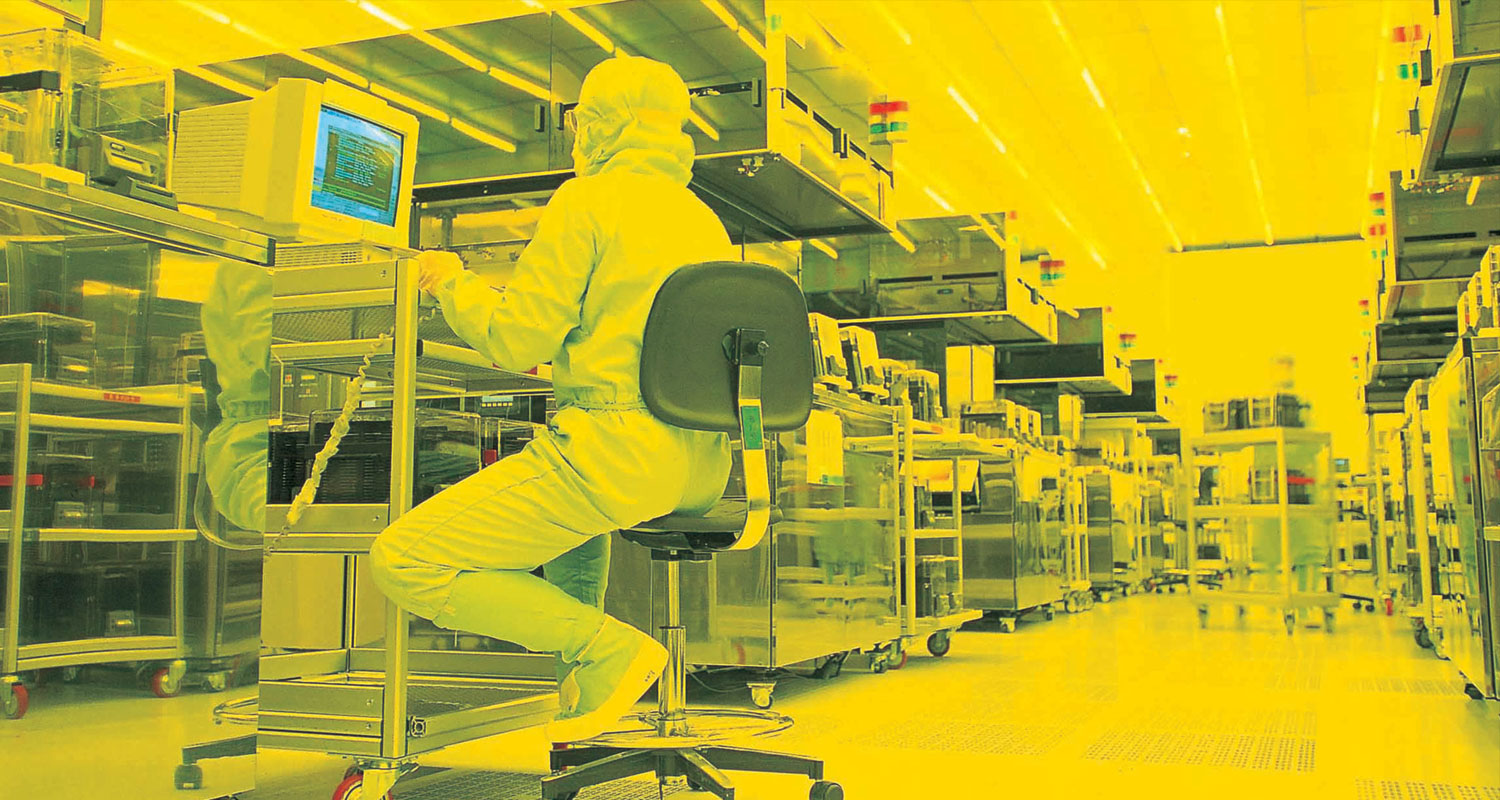
    Inside a TSMC chip fabrication plant in Taiwan. Image: TSMC

    Donald Trump’s comments that Taiwan hollowed out the US semiconductor industry are incorrect. That misunderstanding could impact the future of one of the world’s most important relationships, and end up aiding China at a time it is working hard to push its own tech sector to catch up.

    “Taiwan took our chip business from us,” the returnee US presidential contender told Bloomberg Businessweek in an interview published this week. The remarks came after the Republican nominee was asked whether he’d defend Taiwan against China.

    It’s not the first time he’s said this about the island’s chip sector, but comes amid heightened military, trade and technology rivalry between the two superpowers. In truth, Taiwan accounts for less than a quarter of the global semiconductor market, trailing the US, but has more than a 90% share in the fabrication of the most-advanced chips¹.

    The White House is considering the imposition of the foreign direct product rule on the chip sector

    Right now, the global semiconductor space ought to be celebrating a boom driven by skyrocketing demand for artificial intelligence. Netherlands-based ASML, maker of the world’s most important semiconductor manufacturing equipment, on Wednesday reported bookings for new machines that surpassed estimates by almost 30%. On Thursday, Taiwan Semiconductor Manufacturing Co, which controls more than 90% of leading-edge production capacity, lifted its revenue outlook for the year.

    Instead of rising in recent days, shares of both companies dropped. In addition to Trump’s comment, investors are worried about the possibility of tighter regulations on China from the current Biden administration. The White House is considering the imposition of the foreign direct product rule on the chip sector, which would apply to foreign-made products that use even a tiny amount of US technology. Such a move would extend an existing series of restrictions aimed at limiting China’s technological advance.

    Damaging

    Trump’s broader view of the US-Taiwan relationship, though, could be far more damaging in the long run than another round of export curbs. In his defence, the belief that Taipei took from the US is a common misperception, but the former president happens to be the loudest voice and may soon be back in the White House to act on it.

    In fact, the seed of Taiwan’s technological rise was planted by US foreign policy dating back to 1950, before semiconductors were invented. At the time, President Harry Truman directed his administration to pump money into the island’s economy. The US was also there at the birth of Taiwan’s chip sector. In 1976, Radio Corporation of America agreed to license its semiconductor technology to Taiwan, for a fee. United Microelectronics came from this programme, and was one of the first companies globally to make its factories available to external clients who needed chips made-to-order.

    A decade later, Morris Chang, a US citizen and former senior executive at Texas Instruments, founded TSMC. It was the first to only make chips for external clients. Intel was among the earliest customers. Since then, the US-Taiwan technology relationship has been one of symbiosis and co-dependence. In the 1990s, when fledgling US chip designers couldn’t find a local factory to make their products, TSMC and UMC were on hand to help. Qualcomm, Nvidia and Xilinx, giants of the US semiconductor industry, wouldn’t exist today if not for the Taiwanese.

    Donald Trump. Image: Gage Skidmore

    In the last 20 years, as US firms dropped the ball on technological advancement and capacity expansion, Taiwanese companies have put up the money to research and develop new processes and bet more than $250-billion on the factories needed to churn out American-designed chips. At the same time, Chinese companies, America’s true rivals, have been accused of stealing technology from Taiwanese and US businesses to aid that nation’s technological development².

    If not for the risks taken by Taiwanese enterprises, and cooperation — instead of unbridled competition — with US companies, Qualcomm and Broadcom couldn’t have dominated the global market for communications chips. And Nvidia, Intel and AMD wouldn’t be ahead of China in the AI chip race.

    To view Taiwan-US economic history as anything but mutually beneficial risks fracturing one of the world’s most important industrial relationships, opening the door for China to take advantage of an unnecessary fissure. Instead, the White House, no matter who occupies it, needs to understand that Taipei is not a rival, it’s one of the biggest cheerleaders for US technology leadership.

    ¹The US still dominates thanks to companies like Nvidia, AMD, Qualcomm, Intel and Apple as well as through equipment and design-software providers. ²A US court found Fujian Jinhua not guilty of stealing from Micron because prosecutors failed to prove that the defendants misappropriated proprietary data. Taiwan’s UMC pleaded guilty in a related case.


    Read next: TSMC founder supports US efforts to slow China’s chip advances

    Follow TechCentral on Google News Add TechCentral as your preferred source on Google


    AMD Donald Trump Intel Joe Biden Qualcomm TSMC
    WhatsApp YouTube
    Share. Facebook Twitter LinkedIn WhatsApp Telegram Email Copy Link
    Previous ArticleWhy Telkom still hasn’t launched 5G on phones
    Next Article Demand declines for home solar installations

    Related Posts

    Chip shortage hits PCs as AI swallows the world's memory supply

    Chip shortage hits PCs as AI swallows the world’s memory supply

    12 February 2026
    Smartphone market hit by deepening memory crisis

    Smartphone market hit by deepening memory crisis

    5 February 2026
    OpenAI chip rethink signals turning point in AI hardware market - Sam Altman. Shelby Tauber/Reuters

    OpenAI chip rethink signals turning point in AI hardware market

    3 February 2026
    Company News
    The human side of AI - Altron Digital Business

    The human side of AI

    23 February 2026
    Service is everyone's problem now - and that's exactly why the Atlassian Service Collection matters

    Service is everyone’s problem now – why the Atlassian Service Collection matters

    20 February 2026
    Customers have new expectations. Is your CX ready? 1Stream

    Customers have new expectations. Is your CX ready?

    19 February 2026
    Opinion
    The AI fraud crisis your bank is not ready for - Andries Maritz

    The AI fraud crisis your bank is not ready for

    18 February 2026
    A million reasons monopolies don't work - Duncan McLeod

    A million reasons monopolies don’t work

    10 February 2026
    The author, Business Leadership South Africa CEO Busi Mavuso

    Eskom unbundling U-turn threatens to undo hard-won electricity gains

    9 February 2026

    Subscribe to Updates

    Get the best South African technology news and analysis delivered to your e-mail inbox every morning.

    Latest Posts
    ASML announces chip manufacturing breakthrough

    ASML announces chip manufacturing breakthrough

    23 February 2026
    Home affairs to move all visa processing online - Leon Schreiber

    Home affairs to move all visa processing online

    23 February 2026
    The human side of AI - Altron Digital Business

    The human side of AI

    23 February 2026
    Spar rethinks SAP roll-out amid franchise lawsuit and CEO exit

    Spar rethinks SAP roll-out amid franchise lawsuit and CEO exit

    23 February 2026
    © 2009 - 2026 NewsCentral Media
    • Cookie policy (ZA)
    • TechCentral – privacy and Popia

    Type above and press Enter to search. Press Esc to cancel.

    Manage consent

    TechCentral uses cookies to enhance its offerings. Consenting to these technologies allows us to serve you better. Not consenting or withdrawing consent may adversely affect certain features and functions of the website.

    Functional Always active
    The technical storage or access is strictly necessary for the legitimate purpose of enabling the use of a specific service explicitly requested by the subscriber or user, or for the sole purpose of carrying out the transmission of a communication over an electronic communications network.
    Preferences
    The technical storage or access is necessary for the legitimate purpose of storing preferences that are not requested by the subscriber or user.
    Statistics
    The technical storage or access that is used exclusively for statistical purposes. The technical storage or access that is used exclusively for anonymous statistical purposes. Without a subpoena, voluntary compliance on the part of your Internet Service Provider, or additional records from a third party, information stored or retrieved for this purpose alone cannot usually be used to identify you.
    Marketing
    The technical storage or access is required to create user profiles to send advertising, or to track the user on a website or across several websites for similar marketing purposes.
    • Manage options
    • Manage services
    • Manage {vendor_count} vendors
    • Read more about these purposes
    View preferences
    • {title}
    • {title}
    • {title}