Close Menu
TechCentralTechCentral

    Subscribe to the newsletter

    Get the best South African technology news and analysis delivered to your e-mail inbox every morning.

    Facebook X (Twitter) YouTube LinkedIn
    WhatsApp Facebook X (Twitter) LinkedIn YouTube
    TechCentralTechCentral
    • News
      Why AI chatbots are a legal liability waiting to happen - Ahmore Burger-Smidt

      Why AI chatbots are a legal liability waiting to happen

      21 April 2026
      South African tech juniors squeezed as AI reshapes hiring

      South African tech juniors squeezed as AI reshapes hiring

      21 April 2026
      South Africa's digital ID gets a launch date

      South Africa’s digital ID gets a targeted launch date

      21 April 2026
      Liquid dodges debt crunch - at a hefty price - Hardy Pemhiwa

      Liquid dodges debt crunch – at a hefty price

      21 April 2026
      Seacom takes aim at regional peering costs - Prenesh Padayachee

      Seacom takes aim at regional peering costs

      21 April 2026
    • World
      More organic compounds detected on Mars - Nasa Curiosity rover

      More organic compounds detected on Mars

      21 April 2026
      Adobe bets on AI agents to fend off cheaper rivals

      Adobe bets on AI agents to fend off cheaper rivals

      16 April 2026
      Google poised to lose ad crown to Meta

      Google poised to lose ad crown to Meta

      14 April 2026
      Grand Theft Data - hackers hit Rockstar Games - Grand Theft Auto

      Grand Theft Data – hackers hit Rockstar Games

      14 April 2026
      UK PM Keir Starmer declares war on doomscrolling

      UK PM Keir Starmer declares war on doomscrolling

      13 April 2026
    • In-depth
      Africa switches on as Europe dims the lights

      Africa switches on as Europe dims the lights

      9 April 2026
      The biggest untapped EV market on Earth is hiding in plain sight

      The biggest untapped EV market on Earth is hiding in plain sight

      1 April 2026
      The R18-billion tech giant hiding in plain sight - Jens Montanana

      The R16-billion tech giant hiding in plain sight

      26 March 2026
      The last generation of coders

      The last generation of coders

      18 February 2026
      Sentech is in dire straits

      Sentech is in dire straits

      10 February 2026
    • TCS

      TCS+ | ‘The ISP for ISPs’: Vox’s shift to wholesale aggregator

      20 April 2026
      TCS | Werner Lindemann on how AI is rewriting the infosec rulebook

      TCS | Werner Lindemann on how AI is rewriting the infosec rulebook

      15 April 2026
      TCS | Donovan Marsh on AI and the future of filmmaking

      TCS | Donovan Marsh on AI and the future of filmmaking

      7 April 2026
      TCS+ | Vodacom Business moves to crack the SME tech gap - Andrew Fulton, Sannesh Beharie

      TCS+ | Vodacom Business moves to crack the SME tech gap

      7 April 2026
      TCS | MTN's Divysh Joshi on the strategy behind Pi - Divyesh Joshi

      TCS | MTN’s Divyesh Joshi on the strategy behind Pi

      1 April 2026
    • Opinion
      The conflict of interest at the heart of PayShap's slow adoption - Cheslyn Jacobs

      The conflict of interest at the heart of PayShap’s slow adoption

      26 March 2026
      South Africa's energy future hinges on getting wheeling right - Aishah Gire

      South Africa’s energy future hinges on getting wheeling right

      10 March 2026
      Hold the doom: the case for a South African comeback - Duncan McLeod

      Apple just dropped a bomb on the Windows world

      5 March 2026
      R230-million in the bag for Endeavor's third Harvest Fund - Alison Collier

      VC’s centre of gravity is shifting – and South Africa is in the frame

      3 March 2026
      Hold the doom: the case for a South African comeback - Duncan McLeod

      Hold the doom: the case for a South African comeback

      26 February 2026
    • Company Hubs
      • 1Stream
      • Africa Data Centres
      • AfriGIS
      • Altron Digital Business
      • Altron Document Solutions
      • Altron Group
      • Arctic Wolf
      • Ascent Technology
      • AvertITD
      • BBD
      • Braintree
      • CallMiner
      • CambriLearn
      • CYBER1 Solutions
      • Digicloud Africa
      • Digimune
      • Domains.co.za
      • ESET
      • Euphoria Telecom
      • HOSTAFRICA
      • Incredible Business
      • iONLINE
      • IQbusiness
      • Iris Network Systems
      • Kaspersky
      • LSD Open
      • Mitel
      • NEC XON
      • Netstar
      • Network Platforms
      • Next DLP
      • Ovations
      • Paracon
      • Paratus
      • Q-KON
      • SevenC
      • SkyWire
      • Solid8 Technologies
      • Telit Cinterion
      • Telviva
      • Tenable
      • Vertiv
      • Videri Digital
      • Vodacom Business
      • Wipro
      • Workday
      • XLink
    • Sections
      • AI and machine learning
      • Banking
      • Broadcasting and Media
      • Cloud services
      • Contact centres and CX
      • Cryptocurrencies
      • Education and skills
      • Electronics and hardware
      • Energy and sustainability
      • Enterprise software
      • Financial services
      • HealthTech
      • Information security
      • Internet and connectivity
      • Internet of Things
      • Investment
      • IT services
      • Lifestyle
      • Motoring
      • Policy and regulation
      • Public sector
      • Retail and e-commerce
      • Satellite communications
      • Science
      • SMEs and start-ups
      • Social media
      • Talent and leadership
      • Telecoms
    • Events
    • Advertise
    TechCentralTechCentral
    Home » Editor's pick » Why the SKA is the ultimate in big data

    Why the SKA is the ultimate in big data

    By The Conversation25 November 2014
    Twitter LinkedIn Facebook WhatsApp Email Telegram Copy Link
    News Alerts
    WhatsApp
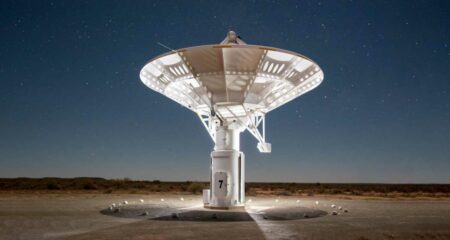
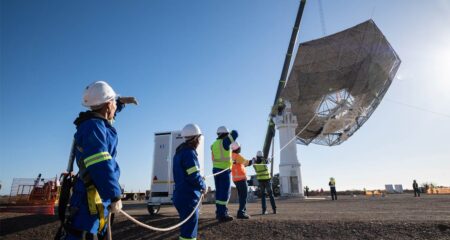
    Construction on the SKA Karoo site (image: SKA South Africa)
    Construction on the SKA Karoo site (image: SKA South Africa)

    Telescopes have come a long way since the days when they were all about lone astronomers watching the night sky through their upstairs windows. Today, teams of astrophysicists build and use much more modern instruments, not only to observe light visible to our eyes, but also radio emissions from the universe.

    Radio telescopes used to use large single dishes to pick up these emissions, but have since graduated to arrays of antennae. These act as one dish over much a wider area and make it possible to receive signals from further away. We refer to them as radio-interferometric arrays because they study the interference of radio waves between pairs of antennae.

    Radio interferometry was developed by the English scientists Antony Hewish and Martin Ryle, who received the Nobel prize in 1974 for using such telescopes to discover pulsars — highly magnetised rotating neutron stars. Pulsars rotate with extreme stability, making them the most precise clocks in the universe.

    In 1993, the American astrophysicists Russell Hulse and Joseph Taylor demonstrated the importance of pulsars in understanding our universe by discovering them in a gravitationally coupled pair known as a binary system. This provided the first indirect evidence for gravitational waves, which are an essential unproven part of Einstein’s theory of general relativity.

    There have been numerous arrays of radio telescopes developed since the 1970s. The state of the art includes the Low-Frequency Array (Lofar) in western Europe, the Murchison Widefield Array (MWA) in western Australia and the Atacama Large Millimetre Array (Alma) in Chile. These are all just coming online and are regarded as a major step forward in our ability to understand the universe.
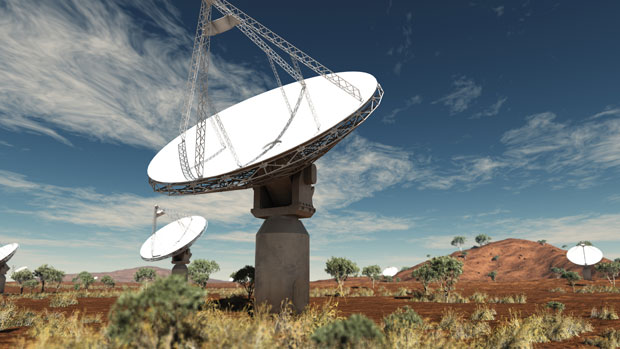
    Artist's impression of SKA dishes (image: SKA Organisation/Swinburne Astronomy Productions)
    Artist’s impression of SKA dishes (image: SKA Organisation/Swinburne Astronomy Productions)

    Yet they will be soon followed by the Square Kilometre Array (SKA), which will be made up of an unprecedented number of antennae spread across two continents for the first time (Australia and Africa). The SKA will see the radio sky with unprecedented sensitivity and resolution, enabling us to pick up extremely small and faint objects and probe the more distant universe. It is due to come online around 2023.

    It is already the case that interferometric data holds only partial information and does not provide immediately recognisable visual images. This is because the antenna array cannot be dense enough to cover each and every position on the ground. To convert the information into images, complex mathematical algorithms are already used.

    To add to this existing complexity, the SKA will record unprecedented volumes of data. To put it in perspective, astronomers anticipate that it will produce as much as 10 times the data as global Internet traffic. Radio astronomical imaging therefore urgently needs to be reinvented in this ultra-precision and big data context.

    This is where we come in. We have recently received funding to develop new ways to acquire data with radio telescopes using a recent theory called compressed sensing.

    This theory enables us to build up whole pictures with far more fragmented data than before, ensuring that each data point contains the maximum amount of information. We will also design image-recovery algorithms that are scalable to the SKA’s big data regime and can reconstruct ultra-high resolution images of the distant universe.

    ET, Einstein and the dark universe
    This forthcoming radio telescope throws up numerous exciting possibilities. It will be able to observe the formation of Earth-like planets in other galaxies, and detect possible signals sent by extraterrestrial intelligence. It will also be able to detect amino acids and carbon biomolecules, which are key building blocks for organic life.

    The SKA has the potential to produce new pulsar discoveries. It should be sensitive enough to allow tens of thousands of pulsars to be detected, with very good chances of finding one orbiting a black hole for the first time. This would allow us to test Einstein’s theories about what happens in the unexplored strong gravity regime around black holes. We might also be able to directly observe gravitational waves for the first time by monitoring the change of distance between pulsars as waves pass by.

    The coming leap forward in radio telescopes will also help us to understand the origins of the universe. Although we can infer the existence of the epoch when the first stars formed from our general understanding of the universe and other observations, we have never observed it directly.

    SKA-280

    Direct observations of hydrogen emission from this period would tell us a lot about how the first stars formed, and also about cosmology in general, including our understanding of the very first moments following the Big Bang. The Lofar and MWA telescopes will look for this very weak signal. But if they are able to detect it, it would only be in a statistical sense. The SKA will be the first telescope capable of producing images of this epoch when the first stars formed.

    Another science goal of the SKA is to develop a deeper understanding of dark energy and dark matter. One way of doing this is to study the distortion of the light from background galaxies by intervening matter as it travels towards us.

    In modern cosmology this effect, called weak lensing, has typically been studied with optical telescopes. Yet there is a lot to be gained from similar studies using radio wavelengths. Very high resolution is required, however, so it can’t be done with existing radio telescopes. The SKA will open up this new area, potentially uncovering a deeper understanding of the nature of dark energy and dark matter.

    In short, we could be on the verge of a great leap forward in our understanding of the universe. If so, the new theory of compressed sensing could play an essential role in recovering images from tiny fragments of information far in the distant universe.

    Beyond this, compressed sensing has a wide range of other applications. For instance we will transfer our techniques from astronomical to biomedical imaging, using compressed sensing to tackle the challenges of fast high-resolution magnetic resonance imaging. This is likely to give researchers a much more detailed understanding of neuronal pathways in the human brain.

    • The ConversationJason McEwen is assistant professor at University College London
    • This article was originally published on The Conversation

    Follow TechCentral on Google News Add TechCentral as your preferred source on Google


    Jason McEwan SKA Square Kilometre Array
    WhatsApp YouTube
    Share. Facebook Twitter LinkedIn WhatsApp Telegram Email Copy Link
    Previous ArticleIt will be a very techie Christmas
    Next Article Chip cards don’t solve SA’s fraud problem

    Related Posts

    A MeerKAT antenna

    MeerKAT detects most powerful natural radio laser ever observed

    19 February 2026
    South Africa's giant SKA telescope clears major technical hurdle

    South Africa’s giant SKA telescope clears major technical hurdle

    8 January 2026
    SA scientists want Musk’s Starlink out of their space

    SA scientists want Musk’s Starlink out of their space

    2 June 2025
    Company News
    Why retail's future is digital - but still physical - NEC XON

    Why the future of retail is digital – but still physical

    21 April 2026
    Africa's AI dream needs bricks and gigawatts - Gary Galolo, head of technology, media, and telecommunications and digital infrastructure finance at Nedbank CIB

    Africa’s AI dream needs bricks and gigawatts

    21 April 2026
    Fibre: the backbone of South Africa's digital health ecosystem - Mweb

    Fibre: the backbone of South Africa’s digital health ecosystem

    16 April 2026
    Opinion
    The conflict of interest at the heart of PayShap's slow adoption - Cheslyn Jacobs

    The conflict of interest at the heart of PayShap’s slow adoption

    26 March 2026
    South Africa's energy future hinges on getting wheeling right - Aishah Gire

    South Africa’s energy future hinges on getting wheeling right

    10 March 2026
    Hold the doom: the case for a South African comeback - Duncan McLeod

    Apple just dropped a bomb on the Windows world

    5 March 2026

    Subscribe to Updates

    Get the best South African technology news and analysis delivered to your e-mail inbox every morning.

    Latest Posts
    Why AI chatbots are a legal liability waiting to happen - Ahmore Burger-Smidt

    Why AI chatbots are a legal liability waiting to happen

    21 April 2026
    South African tech juniors squeezed as AI reshapes hiring

    South African tech juniors squeezed as AI reshapes hiring

    21 April 2026
    South Africa's digital ID gets a launch date

    South Africa’s digital ID gets a targeted launch date

    21 April 2026
    More organic compounds detected on Mars - Nasa Curiosity rover

    More organic compounds detected on Mars

    21 April 2026
    © 2009 - 2026 NewsCentral Media
    • Cookie policy (ZA)
    • TechCentral – privacy and Popia

    Type above and press Enter to search. Press Esc to cancel.

    Manage consent

    TechCentral uses cookies to enhance its offerings. Consenting to these technologies allows us to serve you better. Not consenting or withdrawing consent may adversely affect certain features and functions of the website.

    Functional Always active
    The technical storage or access is strictly necessary for the legitimate purpose of enabling the use of a specific service explicitly requested by the subscriber or user, or for the sole purpose of carrying out the transmission of a communication over an electronic communications network.
    Preferences
    The technical storage or access is necessary for the legitimate purpose of storing preferences that are not requested by the subscriber or user.
    Statistics
    The technical storage or access that is used exclusively for statistical purposes. The technical storage or access that is used exclusively for anonymous statistical purposes. Without a subpoena, voluntary compliance on the part of your Internet Service Provider, or additional records from a third party, information stored or retrieved for this purpose alone cannot usually be used to identify you.
    Marketing
    The technical storage or access is required to create user profiles to send advertising, or to track the user on a website or across several websites for similar marketing purposes.
    • Manage options
    • Manage services
    • Manage {vendor_count} vendors
    • Read more about these purposes
    View preferences
    • {title}
    • {title}
    • {title}