
Close Menu
TechCentralTechCentral

    Subscribe to the newsletter

    Get the best South African technology news and analysis delivered to your e-mail inbox every morning.

    Facebook X (Twitter) YouTube LinkedIn
    WhatsApp Facebook X (Twitter) LinkedIn YouTube
    TechCentralTechCentral
    • News
      Netflix, Warner Bros talks raise fresh headaches for MultiChoice

      Netflix, Warner Bros talks raise fresh headaches for MultiChoice

      5 December 2025
      Big Microsoft 365 price increases coming next year

      Big Microsoft price increases coming next year

      5 December 2025
      Vodacom to take control of Safaricom in R36-billion deal - Shameel Joosub

      Vodacom to take control of Safaricom in R36-billion deal

      4 December 2025
      Black Friday goes digital in South Africa as online spending surges to record high

      Black Friday goes digital in South Africa as online spending surges to record high

      4 December 2025
      BYD takes direct aim at Toyota with launch of sub-R500 000 Sealion 5 PHEV

      BYD takes direct aim at Toyota with launch of sub-R500 000 Sealion 5 PHEV

      4 December 2025
    • World
      Amazon and Google launch multi-cloud service for faster connectivity

      Amazon and Google launch multi-cloud service for faster connectivity

      1 December 2025
      Google makes final court plea to stop US breakup

      Google makes final court plea to stop US breakup

      21 November 2025
      Bezos unveils monster rocket: New Glenn 9x4 set to dwarf Saturn V

      Bezos unveils monster rocket: New Glenn 9×4 set to dwarf Saturn V

      21 November 2025
      Tech shares turbocharged by Nvidia's stellar earnings

      Tech shares turbocharged by stellar Nvidia earnings

      20 November 2025
      Config file blamed for Cloudflare meltdown that disrupted the web

      Config file blamed for Cloudflare meltdown that disrupted the web

      19 November 2025
    • In-depth
      Jensen Huang Nvidia

      So, will China really win the AI race?

      14 November 2025
      Valve's Linux console takes aim at Microsoft's gaming empire

      Valve’s Linux console takes aim at Microsoft’s gaming empire

      13 November 2025
      iOCO's extraordinary comeback plan - Rhys Summerton

      iOCO’s extraordinary comeback plan

      28 October 2025
      Why smart glasses keep failing - no, it's not the tech - Mark Zuckerberg

      Why smart glasses keep failing – it’s not the tech

      19 October 2025
      BYD to blanket South Africa with megawatt-scale EV charging network - Stella Li

      BYD to blanket South Africa with megawatt-scale EV charging network

      16 October 2025
    • TCS
      TCS+ | How Cloud on Demand helps partners thrive in the AWS ecosystem - Odwa Ndyaluvane and Xenia Rhode

      TCS+ | How Cloud On Demand helps partners thrive in the AWS ecosystem

      4 December 2025
      TCS | MTN Group CEO Ralph Mupita on competition, AI and the future of mobile

      TCS | Ralph Mupita on competition, AI and the future of mobile

      28 November 2025
      TCS | Dominic Cull on fixing South Africa's ICT policy bottlenecks

      TCS | Dominic Cull on fixing South Africa’s ICT policy bottlenecks

      21 November 2025
      TCS | BMW CEO Peter van Binsbergen on the future of South Africa's automotive industry

      TCS | BMW CEO Peter van Binsbergen on the future of South Africa’s automotive industry

      6 November 2025
      TCS | Why Altron is building an AI factory - Bongani Andy Mabaso

      TCS | Why Altron is building an AI factory in Johannesburg

      28 October 2025
    • Opinion
      Your data, your hardware: the DIY AI revolution is coming - Duncan McLeod

      Your data, your hardware: the DIY AI revolution is coming

      20 November 2025
      Zero Carbon Charge founder Joubert Roux

      The energy revolution South Africa can’t afford to miss

      20 November 2025
      It's time for a new approach to government IT spend in South Africa - Richard Firth

      It’s time for a new approach to government IT spend in South Africa

      19 November 2025
      How South Africa's broken Rica system fuels murder and mayhem - Farhad Khan

      How South Africa’s broken Rica system fuels murder and mayhem

      10 November 2025
      South Africa's AI data centre boom risks overloading a fragile grid - Paul Colmer

      South Africa’s AI data centre boom risks overloading a fragile grid

      30 October 2025
    • Company Hubs
      • Africa Data Centres
      • AfriGIS
      • Altron Digital Business
      • Altron Document Solutions
      • Altron Group
      • Arctic Wolf
      • AvertITD
      • Braintree
      • CallMiner
      • CambriLearn
      • CYBER1 Solutions
      • Digicloud Africa
      • Digimune
      • Domains.co.za
      • ESET
      • Euphoria Telecom
      • Incredible Business
      • iONLINE
      • IQbusiness
      • Iris Network Systems
      • LSD Open
      • NEC XON
      • Netstar
      • Network Platforms
      • Next DLP
      • Ovations
      • Paracon
      • Paratus
      • Q-KON
      • SevenC
      • SkyWire
      • Solid8 Technologies
      • Telit Cinterion
      • Tenable
      • Vertiv
      • Videri Digital
      • Vodacom Business
      • Wipro
      • Workday
      • XLink
    • Sections
      • AI and machine learning
      • Banking
      • Broadcasting and Media
      • Cloud services
      • Contact centres and CX
      • Cryptocurrencies
      • Education and skills
      • Electronics and hardware
      • Energy and sustainability
      • Enterprise software
      • Financial services
      • Information security
      • Internet and connectivity
      • Internet of Things
      • Investment
      • IT services
      • Lifestyle
      • Motoring
      • Public sector
      • Retail and e-commerce
      • Satellite communications
      • Science
      • SMEs and start-ups
      • Social media
      • Talent and leadership
      • Telecoms
    • Events
    • Advertise
    TechCentralTechCentral
    Home » News » Why you should (almost) never use pie charts for your data

    Why you should (almost) never use pie charts for your data

    Most numerate people avoid using pie charts. Here’s why.
    By The Conversation8 January 2024
    Twitter LinkedIn Facebook WhatsApp Email Telegram Copy Link
    News Alerts
    WhatsApp

    Our lives are becoming increasingly data driven. Our phones monitor our time and internet usage, and online surveys discern our opinions and likes. These data harvests are used for telling us how well we’ve slept or what we might like to buy.

    Numbers are becoming more important for everyday life, yet people’s numerical skills are falling behind. To help the average person understand big data and numbers, we often use visual summaries, such as pie charts. But while non-numerate folk will avoid numbers, most numerate folk will avoid pie charts. Here’s why.

    What is a pie chart?

    A pie chart is a circular diagram that represents numerical percentages. The circle is divided into slices, with the size of each slice proportional to the category it represents. It is named because it resembles a sliced pie and can be “served” in many different ways.

    An example pie chart below shows Australia’s two-party preferred vote before the last election, with Labor on 55% and the the Coalition on 45%. The two near semi-circles show the relatively tight race – this is a useful example of a pie chart.
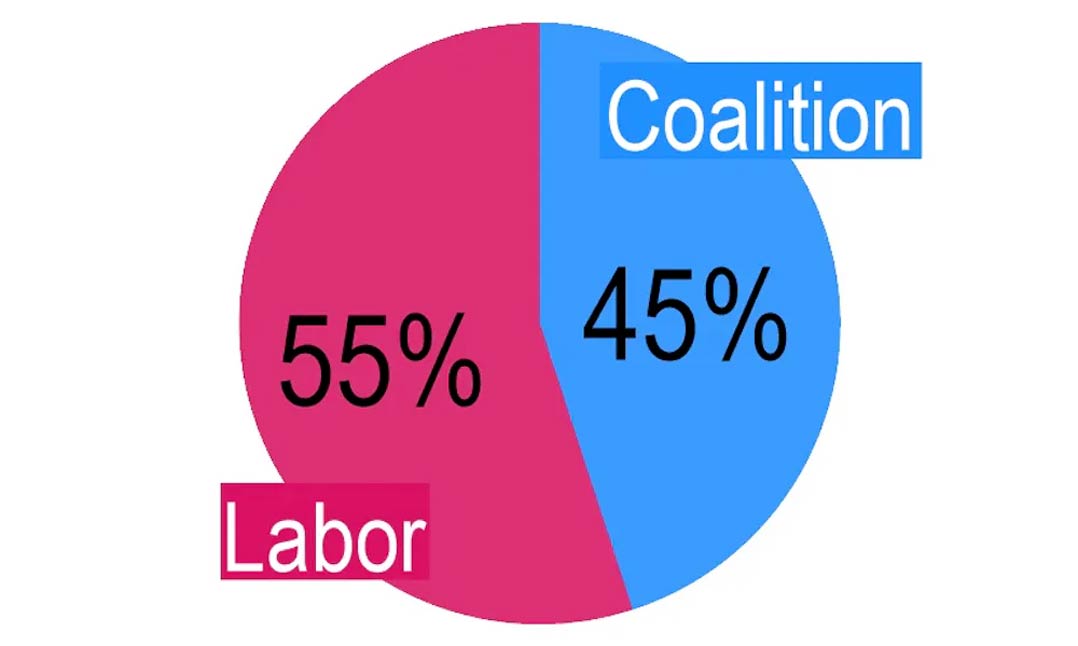
    A simple pie chart showing the percentages for the two major Australian political parties in an opinion poll. Victor Oguoma

    What’s wrong with pie charts?

    Once we have more than two categories, pie charts can easily misrepresent percentages and become hard to read.

    The three charts below are a good example – it is very hard to work out which of the five areas is the largest. The pie chart’s circularity means the areas lack a common reference point.
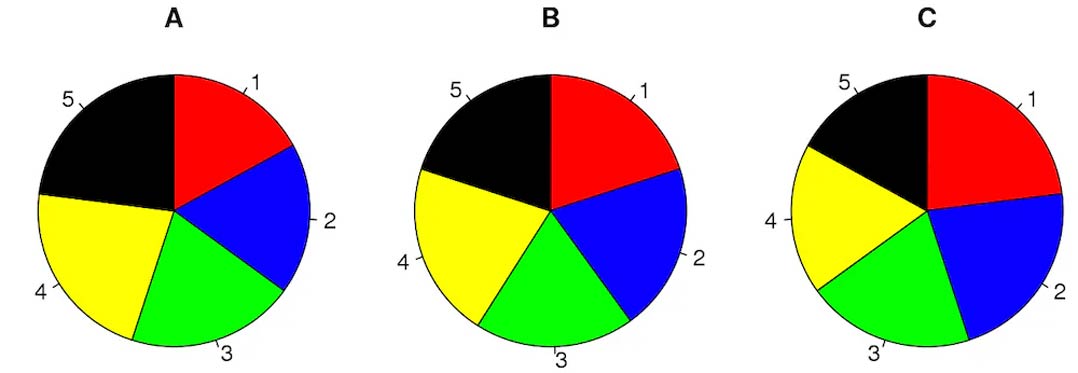
    Three example pie charts, each with five similar categories. Can you quickly tell which colour is the largest in each pie? Schutz/Wikimedia Commons, CC BY

    Pie charts also do badly when there are lots of categories. For example, this chart from a study on data sources used for Covid data visualisation shows hundreds of categories in one pie.
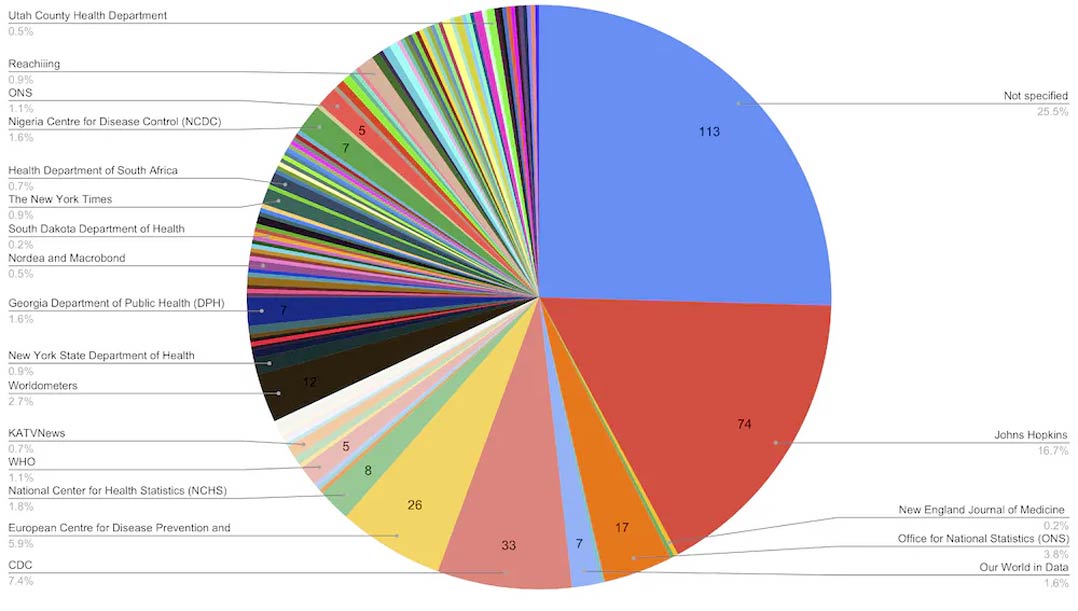
    A pie chart with dozens of categories. Not every category has a label, it’s not clear what the total number of categories is and what the unlabelled slices refer to. Trajkova, et al, Informatics (2020), CC BY

    The tiny slices, lack of clear labelling and the kaleidoscope of colours make interpretation difficult for anyone.

    It’s even harder for a colour-blind person. For example, this is a simulation of what the above chart would look like to a person with deuteranomaly or reduced sensitivity to green light. This is the most common type of colour blindness, affecting roughly 4.6% of the population.
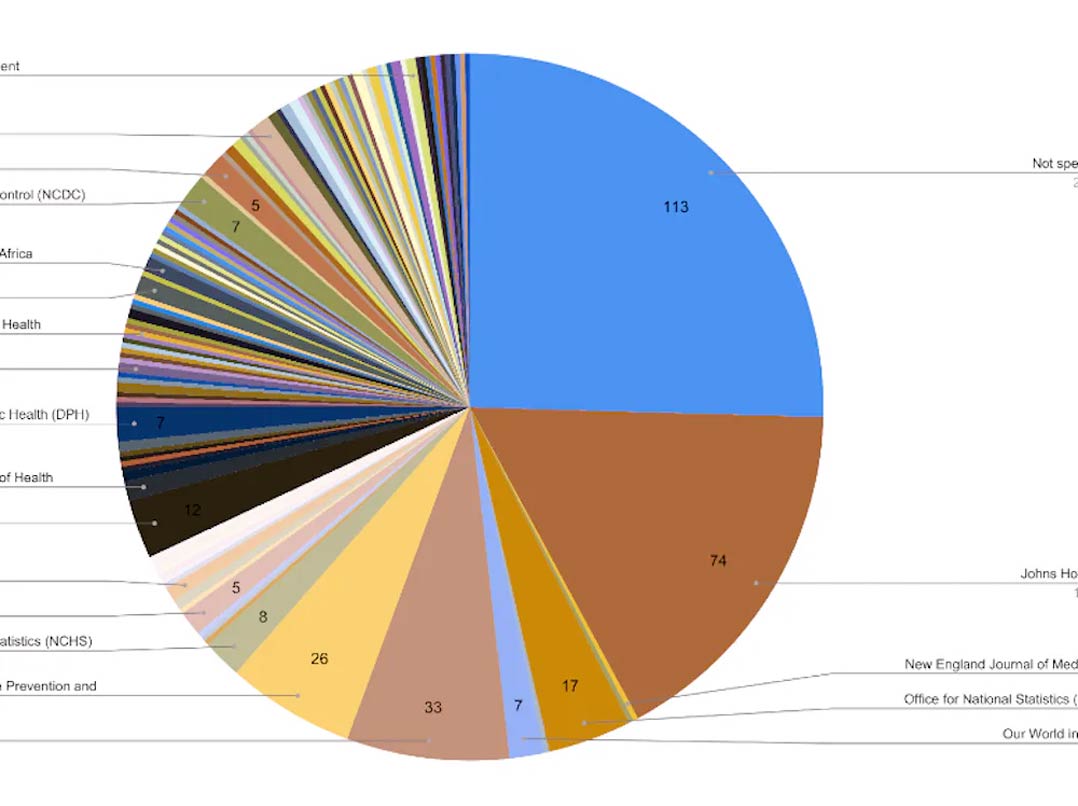
    The same data chart as above, but run through a simulation filter to demonstrate what it would look like for someone with a common type of colour blindness. Trajkova, et al, Informatics (2020); modified., CC BY

    It can get even worse if we take pie charts and make them three-dimensional. This can lead to egregious misrepresentations of data.

    Below, the yellow, red and green areas are all the same size (one-third), but appear to be different based on the angle and which slice is placed at the bottom of the pie.
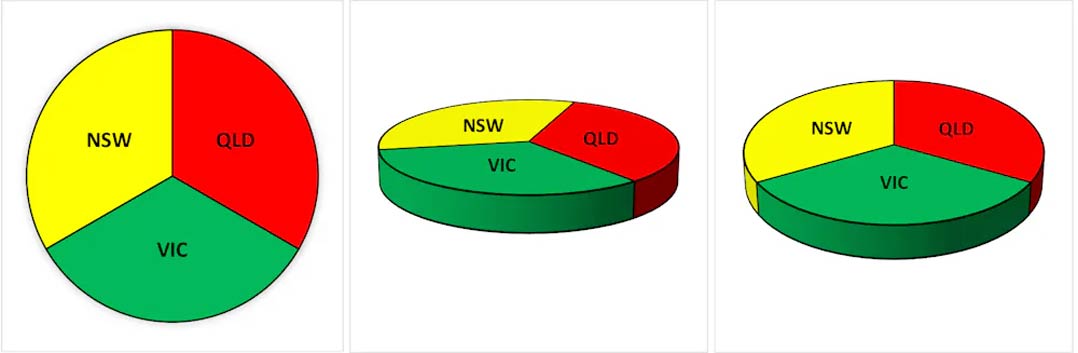
    A standard two-dimensional pie chart and two three-dimensional pie charts. In every chart the proportions are one-third but there appear to be differences between states in the three-dimensional versions. Victor Oguoma, CC BY-ND

    So, why are pie charts everywhere?

    Despite the well-known problems with pie charts, they are everywhere. They are in journal articles, PhD theses, political polling, books, newspapers and government reports.

    While statisticians have criticised them for decades, it’s hard to argue with this logic: “if pie charts are so bad, why are there so many of them?”

    Possibly they are popular because they are popular, which is a circular argument that suits a pie chart.
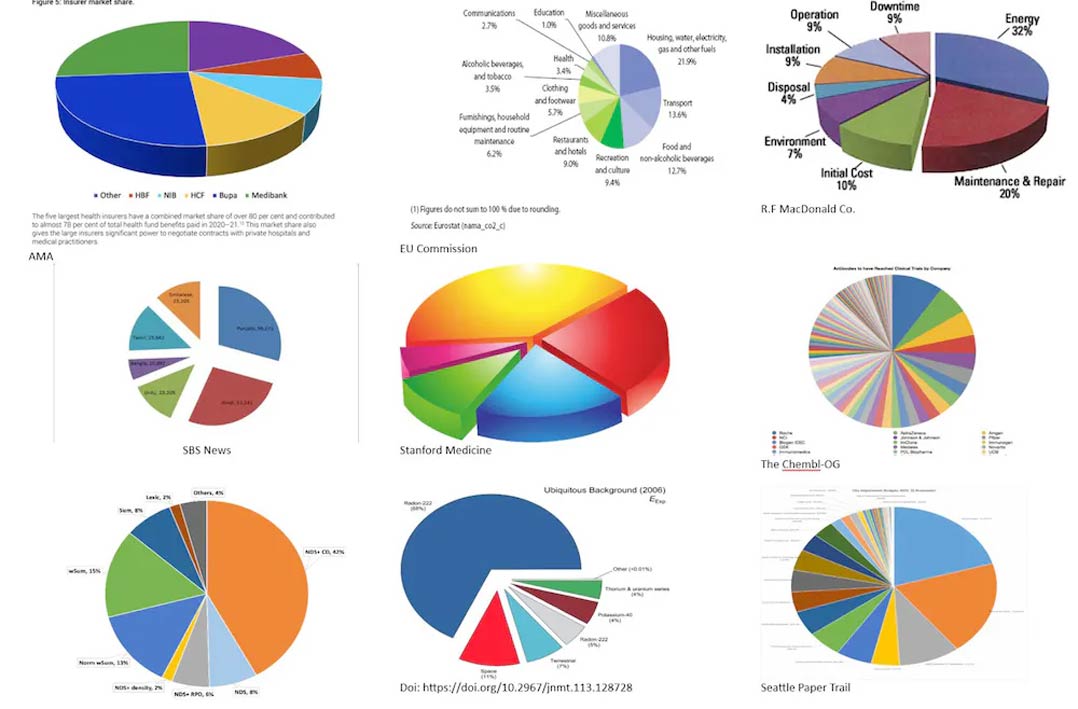
    A collection of terrible pie charts gathered from various open access sources, including ‘exploded’ pie charts and 3D pie charts. Adrian Barnett and Victor Oguoma, CC BY-ND

    What’s a good alternative to pie charts?

    There’s a simple fix that can effectively summarise big data in a small space and still allow creative colour schemes.

    It’s the humble bar chart. Remember the brain-aching pie chart example above with the five categories? Here’s the same example using bars – we can now instantly see which category is the largest.
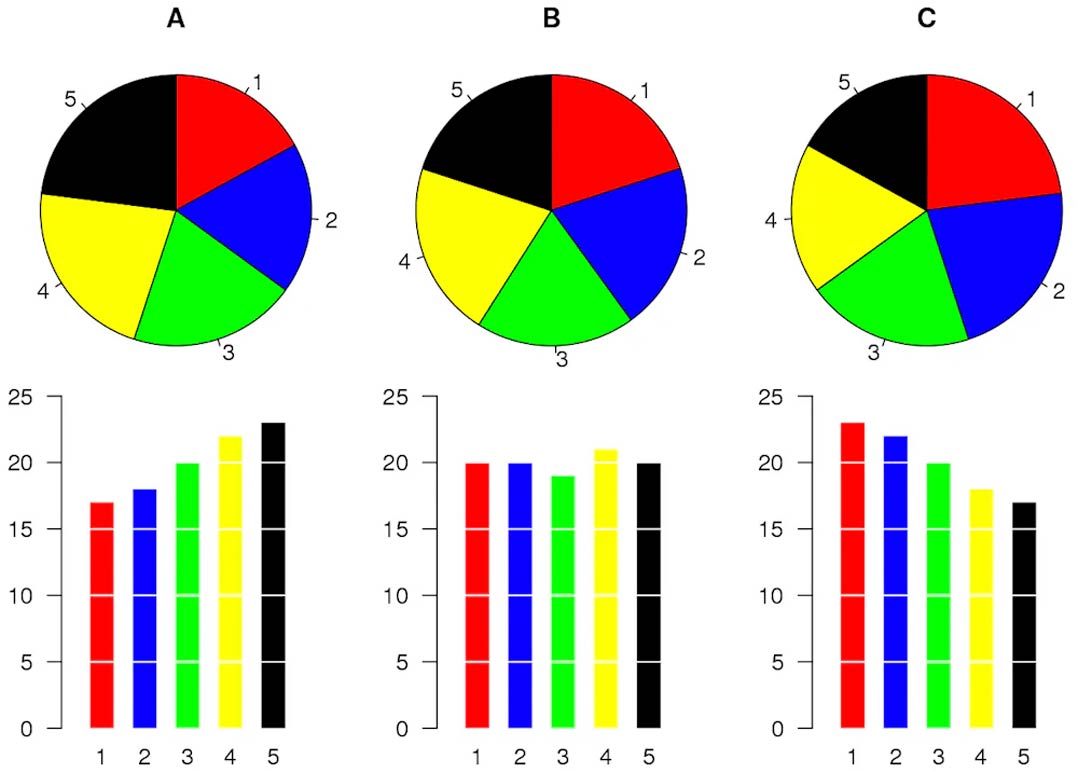
    Three pie charts, each with five similar categories, and the same data presented using bar charts. Schutz/Wikimedia Commons, CC BY

    Linear bars are easier on the eye than the non-linear segments of a pie chart. But beware the temptation to make a humble bar chart look more interesting by adding a 3D effect. As you already saw, 3D charts distort perception and make it harder to find a reference point.

    Below is a standard bar chart and a 3D alternative of the number of voters in the 1992 US presidential election split by family income (from under US$15 000 to over $75 000). Using the 3D version, can you tell the number of voters for each candidate in the highest income category? Not easily.
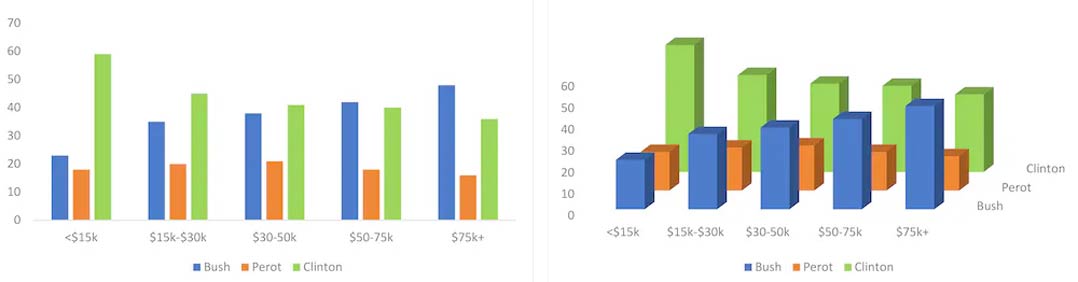
    The same voter data presented as a standard two-dimensional bar chart and an unhelpful three-dimensional version. Victor Oguoma, CC BY-ND

    Is it ever okay to use a pie chart?

    We’ve shown some of the worst examples of pie charts to make a point. Pie charts can be okay when there are just a few categories and the percentages are dissimilar, for example with one large and one small category.

    Overall, it is best to use pie charts sparingly, especially when there is a more “digestible” alternative – the bar chart.

    Whenever we see pie charts, we think one of two things: their creators don’t know what they’re doing, or they know what they are doing and are deliberately trying to mislead.

    A graphical summary aims to easily and quickly communicate the data. If you feel the need to spruce it up, you’re likely reducing understanding without meaning to do so.The Conversation

    • The authors are Adrian Barnett, professor of statistics, Queensland University of Technology, and Victor Oguoma, senior research fellow, Poche Centre for Indigenous Health, University of Queensland
    • This article is republished from The Conversation under a Creative Commons licence

    Get breaking news alerts from TechCentral on WhatsApp


    Subscribe to TechCentral Subscribe to TechCentral
    Share. Facebook Twitter LinkedIn WhatsApp Telegram Email Copy Link
    Previous ArticleApple’s China problem is getting worse
    Next Article Private moon lander mission blasts off from Cape Canaveral

    Related Posts

    Beat the summer heat with Samsung's WindFree air conditioners

    Beat the summer heat with Samsung’s WindFree air conditioners

    5 December 2025
    Netflix, Warner Bros talks raise fresh headaches for MultiChoice

    Netflix, Warner Bros talks raise fresh headaches for MultiChoice

    5 December 2025
    Big Microsoft 365 price increases coming next year

    Big Microsoft price increases coming next year

    5 December 2025
    Company News
    Beat the summer heat with Samsung's WindFree air conditioners

    Beat the summer heat with Samsung’s WindFree air conditioners

    5 December 2025
    AI is not a technology problem - iqbusiness

    AI is not a technology problem – iqbusiness

    5 December 2025
    Telcos are sitting on a data gold mine - but few know what do with it - Phillip du Plessis

    Telcos are sitting on a data gold mine – but few know what do with it

    4 December 2025
    Opinion
    Your data, your hardware: the DIY AI revolution is coming - Duncan McLeod

    Your data, your hardware: the DIY AI revolution is coming

    20 November 2025
    Zero Carbon Charge founder Joubert Roux

    The energy revolution South Africa can’t afford to miss

    20 November 2025
    It's time for a new approach to government IT spend in South Africa - Richard Firth

    It’s time for a new approach to government IT spend in South Africa

    19 November 2025

    Subscribe to Updates

    Get the best South African technology news and analysis delivered to your e-mail inbox every morning.

    Latest Posts
    Beat the summer heat with Samsung's WindFree air conditioners

    Beat the summer heat with Samsung’s WindFree air conditioners

    5 December 2025
    Netflix, Warner Bros talks raise fresh headaches for MultiChoice

    Netflix, Warner Bros talks raise fresh headaches for MultiChoice

    5 December 2025
    Big Microsoft 365 price increases coming next year

    Big Microsoft price increases coming next year

    5 December 2025
    AI is not a technology problem - iqbusiness

    AI is not a technology problem – iqbusiness

    5 December 2025
    © 2009 - 2025 NewsCentral Media
    • Cookie policy (ZA)
    • TechCentral – privacy and Popia

    Type above and press Enter to search. Press Esc to cancel.

    Manage consent

    TechCentral uses cookies to enhance its offerings. Consenting to these technologies allows us to serve you better. Not consenting or withdrawing consent may adversely affect certain features and functions of the website.

    Functional Always active
    The technical storage or access is strictly necessary for the legitimate purpose of enabling the use of a specific service explicitly requested by the subscriber or user, or for the sole purpose of carrying out the transmission of a communication over an electronic communications network.
    Preferences
    The technical storage or access is necessary for the legitimate purpose of storing preferences that are not requested by the subscriber or user.
    Statistics
    The technical storage or access that is used exclusively for statistical purposes. The technical storage or access that is used exclusively for anonymous statistical purposes. Without a subpoena, voluntary compliance on the part of your Internet Service Provider, or additional records from a third party, information stored or retrieved for this purpose alone cannot usually be used to identify you.
    Marketing
    The technical storage or access is required to create user profiles to send advertising, or to track the user on a website or across several websites for similar marketing purposes.
    • Manage options
    • Manage services
    • Manage {vendor_count} vendors
    • Read more about these purposes
    View preferences
    • {title}
    • {title}
    • {title}