


Close Menu
TechCentralTechCentral

    Subscribe to the newsletter

    Get the best South African technology news and analysis delivered to your e-mail inbox every morning.

    Facebook X (Twitter) YouTube LinkedIn
    WhatsApp Facebook X (Twitter) LinkedIn YouTube
    TechCentralTechCentral
    • News
      Post Office on the brink of collapse

      Post Office on the brink of collapse

      13 March 2026
      New policy direction targets South Africa's municipal broadband logjam - Solly Malatsi

      New policy direction targets South Africa’s municipal broadband logjam

      13 March 2026
      How electronic warfare is threatening ships and their crews

      How electronic warfare is threatening ships and their crews

      13 March 2026
      Rand slumps for second week

      Rand slumps for second week

      13 March 2026
      Parliament opens nominations for Icasa council seats

      Parliament opens nominations for Icasa council seats

      13 March 2026
    • World
      Musk launches Macrohard in cheeky nod to Microsoft - Elon Musk

      Musk launches Macrohard in cheeky nod to Microsoft

      12 March 2026
      Europe is building an alternative to Microsoft Office

      Europe is building an alternative to Microsoft Office

      11 March 2026
      Microsoft bets on Anthropic as it loosens ties with OpenAI

      Microsoft bets on Anthropic as it loosens ties with OpenAI

      10 March 2026
      World hit by worst oil shock since the 1970s

      World hit by worst oil shock since the 1970s

      9 March 2026
      iStore prices MacBook Neo at R11 999 in South Africa

      Apple debuts MacBook Neo to challenge Windows PCs, Chromebooks

      5 March 2026
    • In-depth
      The last generation of coders

      The last generation of coders

      18 February 2026
      Sentech is in dire straits

      Sentech is in dire straits

      10 February 2026
      How liberalisation is rewiring South Africa's power sector

      How liberalisation is rewiring South Africa’s power sector

      21 January 2026
      The top-performing South African tech shares of 2025

      The top-performing South African tech shares of 2025

      12 January 2026
      Digital authoritarianism grows as African states normalise internet blackouts

      Digital authoritarianism grows as African states normalise internet blackouts

      19 December 2025
    • TCS
      TCS+ | Vox Kiwi: a wireless solution promising a fibre-like experience - Theo van Zyl

      TCS+ | Vox Kiwi: a wireless solution promising a fibre-like experience

      13 March 2026
      TCS+ | Flipping the narrative on AI in the Global South - Josefin Rosén

      TCS+ | Flipping the narrative on AI in the Global South

      13 March 2026
      TCS | Sink or swim? Antony Makins on how AI is rewriting the rules of work

      TCS | Sink or swim? Antony Makins on how AI is rewriting the rules of work

      5 March 2026
      TCS+ | Bolt ups the ante on platform safety - Simo Kalajdzic

      TCS+ | Bolt ups the ante on platform safety

      4 March 2026
      Watts & Wheels S1E4: 'We drive an electric Uber'

      Watts & Wheels S1E4: ‘We drive an electric Uber’

      10 February 2026
    • Opinion
      South Africa's energy future hinges on getting wheeling right - Aishah Gire

      South Africa’s energy future hinges on getting wheeling right

      10 March 2026
      Hold the doom: the case for a South African comeback - Duncan McLeod

      Apple just dropped a bomb on the Windows world

      5 March 2026
      VC's centre of gravity is shifting - and South Africa is in the frame - Alison Collier

      VC’s centre of gravity is shifting – and South Africa is in the frame

      3 March 2026
      Hold the doom: the case for a South African comeback - Duncan McLeod

      Hold the doom: the case for a South African comeback

      26 February 2026
      The AI fraud crisis your bank is not ready for - Andries Maritz

      The AI fraud crisis your bank is not ready for

      18 February 2026
    • Company Hubs
      • 1Stream
      • Africa Data Centres
      • AfriGIS
      • Altron Digital Business
      • Altron Document Solutions
      • Altron Group
      • Arctic Wolf
      • AvertITD
      • Braintree
      • CallMiner
      • CambriLearn
      • CYBER1 Solutions
      • Digicloud Africa
      • Digimune
      • Domains.co.za
      • ESET
      • Euphoria Telecom
      • HOSTAFRICA
      • Incredible Business
      • iONLINE
      • IQbusiness
      • Iris Network Systems
      • LSD Open
      • Mitel
      • NEC XON
      • Netstar
      • Network Platforms
      • Next DLP
      • Ovations
      • Paracon
      • Paratus
      • Q-KON
      • SevenC
      • SkyWire
      • Solid8 Technologies
      • Telit Cinterion
      • Tenable
      • Vertiv
      • Videri Digital
      • Vodacom Business
      • Wipro
      • Workday
      • XLink
    • Sections
      • AI and machine learning
      • Banking
      • Broadcasting and Media
      • Cloud services
      • Contact centres and CX
      • Cryptocurrencies
      • Education and skills
      • Electronics and hardware
      • Energy and sustainability
      • Enterprise software
      • Financial services
      • HealthTech
      • Information security
      • Internet and connectivity
      • Internet of Things
      • Investment
      • IT services
      • Lifestyle
      • Motoring
      • Policy and regulation
      • Public sector
      • Retail and e-commerce
      • Satellite communications
      • Science
      • SMEs and start-ups
      • Social media
      • Talent and leadership
      • Telecoms
    • Events
    • Advertise
    TechCentralTechCentral
    Home » World » Will Musk’s satellite broadband dream fly?

    Will Musk’s satellite broadband dream fly?

    By Agency Staff1 March 2018
    Twitter LinkedIn Facebook WhatsApp Email Telegram Copy Link
    News Alerts
    WhatsApp
    Elon Musk

    When Elon Musk’s SpaceX heaved two communications satellites aloft last week, he joined a space race that’s foiled plenty of other dreamers.

    Billions of dollars have vanished in the quest to provide Internet service from low-earth orbit. Globalstar and Iridium Communications crashed into bankruptcy but are still at it, while another effort folded despite backing from Bill Gates, Boeing and others.

    That record hasn’t deterred almost two dozen ventures from raising money in an effort to reach broadband users, including many who are out of easy range of traditional mobile services.

    Nothing has changed except the level of hysteria and the level of unrealistic expectations

    “Nothing has changed except the level of hysteria and the level of unrealistic expectations,” analyst Roger Rusch, president of the TelAstra consultancy in Palos Verdes, California, said in an interview.

    SpaceX, Greg Wyler’s OneWeb, Boeing and Canada’s Telesat are among the companies that have asked the US Federal Communications Commission for permission to offer broadband service using satellites.

    But Rusch said the technical challenges are daunting. Low-earth orbit systems need complex software to run constellations of satellites, and sophisticated antennas on the ground to aim at spacecraft zooming from horizon to horizon. Costs quickly overwhelm savings from building smaller gear, Rusch said.

    Boeing is seeking approval for 60 satellites, and the FCC last year granted OneWeb permission to serve the US market using 720 satellites authorised by the UK.

    Thousands of satellites

    SpaceX’s plan calls for 4 425 satellites but it has also applied for another 7 518. FCC Chairman Ajit Pai has given his backing to the proposal, making it likely to win the agency’s clearance to provide broadband via low-earth orbit.

    The planned constellations would far exceed the current number of satellites being operated by all countries, which stood at 1 738 in August last year, according to a tally kept by the Union of Concerned Scientists.

    The two satellites launched last week are tests, John Taylor, a SpaceX spokesman, said in an e-mailed statement. “Even if these satellites work as planned, we still have considerable technical work ahead of us to design and deploy a low-orbit satellite constellation,” Taylor said. The system would give people in less populated areas access to affordable high-speed Internet service, Taylor said without providing a price.
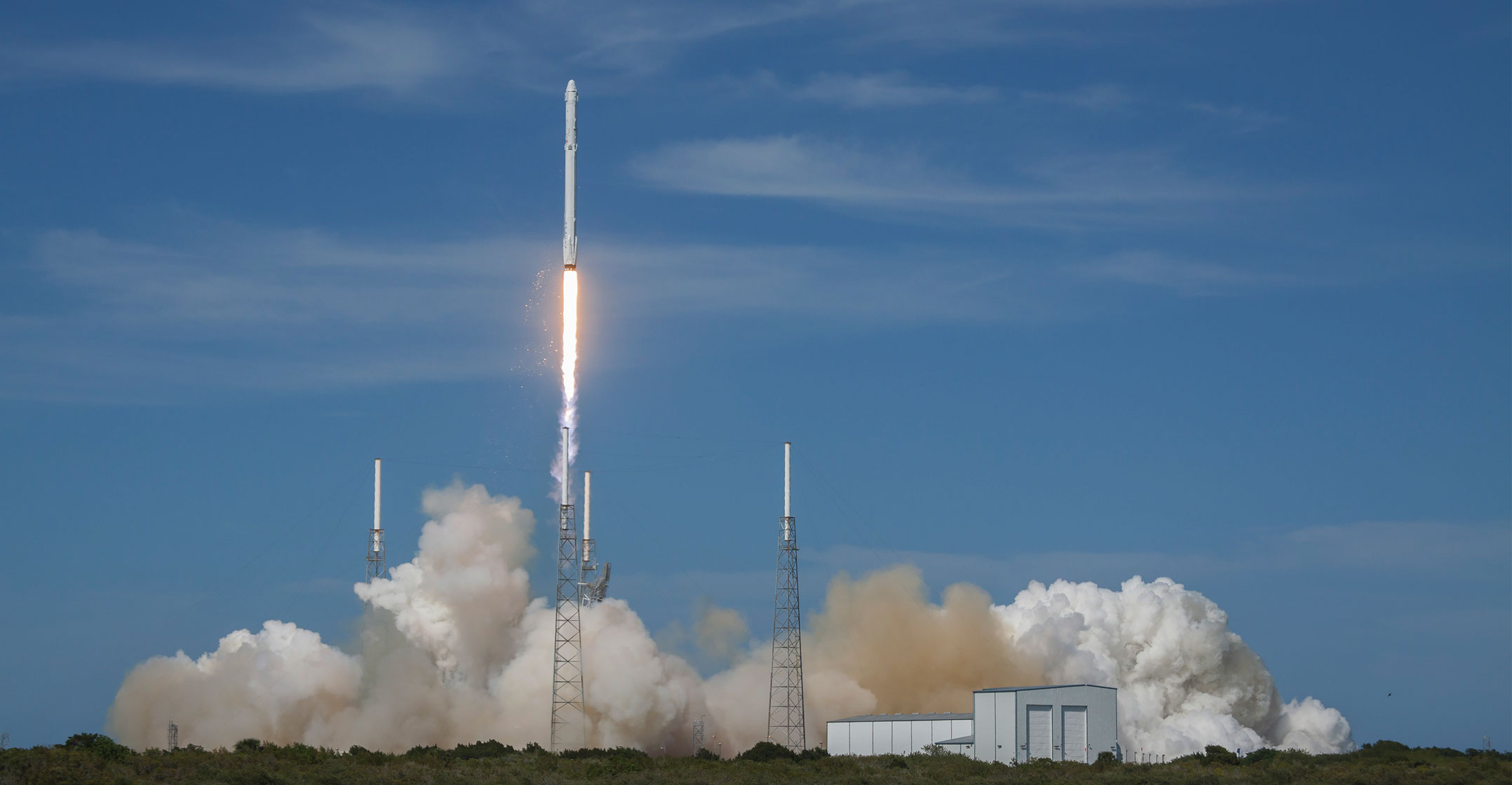
    A SpaceX Falcon 9 rocket blasts off in this file photo

    Satellites in low-earth trajectories operate 80km to 2 000km above Earth and orbit it roughly every 90 minutes. Traditional communications satellites operate much higher, at an altitude of about 36 000 km and appear to hover in one spot because their orbit takes one day, matching the Earth’s rotation.

    Lower satellites have an advantage in sending and receiving broadband, since signals suffer less of the lag time that can interrupt phone conversations and streaming video. As universal broadband has become a more compelling goal, appetite for service by satellites has grown, said Tom Stroup, president of the Satellite Industry Association, a trade group.

    Satellites have become lighter and cheaper, Stroup said. “We’re well beyond experimentation,” Stroup said. “We’re moving into the next generation.”

    Musk helped change the calculus toward more frequent launches with his SpaceX, which re-uses rather than discards expensive rockets

    Satellites have become more capable, partly by using higher frequencies that can carry more data, Tim Farrar, an analyst at TMF Associates, said in an interview. Ground terminals — the antennas that track a satellite across the sky — are getting smaller and cheaper as well, he said.

    The starry-eyed innovators will need to compete with established satellite-service suppliers such as Iridium, which is upgrading its fleet of 66 low-earth orbit satellites using repeated launches from SpaceX. ViaSat on 27 February announced broadband service from a new satellite in high orbit.

    “To me, a business case is just not ‘does it work’, but ‘can I make a return on my investment?’” said Rupert Pearce, chief executive officer of Inmarsat, a survivor of the late 1990s satellite boom-and-bust cycle. The company supplies broadband from a 13-satellite fleet in high orbit, and has eschewed low-earth orbit, sometimes known for its acronym LEO.

    “We do not see a business case for these LEO networks,” Pearce said in an interview. Doing so would be “extremely challenging”, he said. The satellites themselves would need to be manufactured cheaply, difficult for products that are typically “highly bespoke, highly tailored”. They’d need to be replaced every four to five years.

    Operational challenge

    Then there is the operational challenge of connecting to towers on Earth, since no satellite service works indoors. LEO satellites are constantly moving; as one slips over the horizon, another would need to seamlessly connect to a consumer surfing the Web, or the Internet session would drop.

    Musk helped change the calculus toward more frequent launches with his SpaceX, which re-uses rather than discards expensive rockets. As the SpaceX Falcon 9 prepared its 22 February launch of two broadband satellites, Musk tweeted that if successful they would serve the “least served”.

    The satellites — carried aloft along with a Spanish payload — are part of an ambitious plan that Musk outlined in remarks in 2015 as he announced an engineering campus in Redmond, Washington, near Seattle. Musk said the system would cost US$10bn to $15bn to create — maybe more — but once developed, would bring significant revenue to SpaceX and help fund a city on Mars.

    Looking in the long term, and saying what’s needed to create a city on Mars? Well, one thing’s for sure: a lot of money. So we need things that will generate a lot of money

    “Looking in the long term, and saying what’s needed to create a city on Mars? Well, one thing’s for sure: a lot of money,” Musk said. “So we need things that will generate a lot of money.”

    Another pioneer, OneWeb’s Wyler, is working with Airbus to build satellites in France and Florida, and has attracted investments from Qualcomm, Richard Branson’s Virgin Group and SoftBank Group, the technology giant controlled by billionaire Masayoshi Son.

    Satellite giant Intelsat plans to start offering OneWeb’s service as soon as it’s available around 2020, Bruno Fromont, senior vice president of strategy and planning at Intelsat, said in an interview.

    OneWeb is to begin launches this year, and expects to reach a pace of launches every three to six weeks, Wyler said. He calls it a “mission” to “bridge the digital divide by 2027”.

    Whether that’s possible will depend on how much people can pay, said Vincent Chan, a professor at the Massachusetts Institute of Technology who studies networks.

    “The trouble is, because it is technologically feasible doesn’t mean it’s economically viable,” Chan said in an interview. “Who in Africa can afford to pay $100 for service for a month? Maybe $10 they can afford. One dollar, they can do.”

    Stroup, of the Satellite Industry Association, is sure come companies will prevail.

    “The ultimate winner in all this is going to be the consumer,” said Stroup. “There’s going to be several choices just in the category of broadband satellite.”  — Reported by Todd Shields, Dana Hull and Julie Johnsson, with assistance from Olga Kharif, (c) 2018 Bloomberg LP

    Follow TechCentral on Google News Add TechCentral as your preferred source on Google


    Bill Gates Boeing Elon Musk Globalstar Iridium Communications OneWeb SpaceX top
    WhatsApp YouTube
    Share. Facebook Twitter LinkedIn WhatsApp Telegram Email Copy Link
    Previous ArticleWhere bitcoin is headed next
    Next Article Eskom gets breathing room with R20bn facility

    Related Posts

    Musk launches Macrohard in cheeky nod to Microsoft - Elon Musk

    Musk launches Macrohard in cheeky nod to Microsoft

    12 March 2026
    Starlink expands public advocacy campaign as it pushes for SA licence

    Starlink expands public advocacy campaign as it pushes for SA licence

    17 February 2026
    Musk hits brakes on Mars mission

    Musk hits brakes on Mars mission

    9 February 2026
    Company News
    Households still under big pressure, Altron Fintech index shows

    Households still under big pressure, Altron Fintech index shows

    13 March 2026
    How AI is changing the way we work - Angela Ho, Obsidian Systems

    How AI is changing the way we work

    12 March 2026
    Domains.co.za introduces complete domain protection service

    Domains.co.za introduces complete domain protection service

    12 March 2026
    Opinion
    South Africa's energy future hinges on getting wheeling right - Aishah Gire

    South Africa’s energy future hinges on getting wheeling right

    10 March 2026
    Hold the doom: the case for a South African comeback - Duncan McLeod

    Apple just dropped a bomb on the Windows world

    5 March 2026
    VC's centre of gravity is shifting - and South Africa is in the frame - Alison Collier

    VC’s centre of gravity is shifting – and South Africa is in the frame

    3 March 2026

    Subscribe to Updates

    Get the best South African technology news and analysis delivered to your e-mail inbox every morning.

    Latest Posts
    Post Office on the brink of collapse

    Post Office on the brink of collapse

    13 March 2026
    New policy direction targets South Africa's municipal broadband logjam - Solly Malatsi

    New policy direction targets South Africa’s municipal broadband logjam

    13 March 2026
    How electronic warfare is threatening ships and their crews

    How electronic warfare is threatening ships and their crews

    13 March 2026
    Rand slumps for second week

    Rand slumps for second week

    13 March 2026
    © 2009 - 2026 NewsCentral Media
    • Cookie policy (ZA)
    • TechCentral – privacy and Popia

    Type above and press Enter to search. Press Esc to cancel.

    Manage consent

    TechCentral uses cookies to enhance its offerings. Consenting to these technologies allows us to serve you better. Not consenting or withdrawing consent may adversely affect certain features and functions of the website.

    Functional Always active
    The technical storage or access is strictly necessary for the legitimate purpose of enabling the use of a specific service explicitly requested by the subscriber or user, or for the sole purpose of carrying out the transmission of a communication over an electronic communications network.
    Preferences
    The technical storage or access is necessary for the legitimate purpose of storing preferences that are not requested by the subscriber or user.
    Statistics
    The technical storage or access that is used exclusively for statistical purposes. The technical storage or access that is used exclusively for anonymous statistical purposes. Without a subpoena, voluntary compliance on the part of your Internet Service Provider, or additional records from a third party, information stored or retrieved for this purpose alone cannot usually be used to identify you.
    Marketing
    The technical storage or access is required to create user profiles to send advertising, or to track the user on a website or across several websites for similar marketing purposes.
    • Manage options
    • Manage services
    • Manage {vendor_count} vendors
    • Read more about these purposes
    View preferences
    • {title}
    • {title}
    • {title}