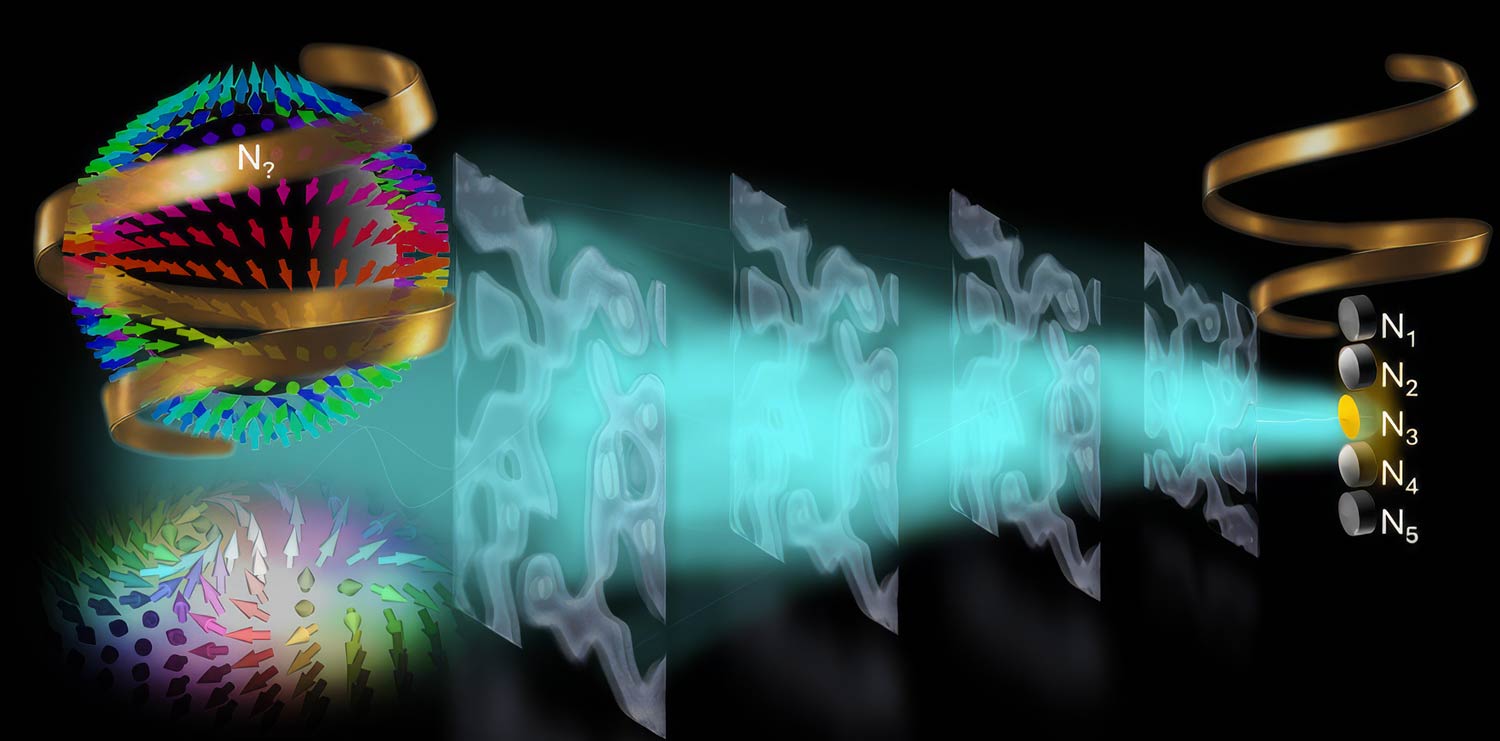
Researchers at Wits University have built what the university calls a “light-powered brain”: an optical neural network that recognises information hidden in complex patterns of light without first taking a detailed picture of them.
The potential payoff is faster, sturdier optical communications. Each light pattern can stand for a different symbol, and there is in principle no limit to how many patterns there are, so a single pulse of light could carry more information than a conventional signal.
Because the information sits in a feature of the pattern that survives distortion, the approach could suit laser links through open air, such as between buildings or to satellites, where turbulence scrambles beams. The authors also point to uses in sensing, imaging and quantum communications, and say a trained detector could be built into fixed optics that draw no power.
The work, published in Nature Communications on 7 October, comes out of the Wits Structured Light Laboratory. Isaac Nape and Andrew Forbes conceived and supervised it, and MSc student Hadrian Bezuidenhout led it, with contributions from Cade Peters and Ram Nandan Kumar.
The research targets a bottleneck in using shaped, or “structured”, light for communications. Light can be moulded into patterns that act like letters in an alphabet, but those letters are only useful if a receiver can read them quickly, even when their appearance changes in transit.
“Creating light patterns that form large alphabets for communications is only useful if we can read them as fast as we can create them,” said Nape. “Our work offers a simpler way to do that, picking out the information we need without first taking a detailed picture.”
Nape holds the Optica Emerging Leader in Optics Chair, a post Wits created with the international optics society Optica, and is a fellow of the Wits Machine Intelligence and Neural Discovery (Mind) Institute.
Counting the twists
The patterns in question are optical skyrmions, which the paper describes as “topological forms of structured light offering an unbounded encoding alphabet robust to perturbations”. Each carries a whole number, its skyrmion number, that does not change even when the pattern is distorted.
Nape compares it to a twisted ribbon: bend and fold it into as many shapes as you like and the number of twists stays the same. Physicists call such hidden, unchanging features topology.
Reading that number has been difficult. Conventional methods involve capturing a detailed image and analysing thousands of individual points. The Wits system instead sends the light through two channels, each with five diffractive layers – patterns that bend light in a set way – which steer it towards separate spots on a detector.
Where the light lands reveals the skyrmion number. In the laboratory setup, the layers are not physical components but patterns displayed on a spatial light modulator, a programmable device that reshapes light. The paper claims it is “the first deterministic detector for optical skyrmions”.
“We don’t need to map every crease in our fabric of light to count the twists. Our network picks out the information that matters and helps us identify the topology quickly,” said Bezuidenhout, now an optics engineer at APSI.

The network was trained live on the optical bench. By describing each layer with a small set of simple patterns rather than pixel by pixel, the team cut the number of training parameters by a factor of about a thousand.
Nor did it need to see every skyrmion. It learnt to recognise nine simple light modes in each of its two polarisation channels, then identified the skyrmion numbers of 81 structures in the family studied, spanning 15 different values, with about 93% accuracy. The authors call this “reminiscent of model generalisation in neural networks”.
The detector also held up under heavy interference. The team mixed incoherent white light into the detected signal and kept accuracy at 100% until the noise peak was about 95% as intense as the signal – levels the paper says “preclude conventional Stokes polarimetry”, the standard way of measuring such beams. The higher figure comes from a threshold: a reading counts only when enough light lands on a single spot, which the paper says rules out incorrect detections.
The researchers also used the system to transmit and recover an image encoded in a 15-letter topological alphabet.
The result is a laboratory demonstration, not a working communications link. Only about 15% of the light entering the detector gets through, mainly because of losses at the modulator and mirrors, which the authors say better components would reduce.
It does, however, address the other half of a problem the same lab has been working on. In July, Forbes’s group showed that the topology of entangled light survives turbulence even when the light patterns carrying it break down.
AI meets physics
Benjamin Rosman, director of the Mind Institute, said the research shows the value of working across disciplines.
“This research is a wonderful example of what becomes possible when we bring together ideas from artificial intelligence and fundamental physics. By embedding neural network principles directly into the behaviour of light, the team is opening up new possibilities for how we process information,” Rosman said.
Forbes, who directs the South African Quantum Technology Initiative (SA QuTI) and the Wits Quantum Initiative (WitsQ), said the work fills a gap in the toolkit for future networks.
“At the Structured Light Laboratory, we are exploring how topology could support a future quantum and classical internet. But creating these light structures is only part of the challenge. We also need practical ways to read them, and that measurement toolbox is still taking shape. This work shows how reaching beyond photonics can help us build it,” Forbes said.
The lab has already produced one spin-out, Button Optics, which works on structured-light systems for secure communications and imaging and has its first product, a quantum-inspired toolkit, ready for sale.
Nape said the team now wants to apply the approach to quantum technologies.
“We hope this is just the beginning. Beyond topology, we want to explore how optical intelligence can contribute to quantum technologies in South Africa. Extracting information from individual particles of light presents even greater measurement challenges, and we are excited to investigate how these tools could help us tackle them.” – © 2026 NewsCentral Media