Physicists at Wits University have shown that information carried on light can survive a trip through turbulent air completely intact, even when the light itself arrives so badly distorted that it is unrecognisable. That matters because of what it could eventually make possible — so-called “indestructible” quantum communications.
Quantum communication is prized for one reason above all: anyone trying to listen in disturbs the light and leaves a trace, so eavesdropping cannot go unnoticed. But today’s systems carry very little information on each particle of light, and they work best through fibre-optic cable or clear, still air.
The property the Wits team has now shown to be weatherproof is the one that would allow a single particle of light to carry far more data — and to do it through open air, which is what beaming quantum-secured traffic between buildings, or up to a satellite, on an ordinary overcast day would require. The same fragility the researchers have sidestepped is also one of the obstacles to linking quantum computers into networks, since those links depend on the same delicate connections between particles.
The finding was published in Physical Review Letters on Tuesday. Lead author Tatjana Kleine of the Wits School of Physics worked with colleagues at Nanyang Technological University in Singapore and the University of Naples Federico II in Italy.
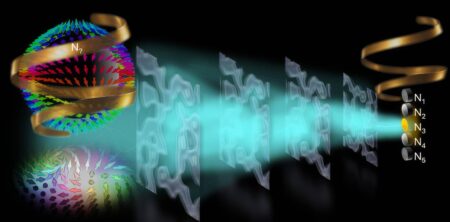
The work concerns a property of light known as its “twist”, or orbital angular momentum. Light can be shaped so that it spirals as it travels forward, rather like the grooves on a corkscrew, and the number of twists in that spiral can be used to encode information. Because there is no practical limit to how many twists a beam can be given, this gives engineers an enormous alphabet to write with — far more than the simple on-off pulses used in ordinary optical communication — and so far more data on every photon.
The problem has always been that the spiral is delicate. Send it through the atmosphere, through bad weather or through water, and the pattern is churned up almost immediately. That fragility is why the idea has spent two decades stuck in the laboratory.
Topology
The Wits team stopped trying to protect the shape of the light and looked instead at something buried inside it: its topology.
Topology is the branch of mathematics concerned with the features of a thing that survive it being stretched, squashed and deformed. Think of a knot tied in a piece of string. You can pull the string, crumple it or drag it through the mud, and the knot is still a knot — you can still count how many knots there are, no matter what state the string is in. That count is a topological property. It does not care how badly the object carrying it has been mangled.
Until now, physicists assumed that if you wanted to build a topological structure into light, you had to build it only out of the sturdy properties of light. The Wits group asked what would happen if they built it out of the fragile twist instead. Their reason was practical: those twisting structures appear on their own whenever quantum light is created, so the topology comes free, with no extra engineering.
Read: South Africa’s quantum bet starts to leave the lab
To test it, the team sent pairs of entangled photons — particles of light whose properties remain linked no matter how far apart they are — through a channel set to a range of turbulence strengths, and measured what came out the other end. The twist patterns were badly degraded and the entanglement between the photons faded, as expected. The topological number, the “knot count”, was unchanged.
“We watched the physical patterns warp under extreme turbulence, and the traditional quantum connection hit a point of severe deterioration. Yet, because the topology is inherently embedded in the entanglement itself, it remained completely unbroken,” said Kleine. “The physical building blocks themselves are fragile, but the topology built upon them is indestructible.”
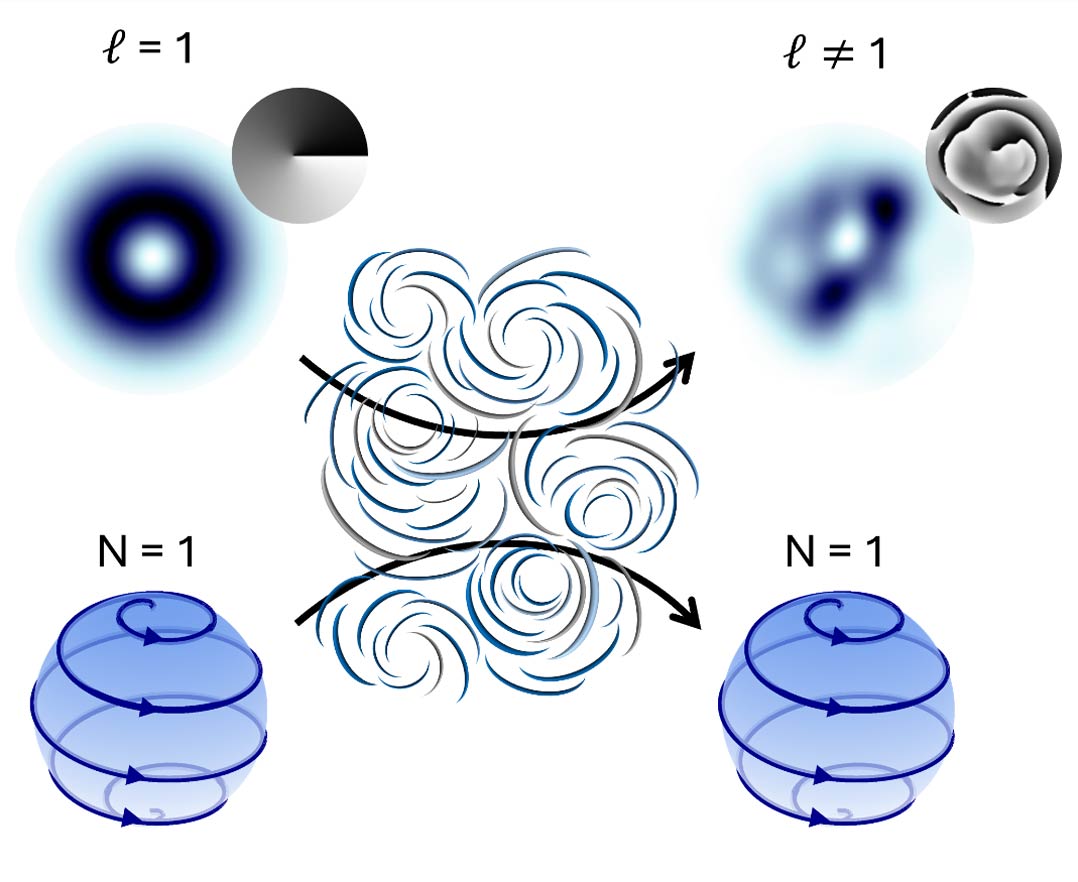
“We now have access to this huge alphabet of spatial modes once again, as long as we look at the topology rather than the state itself,” said Prof Andrew Forbes, head of the Structured Light Laboratory at the Wits School of Physics and the paper’s corresponding author.
Forbes is a central figure in South Africa’s quantum effort. He led the development of the national quantum road map, and the laboratory he runs produced Button Optics, the first spin-out in the South African Quantum Technology Initiative network to put a product on sale.
Two things are worth keeping in mind. This was a controlled experiment in which turbulence was dialled up and down, not a working link strung across a city, and being able to read a topological number is not yet the same as being able to send a message with it. A usable communication protocol still has to be designed and tested. The authors describe their result more modestly than the university’s press release does, calling it “a new perspective on harnessing OAM entanglement in noisy channels” and suggesting it may extend to other spatial bases and channels.
If it does extend, it lands squarely in the area South African researchers have been warning the country is unprepared for: communication that is secure because of physics rather than mathematics, at a moment when the encryption protecting banks and critical infrastructure is running out of road. Longer-distance quantum links are already being demonstrated from South Africa, including the 12 900km satellite link between Beijing and Stellenbosch in October 2024. — © 2026 NewsCentral Media
- Subscribe to TechCentral’s daily newsletter
- Get breaking news alerts on WhatsApp