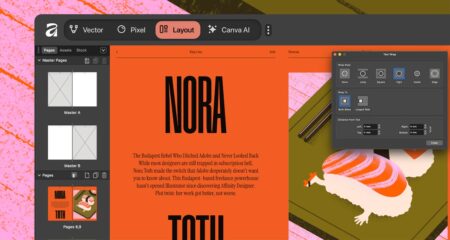
Canva quietly dropped a bombshell at the launch of the company’s Johannesburg office on Tuesday: the design giant is seriously considering porting its Affinity creative software to Linux.
There’s no green light just yet, but global marketing lead for Affinity by Canva, Liam Fisher, told TechCentral that it’s being discussed seriously internally and that it’s one of the top requests from users of the software.
Affinity is currently actively working on an iPad version of its new, free-to-use creative design app; once that’s done, it now seems possible – likely, even – that the team will shift focus to developing the software for Linux.
If it happens, it will arguably be one of the most consequential moments in the history of desktop Linux.
For years, Linux users have lived in something of a parallel universe – a powerful, secure, open ecosystem held back not by technology, but by the absence of mainstream commercial creative software. You could run servers, write code, power supercomputers, build AI tools and secure embedded devices, but if you were a designer or digital creative, Linux has always been a bit of a no-go zone.
There’s one principal reason for that: Adobe.
Photoshop, Illustrator and the rest of Adobe’s Creative Cloud run only on Windows and macOS. This has locked design agencies, marketing teams, photographers and illustrators into those two platforms.
Significant
That’s why the prospect of an official Affinity Linux port is so significant. The software is widely seen as the only full-scale commercial alternative to the market-leading Adobe Creative Cloud – and Canva, which last year acquired the UK’s Serif, the company behind Affinity, recently made it free of charge in a major challenge to Adobe.
Linux users, however, have been left out — until now.
It’s not that Linux has no design software. The Gimp has been around forever and is a superb open-source project. But it comes with two major caveats:
- It has a steep learning curve – its interface and workflows differ significantly from Photoshop.
- It lacks many of the more advanced features that professional designers depend on.
Most creatives don’t want to hack together a workflow from half a dozen open-source tools. They want a polished, integrated suite – something Linux has never truly had. Affinity on Linux would change that overnight.
Linux is having a moment
Importantly, Affinity’s potential arrival on Linux comes at a time when the open-source operating system is stronger than ever on the desktop. And not because of design software but because of gaming.
Thanks to Valve, the company behind the Steam PC games store, Linux gaming is now effectively plug and play. A few years ago, playing major Windows titles on Linux required hacks, technical workarounds and a lot of luck. Today, the Steam Deck – running a custom Linux distribution – is one of the world’s most popular gaming devices. This has had a knock-on effect across the ecosystem.
Linux gaming is ready for primetime, and that’s starting to reshape the perception of the software as a modern desktop environment – not just a server OS. And this is happening just as dissatisfaction with Windows reaches a generational high.
Microsoft’s increasingly intrusive telemetry, ads baked into the OS and the implementation of Copilot AI everywhere have pushed countless users to look elsewhere. Linux, by contrast, stands out as a privacy-friendly, lightweight, flexible and fully user-controlled alternative.
But ask any long-time Linux user why they still dual-boot Windows. The answers are always the same: “I need Photoshop.” “I need Illustrator.”
Affinity on Linux would help solve that. It already does what most creative professionals need. Bringing that power to Linux would open the door for designers, photographers, small agencies, content creators, marketers, publishers and game artists to run a 100% Linux-first workflow. And let’s not forget that one of the most powerful video editing solutions – Blackmagic Design’s DaVinci Resolve – has been available on Linux for years.
Canva clearly didn’t just buy Serif to stand still. It bought it to expand its reach into the professional market that Adobe dominates. Also, many schools around the world deploy Linux because it reduces licensing costs. Offering Affinity there would support Canva’s global education strategy.
If Canva greenlights an Affinity Linux port, it could finally trigger the domino effect Linux users have hoped for. Certainly, Linux would shift – decisively – from a niche operating system for power users to a more mainstream choice.
Linux has quietly been building momentum in recent years. Now design software – real, professional, commercial design software – could propel it higher.
Read: Canva sets up shop in South Africa
If Affinity comes to Linux, it won’t just be a software port. It will be a “platform moment”, one that could help accelerate Linux adoption on the desktop meaningfully. It has the potential to reshape the creative software market, challenge Adobe and finally make Linux a first-class citizen on the desktop. – © 2025 NewsCentral Media
- The author, Duncan McLeod, is editor of TechCentral
Get breaking news from TechCentral on WhatsApp. Sign up here.