Close Menu
TechCentralTechCentral

    Subscribe to the newsletter

    Get the best South African technology news and analysis delivered to your e-mail inbox every morning.

    Facebook X (Twitter) YouTube LinkedIn
    WhatsApp Facebook X (Twitter) LinkedIn YouTube
    TechCentralTechCentral
    • News
      Nedbank hires MTN's former tech chief as group CIO - Nikos Angelopoulos

      Nedbank hires MTN’s former tech chief as group CIO

      31 July 2026
      Eskom's diesel bill falls 86% as breakdowns hit eight-year low

      Eskom’s diesel bill falls 86% as breakdowns hit eight-year low

      31 July 2026
      Ramaphosa signs off on taking the grid away from Eskom

      Ramaphosa signs off on taking the grid away from Eskom

      31 July 2026
      Microsoft just had the biggest day in stock market history

      Microsoft just had the biggest day in stock market history

      31 July 2026
      MTN Nigeria's growth engine stalled in second quarter - Karl Toriola

      MTN Nigeria’s growth engine stalled in second quarter

      31 July 2026
    • World
      Meta AI will now tell parents if their teen is in crisis

      Meta AI will now tell parents if their teen is in crisis

      17 July 2026
      IBM shares crash 25% as AI upends software spending - Arvind Krishna

      IBM shares crash 25% as AI upends software spending

      15 July 2026
      Jony Ive's first OpenAI device: an AI smart speaker - Jony Ive and Sam Altman

      Jony Ive’s first OpenAI device: an AI smart speaker

      15 July 2026
      Stripe, Advent in talks to buy PayPal for $53-billion

      Stripe, Advent in talks to buy PayPal for $53-billion

      15 July 2026
      Memory crisis sends smartphone market into steep decline

      Memory crisis sends smartphone market into steep decline

      13 July 2026
    • In-depth
      The plan to stop AI from breaking the world - Google DeepMind CEO Demis Hassabis. Image: John Sears

      The plan to stop AI from breaking the world

      16 July 2026
      The internet has a Strait of Hormuz problem

      The internet has a Strait of Hormuz problem

      15 July 2026
      AI boom sparks rally, frenzy and fear

      AI boom sparks rally, frenzy and fear

      11 June 2026
      Every plug-in hybrid on sale in South Africa, ranked by price - Lamborghini Temerario

      Every plug-in hybrid on sale in South Africa, ranked by price

      7 June 2026
      What Wi-Fi 8 will mean for wireless networks

      What Wi-Fi 8 will mean for wireless networks

      1 June 2026
    • TCS
      TCS+ | Why South African workers must become supervisors of digital labour - Accelera Digital Group Cliff de Wit

      TCS+ | Why South African workers must become supervisors of digital labour

      31 July 2026
      TCS | Rapid deployment rules can't work without municipalities: ACT - Nomvuyiso Batyi

      TCS | Icasa’s rules skip the real bottleneck: ACT

      30 July 2026
      TCS+ | iStore Business on why Apple makes sense for SMEs - Sudesh Pillay and Tamia Nontsikelelo

      TCS+ | iStore Business on why Apple makes sense for SMEs

      30 July 2026
      TCS+ | A smarter approach to cloud for South African businesses - Joel Chacko and Jonathan Oaker

      TCS+ | A smarter approach to cloud for South African businesses

      28 July 2026
      TCS | How Optasia lends billions to people banks can't see - Salvador Anglada

      TCS | How Optasia lends billions to people banks can’t see

      23 July 2026
    • Opinion
      The author, Jannie van Zyl

      Selling vapour is corporate suicide in slow motion

      16 July 2026
      Brazil's online gambling crackdown is a lesson for South Africa

      How Amazon outmanoeuvred Starlink in South Africa

      15 July 2026
      The Popia problem with agentic AI - Herman Haasbroek

      The Popia problem with agentic AI

      14 July 2026
      The author, Fanie van Rooyen

      South Africa can still catch the AI wave – here’s how

      7 July 2026
      The author, Fanie van Rooyen

      The AI utopia South Africa can’t afford

      1 July 2026
    • Company Hubs
      • 1Stream
      • Africa Data Centres
      • AfriGIS
      • Altron Digital Business
      • Altron Document Solutions
      • Altron Group
      • Arctic Wolf
      • Ascent Technology
      • AvertITD
      • BBD
      • Braintree
      • CallMiner
      • CambriLearn
      • CM Telecom
      • Contactable
      • CYBER1 Solutions
      • Digicloud Africa
      • Digimune
      • Domains.co.za
      • ESET
      • Euphoria Telecom
      • HOSTAFRICA
      • Incredible Business
      • iONLINE
      • IQbusiness
      • Iris Network Systems
      • Kaspersky
      • LSD Open
      • Mitel
      • NEC XON
      • Netstar
      • Network Platforms
      • Next DLP
      • Ovations
      • Paracon
      • Paratus
      • Q-KON
      • SevenC
      • SkyWire
      • Solid8 Technologies
      • Telit Cinterion
      • Telviva
      • Tenable
      • Vertiv
      • Videri Digital
      • Vodacom Business
      • Vox
      • Wipro
      • Workday
      • XLink
    • Sections
      • AI and machine learning
      • Banking
      • Broadcasting and Media
      • Cloud services
      • Contact centres and CX
      • Cryptocurrencies
      • Education and skills
      • Electronics and hardware
      • Energy and sustainability
      • Enterprise software
      • Financial services
      • HealthTech
      • Information security
      • Internet and connectivity
      • Internet of Things
      • Investment
      • IT services
      • Lifestyle
      • Policy and regulation
      • Public sector
      • Retail and e-commerce
      • Satellite communications
      • Science
      • SMEs and start-ups
      • Social media
      • Talent and leadership
      • Telecoms
      • Watts & Wheels
    • Events
    • Advertise
    TechCentralTechCentral
    Home » Sections » Science » Astronomy Olympics is being hosted in Africa for the first time

    Astronomy Olympics is being hosted in Africa for the first time

    The 32nd General Assembly of the International Astronomical Union kicked off on Tuesday in Cape Town.
    By The Conversation7 August 2024
    Twitter LinkedIn Facebook WhatsApp Email Telegram Copy Link
    News Alerts
    WhatsApp
    Astronomy Olympics is being hosted in Africa for the first time
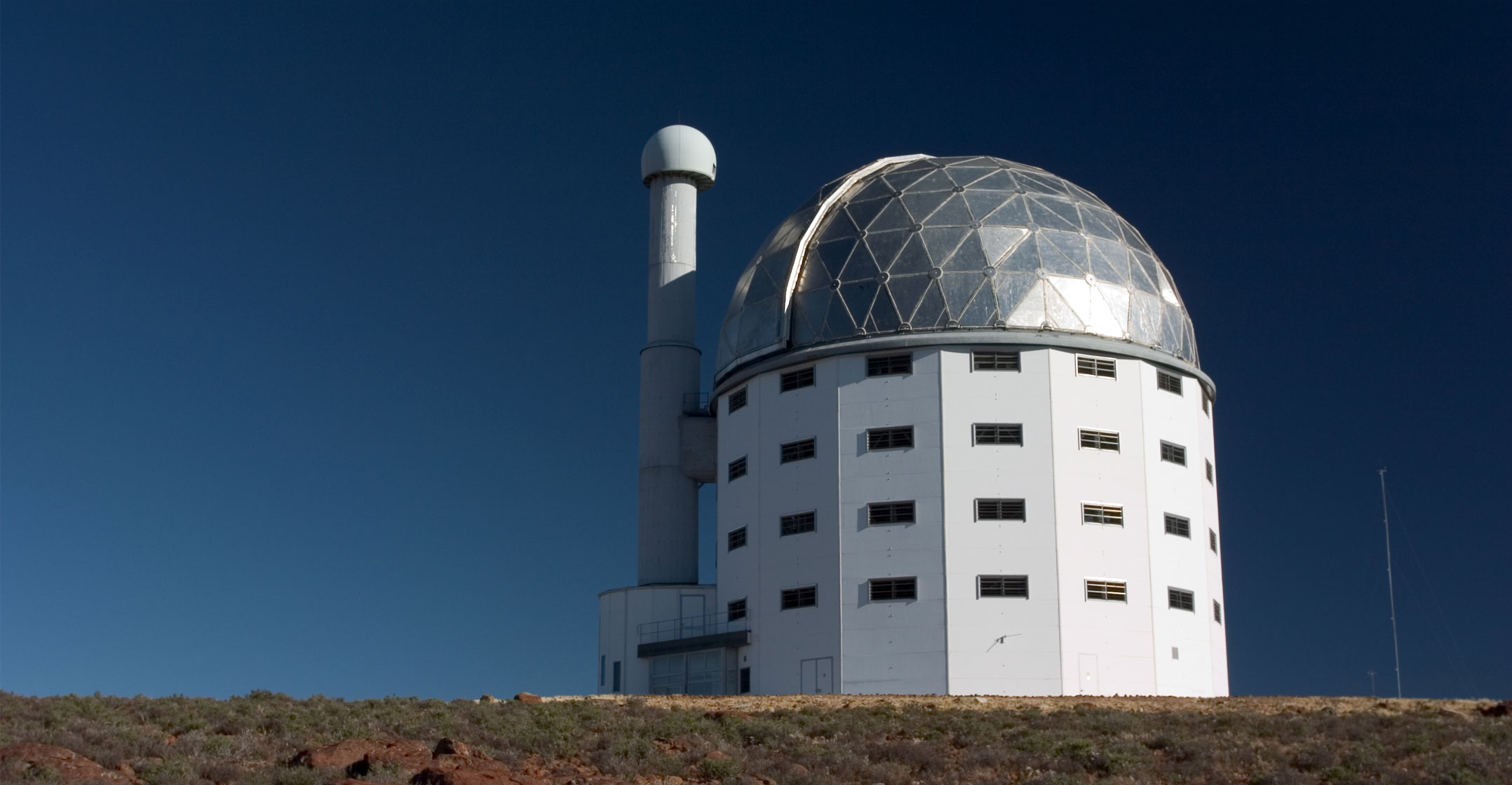
    The Salt observatory in Sutherland

    Cutting-edge telescopes, gravitational waves, black holes and our solar system’s central star, the sun, are just a few of the topics that will be on the table in Cape Town for an event that’s a scientific version of the Olympic Games – though the world’s leading astronomy researchers in attendance will be showcasing their brains rather than their brawn.

    The International Astronomical Union (IAU) was established in 1919 and held its first General Assembly in Rome, Italy in 1922. These assemblies, held every four years, are a chance for the organisation’s members and affiliates to meet in person, and for researchers to share their work with their peers from around the globe.

    The 32nd General Assembly, which kicked off on Tuesday and which concludes next week, marks the meeting’s first outing in Africa. This is a significant milestone for the continent; astronomy has grown and strengthened tremendously over the past decade.

    This is largely, though not entirely, a result of South Africa’s status as co-host, with Australia, of what will be the world’s largest radio telescope, the Square Kilometre Array (SKA), operated and managed by the Square Kilometre Array Observatory. Its first phase is set for completion in 2027; its precursor, the MeerKAT telescope, is already making huge contributions to both South African and international science. Additional SKA dishes will be located in eight other African countries: Ghana, Zambia, Madagascar, Botswana, Namibia, Kenya, Mauritius and Mozambique.

    The programme is packed with symposia, focus meetings dedicated to a variety of astronomical subjects, poster presentations and more. Here are just four of the scientific topics under discussion during the assembly.
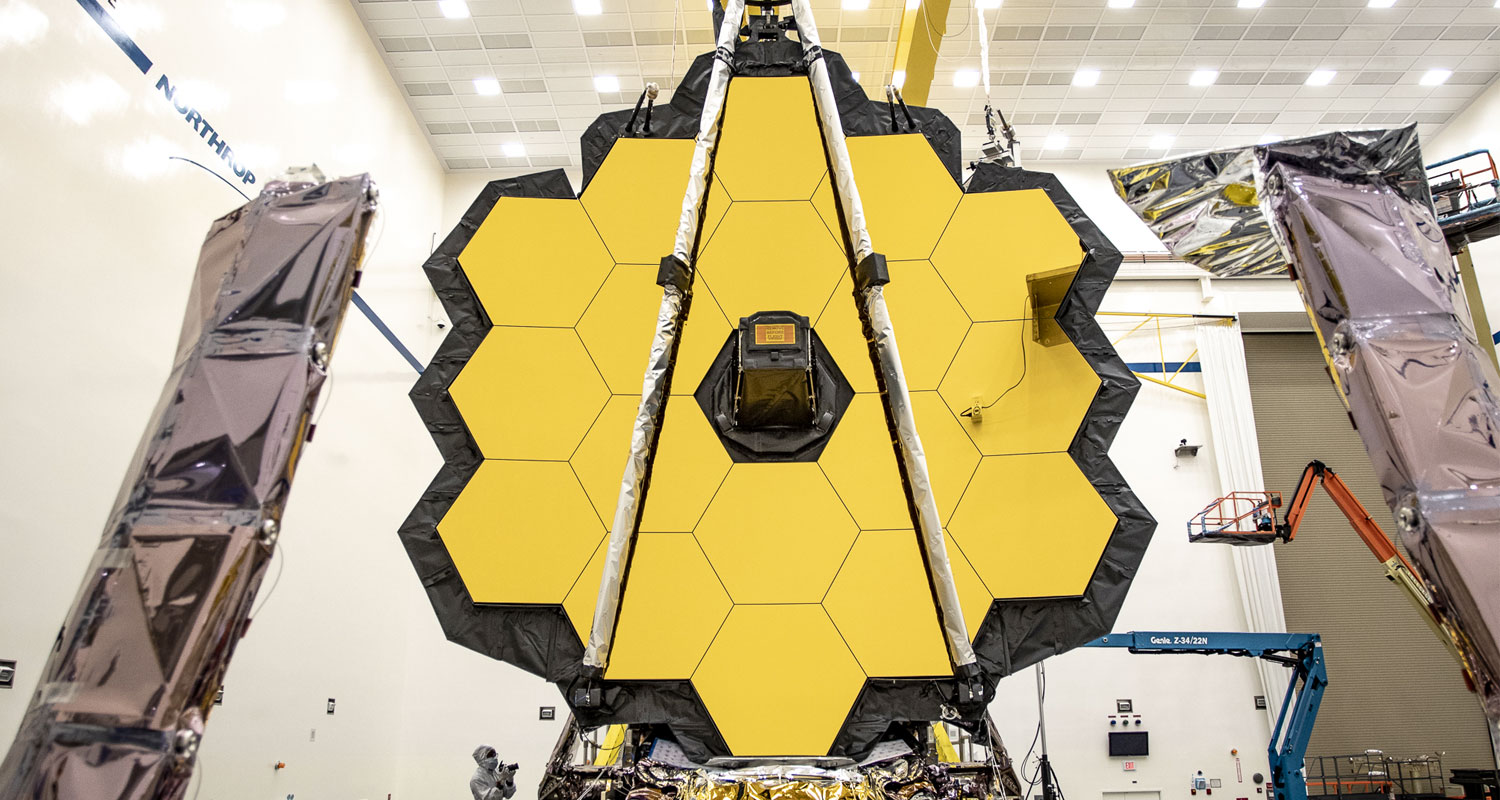
    The James Webb Space Telescope’s main mirror, photographed in April 2020. Image: Nasa

    1. The James Webb Space Telescope

    The astronomy world rejoiced on 25 December 2021 when the James Webb Space Telescope was successfully launched.

    Months later the telescope went into testing and verification phases; it is now in full science operations mode and producing discoveries at an astonishing rate. What makes it especially effective is that it offers astronomers the high sensitivity – the ability to detect faint, distant objects – required to study the early universe.

    One of the assembly’s symposia, titled “The first chapters of our cosmic history with JWST” features some of the new results in the exploration of the early universe, when the first stars and galaxies were formed.

    This is fascinating for astronomers and non-astronomers alike: we’re all interested in knowing whether there’s another planet like ours out there, and the James Webb Space Telescope has already been used to discover many new exoplanets (planets that orbit outside our own solar system). Could any of these planets be habitable for humans? We may have answers sooner than we expected as the telescope continues its remarkable work.

    2. The incoming king of radio astronomy

    Neutral hydrogen is the most abundant element in the universe and is an essential part of the makeup of galaxies in the universe. When the spin direction of the electron in the hydrogen atom flips, radio emissions are produced. These emissions can be detected by radio telescopes and are crucial for understanding the distribution and kinematics (motion) of gases in galaxies.

    MeerKAT, a precursor to the SKA, is already producing ground-breaking neutral hydrogen science because it is currently the most sensitive telescope for neutral hydrogen observations.

    Of course, a project the size and scope of the SKA won’t only be discussed in one or two sessions. An entire focus meeting at the assembly is dedicated to delving into the history of astronomy in South Africa and how it evolved to the point that it was chosen to host the world’s biggest radio astronomy project.

    3. Gravitational waves

    It’s been nine years since scientists announced that they had, for the first time ever, detected gravitational waves. This provided clear evidence to support Albert Einstein’s prediction, a century earlier, that gravitational waves existed.

    Since that first confirmation, a variety of new science has emerged in the field of gravitational wave astrophysics. Astronomers are able to explore our observable universe using not just electromagnetic waves, but gravitational waves – “ripples” in space-time – too. Many of these results will be showcased in a symposium at the general assembly.

    4. Our star: the Sun and its massive counterparts

    The sun, the centre of our solar system, is the nearest stellar laboratory available to scientists studying the true nature and environmental impact of solar winds and coronal mass ejections, otherwise referred to as space storms that cause aurora.

    Stars of masses eight times or more than that of the sun are referred to as massive stars. Such high-mass stars evolve faster than their low-mass counterparts. They end their lives in an explosive process, a supernova, and leave behind a fast-spinning neutron star, known as a pulsar.

    One of the focus meetings will concentrate on exploring new results that bridge the gap between massive stars, supernovae and transients from pulsars. Understanding the full evolutionary sequence of massive stars is key to understanding the evolution of galaxies since massive stars influence the chemical composition, structure and morphology of their host galaxy. And a symposium has been dedicated to considering recent advances in solar observations.

    Side meetings

    The general assembly is also a chance for groups of astronomers to organise side meetings. Some of the science under discussion at these meetings in 2024 includes the Event Horizon Telescope, a global array which is used for black hole imaging, and the African Millimetre Telescope in Namibia. Other meetings will focus on the South African Radio Astronomy Observatory and how to keep night skies dark and quiet for optimal radio astronomy.The Conversation

    • The author, James Okwe Chibueze, is distinguished professor at the College of Science, Engineering and Technology at the University of South Africa
    • This article is republished from The Conversation under a Creative Commons licence

    Follow TechCentral on Google News Add TechCentral as your preferred source on Google


    IAU International Astronomical Union SKA Square Kilometre Array
    WhatsApp YouTube
    Share. Facebook Twitter LinkedIn WhatsApp Telegram Email Copy Link
    Previous ArticleDelinquent municipalities owe Eskom R82-billion
    Next Article Musk sues over X advertiser ‘boycott’

    Related Posts

    A MeerKAT antenna

    MeerKAT detects most powerful natural radio laser ever observed

    19 February 2026
    South Africa's giant SKA telescope clears major technical hurdle

    South Africa’s giant SKA telescope clears major technical hurdle

    8 January 2026
    SA scientists want Musk’s Starlink out of their space

    SA scientists want Musk’s Starlink out of their space

    2 June 2025
    Company News
    Domains.co.za launches self-hosted n8n VPS hosting

    Domains.co.za launches self-hosted n8n VPS hosting

    31 July 2026
    Smarter.tech '26 shows why smarter technology begins with context - Obsidian Systems

    Context is the missing piece in enterprise AI: Obsidian

    31 July 2026
    Huawei launches 12 intelligent transport solutions in South Africa - Sam Tang

    Huawei launches 12 intelligent transport solutions in South Africa

    30 July 2026
    Opinion
    The author, Jannie van Zyl

    Selling vapour is corporate suicide in slow motion

    16 July 2026
    Brazil's online gambling crackdown is a lesson for South Africa

    How Amazon outmanoeuvred Starlink in South Africa

    15 July 2026
    The Popia problem with agentic AI - Herman Haasbroek

    The Popia problem with agentic AI

    14 July 2026

    Subscribe to Updates

    Get the best South African technology news and analysis delivered to your e-mail inbox every morning.

    Latest Posts
    Nedbank hires MTN's former tech chief as group CIO - Nikos Angelopoulos

    Nedbank hires MTN’s former tech chief as group CIO

    31 July 2026
    Eskom's diesel bill falls 86% as breakdowns hit eight-year low

    Eskom’s diesel bill falls 86% as breakdowns hit eight-year low

    31 July 2026
    Ramaphosa signs off on taking the grid away from Eskom

    Ramaphosa signs off on taking the grid away from Eskom

    31 July 2026
    TCS+ | Why South African workers must become supervisors of digital labour - Accelera Digital Group Cliff de Wit

    TCS+ | Why South African workers must become supervisors of digital labour

    31 July 2026
    © 2009 - 2026 NewsCentral Media
    Built and maintained by Chronon
    • Cookie policy (ZA)
    • TechCentral – privacy and Popia

    Type above and press Enter to search. Press Esc to cancel.

    Manage consent

    TechCentral uses cookies to enhance its offerings. Consenting to these technologies allows us to serve you better. Not consenting or withdrawing consent may adversely affect certain features and functions of the website.

    Functional Always active
    The technical storage or access is strictly necessary for the legitimate purpose of enabling the use of a specific service explicitly requested by the subscriber or user, or for the sole purpose of carrying out the transmission of a communication over an electronic communications network.
    Preferences
    The technical storage or access is necessary for the legitimate purpose of storing preferences that are not requested by the subscriber or user.
    Statistics
    The technical storage or access that is used exclusively for statistical purposes. The technical storage or access that is used exclusively for anonymous statistical purposes. Without a subpoena, voluntary compliance on the part of your Internet Service Provider, or additional records from a third party, information stored or retrieved for this purpose alone cannot usually be used to identify you.
    Marketing
    The technical storage or access is required to create user profiles to send advertising, or to track the user on a website or across several websites for similar marketing purposes.
    • Manage options
    • Manage services
    • Manage {vendor_count} vendors
    • Read more about these purposes
    View preferences
    • {title}
    • {title}
    • {title}