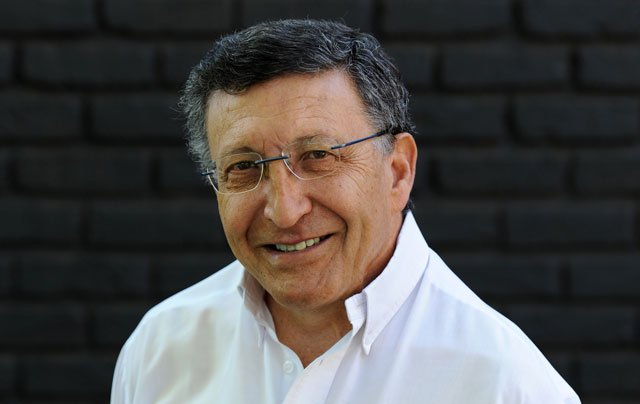
When Bernie Fanaroff graduated in physics from the University of the Witwatersrand, he went to his department head and said he would like to be a cosmologist. “I was always interested in the universe but I was never very practical, so I never built a telescope or looked at the stars or anything,” he said.
His professor told him he was not clever enough to be a cosmologist and suggested he try radio astronomy instead.
Fanaroff said it sounded fine and went to Cambridge where he got a doctorate in radio astronomy.
That was in 1970. In the ensuing 42 years, Fanaroff has worked as a radio astronomer for more than a decade. In that time he has made two major international contributions to the science. One, in 1974, was a breakthrough in the classification of radio galaxies with a British astronomer, Julia Riley. It is called the Fanaroff-Riley classification and is renowned among astronomers.
The second was to lead the team that has just landed the biggest global scientific project in Africa, the Square Kilometre Array, or SKA.
It is hard, though, to get this information from Fanaroff himself. A self-effacing man, he at first refused my request for an interview and then, when he relented, asked me whether it was okay if his dog sat in on it.
Compatriots
Actually, his dog, Emma, a well-mannered and elderly border collie, slept in on the interview. She is a fixture now in the busy SKA office in Pinelands, Cape Town, because Fanaroff, who has recently had to put down his other border collie, Alice, does not have the heart to leave the grieving animal at home alone.
Fanaroff’s contributions to radio astronomy are not well known to his compatriots.
“Even when the SKA came up” and Fanaroff was identified as a project leader, said Derek Hanekom, deputy minister of science & technology, “I thought they may have identified him as a good negotiator, a strategic thinker, only to discover his own contributions to radio astronomy”.
Hanekom knew there was something in the heavens named after him but was not quite sure what. A galaxy? I asked Fanaroff. A star? “No, no,” he said. “Just a classification.”
But it has been fundamental to the science. Fanaroff and Riley realised there was a correlation between the luminosity, or energy, of a galaxy and the structure of radio lobes, a name given to the most common large-scale structures of radio galaxies.
“To this day, nobody has come up with a better classification,” said Justin Jonas, professor of physics and electronics at Rhodes University and also the SKA associate director for science and engineering.
Real enigmas
“Radio galaxies are real enigmas in all sorts of ways. They are powered by black holes, which are complete enigmas in themselves. There are billions of these things in the universe and they are not well understood.”
Fanaroff and Riley realised there was a basic distinction between radio galaxies, one in which the radio emission came from close to them, the other when it came from far away. It correlated with the energy, or luminosity, of the galaxy.
“Initially not many people cited the paper,” said Jonas. When they did the work, only about 200 galaxies were known. “We now look at many thousands of galaxies and they all show the same correlation. The classification has not changed, despite huge improvements in radio telescopes. Now there is not a single radio astronomer in the world who does not know about FR-I and FR-II type galaxies.”
In terms of his other great scientific breakthrough, not even the phlegmatic Fanaroff can hide his pleasure at landing the bulk of the SKA project in Africa.
In the last stages of the bid process, the SA team submitted 27 000 pages of detail to the international SKA committee. “We had to build equipment, measure radio frequency and tropospheric interference, all that stuff. Our guys did a spectacular job. We had a fantastic team.”
The bulk of infrastructural design was done by teams led by Jonas and Adrian Tiplady, the SKA site bid manager.
Unionists
Jonas was one of the pioneers of the bid with George Nicolson, founding director of the Hartebeesthoek Radio Astronomy Observatory. They and the National Research Foundation’s Khotso Mokhele approached Rob Adam in 2002 to suggest that SA pursue the SKA, although siting it in SA was not even on the table. Adam, then the director-general of the department of arts, culture, science and technology, was enthusiastic.
“And we said if this is going to be real project, it needs a project manager. And who would be a good person? And we all thought ‘Bernie. Bernie would be a good person.’”
Fanaroff has spent the past three decades working for the trade union movement as head of the reconstruction and development office, and in the safety and security secretariat.
He went into the union movement soon after he returned from Cambridge. “The only thing that seemed interesting to me was the union movement.”
He began working in the wake of the banning of a number of unionists who had been at the forefront of the birth of militant African unions.
“They banned people in 1974 and then again in 1976. I thought this would be another two-year cycle so I asked Wits [University] for unpaid leave for two years.”
Tradition of transparency
The two years stretched to 18 — “they did not ban people after that” — and during them he helped to build one of the most powerful African unions in SA, the Metal and Allied Workers’ Union, which later became the National Union of Metalworkers of SA.
The African trade union movement made an indelible stamp on the fabric of the struggle. It established “a tradition of transparency and accountability in the organisation”, Fanaroff said. It was this strength that enabled the unions to take on the might of the apartheid government in the 1980s.
In 1984, they organised one of the biggest stayaways with the United Democratic Front. They took up issues of rent and services in the townships, unequal education and forced removals in the homeland of Bophuthatswana.
“The unions were the core of those mass actions because it was possible to mobilise members in a very organised way,” he said.
When the state of emergency was declared in 1986 and scores of unionists were detained, the Metal and Allied Workers’ Union struck at the heart of the state. It brought an urgent interdict to get the emergency declared ultra vires and force the police to allow detained unionist Willies Mchunu, now an MEC in KwaZulu-Natal, access to a lawyer and doctor.
It won on the Mchunu issue, but lost the main battle. Halton Cheadle, a unionist who was banned in 1974, was the lawyer who took the case. Although they did not get the state of emergency scrapped, many of the regulations were declared invalid.
Dogged
Fanaroff, said Cheadle, showed the same attributes then as he did in the bid to land the SKA project: “Dogged … and [remarkable] just the amount of time he devoted to the unions in his quiet and undemonstrative way and the extent of loyalty he built up around him.”
When freedom came, his erstwhile union colleague Jay Naidoo appointed him to run the reconstruction and development programme office. It was not an easy place to be.
“We were very popular [with departments] because we had money to hand out,” said Fanaroff, “but also very unpopular because that money was top-sliced from everyone else’s budget.”
The state expenditure department complained that it “polluted the budget process”. But the biggest problem was that “we were very naive and overestimated the skills and capacity of the government to deliver”.
Fanaroff and his staff were taken by surprise when then-president Nelson Mandela closed down the office two years later. Fanaroff was recruited by another former unionist, Sydney Mufamadi, then the minister of safety and security, to be part of the secretariat.
That lasted until Jackie Selebi became police commissioner in 2000. “He said he did not really see the need for a civilian secretariat because he was a civilian. He suggested I become a divisional commissioner, but I really did not see myself as a policeman.”
Dream persisted
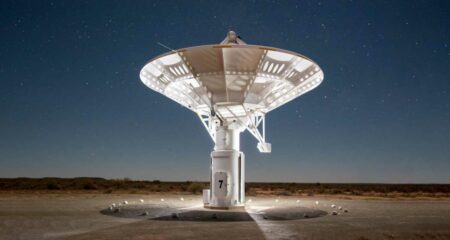
When Fanaroff was recruited to manage the SKA project in 2003, it was still a distant dream. Not even the MeerKAT — which will be the 64-dish array in the Karoo — had been conceived.
Yet the dream persisted. Perhaps when you are studying a universe that is 15bn-odd years old, 20 years is just a moment.
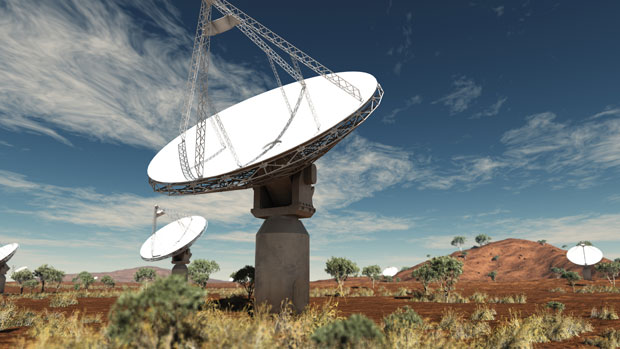
In the 1990s, said Fanaroff, “radio astronomers had started asking what the next big thing was … and they decided they should build a telescope that could see back to before when the first stars were in the universe. And they did a back-of-the-envelope calculation and said you would have to have a telescope with a collecting area of a square kilometre. But you cannot build a single dish big enough, so it is made up of lots of smaller dishes that you connect together.”
It is called an interferometer and is a kind of galaxy of dishes.
He and his team asked the treasury to fund the Karoo Array Telescope (the seven-dish KAT), which is now operational, and the R895m MeerKAT, which will be completed by 2016.
The remaining cost for phase one of the SKA, which will be the 64 dishes plus another 90, is estimated to be about €350m, but as Jonas said, “that is just a nominal number”.
SKA consortium
The drive now is to deepen the pockets of the SKA consortium of nine countries to secure the €1,5bn that will be needed for phase two, which will consist of about 3 000 dishes across eight countries in Africa.
When the results of the bid were announced in SA, those like Fanaroff, who had been plugging away at it, were slightly disappointed by the lack of cheers.
“The world should have been celebrating,” said Audrey Dikgale, a 27-year-old telescope operator at the SKA office in Pinelands. “The world’s biggest scientific instrument will be in Africa and that is not something you could ever say before.”
“Largely, it is a very, very favourable decision,” said Hanekom.
But the reaction was a bit “flat”, partly because it came out in the same week as the raucous noise about The Spear painting and partly because Fanaroff, in particular, is the consummate diplomat about the politics that led to the decision to split the bid between SA and Australia.
The split is about two-thirds in favour of SA, but this is only for phase one of the project. In phase two, it would be closer to 80-20 in favour of SA, said Hanekom.
Spin-offs
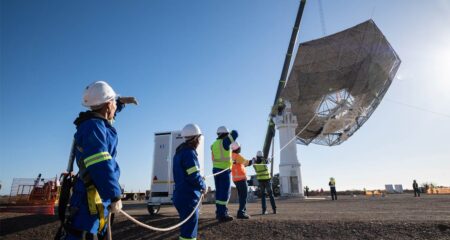
One of the big spin-offs for the SA team is the local manufacturing and scientific capacity the bid has brought. All the KAT dishes were manufactured locally, whereas in Australia’s prototype, called ASKAP, the dishes were made in China.
And then there are the more than 400 bursaries that have been given to universities to train young people to work in the project.
The SKA itself will have to drive more innovation. For instance, said Fanaroff, the flow of data that would come from the 3 000 dishes “will far exceed the total traffic on the World Wide Web”. So, just as astronomy gave the world digital cameras and Wi-Fi, it now it has to develop more powerful computers. Fanaroff believes “young people in SA have the skills and capabilities of taking on any technology challenge”.
Already, the SKA office in Cape Town buzzes with young telescope operators, computer engineers and budding astronomers. Ruvana Casper and Monde Manzini from the Durban University of Technology are learning to build a remote controller for the dish in Ghana, for instance.
Dikgale is one of four young telescope controllers who write computer scripts to control the antennas as they scan the heavens. It is all done from Pinelands because few people are allowed on to the site, which is west of Carnarvon in the Northern Cape.
Intellectually arid
She describes it as “another world”. Dikgale, a maths and physics graduate from the University of Limpopo, spent a few years in what she described as an “intellectually arid” government environment. Now she “thanks the stars” that she is here.
And Fanaroff, she said, was “like a textbook walking. A textbook walking! Whenever you are in his presence you learn something.”
Hanekom said this would be the most powerful and sensitive telescope the world had ever built.
It will have catalytic value because it will develop local skills and economic value because it will promote growth. And it is Fanaroff’s unique combination of skills that has brought it here.
“He has been an underrated figure. He does not like to be upfront … that is Bernie’s style. He does his work; other people cut the ribbons. But we would never have been here if it were not for Bernie. Bottom line. The SKA and Bernie have to be synonymous.” — (c) 2012 Mail & Guardian
- Visit the Mail & Guardian Online, the smart news source