Edge AI has matured from an experimental frontier to a practical necessity, as manufacturers want real-time anomaly detection on production lines, retailers want instant customer-flow analytics and cities want smarter surveillance without streaming terabytes of video to the cloud.
Across these environments, the hardware running at the edge must be compact, rugged, power‑efficient and capable of serious AI inference.
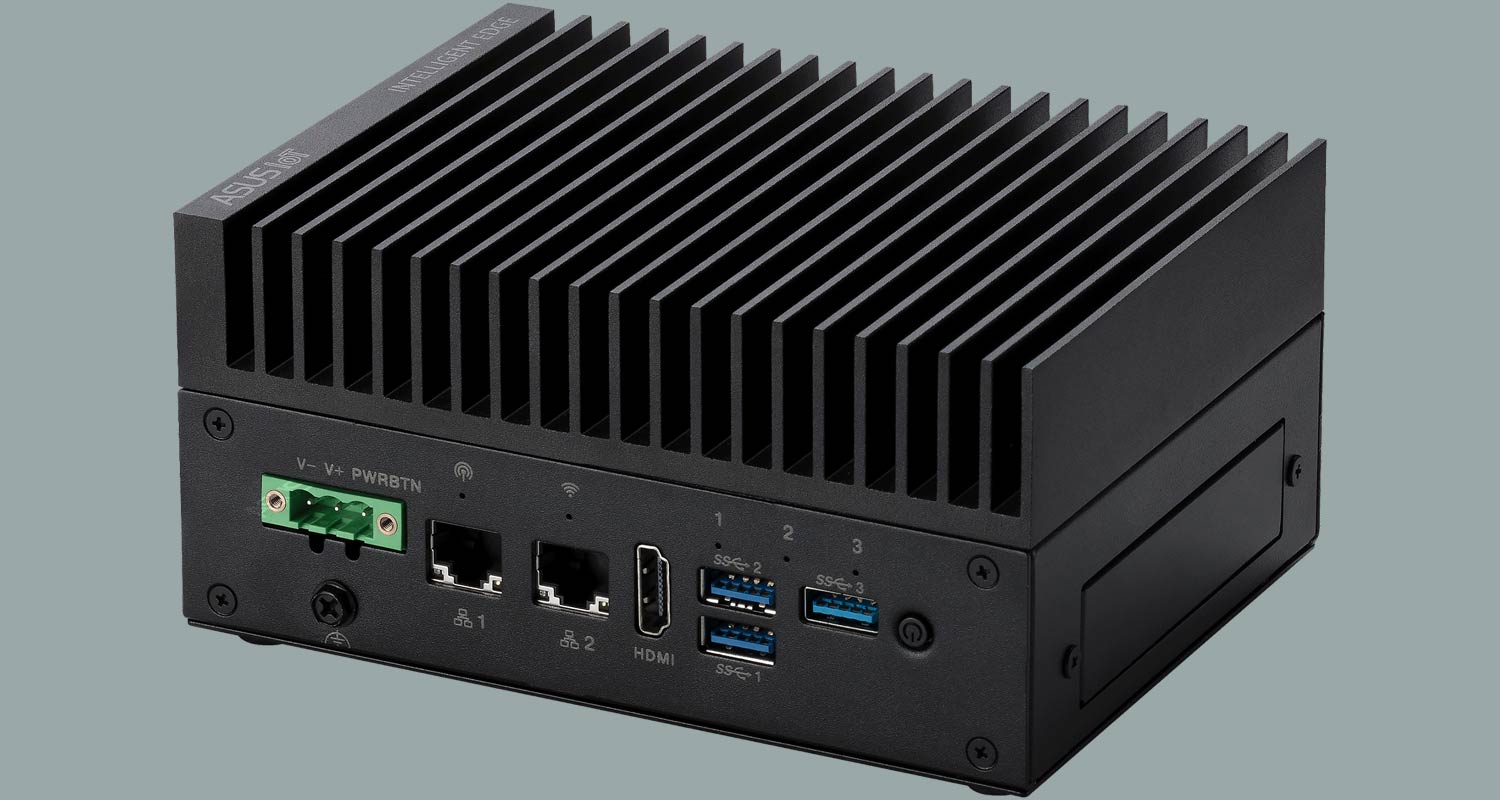
ASUS’s PE1100N Intelligent Edge Computer fits neatly into this emerging sweet spot. While not new on the market, it remains one of the more thoughtfully engineered industrial edge platforms available, particularly for organisations standardising on Nvidia Jetson-based AI deployments.
What makes it compelling is not just raw performance, but the way ASUS has packaged compute, connectivity and durability into a system that can be bolted to a wall, tucked into a cabinet or mounted on a robot without fuss.
A Jetson‑powered AI engine in a palm-sized chassis
At the heart of the PE1100N is Nvidia’s Jetson Orin family, available in Orin Nano (4GB or 8GB) and Orin NX (8GB or 16GB) variants. These modules deliver between 34 Tops and 100 Tops of AI performance, depending on configuration, giving the system enough horsepower for computer vision, robotics, predictive maintenance and multi-sensor fusion workloads.
The Orin NX 16GB model features an eight-core ARM Cortex-A78AE CPU and a 1 024-core Nvidia Ampere GPU with 32 Tensor Cores – a serious amount of compute for a fanless device operating at the edge. Even the smaller Orin Nano variants include a 512-core Ampere GPU, making them suitable for lightweight inference or multi-stream video analytics.
This combination of ARM efficiency and Nvidia acceleration is the PE1100N’s defining strength, allowing it to run modern AI models locally, without relying on cloud compute. That means lower latency, reduced bandwidth consumption and improved data privacy – critical in environments where video or sensor data cannot leave the premises.
Industrial design that means business
The PE1100N is built for the real world, not the server room. ASUS has engineered a compact, fanless enclosure measuring 152×114×72 mm and weighing 1.4kg, with a wide operating temperature range of -20°C to 50°C. It also meets MIL-STD-810H vibration and shock standards, meaning it can survive in vehicles, factory floors or outdoor enclosures.
The system supports wall mounting and can be adapted for DIN-rail installations, making it easy to integrate into control cabinets or equipment racks.
…article continues below…

Connectivity and I/O designed for edge deployments
Where many compact AI boxes compromise on connectivity, the PE1100N does the opposite. ASUS has equipped it with a broad set of industrial-grade interfaces:
- Dual gigabit Ethernet (RJ45)
- Three USB 3.2 Gen 1 ports
- Multiple USB 2.0 ports, including internal headers
- Two RS-232/422/485 serial ports
- One CAN bus port
- 4× digital inputs and 4× digital outputs, isolated
- HDMI output (up to 4K@60Hz on Orin NX models)
This makes the device suitable for machine-to-machine communication, PLC integration, robotics and multi-sensor environments.
Wireless connectivity is modular: M.2 slots allow integrators to add Wi-Fi, Bluetooth, LTE or 5G modules, and the system includes dual nano-Sim slots for redundancy or multi-network deployments.
Storage is equally flexible, with an M.2 M-key slot supporting NVMe SSDs up to 2280 size, ideal for high-speed logging or local dataset storage.
Built for AI at the edge
While many embedded computers can run Linux and handle basic workloads, the PE1100N is explicitly designed for AI inference. ASUS highlights compatibility with AWS IoT Greengrass, and the Jetson platform ensures support for Nvidia’s full AI software stack, including TensorRT, DeepStream and Cuda.
This makes the device particularly well-suited for:
- Smart manufacturing: Real-time defect detection, equipment monitoring and robotic control benefit from the low latency of on-device inference. The PE1100N’s serial ports and CAN bus make it easy to integrate with industrial machinery.
- Surveillance and smart cities: Running video analytics at the edge reduces the need to stream high-resolution footage to the cloud. With up to 100 Tops of performance, the PE1100N can handle multiple camera streams simultaneously.
- Retail analytics: Footfall analysis, queue monitoring and shelf-scanning robots all benefit from local AI processing, especially in bandwidth-constrained environments.
- Autonomous and mobile systems: The rugged design, wide temperature tolerance and optional 5G connectivity make it suitable for drones, AMRs and AGVs.
AEM expansion and futureproofing
ASUS also supports its AEM (ASUS Expansion Module) ecosystem, allowing integrators to add features such as additional LAN ports or specialised interfaces. This modularity extends the lifespan of deployments and allows the PE1100N to adapt to evolving requirements.
A mature, reliable platform for industrial AI
The PE1100N is not flashy, and it’s not trying to be. Instead, it’s a mature, robust and thoughtfully engineered platform that solves real-world problems for organisations deploying AI at the edge.
In a market crowded with edge devices that either underperform or overheat, the ASUS PE1100N stands out as a compact workhorse – quiet, durable and powerful enough to run the next generation of edge intelligence.
- Read more articles by Altron Arrow on TechCentral
- This promoted content was paid for by the party concerned