
Close Menu
TechCentralTechCentral

    Subscribe to the newsletter

    Get the best South African technology news and analysis delivered to your e-mail inbox every morning.

    Facebook X (Twitter) YouTube LinkedIn
    WhatsApp Facebook X (Twitter) LinkedIn YouTube
    TechCentralTechCentral
    • News
      Nedbank hires MTN's former tech chief as group CIO - Nikos Angelopoulos

      Nedbank hires MTN’s former tech chief as group CIO

      31 July 2026
      Eskom's diesel bill falls 86% as breakdowns hit eight-year low

      Eskom’s diesel bill falls 86% as breakdowns hit eight-year low

      31 July 2026
      Ramaphosa signs off on taking the grid away from Eskom

      Ramaphosa signs off on taking the grid away from Eskom

      31 July 2026
      Microsoft just had the biggest day in stock market history

      Microsoft just had the biggest day in stock market history

      31 July 2026
      MTN Nigeria's growth engine stalled in second quarter - Karl Toriola

      MTN Nigeria’s growth engine stalled in second quarter

      31 July 2026
    • World
      Meta AI will now tell parents if their teen is in crisis

      Meta AI will now tell parents if their teen is in crisis

      17 July 2026
      IBM shares crash 25% as AI upends software spending - Arvind Krishna

      IBM shares crash 25% as AI upends software spending

      15 July 2026
      Jony Ive's first OpenAI device: an AI smart speaker - Jony Ive and Sam Altman

      Jony Ive’s first OpenAI device: an AI smart speaker

      15 July 2026
      Stripe, Advent in talks to buy PayPal for $53-billion

      Stripe, Advent in talks to buy PayPal for $53-billion

      15 July 2026
      Memory crisis sends smartphone market into steep decline

      Memory crisis sends smartphone market into steep decline

      13 July 2026
    • In-depth
      The plan to stop AI from breaking the world - Google DeepMind CEO Demis Hassabis. Image: John Sears

      The plan to stop AI from breaking the world

      16 July 2026
      The internet has a Strait of Hormuz problem

      The internet has a Strait of Hormuz problem

      15 July 2026
      AI boom sparks rally, frenzy and fear

      AI boom sparks rally, frenzy and fear

      11 June 2026
      Every plug-in hybrid on sale in South Africa, ranked by price - Lamborghini Temerario

      Every plug-in hybrid on sale in South Africa, ranked by price

      7 June 2026
      What Wi-Fi 8 will mean for wireless networks

      What Wi-Fi 8 will mean for wireless networks

      1 June 2026
    • TCS
      TCS+ | Why South African workers must become supervisors of digital labour - Accelera Digital Group Cliff de Wit

      TCS+ | Why South African workers must become supervisors of digital labour

      31 July 2026
      TCS | Rapid deployment rules can't work without municipalities: ACT - Nomvuyiso Batyi

      TCS | Icasa’s rules skip the real bottleneck: ACT

      30 July 2026
      TCS+ | iStore Business on why Apple makes sense for SMEs - Sudesh Pillay and Tamia Nontsikelelo

      TCS+ | iStore Business on why Apple makes sense for SMEs

      30 July 2026
      TCS+ | A smarter approach to cloud for South African businesses - Joel Chacko and Jonathan Oaker

      TCS+ | A smarter approach to cloud for South African businesses

      28 July 2026
      TCS | How Optasia lends billions to people banks can't see - Salvador Anglada

      TCS | How Optasia lends billions to people banks can’t see

      23 July 2026
    • Opinion
      The author, Jannie van Zyl

      Selling vapour is corporate suicide in slow motion

      16 July 2026
      Brazil's online gambling crackdown is a lesson for South Africa

      How Amazon outmanoeuvred Starlink in South Africa

      15 July 2026
      The Popia problem with agentic AI - Herman Haasbroek

      The Popia problem with agentic AI

      14 July 2026
      The author, Fanie van Rooyen

      South Africa can still catch the AI wave – here’s how

      7 July 2026
      The author, Fanie van Rooyen

      The AI utopia South Africa can’t afford

      1 July 2026
    • Company Hubs
      • 1Stream
      • Africa Data Centres
      • AfriGIS
      • Altron Digital Business
      • Altron Document Solutions
      • Altron Group
      • Arctic Wolf
      • Ascent Technology
      • AvertITD
      • BBD
      • Braintree
      • CallMiner
      • CambriLearn
      • CM Telecom
      • Contactable
      • CYBER1 Solutions
      • Digicloud Africa
      • Digimune
      • Domains.co.za
      • ESET
      • Euphoria Telecom
      • HOSTAFRICA
      • Incredible Business
      • iONLINE
      • IQbusiness
      • Iris Network Systems
      • Kaspersky
      • LSD Open
      • Mitel
      • NEC XON
      • Netstar
      • Network Platforms
      • Next DLP
      • Ovations
      • Paracon
      • Paratus
      • Q-KON
      • SevenC
      • SkyWire
      • Solid8 Technologies
      • Telit Cinterion
      • Telviva
      • Tenable
      • Vertiv
      • Videri Digital
      • Vodacom Business
      • Vox
      • Wipro
      • Workday
      • XLink
    • Sections
      • AI and machine learning
      • Banking
      • Broadcasting and Media
      • Cloud services
      • Contact centres and CX
      • Cryptocurrencies
      • Education and skills
      • Electronics and hardware
      • Energy and sustainability
      • Enterprise software
      • Financial services
      • HealthTech
      • Information security
      • Internet and connectivity
      • Internet of Things
      • Investment
      • IT services
      • Lifestyle
      • Policy and regulation
      • Public sector
      • Retail and e-commerce
      • Satellite communications
      • Science
      • SMEs and start-ups
      • Social media
      • Talent and leadership
      • Telecoms
      • Watts & Wheels
    • Events
    • Advertise
    TechCentralTechCentral
    Home » In-depth » Delving deeper into Eskom’s chronic mismanagement

    Delving deeper into Eskom’s chronic mismanagement

    By Prof PMD Rwelamila28 September 2018
    Twitter LinkedIn Facebook WhatsApp Email Telegram Copy Link
    News Alerts
    WhatsApp

    The failure of Eskom to adopt sound project management strategies could have circumvented billions of rand wasted due to administrative failure and non-compliance.

    In July this year, Eskom released its much-delayed financial results. Poor results revealed, among others, a net loss of R2.3-billion and an amount of R19.6-billion that was attributed to “irregular expenditure”. The utility claims that 60% of incidents related to administrative non-compliance‚ and noted that irregular spending was not necessarily fruitless and wasteful expenditure.

    With an amassed debt of R399-billion at the end of March 2018 (according to data compiled by Bloomberg), it will take a mountain of concerted effort to move the utility into a sustainable, profit-making organisation. As rescue strategies are fleshed out in the coming months, and as parliamentary hearings unravel the extent of the wrongdoing and mismanagement, a critical question to ask in practical terms is how Eskom came to be so woefully mismanaged.

    A decade ago, in a bid to meet South Africa’s expanding power consumption, Eskom embarked on one of the world’s biggest projects

    If one is to take a step back to see where the utility went wrong, there are clear indications that inadequate monitoring as a result of unsatisfactory internal processes and a poorly applied organisational structure allowed flawed decisions and critical actions to go unchecked.

    A decade ago, in a bid to meet South Africa’s expanding power consumption, Eskom embarked on one of the world’s biggest projects. A mega-structure power station, named Medupi, was to be developed in Limpopo. A total of six boilers would each power an 800MW turbine, producing 4.8GW of electricity for South Africa’s national grid — making it the largest dry-cooled, coal-fired power station in the world. The cost of producing the power station would be R80-billion.

    In 2018, production at Medupi only now nears completion. According to the station’s director, all units will be fully operational by 2020.

    The Medupi project has endured numerous delays over its lifetime with an overspend of R52-billion — almost equal to that of the original total estimated cost.

    Different orientation

    Successful management of a project the size of Medupi requires a different orientation of governance and an appropriate organisational structure. An organisation’s structure directly informs how human resources are able to be distributed; how activity is rolled out and managed; how risks are identified; and how project learning — and, ultimately, project memory — is captured.

    Complex projects like Medupi require large-scale outsourcing to multiple stakeholders with the incorporation of varied timelines and deliverables, and the development of different risk profiles. Project-based organisations can handle this complexity due to their governance frameworks and structure that gathers human resources and supporting processes around projects’ development, implementation and completion.

    PBOs are substantially different to routine organisations, which rather use the principle of specialisation based on function or role. In a routine organisation, decisions are decentralised since issues are delegated to specialised persons or units, leaving them the responsibility of implementing, evaluating or controlling the given procedures or goals.
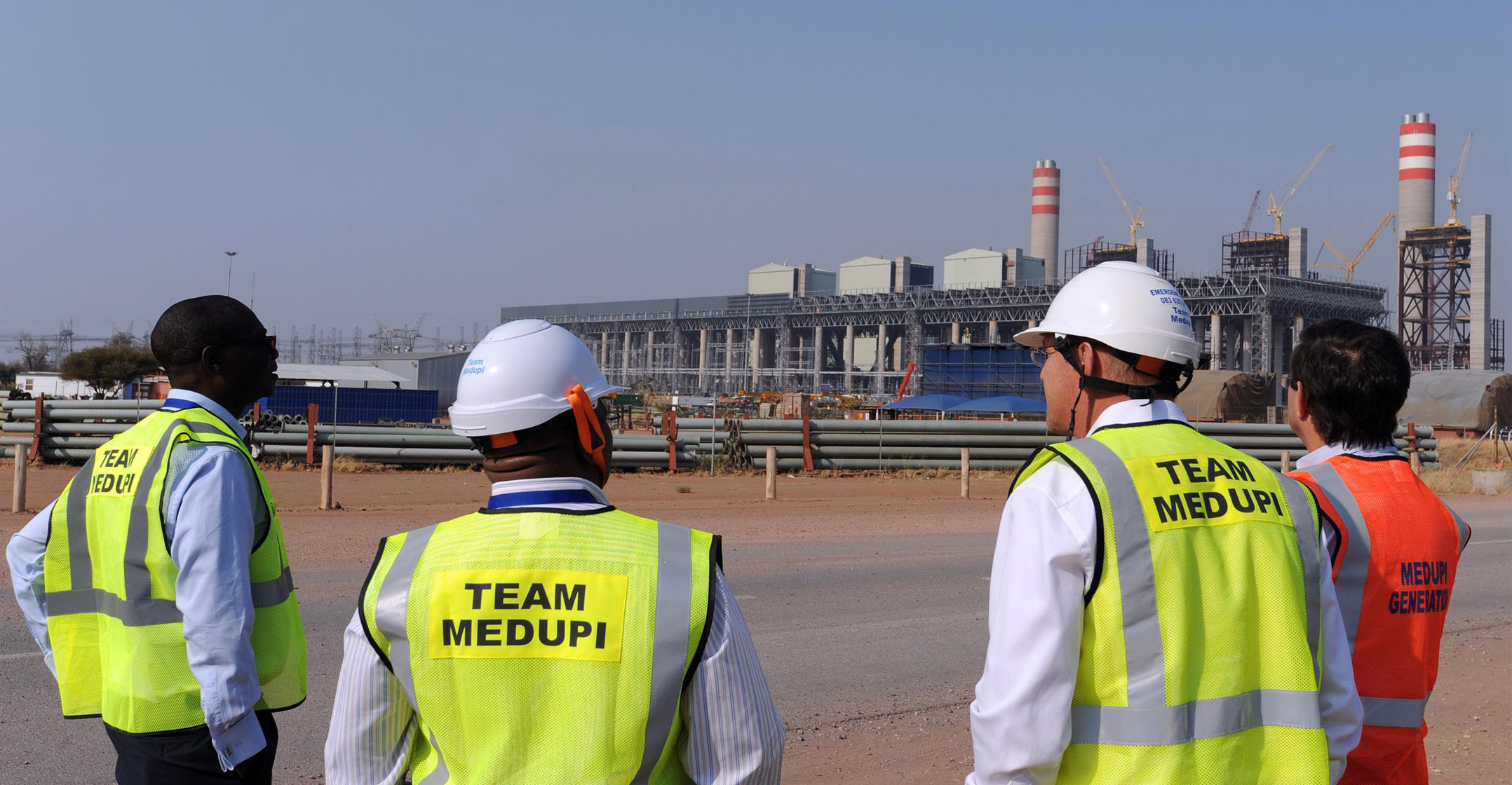
    Image: GCIS

    For all intents and purposes, Eskom appears to have been structured as a routine organisation, which is a fundamental shortcoming. Power stations are — or should be — discrete projects, each with their own life cycle, cost centres and risk profile. Eskom’s management of its power stations has resulted in sub-optimal development and management, and ultimately delivery. For personnel, operating in departmental silos makes it difficult to perceive how their particular contribution relates to the company’s — or project’s — big picture. A lack of accountability has invariably given rise to inefficiencies in administrative processes that have impacted negatively on the project.

    Central to the PBO, the core team represents all the disciplines from departments or functional units that are necessary for successful project implementation. The core team remains visibly active throughout the duration of the project, not only because this signifies “warm bodies” around the table at all times, but because the team carries with it the institutional memory. In terms of Medupi, it is doubtful whether Eskom has had one core team since project inception.

    Had Eskom undertaken a comprehensive due diligence, the lack of local welders would have been identified as a major risk

    Risk management is an integral feature of a PBO. Not only does it speak to the roadmap of the overall project, but it also interrogates the detail. Risk management requires rigorous consideration of what must be achieved in relation to resource availability. And this lack of adequate risk management is one of the most glaring inefficiencies in Eskom’s project management environment.

    When conceptualising and later scoping Medupi, Eskom failed to recognise a lack of mega-structure A-class welders and non-destructive testing specialists in South Africa, a critical aspect to the project’s implementation. The resultant solution was a failed bid to upskill local welders; the local industry was unable to train local welders fast enough to do the job reliably and productively. The utility then worked with Hitachi to bring Asian welders to the Medupi project.

    As many as 2000 specialist welders were required to work on Medupi (and Kusile) power plant construction sites. In 2013, it was reported that a total of over 34 000 A-class welds had been completed at Medupi boiler 6 in a 19-month period.

    Additionally, although recognised upfront that there were insufficient competent engineering practitioners to execute Medupi and a resultant strategy formulated to contract-in large and multinational engineering companies to assist, the roles and responsibilities were not ideally defined. As a result, the decision making and processes to be followed were highly protracted and resulted in significant delays.

    Had Eskom undertaken a comprehensive due diligence, the lack of local welders would have been identified as a major risk, requiring solid contingency plans to be put in place before the project reached implementation phase. Comprehensive due diligence is a foundation of a mature PBO. Eskom has no choice but to take a deliberate introspection and assess its project management maturity challenges.

    Conclusion

    It is imperative for Eskom to surrender an ongoing reliance on reactive solution-seeking.

    To succeed in the long term, the utility should ensure that its expertise dominates all plans. Plans should be project-based and complemented by stringent evaluation processes. When specialist project teams are gathered, it is critical that those specialists have the supporting knowledge and experience to drive each aspect of the project.

    Ongoing compliance must be supported by stringent checks and balances at regular intervals built into the project’s timeline. When concluded, all projects should be completed using a standardised concluding process based on best practice and should be uniformly monitored and evaluated using external parties to provide credible audits.

    Risk management must be both immediate and insightful, complemented by robust disaster management that enables quick turnaround times on decisions. Consultation with external parties in the private sector should be continually undertaken to harness practical solutions.

    As the largest power utility on the African continent, Eskom authorities and the government as shareholder simply cannot behave like ostriches. The solution lies in making sure that Eskom can leap-frog to at least a level-3 maturing across all functional areas. Eskom should be blazing the way as an institution that is capable of innovation and flexibility, committed to continuous learning and knowledge-gathering. In conjunction with this, the utility should prioritise the ongoing and transparent communication of its goals and progress for the public to understand the organisation’s strategy in bringing power to the people.

    • Prof PMD Rwelamila is a specialist in management systems at Unisa’s Graduate School of Business Leadership

    Follow TechCentral on Google News Add TechCentral as your preferred source on Google


    Eskom top
    WhatsApp YouTube
    Share. Facebook Twitter LinkedIn WhatsApp Telegram Email Copy Link
    Previous Article50 million accounts compromised in Facebook security breach
    Next Article Government’s spectrum licensing plans revealed

    Related Posts

    Eskom's diesel bill falls 86% as breakdowns hit eight-year low

    Eskom’s diesel bill falls 86% as breakdowns hit eight-year low

    31 July 2026
    Ramaphosa signs off on taking the grid away from Eskom

    Ramaphosa signs off on taking the grid away from Eskom

    31 July 2026
    Huawei Connect 2026: taking South African AI beyond pilots

    Huawei Connect 2026: taking South African AI beyond pilots

    29 July 2026
    Company News
    Domains.co.za launches self-hosted n8n VPS hosting

    Domains.co.za launches self-hosted n8n VPS hosting

    31 July 2026
    Smarter.tech '26 shows why smarter technology begins with context - Obsidian Systems

    Context is the missing piece in enterprise AI: Obsidian

    31 July 2026
    Huawei launches 12 intelligent transport solutions in South Africa - Sam Tang

    Huawei launches 12 intelligent transport solutions in South Africa

    30 July 2026
    Opinion
    The author, Jannie van Zyl

    Selling vapour is corporate suicide in slow motion

    16 July 2026
    Brazil's online gambling crackdown is a lesson for South Africa

    How Amazon outmanoeuvred Starlink in South Africa

    15 July 2026
    The Popia problem with agentic AI - Herman Haasbroek

    The Popia problem with agentic AI

    14 July 2026

    Subscribe to Updates

    Get the best South African technology news and analysis delivered to your e-mail inbox every morning.

    Latest Posts
    Nedbank hires MTN's former tech chief as group CIO - Nikos Angelopoulos

    Nedbank hires MTN’s former tech chief as group CIO

    31 July 2026
    Eskom's diesel bill falls 86% as breakdowns hit eight-year low

    Eskom’s diesel bill falls 86% as breakdowns hit eight-year low

    31 July 2026
    Ramaphosa signs off on taking the grid away from Eskom

    Ramaphosa signs off on taking the grid away from Eskom

    31 July 2026
    TCS+ | Why South African workers must become supervisors of digital labour - Accelera Digital Group Cliff de Wit

    TCS+ | Why South African workers must become supervisors of digital labour

    31 July 2026
    © 2009 - 2026 NewsCentral Media
    Built and maintained by Chronon
    • Cookie policy (ZA)
    • TechCentral – privacy and Popia

    Type above and press Enter to search. Press Esc to cancel.

    Manage consent

    TechCentral uses cookies to enhance its offerings. Consenting to these technologies allows us to serve you better. Not consenting or withdrawing consent may adversely affect certain features and functions of the website.

    Functional Always active
    The technical storage or access is strictly necessary for the legitimate purpose of enabling the use of a specific service explicitly requested by the subscriber or user, or for the sole purpose of carrying out the transmission of a communication over an electronic communications network.
    Preferences
    The technical storage or access is necessary for the legitimate purpose of storing preferences that are not requested by the subscriber or user.
    Statistics
    The technical storage or access that is used exclusively for statistical purposes. The technical storage or access that is used exclusively for anonymous statistical purposes. Without a subpoena, voluntary compliance on the part of your Internet Service Provider, or additional records from a third party, information stored or retrieved for this purpose alone cannot usually be used to identify you.
    Marketing
    The technical storage or access is required to create user profiles to send advertising, or to track the user on a website or across several websites for similar marketing purposes.
    • Manage options
    • Manage services
    • Manage {vendor_count} vendors
    • Read more about these purposes
    View preferences
    • {title}
    • {title}
    • {title}