Close Menu
TechCentralTechCentral

    Subscribe to the newsletter

    Get the best South African technology news and analysis delivered to your e-mail inbox every morning.

    Facebook X (Twitter) YouTube LinkedIn
    WhatsApp Facebook X (Twitter) LinkedIn YouTube
    TechCentralTechCentral
    • News
      Big Microsoft 365 price increases coming next year

      Big Microsoft price increases coming next year

      5 December 2025
      Vodacom to take control of Safaricom in R36-billion deal - Shameel Joosub

      Vodacom to take control of Safaricom in R36-billion deal

      4 December 2025
      Black Friday goes digital in South Africa as online spending surges to record high

      Black Friday goes digital in South Africa as online spending surges to record high

      4 December 2025
      BYD takes direct aim at Toyota with launch of sub-R500 000 Sealion 5 PHEV

      BYD takes direct aim at Toyota with launch of sub-R500 000 Sealion 5 PHEV

      4 December 2025
      'Get it now': Takealot in new instant deliveries pilot

      ‘Get it now’: Takealot in new instant deliveries pilot

      4 December 2025
    • World
      Amazon and Google launch multi-cloud service for faster connectivity

      Amazon and Google launch multi-cloud service for faster connectivity

      1 December 2025
      Google makes final court plea to stop US breakup

      Google makes final court plea to stop US breakup

      21 November 2025
      Bezos unveils monster rocket: New Glenn 9x4 set to dwarf Saturn V

      Bezos unveils monster rocket: New Glenn 9×4 set to dwarf Saturn V

      21 November 2025
      Tech shares turbocharged by Nvidia's stellar earnings

      Tech shares turbocharged by stellar Nvidia earnings

      20 November 2025
      Config file blamed for Cloudflare meltdown that disrupted the web

      Config file blamed for Cloudflare meltdown that disrupted the web

      19 November 2025
    • In-depth
      Jensen Huang Nvidia

      So, will China really win the AI race?

      14 November 2025
      Valve's Linux console takes aim at Microsoft's gaming empire

      Valve’s Linux console takes aim at Microsoft’s gaming empire

      13 November 2025
      iOCO's extraordinary comeback plan - Rhys Summerton

      iOCO’s extraordinary comeback plan

      28 October 2025
      Why smart glasses keep failing - no, it's not the tech - Mark Zuckerberg

      Why smart glasses keep failing – it’s not the tech

      19 October 2025
      BYD to blanket South Africa with megawatt-scale EV charging network - Stella Li

      BYD to blanket South Africa with megawatt-scale EV charging network

      16 October 2025
    • TCS
      TCS+ | How Cloud on Demand helps partners thrive in the AWS ecosystem - Odwa Ndyaluvane and Xenia Rhode

      TCS+ | How Cloud On Demand helps partners thrive in the AWS ecosystem

      4 December 2025
      TCS | MTN Group CEO Ralph Mupita on competition, AI and the future of mobile

      TCS | Ralph Mupita on competition, AI and the future of mobile

      28 November 2025
      TCS | Dominic Cull on fixing South Africa's ICT policy bottlenecks

      TCS | Dominic Cull on fixing South Africa’s ICT policy bottlenecks

      21 November 2025
      TCS | BMW CEO Peter van Binsbergen on the future of South Africa's automotive industry

      TCS | BMW CEO Peter van Binsbergen on the future of South Africa’s automotive industry

      6 November 2025
      TCS | Why Altron is building an AI factory - Bongani Andy Mabaso

      TCS | Why Altron is building an AI factory in Johannesburg

      28 October 2025
    • Opinion
      Your data, your hardware: the DIY AI revolution is coming - Duncan McLeod

      Your data, your hardware: the DIY AI revolution is coming

      20 November 2025
      Zero Carbon Charge founder Joubert Roux

      The energy revolution South Africa can’t afford to miss

      20 November 2025
      It's time for a new approach to government IT spend in South Africa - Richard Firth

      It’s time for a new approach to government IT spend in South Africa

      19 November 2025
      How South Africa's broken Rica system fuels murder and mayhem - Farhad Khan

      How South Africa’s broken Rica system fuels murder and mayhem

      10 November 2025
      South Africa's AI data centre boom risks overloading a fragile grid - Paul Colmer

      South Africa’s AI data centre boom risks overloading a fragile grid

      30 October 2025
    • Company Hubs
      • Africa Data Centres
      • AfriGIS
      • Altron Digital Business
      • Altron Document Solutions
      • Altron Group
      • Arctic Wolf
      • AvertITD
      • Braintree
      • CallMiner
      • CambriLearn
      • CYBER1 Solutions
      • Digicloud Africa
      • Digimune
      • Domains.co.za
      • ESET
      • Euphoria Telecom
      • Incredible Business
      • iONLINE
      • IQbusiness
      • Iris Network Systems
      • LSD Open
      • NEC XON
      • Netstar
      • Network Platforms
      • Next DLP
      • Ovations
      • Paracon
      • Paratus
      • Q-KON
      • SevenC
      • SkyWire
      • Solid8 Technologies
      • Telit Cinterion
      • Tenable
      • Vertiv
      • Videri Digital
      • Vodacom Business
      • Wipro
      • Workday
      • XLink
    • Sections
      • AI and machine learning
      • Banking
      • Broadcasting and Media
      • Cloud services
      • Contact centres and CX
      • Cryptocurrencies
      • Education and skills
      • Electronics and hardware
      • Energy and sustainability
      • Enterprise software
      • Financial services
      • Information security
      • Internet and connectivity
      • Internet of Things
      • Investment
      • IT services
      • Lifestyle
      • Motoring
      • Public sector
      • Retail and e-commerce
      • Satellite communications
      • Science
      • SMEs and start-ups
      • Social media
      • Talent and leadership
      • Telecoms
    • Events
    • Advertise
    TechCentralTechCentral
    Home » Sections » Science » Earth-sized planet found in habitable zone of nearby star

    Earth-sized planet found in habitable zone of nearby star

    By The Conversation8 January 2020
    Twitter LinkedIn Facebook WhatsApp Email Telegram Copy Link
    News Alerts
    WhatsApp
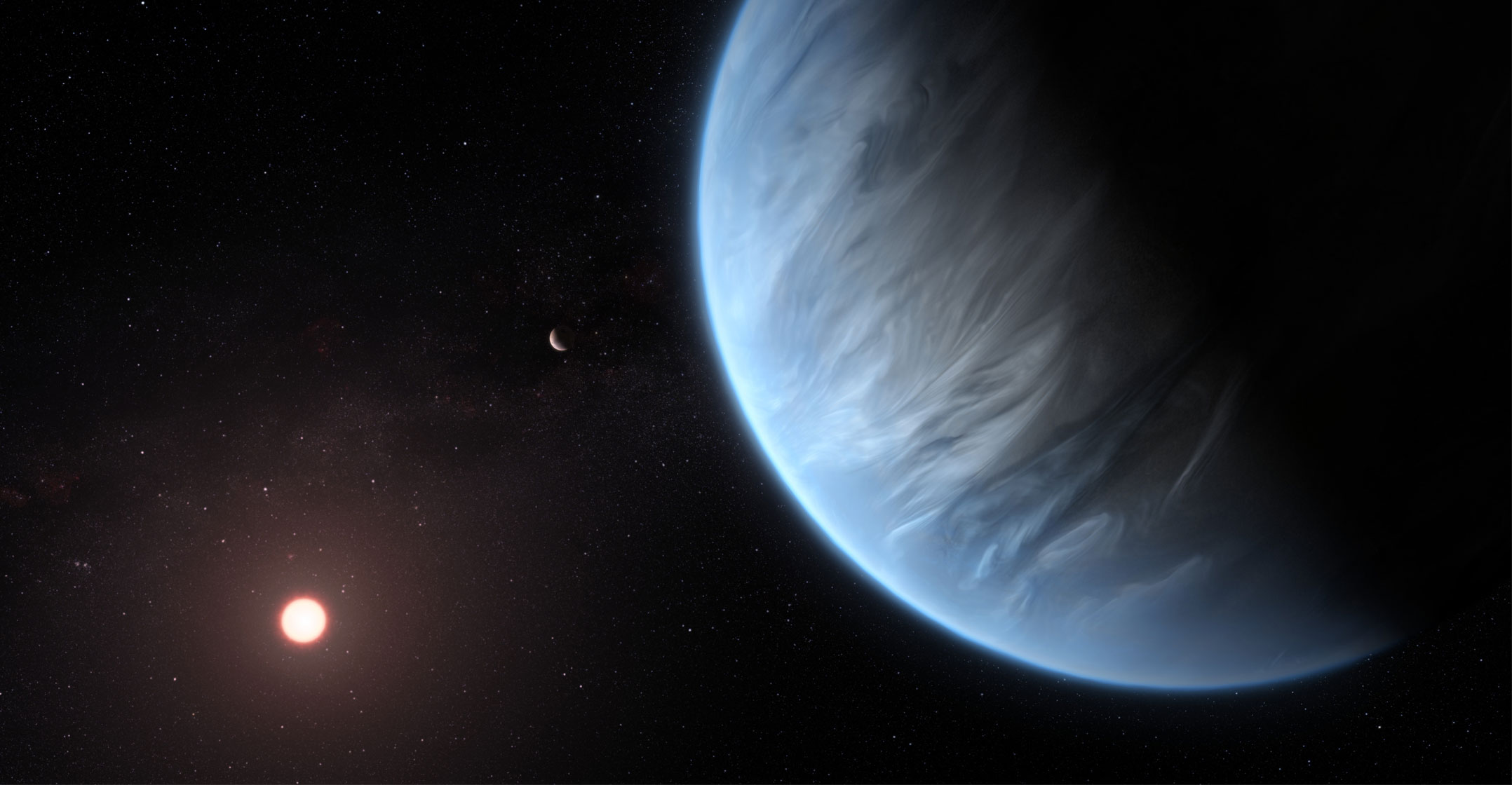
    An artist’s impression of an exoplanet in the habitable zone around a star. Credits: ESA/Hubble, M Kornmesser

    A few months ago, a group of Nasa exoplanet astronomers, who are in the business of discovering planets around other stars, called me into a secret meeting to tell me about a planet that had captured their interest.

    Because my expertise lies in modelling the climate of exoplanets, they asked me to figure out whether this new planet was habitable — a place where liquid water might exist.

    These Nasa colleagues, Josh Schlieder and his students Emily Gilbert, Tom Barclay and Elisa Quintana, had been studying data from Tess (Transiting Exoplanet Survey Satellite) when they discovered what may be Tess’s first-known Earth-sized planet in a zone where liquid water could exist on the surface of a terrestrial planet. This is exciting news because this new planet is relatively close to Earth, and it may be possible to observe its atmosphere with either the James Webb Space Telescope or ground-based large telescopes.

    There are three planets around TOI-700: b, c and d. Planet d is Earth-size, within the star’s habitable zone and orbits TOI-700 every 37 days

    The host star of the planet that Gilbert’s team discovered is called Tess of Interest number 700, or TOI-700. Compared to the sun, it is a small, dim star. It is 40% the size, only about a 50th of the sun’s brightness and is located about 100 light years from Earth in the constellation Dorado, which is visible from the southern hemisphere. For comparison, the nearest star to us, Proxima Centauri, is 4.2 light years away from Earth. To get a sense of these distances, if you were to travel on the fastest spacecraft (Parker Solar Probe) to reach Proxima Centauri, it would take nearly 20 000 years.

    There are three planets around TOI-700: b, c and d. Planet d is Earth-size, within the star’s habitable zone and orbits TOI-700 every 37 days. My colleagues wanted me to create a climate model for Planet d using the known properties of the star and planet. Planets b and c are Earth-size and mini-Neptune-size, respectively. However, they orbit much closer to their host star, receiving five times and 2.6 times the starlight that our own Earth receives from the sun. For comparison, Venus, a dry and hellishly hot world with surface temperature of approximately 460 degrees, receives twice the sunlight of Earth.

    A dozen planets

    Until about a decade ago, only two habitable zone planets of any size were known to astronomers: Earth and Mars. Within the last decade, however, thanks to discoveries made through both ground-based telescopes and the Kepler mission (which also looked for exoplanets from 2009 to 2019, but is now retired), astronomers have discovered about a dozen terrestrial-sized exoplanets. These are between half and two times larger than the Earth within the habitable zones of their host stars.

    Despite the relatively large number of small exoplanet discoveries to date, the majority of stars are between 600 to 3 000 light years away from Earth — too far and dim for detailed follow-up observation.

    Unlike Kepler, Tess’s mission is to search for planets around the sun’s nearest neighbours: those bright enough for follow-up observations.

    Between April 2018 and now, Tess has discovered more than 1 500 planet candidates. Most are more than twice the size of Earth with orbits of less than 10 days. Earth, of course, takes 365 days to orbit around our sun. As a result, the planets receive significantly more heat than Earth receives from the sun and are too hot for liquid water to exist on the surface.

    Liquid water is essential for habitability. It provides a medium for chemicals to interact with each other. While it is possible for exotic life to exist at higher pressures, or hotter temperatures — like the extremophiles found near hydro-thermal vents or the microbes found half a mile beneath the West Antarctic ice sheet — those discoveries were possible because humans were able to directly probe those extreme environments. They would not have been detectable from space.

    When it comes to finding life beyond our solar system, humans depend entirely upon remote observations

    When it comes to finding life, or even habitable conditions, beyond our solar system, humans depend entirely upon remote observations. Surface liquid water may create habitable conditions that can potentially promote life. These life forms can then interact with the atmosphere above, creating remotely detectable bio-signatures that Earth-based telescopes can detect. These bio-signatures could be current Earth-like gas compositions (oxygen, ozone, methane, carbon dioxide and water vapour), or the composition of ancient Earth 2.7 billion years ago (mostly methane and carbon dioxide, and no oxygen).

    We know one such planet where this has already happened: Earth. Therefore, astronomers’ goal is to find those planets that are about Earth-size, orbiting at those distances from the star where water could exist in liquid form on the surface. These planets will be our primary targets to hunt for habitable worlds and signatures of life outside our solar system.

    Dip in starlight

    To prove that TOI-700 d is real, Gilbert’s team needed to confirm using data from a different type of telescope. Tess detects planets when they cross in front of the star, causing a dip in the starlight. However, such dips could also be created by other sources, such as spurious instrumental noise or binary stars in the background eclipsing each other, creating false-positive signals. Independent observations came from Joey Rodriguez at Centre for Astrophysics at Harvard University. Rodriguez and his team confirmed the Tess detection of TOI-700 d with the Spitzer telescope, and removed any remaining doubt that it is a genuine planet.

    My student Gabrielle Engelmann-Suissa and I used our modelling software to figure out what type of climate might exist on planet TOI-700 d. Because we do not yet know what kind of gases this planet may have in its atmosphere, we use our climate models to explore possible gas combinations that would support liquid oceans on its surface. Engelmann-Suissa, with the help of my long-time collaborator Eric Wolf, tested various scenarios including the current Earth atmosphere (77% nitrogen, 21% oxygen, remaining methane and carbon dioxide), the composition of Earth’s atmosphere 2.7 billion years ago (mostly methane and carbon dioxide) and even a Martian atmosphere (a lot of carbon dioxide) as it possibly existed 3.5 billion years ago.
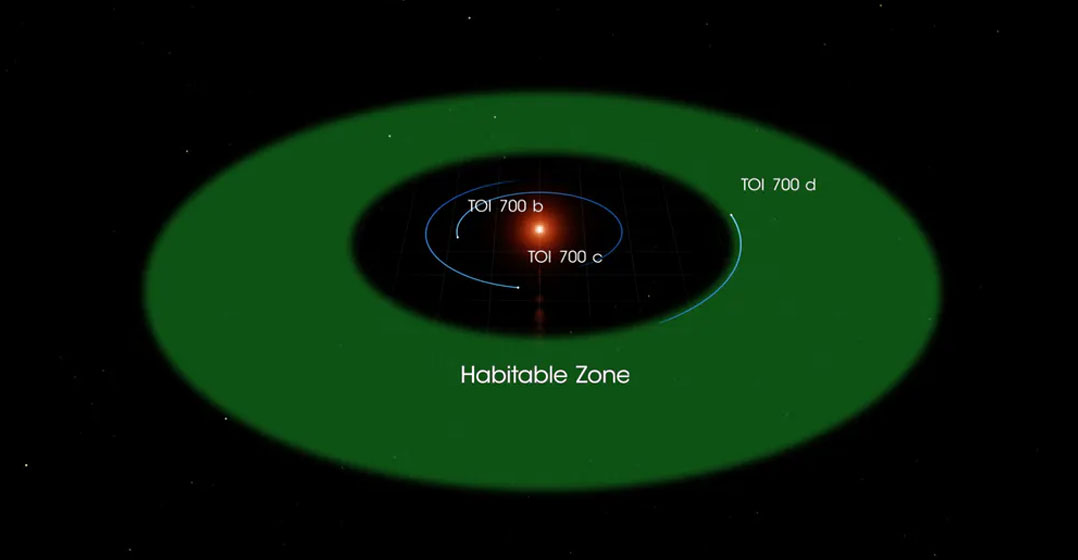
    The three planets of the TOI 700 system orbit a small, cool M dwarf star. TOI 700 d is the first Earth-size habitable-zone world discovered by Tess. Image: Nasa’s Goddard Space Flight Centre

    Based on our models, we found that if the atmosphere of planet TOI-700 d contains a combination of methane or carbon dioxide or water vapour, the planet could be habitable. Now our team needs to confirm these hypotheses with the James Webb Space Telescope.

    The climate simulations our Nasa team has completed suggest that an Earth-like atmosphere and gas pressure isn’t adequate to support liquid water on its surface. If we put the same quantity of greenhouse gases as we have on Earth on TOI-700 d, the surface temperature on this planet would still be below freezing.

    Our own atmosphere supports a liquid ocean on Earth now because our star is quite big and brighter than TOI-700. One thing is for sure: all of our teams’ modelling indicates that the climates of planets around small and dim stars like TOI-700 are very unlike what we see on Earth.

    The field of exoplanets is now in a transitional era from discovering them to characterising their atmospheres. In the history of astronomy, new techniques enable new observations of the universe including surprises like the discovery of hot-Jupiters and mini-Neptunes, which have no equivalent in our solar system. The stage is now set to observe the atmospheres of these planets to see which ones have conditions that support life.The Conversation

    • Written by Ravi Kumar Kopparapu, research scientist of planetary studies, Nasa
    • This article is republished from The Conversation under a Creative Commons licence

    Nasa Ravi Kumar Kopparapu Tess top
    Subscribe to TechCentral Subscribe to TechCentral
    Share. Facebook Twitter LinkedIn WhatsApp Telegram Email Copy Link
    Previous ArticleOpen collaboration essential in navigating 4IR
    Next Article Africa is still in the dark as electrification plans stall

    Related Posts

    Low-Earth orbit satellites - the way forward for Africa

    Why car companies like Toyota are turning to space

    14 February 2025

    Bookmarks | The number of new mobile internet users is stalling

    25 November 2024
    Bookmarks | Firefox at 20 - does Mozilla's browser still matter?

    Bookmarks | Firefox at 20 – does Mozilla’s browser still matter?

    14 November 2024
    Company News
    AI is not a technology problem - iqbusiness

    AI is not a technology problem – iqbusiness

    5 December 2025
    Telcos are sitting on a data gold mine - but few know what do with it - Phillip du Plessis

    Telcos are sitting on a data gold mine – but few know what do with it

    4 December 2025
    Unlock smarter computing with your surface Copilot+ PC

    Unlock smarter computing with your Surface Copilot+ PC

    4 December 2025
    Opinion
    Your data, your hardware: the DIY AI revolution is coming - Duncan McLeod

    Your data, your hardware: the DIY AI revolution is coming

    20 November 2025
    Zero Carbon Charge founder Joubert Roux

    The energy revolution South Africa can’t afford to miss

    20 November 2025
    It's time for a new approach to government IT spend in South Africa - Richard Firth

    It’s time for a new approach to government IT spend in South Africa

    19 November 2025

    Subscribe to Updates

    Get the best South African technology news and analysis delivered to your e-mail inbox every morning.

    Latest Posts
    Big Microsoft 365 price increases coming next year

    Big Microsoft price increases coming next year

    5 December 2025
    AI is not a technology problem - iqbusiness

    AI is not a technology problem – iqbusiness

    5 December 2025
    Vodacom to take control of Safaricom in R36-billion deal - Shameel Joosub

    Vodacom to take control of Safaricom in R36-billion deal

    4 December 2025
    Black Friday goes digital in South Africa as online spending surges to record high

    Black Friday goes digital in South Africa as online spending surges to record high

    4 December 2025
    © 2009 - 2025 NewsCentral Media
    • Cookie policy (ZA)
    • TechCentral – privacy and Popia

    Type above and press Enter to search. Press Esc to cancel.

    Manage consent

    TechCentral uses cookies to enhance its offerings. Consenting to these technologies allows us to serve you better. Not consenting or withdrawing consent may adversely affect certain features and functions of the website.

    Functional Always active
    The technical storage or access is strictly necessary for the legitimate purpose of enabling the use of a specific service explicitly requested by the subscriber or user, or for the sole purpose of carrying out the transmission of a communication over an electronic communications network.
    Preferences
    The technical storage or access is necessary for the legitimate purpose of storing preferences that are not requested by the subscriber or user.
    Statistics
    The technical storage or access that is used exclusively for statistical purposes. The technical storage or access that is used exclusively for anonymous statistical purposes. Without a subpoena, voluntary compliance on the part of your Internet Service Provider, or additional records from a third party, information stored or retrieved for this purpose alone cannot usually be used to identify you.
    Marketing
    The technical storage or access is required to create user profiles to send advertising, or to track the user on a website or across several websites for similar marketing purposes.
    • Manage options
    • Manage services
    • Manage {vendor_count} vendors
    • Read more about these purposes
    View preferences
    • {title}
    • {title}
    • {title}