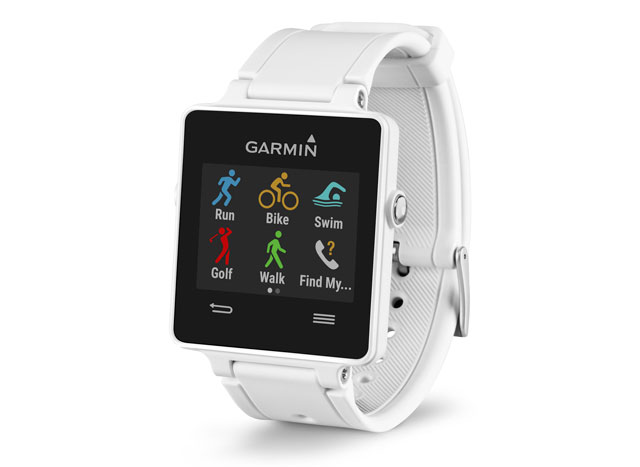
The Vívoactive is Garmin’s foray into the exploding smartwatch market, which Smartwatch Group predicts will be worth US$8,9bn in 2015. Although modern stereotypes suggest one can’t be both smart and sporty, Garmin seems to have broken the smartwatch mould, at least as far as sports activity tracking is concerned.
There are many “smart” attributes in the Vívoactive, but when you get to know it, it becomes apparent that it is more of a crossover device — a hybrid of Garmin’s activity tracker smartband range, which includes the Vívosmart (yes, they got the naming conventions mixed up) and the Vívofit, with loads of sports-specific GPS-enabled tracking and metrics derived from the manufacturer’s extensive sports and fitness watch ranges.
There is sufficient functionality from the apps and widgets that are available for download to warrant Vívoactive’s “smart” moniker. However, it fails to offer the same level of functionality that smartwatches such as the Apple Watch, Samsung Gear, Motorola Moto 360 or the Sony SmartWatch offer. So, if you’re in the market for a serious smartwatch then rather read this review of the bestselling device of 2015 thus far.
If, however, you’re an active individual and are looking for something with more functionality than the basic activity and sleep tracking of smartbands, but aren’t willing to pay the hefty price tag attached to other more specific GPS-enabled sports watches, then this is a serious contender.
 First impressions
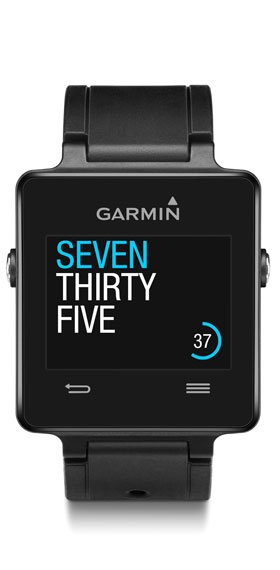
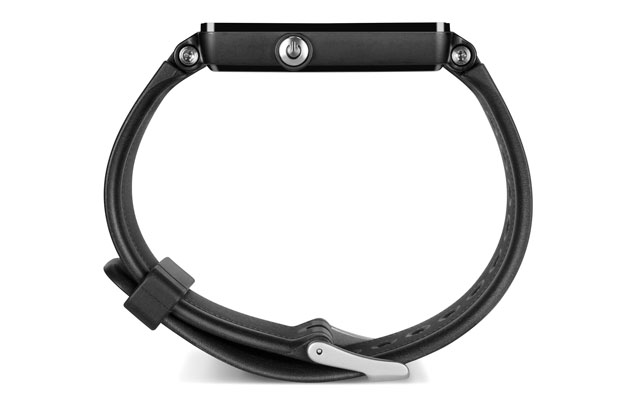
The Vívoactive is certainly understated as far as smartwatch design goes. It is thin — surprising considering the device contains a GPS receiver — and also extremely light at just 38g.
The device is available in black or white and is sold either as a bundled version with an ANT+ heart rate monitor (R5 099) or as a single unit (R4 499), which is what I tested. Included in the box is a USB charging and data transfer cradle.
There are interchangeable straps available in five different colours, or white or black leather options, which are sold separately if you’re not a fan of the standard rubber strap, but I found it to be very comfortable.
The interface is a 1,38-inch, 205×148-pixel LED colour touchscreen. These specs place the Vívoactive far behind the pack in terms of resolution, but the low energy demand of this technology is one of the main reasons why this device has an astounding (claimed) battery life of up three weeks in basic activity-tracking mode (estimated battery life is 10 hours in GPS mode, which is more than sufficient to complete multiple training sessions or races between charges). With combined use, with limited use in GPS mode, I still had a quarter of a charge left after a week.
The screen is easily readable outdoors and the LED backlight delivers sufficient brightness to make the screen easy to read in artificial light.
Getting started
As a regular and entrenched Garmin user — I own a Fēnix 2 that I use mainly for running — the setup was quick and painless when connecting the watch to the Garmin Express app on my MacBook via the charging cradle. (Those who are new to the Garmin ecosystem will need to register a Garmin Connect account and download the app — available for iOS and Android.)
 However, pairing the watch with my iPhone 5S required a little more effort as I had to connect them using Bluetooth in the settings menu and then had to repeat the pairing process in the Garmin Connect app. Once that was done, though, a quick sync of the two devices and all my user data was already uploaded onto the Vívoactive, including my heart rate ranges, resting heart rate and weight.
With Bluetooth pairing done, the “smart” elements of the device came to life, including the on-screen notifications for caller ID, missed call information, messages, e-mails, calendar reminders, social media notifications and other mobile app messages. However, the small screen means that you don’t get to see entire messages. You can generally catch the name of the app or sender of the message, with a line or two of information, but it isn’t suitable for engagement — a key feature of true smartwatch functionality.
That said, the Vívoactive allows you to play, pause or skip a song or podcast on your smartphone, and it has a nifty audible alert function on the main menu to help you locate your phone if it has been misplaced (and is still within range of Bluetooth).
While the device comes preloaded with the activity and sports apps, to get more functionality from the watch you need to add additional apps and widgets from Connect IQ, Garmin’s recently launched app store. The apps and widgets are free but are fairly limited at present, which means few games (only two) or other variants of many of the smartwatch apps you would find in the iTunes or Google Play stores. However, there are a few that caught my eye, including the heart rate variability app and the AccuWeather pollen and allergen tracker, which is handy for this time of the year.
The Connect IQ apps and widgets also make the device highly customisable with a number of interesting watch-face options available. Garmin has opened the store to third-party developers, so hopefully the store will expand and offer greater variety with time. Garmin has also announced the imminent release of various apps that will greatly add to the metrics and data you can glean from the device.
Daily tracking
With the set up complete, the daily activity tracking starts automatically. Steps, calories burnt, distance covered and sleep are the main metrics tracked. The device uses an accelerometer to track these metrics, but this comes with certain drawbacks. For instance, most devices can’t distinguish between arm movement and actual walking, so brushing teeth or waving your arms often gets registered as steps. However, the daily activity tracking is more of an estimate than an exact science so you always get a figure that’s in the ballpark.
The sleep metrics are also very basic. There is no intuitive feedback on sleep quality, just metrics on movement and periods of deep versus light sleep. If you don’t know what to look for, it can be a bit meaningless. What I do like is that the device intuitively determines when you go to bed, so no need to “tell” it that it’s bedtime. There is an option to start sleep tracking manually for a more accurate timeframe but I found the automated function to be accurate enough.
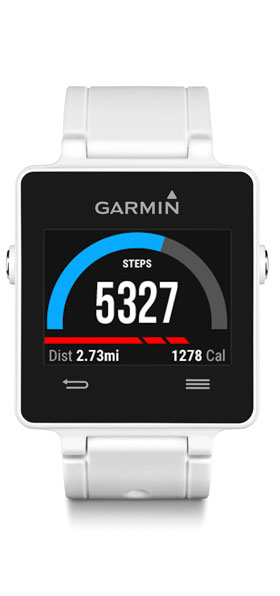
You can also set daily step goals, with progress depicted on the move bar page. The device also sends gentle reminders to you by displaying a red move bar when you have been inactive for too long. A colourful fireworks display signifies the successful attainment of your daily goal.
Syncing this data with the Garmin Connect app is also automatic, as long as your smartphone remains within Bluetooth range. This means your activity is sent automatically to your Garmin Connect account via the app as soon as you finish recording the activity (provided the app is open).
Another nice Bluetooth-connected feature is Garmin LiveTrack, which allows friends and family to follow you in real time during races and training activities, but you’ll need to keep your phone with you to do this.
Where I feel the Vívoactive falls short in terms of its daily activity tracking functionality is a lack of wrist-based heart-rate monitoring, which is now offered by competitor devices such as the Fitbit Surge. Daily heart-rate tracking offers so much more depth in terms of tracking and monitoring data and analytics with insights into recovery and more accurate calorie consumption estimations, to name a few. However, with the release of the Garmin FR225, which features optical wrist-based heart-rate monitoring from Mio, I’m sure the next iteration of this device will integrate it.
Furthermore, when your smartphone is out of Bluetooth range, the smart capabilities of the Vívoactive cease to operate as nothing updates on the device and there is no Wi-Fi or 3G fallback.
Sport tracking
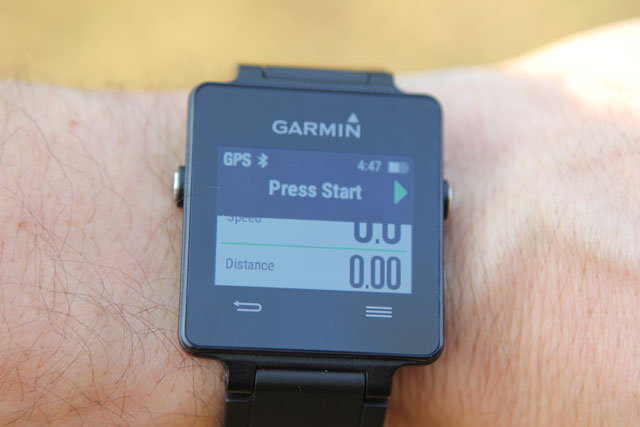
The built-in GPS-enabled sports apps allow users to track multiple metrics while they walk, hike, run, bike or swim outdoors. No other smartwatch offers this depth of sports activity tracking. The Vívoactive is also able to connect to Garmin’s extensive range of peripheral ANT+ sensors such as the heart rate monitor, foot pod or bike speed or cadence sensors for even greater depth in metrics. Even the Garmin Virb Elite action camera can be paired with the watch and controlled from the screen.
Running: The running app displays pace, time and distance using the GPS, and measures cadence with the built-in accelerometer. This also means it is able to track speed and distance when the GPS is not available. Additional features include Auto Lap, Auto Pause and vibration alerts for pre-determined heart rate, pace and run/walk intervals or thresholds. The data screen is customisable and can show up to three different metrics per page. A simple swipe also switches between pages.
I tested the accuracy of the app against my Fēnix 2, which boasts a much more powerful GPS receiver and which uses the GPS and a barometric altimeter to determine a more accurate reading of elevation. Distances were very close, but it was only a 5km course — the variance may increase over longer distances. The greatest discrepancy seems to be the stated elevation gain and loss, with a difference of between 40m and 30m respectively. Other than that I was impressed at the depth of data provided, which included stride length and cadence.
Golf: A key feature that will appeal to a broad market is the golf app, which offers maps of more than 38 000 courses worldwide, and are automatically updated when accessing the app. The Vívoactive uses GPS to measure lay-up and dogleg distances, as well as distances to the front, middle and back of the green. Golfers can also use the Vívoactive to keep individual scorecards and measure shot distances.
Swimming: The Vívoactive is water-resistant to 50m and sensor-based technology enables the swimming app to compute metrics such as number of lengths, total and interval distances, pace (by length, interval or for the full session) and calories burned. The app is also able to determine a swimmer’s SWOLF score — a measure of swim efficiency that tracks the number of strokes taken to complete a length.
Cycling: The cycling app delivers the same data as the running app in terms of pace, distance and time.
Practical considerations
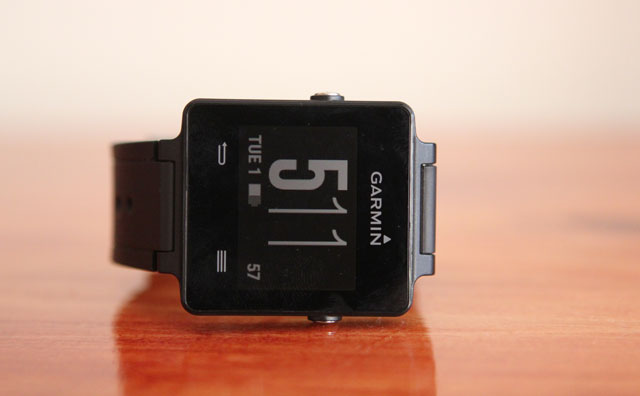
Overall, I found the user experience to be intuitive, as most Garmin devices are. One-touch functionality means you can get active or racing almost immediately without having to fumble around with multiple buttons and through numerous menus. Although the GPS accuracy is understandably not as sharp as the bigger, purpose-built devices in the range, it was able to establish a satellite connection much faster than my Fēnix 2.
I did find that I had issues when jumping between devices to upload data via the Garmin Connect iOS app. After uploading data from my Fēnix 2, the Vívoactive lost the ability to sync with my iPhone. I still got notifications, meaning that the Bluetooth connection wasn’t lost entirely, but syncing data in the other direction was impossible. This required that I re-pair the devices, both in the systems menu and again in the Garmin Connect app each time.
Final thoughts
So, should you buy one? If you’re after a full-featured smartwatch, then this device isn’t for you. Conversely, if you’re a serious athlete or plan to get serious in a specific sporting code in the next 12 months, you’re probably better off spending the extra R1 000 or R2 000 for the sports watch that best suits your needs — perhaps the Forerunner 620 for runners or the Fēnix 3 or 920xt for multi-sport athletes, both of which now integrate with the Connect IQ app store for some smartwatch-like functionality.
However, if you’re a middle-of-the-pack athlete who does a variety of activities on a regular basis, and you’re as interested in consumer tech and the functionality it brings to modern life as much as you enjoy a 10km race on weekends, then this is the perfect device for you. When compared to the sports activity tracking of its closest rivals, the Pebble or Fitbit Surge, it has them beat. It’s just not as “smart”, which means the stereotype might not be entirely unwarranted.
- Review unit supplied by Garmin Southern Africa
- Pedro van Gaalen is the editor of Fitness His Edition magazine. The views expressed in this review are his own and do not represent those of the magazine