Close Menu
TechCentralTechCentral

    Subscribe to the newsletter

    Get the best South African technology news and analysis delivered to your e-mail inbox every morning.

    Facebook X (Twitter) YouTube LinkedIn
    WhatsApp Facebook X (Twitter) LinkedIn YouTube
    TechCentralTechCentral
    • News
      The Post Office is out of options - Anoosh Rooplal

      The Post Office is out of options

      24 March 2026
      Namibia rejects Starlink

      Namibia rejects Starlink

      24 March 2026
      Optasia wants to do for banks what it did for telcos - Salvador Anglada

      Optasia wants to do for banks what it did for telcos

      24 March 2026
      Sanlam appoints group chief AI officer - Theo Mabaso

      Sanlam appoints group chief AI officer

      24 March 2026
      SA's digital economy is booming - but so is the fraud that comes with it - Nomvuyiso Batyi

      SA’s digital economy is booming – but so is the fraud that comes with it

      24 March 2026
    • World
      It's official: ads are coming to ChatGPT

      It’s official: ads are coming to ChatGPT

      23 March 2026
      Mystery Chinese AI model revealed to be Xiaomi's

      Mystery Chinese AI model revealed to be Xiaomi’s

      19 March 2026
      A mystery AI model has developers buzzing

      A mystery AI model has developers buzzing

      18 March 2026
      Samsung's trifold gamble ends in retreat

      Samsung’s trifold gamble ends in retreat

      17 March 2026
      Nvidia targets $1-trillion in AI chip sales as inference demand surges - Jensen Huang

      Nvidia targets $1-trillion in AI chip sales as inference demand surges

      17 March 2026
    • In-depth
      The last generation of coders

      The last generation of coders

      18 February 2026
      Sentech is in dire straits

      Sentech is in dire straits

      10 February 2026
      How liberalisation is rewiring South Africa's power sector

      How liberalisation is rewiring South Africa’s power sector

      21 January 2026
      The top-performing South African tech shares of 2025

      The top-performing South African tech shares of 2025

      12 January 2026
      Digital authoritarianism grows as African states normalise internet blackouts

      Digital authoritarianism grows as African states normalise internet blackouts

      19 December 2025
    • TCS
      Meet the CIO | HealthBridge CTO Anton Fatti on the future of digital health

      Meet the CIO | Healthbridge CTO Anton Fatti on the future of digital health

      23 March 2026
      TCS+ | Arctic Wolf unpacks the evolving threat landscape for SA businesses - Clare Loveridge and Jason Oehley

      TCS+ | Arctic Wolf unpacks the evolving threat landscape for SA businesses

      19 March 2026
      TCS+ | Vox Kiwi: a wireless solution promising a fibre-like experience - Theo van Zyl

      TCS+ | Vox Kiwi: a wireless solution promising a fibre-like experience

      13 March 2026
      TCS+ | Flipping the narrative on AI in the Global South - Josefin Rosén

      TCS+ | Flipping the narrative on AI in the Global South

      13 March 2026
      TCS | Sink or swim? Antony Makins on how AI is rewriting the rules of work

      TCS | Sink or swim? Antony Makins on how AI is rewriting the rules of work

      5 March 2026
    • Opinion
      South Africa's energy future hinges on getting wheeling right - Aishah Gire

      South Africa’s energy future hinges on getting wheeling right

      10 March 2026
      Hold the doom: the case for a South African comeback - Duncan McLeod

      Apple just dropped a bomb on the Windows world

      5 March 2026
      VC's centre of gravity is shifting - and South Africa is in the frame - Alison Collier

      VC’s centre of gravity is shifting – and South Africa is in the frame

      3 March 2026
      Hold the doom: the case for a South African comeback - Duncan McLeod

      Hold the doom: the case for a South African comeback

      26 February 2026
      The AI fraud crisis your bank is not ready for - Andries Maritz

      The AI fraud crisis your bank is not ready for

      18 February 2026
    • Company Hubs
      • 1Stream
      • Africa Data Centres
      • AfriGIS
      • Altron Digital Business
      • Altron Document Solutions
      • Altron Group
      • Arctic Wolf
      • Ascent Technology
      • AvertITD
      • Braintree
      • CallMiner
      • CambriLearn
      • CYBER1 Solutions
      • Digicloud Africa
      • Digimune
      • Domains.co.za
      • ESET
      • Euphoria Telecom
      • HOSTAFRICA
      • Incredible Business
      • iONLINE
      • IQbusiness
      • Iris Network Systems
      • LSD Open
      • Mitel
      • NEC XON
      • Netstar
      • Network Platforms
      • Next DLP
      • Ovations
      • Paracon
      • Paratus
      • Q-KON
      • SevenC
      • SkyWire
      • Solid8 Technologies
      • Telit Cinterion
      • Tenable
      • Vertiv
      • Videri Digital
      • Vodacom Business
      • Wipro
      • Workday
      • XLink
    • Sections
      • AI and machine learning
      • Banking
      • Broadcasting and Media
      • Cloud services
      • Contact centres and CX
      • Cryptocurrencies
      • Education and skills
      • Electronics and hardware
      • Energy and sustainability
      • Enterprise software
      • Financial services
      • HealthTech
      • Information security
      • Internet and connectivity
      • Internet of Things
      • Investment
      • IT services
      • Lifestyle
      • Motoring
      • Policy and regulation
      • Public sector
      • Retail and e-commerce
      • Satellite communications
      • Science
      • SMEs and start-ups
      • Social media
      • Talent and leadership
      • Telecoms
    • Events
    • Advertise
    TechCentralTechCentral
    Home » In-depth » We go inside the Guptabot fake news network

    We go inside the Guptabot fake news network

    By Andrew Fraser4 September 2017
    Twitter LinkedIn Facebook WhatsApp Email Telegram Copy Link
    News Alerts
    WhatsApp
    Figure 1: Screenshot of TweetDeck showing search results for “DumbPoplak” on 29 August 2017

    On Monday last week, Richard Poplak, in his Trainspotter column on the Daily Maverick website, wrote a funny but scathing rant about the two Zuma sons, Edward and Duduzane (or is that Duduzani?). By Tuesday his Twitter timeline was clogged with insults and defamatory memes from a bunch of anonymous Twitter trolls. Talk to any South African journalist reporting on the relationship between the Guptas and President Zuma or his acolytes and they’ll tell you a similar story. Abuse from the so-called Guptabots is the new normal.

    The use of social media to drive political messaging and propaganda is common lately, and state-sponsored botnets have been accused of assisting to get Trump elected in the US, trying to paint the Ukrainian leadership as neo-Nazis, threatening pro-democracy activists in Eritrea, or simply massaging the ego of Paul Kagame in Rwanda.

    In addition, there is a flourishing commercial trade in fake accounts, purchased to bolster follower numbers on Twitter and Instagram (where “influence” has some value to marketers), or simply to be used as spambots.

    For analysis, the attack on Richard Poplak is a good example, because, until Monday’s column, the sockpuppets had largely ignored him

    On the Indian subcontinent, where labour is relatively cheap and computer literate, there are businesses set up to generate fake accounts and then sell or rent them. A simple Google search delivers hundreds of options. Over the past two years, we’ve seen the use of these commercial “follower farms” being used to drive content from fake news sites.

    The first examples of this were some of the fake news spread around the US election in 2016, much of which was traced back to Macedonian teenage entrepreneurs who abused the credulity of the Republican Party supporters on Facebook and Twitter. By using fake accounts to seed links to their websites, they could make money from advertising on the fake news sites.

    But the South African situation is a little different. In most of the examples above, there are single motives: either the propaganda is used to push an agenda (such as Russia good, Ukraine bad; or Hillary Clinton is corrupt; or Paul Kagame is the saviour of Rwanda), or the fake accounts are purely commercial (spam, links to advertising-supported fake news, or just followers for sale). Locally, we see a combination of the two: propaganda not only to support the Zuma faction in the ANC, but also to protect what is alleged to be the corrupt business practices of the Guptas and their cronies.

    #dumbpoplak

    For analysis, the attack on Richard Poplak is a good example, because, until Monday’s column, the sockpuppets had largely ignored him, plus they created a unique hashtag, #dumbpoplak (along with some extremely derogatory ones). All of which helps to identify the tweets.

    Over a two-hour period on Tuesday, 29 August, 21 accounts tweeted at the @poplak Twitter handle using that hashtag (and at the completely unrelated and seemingly innocent @polak account — nobody can claim that the guptabots have good attention to detail). Of those 21 accounts, all appear to be fake. All seem connected to the WMCLeaks.com fake news website, which investigations have shown is based and managed from India.

    If we map the use of that hashtag, it is plain to see the use of multiple fake accounts to drive a particular message (see figure 2). It is also possible to map the affiliations of the tweets to see the accounts that are most active in driving the hashtag (see figure 3). The @poplak (and @polak) accounts are shown as having high affiliation because the tweets were directed at them — but the @zuzilekhosa, @marcelocampos00, and @kagisobubu accounts were significant in spreading the hashtag. All three of these accounts have long been suspected of being sockpuppets for Gupta-aligned actors.
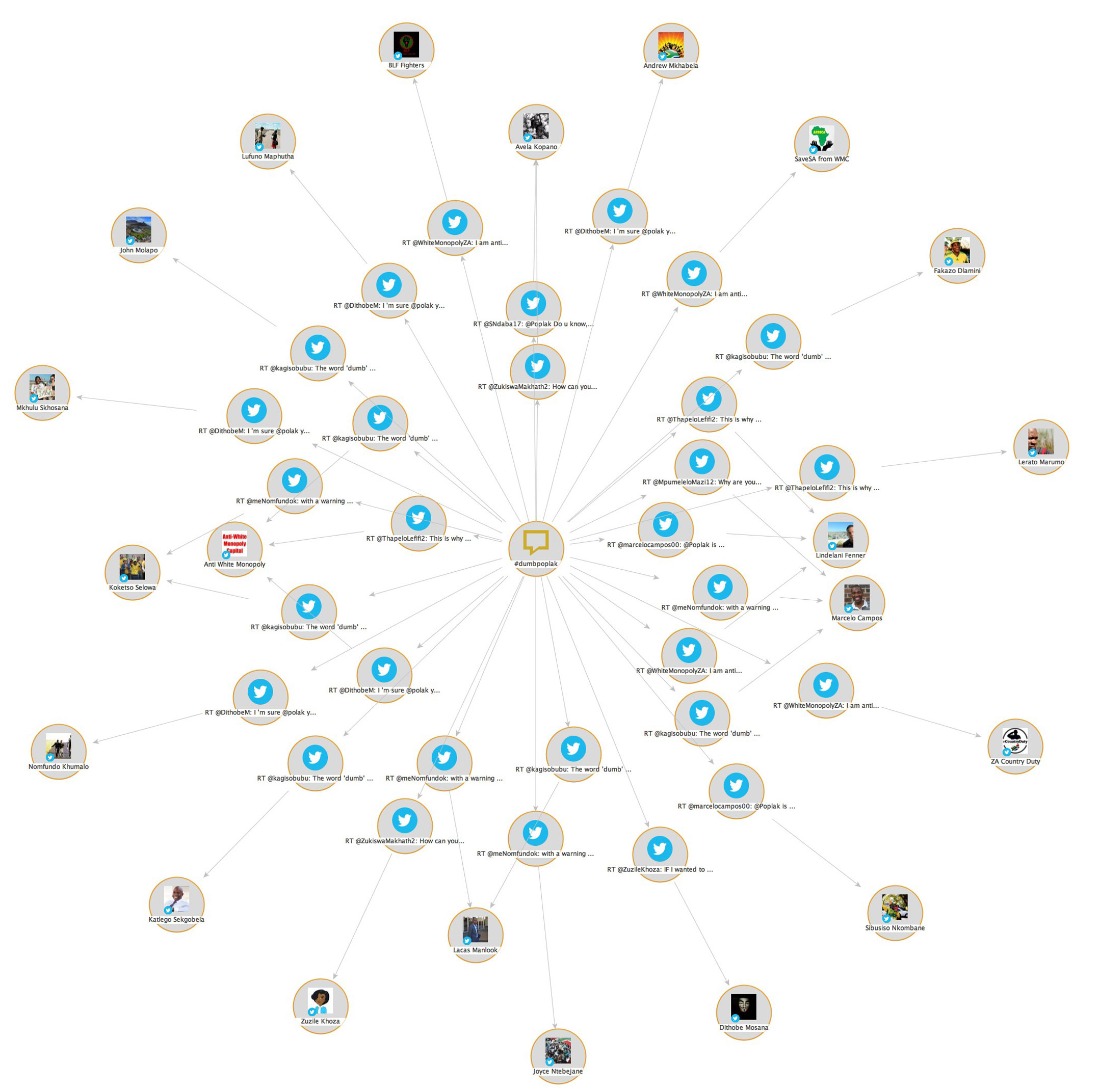
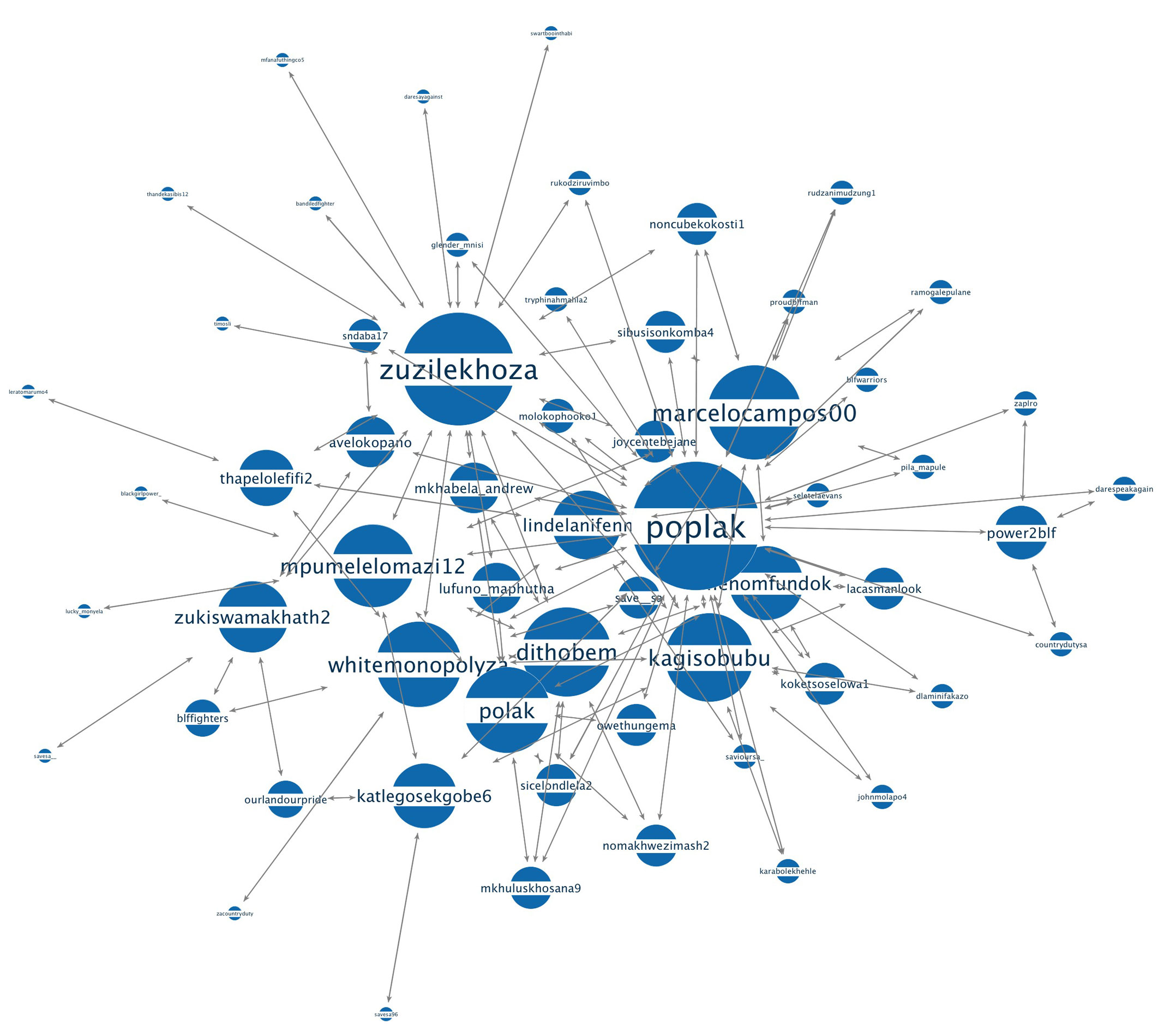
    Figure 2: Map of tweets on 29 August 2017 mentioning “#DumbPoplak”. Created with Paterva Maltego
    Figure 3: Twitter affinity map “#DumbPoplak”. Chart created with Maltego Paterva with data from Netlytic

    The first signs of this Gupta-linked online propaganda were visible in early 2016 when a website and associated social media accounts were set up to tell the “Truth by Connor Mead”. The site was an obvious PR exercise by the Guptas — Connor Mead seemingly does not exist, and the content of the site, right down to the headline, was used as a double-page advert in The New Age newspaper (at that stage owned by the Guptas). The setting up of this site coincided with the appointment of Bell Pottinger as spin doctors for the Gupta empire. A small number of sockpuppet accounts tried to drive the website narrative but largely unsuccessfully. It has since been shuttered, although the Twitter account, @kjbjohn832, is still open, but dormant since September 2016.

    Real growth of activity of the social media fake troll network was first identified in November 2016

    Real growth of activity of the social media fake troll network was first identified in November 2016, the key theme seeming to be that former public protector Thuli Madonsela’s “State of Capture” report was incorrect and biased. Jean le Roux, an analyst, identified around 100 accounts that were tweeting around this certain theme. He then demonstrated that many of the accounts were automated (tweeting identical content within seconds of each other) and identified certain “control” or seeding accounts that were supplying the content for retweets. The “white monopoly capital” theme is visible in the tweets.

    Another social media researcher had been seeing similar activity, and before the community was identified as fake, Superlinear’s Kyle Findlay had highlighted a strange convergence between tweets from Andile Mngxitama’s Black First Land First (BLF) community and those of The New Age and ANN7 media companies. Kyle was also the first to identify the white monopoly capital theme and to attempt to map its usage. Independently, two researchers had isolated a similar phenomenon — what appeared to be a botnet of pro-Zuma, pro-Gupta fake accounts driving a narrative that Pravin Gordhan, Thuli Madonsela and Mcebisi Jonas were stooges of “white monopoly capital”, most particularly of Johann Rupert.

    The first quarter of 2017 continued in the same vein, but after the cabinet reshuffle in March, a new battery of fake news sites, along with a new army of fake accounts began an assault. The WMCleaks.com and WMCScan.com websites were created to provide content for a huge number of Twitter sockpuppets.

    Figure 4: Screenshot of TweetDeck showing several sockpuppet accounts tweeting content from WMCLeaks

    At the same time, similar activity was attempted on Facebook, but with nowhere near the same reach. Creating fake Facebook accounts, while not impossible, is significantly more complex than on Twitter and this can be seen by the minimal sharing and traction these Facebook accounts generate. Most of the engagement on Facebook took the form of negative comments by real South Africans — probably not what was planned.

    There do seem to be two major nodes of these fake accounts. The WMCLeaks node is huge and likely based out of India. The few accounts that actually type content in their tweets tend to use a style of English that is foreign to South Africans. There are unusual grammatical errors and these accounts never tweet in anything but English, even if engaged in other South African languages.

    The other is older and likely controlled from within South Africa and by South Africans (Kyle Findlay identifies this as the “BLF node”). These fake accounts tend to retweet anything that comes from local BLF spokespeople or leaders and local blogs like blackopinion.co.za, as well as distributing defamatory memes. Recently, this node has begun to retweet content from Nkosazana Dlamini-Zuma’s Twitter feed. Due to the type of content distributed by real BLF supporters, it is more difficult to differentiate the fake accounts from real supporters.
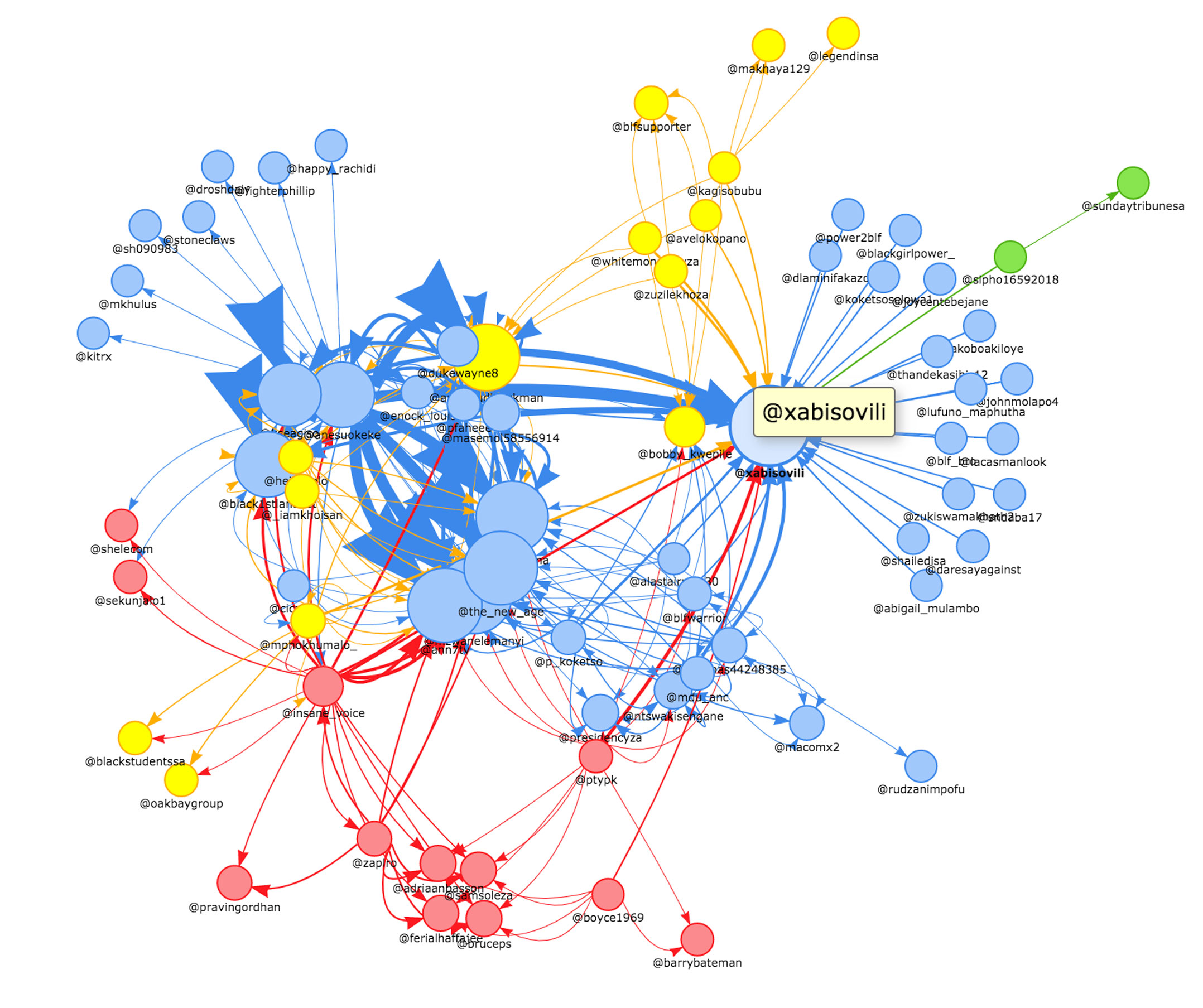
    Figure 5: Mapping of tweets relating to a suspected local master account (@XabisoVili). Blue areas relate to activity by local sockpuppets, yellow by suspected foreign accounts. Red areas indicate tagging of local journalists and targets

    There is crossover in content between the two networks, with both appropriating content from the other, and it does seem that they have similar motives, if they are, in fact, not part of the same organisation.

    Figure 5 is a messy map of the various tweet connections by what is suspected to be a local master account, @XabisoVili. Much of the content is distributed by a group of sockpuppets (blue, upper left, and upper right), but there is significant tagging and retweeting of content from Mzwanele Manyi, Andile Mngxitama, ANN7 and The New Age Twitter accounts. The yellow portion is suspected Indian-controlled activity with some recurring master accounts, @makhaya129, @ZuzileKhosa and @avelokopano. Included in both groups is a small number of real accounts that interacted with the sockpuppets. The red portion of the map mostly consists of accounts that have been targeted by the fake accounts.

    This kind of mass propaganda work is used in countries like China to overwhelm the discussion space, a way to obfuscate the conversation. But in South Africa, this isn’t really happening

    The motive for this activity isn’t completely clear and we can only judge it by the activities. There does seem to be a clear group of targets of these Guptabots: anyone opposed to the Zuma cabal in the ANC, along with anyone highlighting the activities of the Gupta family or their associates. This extends to attacking critics of Eskom, Brian Molefe, Hlaudi Motsoeneng and Manyi. There is high praise from the fake accounts for people like Mngxitama and mineral resources minister Mosebenzi Zwane, not to mention presidential hopeful Nkosozana Dlamini-Zuma.

    What the accounts intend to achieve is less clear. This kind of mass propaganda work is used in countries like China to overwhelm the discussion space, a way to obfuscate the conversation. But in South Africa, this isn’t really happening; the size and competence of the network doesn’t allow for that. This network is using minimal automation, only using tools like TweetDeck to auto-retweet content (and that, mostly, is to an echo chamber of sockpuppets). Possibly the idea is to use mass retweeting to get hashtags to trend, but if that is the plan, they have been largely unsuccessful.

    Often, we see that tweeted images are tagged with the names of the targeted people (for example, prominent investigative journalists or prominent politicians) to spam their timelines, but that is easily thwarted by adjusting Twitter’s settings. Likewise, direct tagging of Twitter handles in posts is thwarted by simply blocking (or better, muting) the accounts.

    Doomed to fail

    If the aim is to show that some kind of mass popular movement exists, it is doomed to fail. The network is simply too unsophisticated for that. Most of the fakes are so easily identified that they have no credibility. If anything, lately, they have become a target of derision. But there doesn’t seem to be any reduction in activity, so there may well be an objective that isn’t apparent.

    One final point that must be noted is that Twitter’s abuse controls are woefully inadequate. Many, if not most, of these accounts are easily identified as fake by simple metrics like the time that the accounts were created, multiple accounts using identical mobile numbers or email addresses for registration, the kind of content that they post, the fake profile images, the rapid retweeting by multiple accounts of identical content. Many of these can be automatically identified, and, if Twitter had the will to shut down fake accounts, I’m sure that they would be. But Twitter seems less than willing to institute these kinds of measures.  — (c) 2017 NewsCentral Media

    • Andrew Fraser is an independent marketing consultant

    Follow TechCentral on Google News Add TechCentral as your preferred source on Google


    Andrew Fraser ANN7 Duduzane Zuma Facebook Guptabots Mzwanele Manyi Richard Poplak The New Age top Twitter
    WhatsApp YouTube
    Share. Facebook Twitter LinkedIn WhatsApp Telegram Email Copy Link
    Previous ArticleInterview: Michael Jordaan, CEO, Montegray Capital
    Next Article In digital era, companies must adapt or die

    Related Posts

    X moves to block bid to revive Twitter brand

    X moves to block bid to revive Twitter brand

    17 December 2025
    Australia has banned kids from social media. Should South Africa follow suit?

    Australia has banned kids from social media. Should South Africa follow suit?

    11 December 2025
    Australia fires starting gun on global social media reform

    Australia fires starting gun on global social media reform

    10 December 2025
    Company News
    AnyDesk - high-performance remote access built for the modern enterprise

    AnyDesk – high-performance remote access built for the modern enterprise

    23 March 2026

    How South African executives can crack the AI ROI code

    20 March 2026
    Africa's first Nvidia RTX Pro GPU servers have landed

    Africa’s first Nvidia RTX Pro GPU servers have landed

    19 March 2026
    Opinion
    South Africa's energy future hinges on getting wheeling right - Aishah Gire

    South Africa’s energy future hinges on getting wheeling right

    10 March 2026
    Hold the doom: the case for a South African comeback - Duncan McLeod

    Apple just dropped a bomb on the Windows world

    5 March 2026
    VC's centre of gravity is shifting - and South Africa is in the frame - Alison Collier

    VC’s centre of gravity is shifting – and South Africa is in the frame

    3 March 2026

    Subscribe to Updates

    Get the best South African technology news and analysis delivered to your e-mail inbox every morning.

    Latest Posts
    The Post Office is out of options - Anoosh Rooplal

    The Post Office is out of options

    24 March 2026
    Namibia rejects Starlink

    Namibia rejects Starlink

    24 March 2026
    Optasia wants to do for banks what it did for telcos - Salvador Anglada

    Optasia wants to do for banks what it did for telcos

    24 March 2026
    Sanlam appoints group chief AI officer - Theo Mabaso

    Sanlam appoints group chief AI officer

    24 March 2026
    © 2009 - 2026 NewsCentral Media
    • Cookie policy (ZA)
    • TechCentral – privacy and Popia

    Type above and press Enter to search. Press Esc to cancel.

    Manage consent

    TechCentral uses cookies to enhance its offerings. Consenting to these technologies allows us to serve you better. Not consenting or withdrawing consent may adversely affect certain features and functions of the website.

    Functional Always active
    The technical storage or access is strictly necessary for the legitimate purpose of enabling the use of a specific service explicitly requested by the subscriber or user, or for the sole purpose of carrying out the transmission of a communication over an electronic communications network.
    Preferences
    The technical storage or access is necessary for the legitimate purpose of storing preferences that are not requested by the subscriber or user.
    Statistics
    The technical storage or access that is used exclusively for statistical purposes. The technical storage or access that is used exclusively for anonymous statistical purposes. Without a subpoena, voluntary compliance on the part of your Internet Service Provider, or additional records from a third party, information stored or retrieved for this purpose alone cannot usually be used to identify you.
    Marketing
    The technical storage or access is required to create user profiles to send advertising, or to track the user on a website or across several websites for similar marketing purposes.
    • Manage options
    • Manage services
    • Manage {vendor_count} vendors
    • Read more about these purposes
    View preferences
    • {title}
    • {title}
    • {title}