Close Menu
TechCentralTechCentral

    Subscribe to the newsletter

    Get the best South African technology news and analysis delivered to your e-mail inbox every morning.

    Facebook X (Twitter) YouTube LinkedIn
    WhatsApp Facebook X (Twitter) LinkedIn YouTube
    TechCentralTechCentral
    • News
      MultiChoice scraps annual DStv price hikes for 2026 - David Mignot

      MultiChoice scraps annual DStv price hike

      20 February 2026
      What Gen Z really thinks about the tech world it inherited - Tinashe Mazodze

      What Gen Z really thinks about the tech world it inherited

      20 February 2026
      Showmax 'can't continue' in its current form

      Showmax ‘can’t continue’ in its current form

      20 February 2026
      Free Market Foundation slams treasury's proposed gambling tax

      Free Market Foundation slams treasury’s proposed gambling tax

      20 February 2026
      South Africa's dynamic spectrum breakthrough - Paul Colmer

      South Africa’s dynamic spectrum breakthrough

      20 February 2026
    • World
      Prominent Southern African journalist targeted with Predator spyware

      Prominent Southern African journalist targeted with Predator spyware

      18 February 2026
      More drama in Warner Bros tug of war

      More drama in Warner Bros tug of war

      17 February 2026
      Russia bans WhatsApp

      Russia bans WhatsApp

      12 February 2026
      EU regulators take aim at WhatsApp

      EU regulators take aim at WhatsApp

      9 February 2026
      Musk hits brakes on Mars mission

      Musk hits brakes on Mars mission

      9 February 2026
    • In-depth
      How liberalisation is rewiring South Africa's power sector

      How liberalisation is rewiring South Africa’s power sector

      21 January 2026
      The top-performing South African tech shares of 2025

      The top-performing South African tech shares of 2025

      12 January 2026
      Digital authoritarianism grows as African states normalise internet blackouts

      Digital authoritarianism grows as African states normalise internet blackouts

      19 December 2025
      TechCentral's South African Newsmakers of 2025

      TechCentral’s South African Newsmakers of 2025

      18 December 2025
      Black Friday goes digital in South Africa as online spending surges to record high

      Black Friday goes digital in South Africa as online spending surges to record high

      4 December 2025
    • TCS
      Watts & Wheels S1E4: 'We drive an electric Uber'

      Watts & Wheels S1E4: ‘We drive an electric Uber’

      10 February 2026
      TCS+ | How Cloud On Demand is helping SA businesses succeed in the cloud - Xhenia Rhode, Dion Kalicharan

      TCS+ | Cloud On Demand and Consnet: inside a real-world AWS partner success story

      30 January 2026
      Watts & Wheels S1E4: 'We drive an electric Uber'

      Watts & Wheels S1E3: ‘BYD’s Corolla Cross challenger’

      30 January 2026
      Watts & Wheels S1E4: 'We drive an electric Uber'

      Watts & Wheels S1E2: ‘China attacks, BMW digs in, Toyota’s sublime supercar’

      23 January 2026

      TCS+ | Why cybersecurity is becoming a competitive advantage for SA businesses

      20 January 2026
    • Opinion
      A million reasons monopolies don't work - Duncan McLeod

      A million reasons monopolies don’t work

      10 February 2026
      The author, Business Leadership South Africa CEO Busi Mavuso

      Eskom unbundling U-turn threatens to undo hard-won electricity gains

      9 February 2026
      South Africa's skills advantage is being overlooked at home - Richard Firth

      South Africa’s skills advantage is being overlooked at home

      29 January 2026
      Why Elon Musk's Starlink is a 'hard no' for me - Songezo Zibi

      Why Elon Musk’s Starlink is a ‘hard no’ for me

      26 January 2026
      A million reasons monopolies don't work - Duncan McLeod

      South Africa’s new fibre broadband battle

      20 January 2026
    • Company Hubs
      • Africa Data Centres
      • AfriGIS
      • Altron Digital Business
      • Altron Document Solutions
      • Altron Group
      • Arctic Wolf
      • AvertITD
      • Braintree
      • CallMiner
      • CambriLearn
      • CYBER1 Solutions
      • Digicloud Africa
      • Digimune
      • Domains.co.za
      • ESET
      • Euphoria Telecom
      • Incredible Business
      • iONLINE
      • IQbusiness
      • Iris Network Systems
      • LSD Open
      • Mitel
      • NEC XON
      • Netstar
      • Network Platforms
      • Next DLP
      • Ovations
      • Paracon
      • Paratus
      • Q-KON
      • SevenC
      • SkyWire
      • Solid8 Technologies
      • Telit Cinterion
      • Tenable
      • Vertiv
      • Videri Digital
      • Vodacom Business
      • Wipro
      • Workday
      • XLink
    • Sections
      • AI and machine learning
      • Banking
      • Broadcasting and Media
      • Cloud services
      • Contact centres and CX
      • Cryptocurrencies
      • Education and skills
      • Electronics and hardware
      • Energy and sustainability
      • Enterprise software
      • Financial services
      • Information security
      • Internet and connectivity
      • Internet of Things
      • Investment
      • IT services
      • Lifestyle
      • Motoring
      • Public sector
      • Retail and e-commerce
      • Satellite communications
      • Science
      • SMEs and start-ups
      • Social media
      • Talent and leadership
      • Telecoms
    • Events
    • Advertise
    TechCentralTechCentral
    Home » Sections » Science » Hidden South African observatory quietly shapes our view of space
    Hidden South African observatory quietly shapes our view of space - HartRAO
    Image: HartRAO

    Hidden South African observatory quietly shapes our view of space

    By Nkosinathi Ndlovu25 October 2024

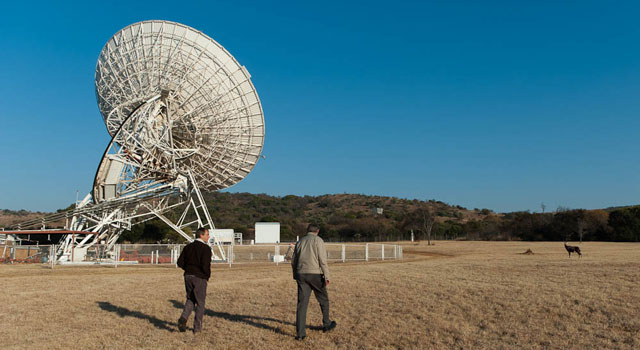
    Nestled in a natural bowl surrounded by hills 50km north-west of Johannesburg, the Hartebeesthoek Radio Astronomy Observatory (HartRAO), with its collection of radio dishes, looks quite out of place.

    The road that snakes towards the observatory’s security entrance seems to conspire with the surrounding hillsides to hide the facility below, obscuring the site in an invisible layer of insignificance – except for the dishes that give away that something technologically advanced is taking place in this unlikely corner of the country.

    The work that happens at HartRAO — which is a facility of the South African Radio Astronomy Observatory — is critical, however: the site plays a big role in ensuring the navigation systems used by people all over the world are accurate and reliable, while also contributing to advancing our understanding of the universe.

    Geodesy is about finding the shortest distance between two points in n-dimensional spacetime

    It was during a recent tour of HartRAO that TechCentral learnt that Johannesburg “bobs up and down” by around 30cm each day (along with the rest of the planet at between 20cm and 40cm). These “solid earth tides”, which cause the Earth’s mantle to ebb and flow like oceanic tides, are due to the gravitational forces exerted on the planet by the moon and sun.

    Since this changes the position of a point on Earth’s surface, albeit only slightly in the grand scheme things, it has a significant impact on the accuracy of systems like GPS.

    This is the explanation from Roelf Botha, manager of the space geodesy project at HartRAO. “Geodesy is about finding the shortest distance between two points in n-dimensional spacetime,” Botha said in an interview at the facility.

    ‘Fundamental sites’

    “As a modern society, the ability to navigate underpins everything. For that, position is very important, because if you know where you are and you know where you want to be, then a system like Google Maps … can figure out a route that tells you which way to go.”

    HartRAO is unusual in that it is one of only seven such stations in the world known as “fundamental sites”. These are locations where all four of the major space-geodetic techniques are collocated.

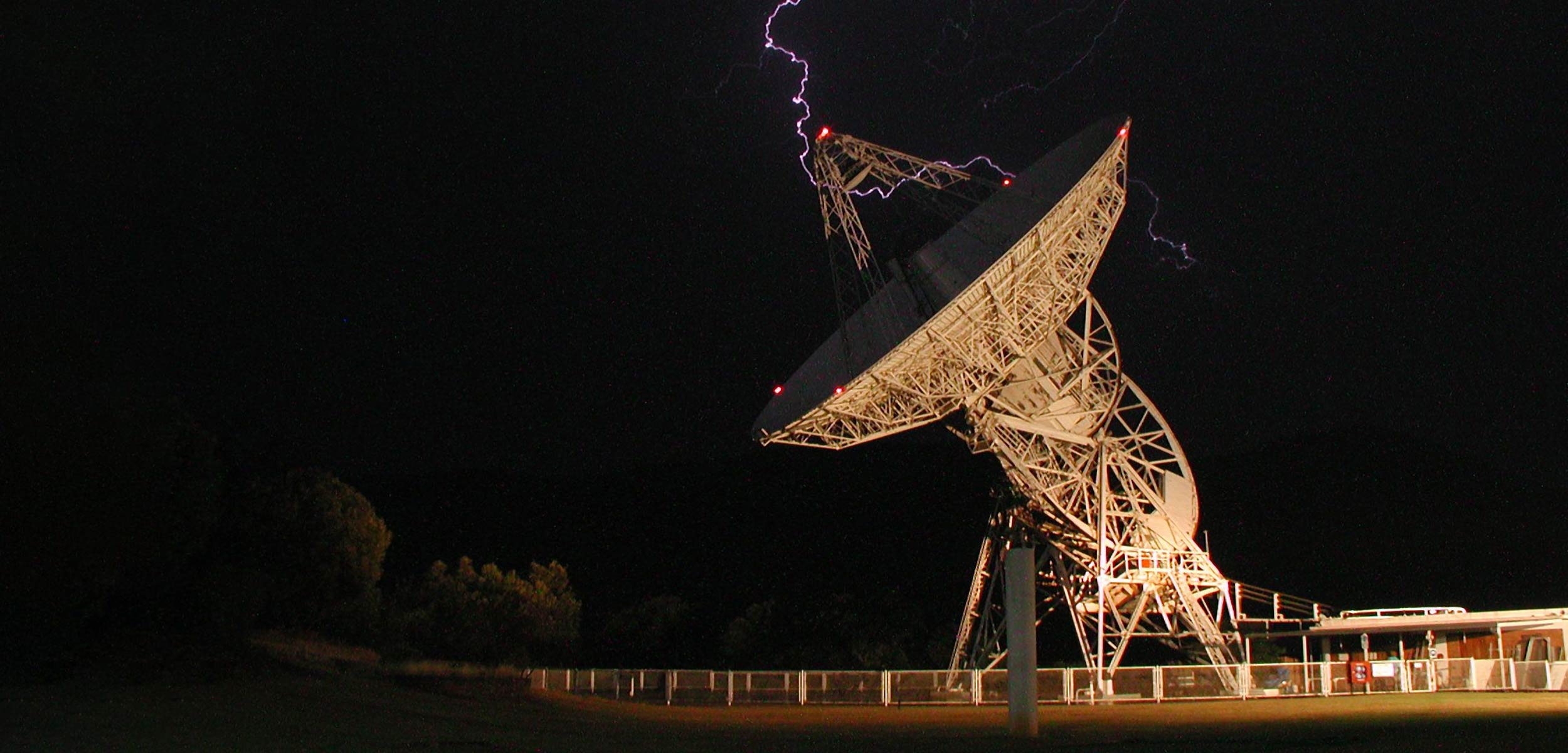
    The first of these techniques is very long baseline interferometry (VLBI), which uses a giant, 26m-wide radio telescope at HartRAO. Built in the 1960s, it was the first structure erected at the site by Nasa. VLBI is used to determine Earth’s position in space and the site’s position on the planet. This position is the reference then used in other geodetic techniques.

    Read: Eastern Cape meteorite likely a rare achondrite

    One of the uses of VLBI data is to determine the exact position of objects like satellites in orbit as well as their velocity, helping navigation systems like GPS improve their accuracy.

    The second geodetic technique used at HartRAO involves the Global Navigation Satellite System (GNSS), a federation of different position system satellite constellations which includes the US’s Global Positioning System (GPS), Russia’s Global Navigation Satellite System (Glonass), the EU’s Galileo and China’s BeiDou. Receivers for the various kinds of navigation systems are spread out across the HartRAO site and used to calibrate the positioning products they provide.

    The third geodetic technique used at HartRAO is satellite laser ranging (SLR), which uses the round-trip time of laser beams from the site to reflective prisms on orbiting satellites to determine their exact location relative to the Earth. The data is also used to improve the accuracy of satellite tracking systems. The Moblas 6 station, used to emit satellite tracking laser beams from HartRAO to satellites in orbit, has been in use there since November 2000.

    The fourth geodetic technique used is Doppler Orbitography and Radiopositioning Integrated by Satellite (Doris), which uses changes in frequency due to the relative motion of instruments on Earth and satellites in space to help satellites determine their positions accurately.

    Urbanisation

    Marion West, radio astronomy researcher at HartRAO, who took TechCentral on a tour of the facility, said Nasa – which originally built the facility in 1961 – chose the location because it is far from any city and shielded from radio interference by the terrain around it. The growing rate of urbanisation over the years has, however, meant that the site is subject to more interference from cellphones, radios and TVs today than it was historically.
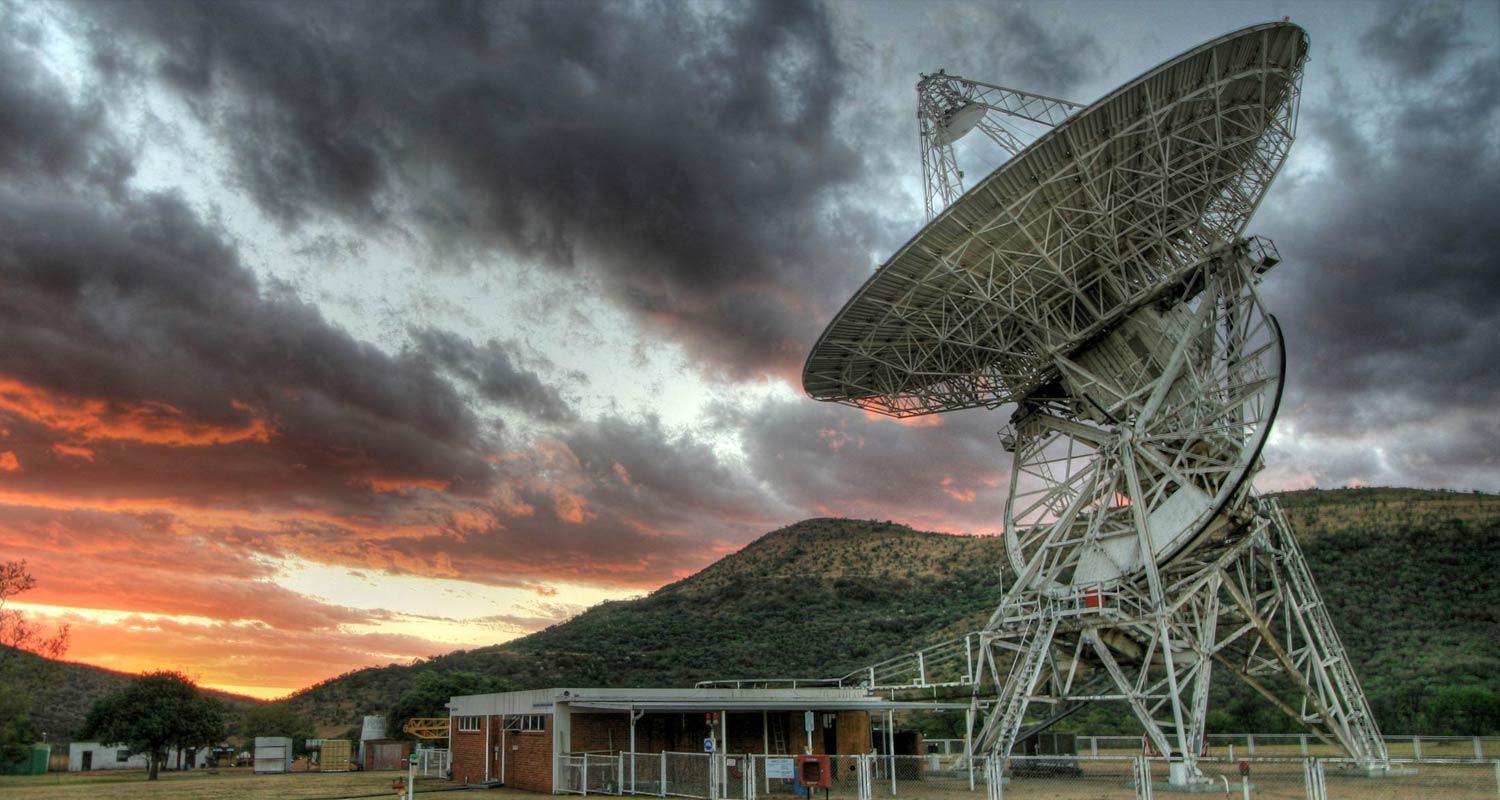
    HartRAO main dish at sunset
    Image: HartRAO

    HartRAO was a critical site for many of Nasa’s unmanned lunar missions, including Ranger, Surveyor and Lunar Orbiter. Nasa handed the site over to the Council for Scientific and Industrial Research (CSIR) in 1975, when it was converted into a radio astronomy facility. In 1991 the site was put under the auspices of the Foundation for Research and Development, which was amalgamated into the National Research Foundation in 1998.

    Employees at HartRAO conduct regular outreach work in conjunction with the department of education, producing explainer charts about various space-related concepts used in classrooms across the country.

    Read: A new generation of telescopes could transform our knowledge of the universe

    The facility also serves as a practical training ground for students of astronomy, physics and applied mathematics from Rhodes University, North-West University, the University of the Western Cape, the University of Cape Town and Unisa. Prior to the Covid-19 pandemic, school tours were facilitated on the premises, and according to West, these should resume soon.

    “Our work here has helped discover some amazing things. The African continent, for example, is moving at about 2cm/year towards India. Places like Hawaii and Tasmania are moving at a rate of 10cm/year. And collaboration with international peers helped produce the most detailed picture of our Milky Way galaxy at a frequency of 2.3GHz, at that time – from this site,” said West.  – © 2024 NewsCentral Media

    Get breaking news from TechCentral on WhatsApp. Sign up here
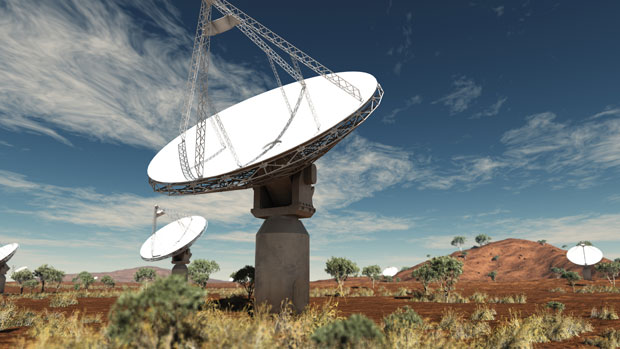
    Don’t miss:

    Watch | SpaceX catches giant Starship booster

    Follow TechCentral on Google News Add TechCentral as your preferred source on Google


    Hartebeesthoek Radio Astronomy Observatory HartRAO Marion West Roelf Botha
    WhatsApp YouTube
    Share. Facebook Twitter LinkedIn WhatsApp Telegram Email Copy Link
    Previous ArticleExperts disagree on AI regulation in South Africa
    Next Article Google to develop AI that ‘takes over PCs’

    Related Posts

    SKA: bringing astronomy to Africa

    21 August 2013

    SA pools astronomy data

    2 August 2013

    HartRAO: 50 years of scanning the skies

    21 July 2011
    Company News
    Service is everyone's problem now - and that's exactly why the Atlassian Service Collection matters

    Service is everyone’s problem now – why the Atlassian Service Collection matters

    20 February 2026
    Customers have new expectations. Is your CX ready? 1Stream

    Customers have new expectations. Is your CX ready?

    19 February 2026
    South Africa's cybersecurity challenge is not a tool problem - Nicholas Applewhite, Trinexia South Africa

    South Africa’s cybersecurity challenge is not a tool problem

    19 February 2026
    Opinion
    A million reasons monopolies don't work - Duncan McLeod

    A million reasons monopolies don’t work

    10 February 2026
    The author, Business Leadership South Africa CEO Busi Mavuso

    Eskom unbundling U-turn threatens to undo hard-won electricity gains

    9 February 2026
    South Africa's skills advantage is being overlooked at home - Richard Firth

    South Africa’s skills advantage is being overlooked at home

    29 January 2026

    Subscribe to Updates

    Get the best South African technology news and analysis delivered to your e-mail inbox every morning.

    Latest Posts
    MultiChoice scraps annual DStv price hikes for 2026 - David Mignot

    MultiChoice scraps annual DStv price hike

    20 February 2026
    What Gen Z really thinks about the tech world it inherited - Tinashe Mazodze

    What Gen Z really thinks about the tech world it inherited

    20 February 2026
    Showmax 'can't continue' in its current form

    Showmax ‘can’t continue’ in its current form

    20 February 2026
    Free Market Foundation slams treasury's proposed gambling tax

    Free Market Foundation slams treasury’s proposed gambling tax

    20 February 2026
    © 2009 - 2026 NewsCentral Media
    • Cookie policy (ZA)
    • TechCentral – privacy and Popia

    Type above and press Enter to search. Press Esc to cancel.

    Manage consent

    TechCentral uses cookies to enhance its offerings. Consenting to these technologies allows us to serve you better. Not consenting or withdrawing consent may adversely affect certain features and functions of the website.

    Functional Always active
    The technical storage or access is strictly necessary for the legitimate purpose of enabling the use of a specific service explicitly requested by the subscriber or user, or for the sole purpose of carrying out the transmission of a communication over an electronic communications network.
    Preferences
    The technical storage or access is necessary for the legitimate purpose of storing preferences that are not requested by the subscriber or user.
    Statistics
    The technical storage or access that is used exclusively for statistical purposes. The technical storage or access that is used exclusively for anonymous statistical purposes. Without a subpoena, voluntary compliance on the part of your Internet Service Provider, or additional records from a third party, information stored or retrieved for this purpose alone cannot usually be used to identify you.
    Marketing
    The technical storage or access is required to create user profiles to send advertising, or to track the user on a website or across several websites for similar marketing purposes.
    • Manage options
    • Manage services
    • Manage {vendor_count} vendors
    • Read more about these purposes
    View preferences
    • {title}
    • {title}
    • {title}