Inside a low-rise building in a business park at Rock Hill, South Carolina, is a vision of the factory of the future. Several dozen machines are humming away, monitored from a glass-fronted control room by two people looking at computer screens. Some of the machines are the size of a car, others that of a microwave oven, but they all have windows that you can peer into. One is making jewellery, others are producing the plastic grip for an electric drill, the dashboard of a car, an intricate lampshade and a bespoke artificial leg. One is even making parts to build more machines like itself.
This is the headquarters of 3D Systems, a firm founded by Chuck Hull, who in a 1986 patent described a system he had invented for making three-dimensional objects as “stereolithography”. It worked by using a beam of ultraviolet light to solidify a thin layer of liquid plastic, a bit like ink, and repeating the process by adding more liquid plastic. Other forms of 3D printing have since emerged, but they all work as an additive process, building objects up layer by layer.
3D printing was originally conceived as a way to make one-off prototypes, but as the technology is getting better more things are being printed as finished goods (a process known as additive manufacturing). Currently around 28% of the money spent on printing things is for final products, according to Terry Wohlers, who runs a research firm specialising in the field. He predicts that this will rise to just over 50% by 2016 and to more than 80% by 2020. But it will never reach 100%, he thinks, because the ability to make prototypes quickly and cheaply will remain an important part of the mix.
One of a kind
One-off prototypes can be hideously expensive to produce, but a 3D printer can bring down the cost by a huge margin. Lots of consumer goods, mechanical parts, shoes and architects’ models now appear in a 3D-printed form for appraisal by engineers, stylists and clients before getting the go-ahead. Any changes can be swiftly reprinted in a few hours or overnight, whereas waiting for a new prototype to emerge from a machine shop could take weeks. Some designers are already printing ready-to-wear shoes and dresses from plastic and nylon materials. Iris van Herpen, a Dutch fashion designer, has produced striking 3D-printed collections for the catwalks. No one can yet print leather, but they are working on it.
As there are barely any economies of scale in additive manufacturing, the technology is ideally suited to low-volume production. It also allows the mass customisation of finished parts. Millions of dental crowns and shells for hearing aids are already being made individually with 3D printers.
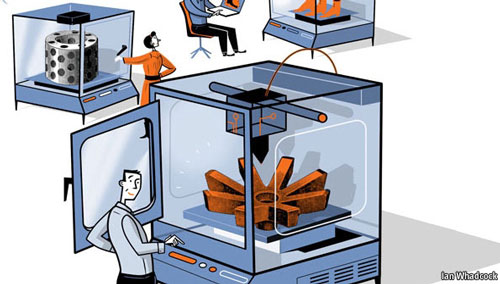
Freed of the constraints of traditional factories, additive manufacturing allows designers to produce things that were previously considered far too complex to make economically. That could be for aesthetic reasons, but engineers are finding practical applications, too. For example, fluids flow more efficiently through rounded channels than they do around sharp corners, but it is very difficult to make such channels inside a solid metal structure by conventional means, whereas a 3D printer can do this easily.
3T RPD, a British firm that offers additive-manufacturing services, printed a gearbox for a racing car with smooth internal pathways for hydraulic oil instead of drilled-out right-angle bends. The box not only allows faster gear changes but is some 30% lighter, says Ian Halliday, the firm’s CEO. A Boeing F-18 fighter contains a number of printed parts such as air ducts, for similar reasons.
Weight savings are part of the attraction of 3D-printed parts. With objects being built up layer by layer, it is possible to use just enough material to make the part work. Building things in a traditional factory requires adding flanges and brackets so that objects can be handled, milled and moulded by machine tools, and to provide surfaces for the parts to be bolted or welded together. A 3D printer is likely to print the item as a complete part that requires no assembly. It can even make mechanical objects with moving parts in one go.
This promises big savings in material costs. In the aerospace industry, metal parts are often machined from a solid billet of costly high-grade titanium. This can mean that 90% of the material is cut away, and the swarf is of no use for making aircraft. However, titanium powder can be used to print things like a bracket for an aircraft door or part of a satellite. These can be as strong as a machined part but use only 10% of the raw material, according to researchers at EADS, the European aerospace consortium which is the parent of Airbus.
The ability to produce highly complex designs with powerful computer software and turn them into real objects with 3D printing is creating a new design language. 3D-printed items often have an organic, natural look. “Nature has come up with some very efficient designs, and often it is a good idea to mimic them,” says Wim Michiels, vice-president of Materialise, a Belgian firm that uses additive manufacturing to make a range of products, including medical devices. By incorporating the fine, lattice-like internal structure of natural bone into a metal implant, for instance, it can be made lighter than a machined one without any loss of strength, integrate more easily with the patient’s own bones and can be crafted precisely to fit the intended patient. Last year, surgeons in the Netherlands printed a new titanium jaw for a woman suffering from a chronic bone infection.
Many companies are now wondering about the effect that additive manufacturing will have on their business. Some are taking the technology very seriously; GE, for one, is exploring how it might use 3D printing in all its operations. It already has one product in the pipeline, in the form of a small ultrasound scanner. Such scanners are used by doctors to produce an image of features inside the body, such as unborn babies. The size, weight and cost of the imaging consoles has shrunk, but the transducer probe which is placed on the body has remained largely unchanged and is now the most costly part of the system. The probe transmits pulses of high-frequency sound and receives signals back, using the reflections to produce images. It contains tiny piezoelectric structures that are made by painstakingly micro-machining a brittle block of ceramic material.
Now GE has developed an additive system to print the transducer. This will greatly reduce production costs and allow new, inexpensive portable scanners to be developed, not only for medical use but also to inspect critical aerospace and industrial structures for cracks.
 Repeat after me
How far could this technology go? Idelchik, of GE Global Research, has his sights set high: “One day we will print an engine.” But a number of manufacturers, such as GE and Rolls-Royce, believe that some form of hybrid printing system will emerge. This would produce the outline of a shape, thus saving on material, which can then be machined for precision.
The Replicator, a robotic rapid-manufacturing system made by Cybaman Technologies, a British firm, already gets close. The size of a large refrigerator, it is capable of both subtractive and additive manufacturing. It uses a laser-based deposition system to build a basic shape which is finished by machining. The Replicator, as befits its name, is also capable of reverse engineering by digitally scanning an object placed inside it to produce the data needed to build an exact replica.
The Replicator is as near as current technology can get to the teleporter of science fiction. It could scan an object in one place and tell another machine on the other side of the world how to build a copy. That means, for instance, that urgently needed spares could be produced in remote places without having to ship anything. Even parts that are no longer available could be replicated, by scanning a broken item, repairing it virtually and then printing a new one. The chances are, though, that digital libraries will appear online for parts and products that are no longer available. Just as the emergence of e-books means books may never go out of print, components could always remain available. Service mechanics could have portable 3D printers in their vans, or hardware stores could offer part-printing services.
3D printers would also be invaluable in remote areas. Deon de Beer of Vaal University of Technology near Johannesburg is working on a project called the Idea 2 Product Lab which uses low-cost 3D printers for training and to spark an interest in design and manufacturing among students. When setting up a similar lab at one of the college’s satellite campuses at Upington, a largely rural area in the Northern Cape, his team found itself short of a particular type of flat spanner. Rather than waiting days for the correct tool to be delivered, it printed one and completed the job.
Instead of a spanner, this could have been a small plastic part, perhaps to fix a piece of equipment in a local hospital or to repair an agricultural machine, says De Beer. He believes 3D printers could “produce a new breed of mechanical engineers”, especially in rural regions.
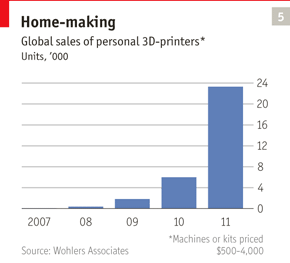
Some people already have 3D printers at home. Industrial 3D-printing systems start at about US$15 000 and go up to more than $1m, says Wohlers. But cheaper desktop machines are creating an entirely new market (see chart). This is made up of hobbyists, do-it-yourself enthusiasts, tinkerers, inventors, researchers and entrepreneurs. Some 3D-printing systems can be built from kits and use open-source software. But big producers of 3D printers are also entering the market.
3D Systems, which produces a variety of prototyping and industrial machines, is now launching a consumer range of small 3D printers, called the Cube, which can make things like toys, chess pieces and ornaments. They have been developed along with an online platform called Cubify to provide services for a community of users. Priced at $1 299, the Cube prints by depositing a thin layer of material from cartridges, which come in different colours. This cures as a hard plastic. They can produce parts up to 5,5 inches (140mm) cubed at a typical cost in materials of about $3,50. The quality is not up to that of industrial printers, but it is good enough for many people. Higher-quality creations can be uploaded to Cubify’s online printing service.
The new range is not just about printing things, says Abe Reichental, 3D Systems’ CEO. It is also about simplifying the process of making products and letting people use the power of the web to share ideas. “This is a personal manufacturing revolution,” he says. — (c) 2012 The Economist