
Close Menu
TechCentralTechCentral

    Subscribe to the newsletter

    Get the best South African technology news and analysis delivered to your e-mail inbox every morning.

    Facebook X (Twitter) YouTube LinkedIn
    WhatsApp Facebook X (Twitter) LinkedIn YouTube
    TechCentralTechCentral
    • News
      Vuyani Jarana: Mobile coverage masks a deeper broadband failure

      Vuyani Jarana: Mobile coverage masks a deeper broadband failure

      30 January 2026
      SABC Plus to flight Microsoft AI training videos

      SABC Plus to flight Microsoft AI training videos

      30 January 2026
      Fibre ducts

      Fibre industry consolidation in KZN

      30 January 2026
      Watts & Wheels S1E3: 'BYD's Corolla Cross challenger'

      Watts & Wheels S1E3: ‘BYD’s Corolla Cross challenger’

      30 January 2026
      What ordinary South Africans really think of AI

      What ordinary South Africans really think of AI

      30 January 2026
    • World
      Apple acquires audio AI start-up Q.ai

      Apple acquires audio AI start-up Q.ai

      30 January 2026
      SpaceX IPO may be largest in history

      SpaceX IPO may be largest in history

      28 January 2026
      Nvidia throws AI at the weather

      Nvidia throws AI at weather forecasting

      27 January 2026
      Debate erupts over value of in-flight Wi-Fi

      Debate erupts over value of in-flight Wi-Fi

      26 January 2026
      Intel takes another hit - Intel CEO Lip-Bu Tan. Laure Andrillon/Reuters

      Intel takes another hit

      23 January 2026
    • In-depth
      How liberalisation is rewiring South Africa's power sector

      How liberalisation is rewiring South Africa’s power sector

      21 January 2026
      The top-performing South African tech shares of 2025

      The top-performing South African tech shares of 2025

      12 January 2026
      Digital authoritarianism grows as African states normalise internet blackouts

      Digital authoritarianism grows as African states normalise internet blackouts

      19 December 2025
      TechCentral's South African Newsmakers of 2025

      TechCentral’s South African Newsmakers of 2025

      18 December 2025
      Black Friday goes digital in South Africa as online spending surges to record high

      Black Friday goes digital in South Africa as online spending surges to record high

      4 December 2025
    • TCS
      TCS+ | How Cloud On Demand is helping SA businesses succeed in the cloud - Xhenia Rhode, Dion Kalicharan

      TCS+ | Cloud On Demand and Consnet: inside a real-world AWS partner success story

      30 January 2026
      Watts & Wheels S1E3: 'BYD's Corolla Cross challenger'

      Watts & Wheels S1E2: ‘China attacks, BMW digs in, Toyota’s sublime supercar’

      23 January 2026

      TCS+ | Why cybersecurity is becoming a competitive advantage for SA businesses

      20 January 2026
      Watts & Wheels S1E3: 'BYD's Corolla Cross challenger'

      Watts & Wheels: S1E1 – ‘William, Prince of Wheels’

      8 January 2026
      TCS+ | Africa's digital transformation - unlocking AI through cloud and culture - Cliff de Wit Accelera Digital Group

      TCS+ | Cloud without culture won’t deliver AI: Accelera’s Cliff de Wit

      12 December 2025
    • Opinion
      South Africa's skills advantage is being overlooked at home - Richard Firth

      South Africa’s skills advantage is being overlooked at home

      29 January 2026
      Why Elon Musk's Starlink is a 'hard no' for me - Songezo Zibi

      Why Elon Musk’s Starlink is a ‘hard no’ for me

      26 January 2026
      South Africa's new fibre broadband battle - Duncan McLeod

      South Africa’s new fibre broadband battle

      20 January 2026
      AI moves from pilots to production in South African companies - Nazia Pillay SAP

      AI moves from pilots to production in South African companies

      20 January 2026
      South Africa's new fibre broadband battle - Duncan McLeod

      ANC’s attack on Solly Malatsi shows how BEE dogma trumps economic reality

      14 December 2025
    • Company Hubs
      • Africa Data Centres
      • AfriGIS
      • Altron Digital Business
      • Altron Document Solutions
      • Altron Group
      • Arctic Wolf
      • AvertITD
      • Braintree
      • CallMiner
      • CambriLearn
      • CYBER1 Solutions
      • Digicloud Africa
      • Digimune
      • Domains.co.za
      • ESET
      • Euphoria Telecom
      • Incredible Business
      • iONLINE
      • IQbusiness
      • Iris Network Systems
      • LSD Open
      • NEC XON
      • Netstar
      • Network Platforms
      • Next DLP
      • Ovations
      • Paracon
      • Paratus
      • Q-KON
      • SevenC
      • SkyWire
      • Solid8 Technologies
      • Telit Cinterion
      • Tenable
      • Vertiv
      • Videri Digital
      • Vodacom Business
      • Wipro
      • Workday
      • XLink
    • Sections
      • AI and machine learning
      • Banking
      • Broadcasting and Media
      • Cloud services
      • Contact centres and CX
      • Cryptocurrencies
      • Education and skills
      • Electronics and hardware
      • Energy and sustainability
      • Enterprise software
      • Financial services
      • Information security
      • Internet and connectivity
      • Internet of Things
      • Investment
      • IT services
      • Lifestyle
      • Motoring
      • Public sector
      • Retail and e-commerce
      • Satellite communications
      • Science
      • SMEs and start-ups
      • Social media
      • Talent and leadership
      • Telecoms
    • Events
    • Advertise
    TechCentralTechCentral
    Home » In-depth » IBM launches commercial quantum computing – we’re not ready for what comes next

    IBM launches commercial quantum computing – we’re not ready for what comes next

    By The Conversation26 January 2019
    Twitter LinkedIn Facebook WhatsApp Email Telegram Copy Link
    News Alerts
    WhatsApp
    IBM’s Q System One

    IBM recently unveiled what it claimed was the world’s first commercial quantum computer. While the announcement of the Q System One wasn’t scientifically ground-breaking, the fact that IBM sees this as a commercial product that organisations (if not individuals) will want to use is an important breakthrough.

    IBM has taken a prototype technology that has existed in the lab for over 20 years and launched it in the real world. In doing so, it marks an important step towards the next generation of computing technology becoming ubiquitous, something the world isn’t yet ready for. In fact, quantum may well prove to be the most disruptive technology of the information age.

    Quantum computers work by exploiting the weird phenomenon described by quantum physics, like the ability of an object to be, in a very real sense, in more than one place at the same time. Doing so enables them to solve problems in seconds that would take the age of the universe to solve on even the most powerful of today’s supercomputers.

    Quantum computers are very easily disrupted by changes in the environment and take a long time to reset

    The one criticism typically laid against quantum technologies is that they are “too expensive”, and will continue to be so even as they become more readily available. This is certainly the case today. IBM isn’t making its quantum computer available to buy but rather to access over the Internet. But this shows the technology is on its way to becoming affordable in the near future.

    Quantum computers are very easily disrupted by changes in the environment and take a long time to reset. So IBM has developed a protective system to keep the Q System One stable enough to perform tasks for commercial customers, which are likely to include large companies, universities and research organisations that want to run complex simulations. As a result, IBM believes it has a commercially viable product, and is putting its money where its mouth is.

    Rapid growth

    History shows us that technologies can experience rapid growth in use and capability once they become viable commercial products. After conventional digital computers became commercially viable, they experienced an exponential explosion referred to commonly as Moore’s Law. Roughly every two years, computers have doubled in power while their size and costs have fallen by half. This “law” is really just a trend that has been made possible, in part, by market forces.

    The IBM announcement does not guarantee that quantum computers will now experience Moore’s Law-style exponential growth of their own. It does, however, make that explosion likelier and sooner.

    In the long run, this means better, more advanced technology overall, for all of us. Quantum measurement devices are more accurate. Quantum imaging devices can produce better pictures. Quantum batteries can charge faster. Quantum cybersecurity offers better protection. And quantum computers can solve problems no classical computer could ever hope to.
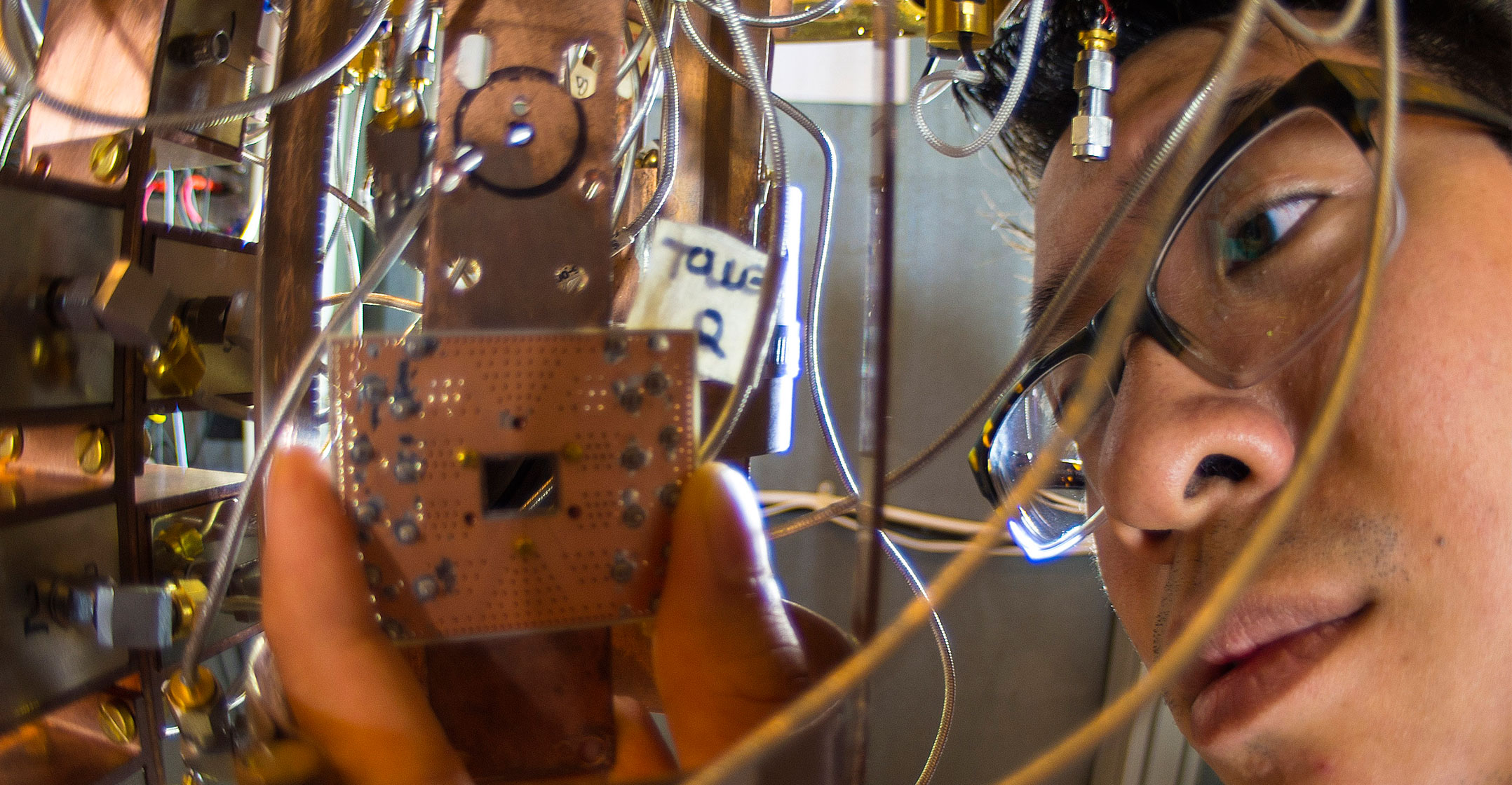
    IBM Research scientist Jerry Chow conducts a quantum computing experiment at IBM’s Thomas J Watson Research Centre

    These are just the tip of the iceberg. In the short to mid-term, however, this also means we have something of an approaching crisis.

    Quantum technologies are disruptive, and more so in cybersecurity than any other field. Once large-scale quantum computers become available (which at the current rate could take another 10 to 15 years), they could be used to access pretty much every secret on the Internet. Online banking, private e-mails, passwords and secure chats would all be opened up. You would be able to impersonate any person or web page online.

    It is quite likely that many tech professionals will see their skills turn obsolete very quickly

    This is because the information locks we use to secure privacy and authentication online are like butter to a quantum computer’s hot knife. Quantum technology is disruptive in many other areas as well. If your business decides not to “go quantum” and your competitor or adversary does, you may well be at a strong disadvantage.

    As the technology landscape realigns itself, it is quite likely that many tech professionals will see their skills turn obsolete very quickly. Simultaneously, companies may find themselves frantic to hire expertise that does not readily exist.

    When geopolitical and market forces realign, it’s common for people in business to say everyone now has to learn a new language. For example, as China has grown in power and influence, it is not uncommon in business communities to hear the phrase “we’ll all have to learn Mandarin now”. Perhaps it’s time for all of us to start learning to speak quantum.The Conversation

    • Written by Carlos Perez-Delgado, lecturer in computing, University of Kent
    • This article is republished from The Conversation under a Creative Commons licence


    Carlos Perez-Delgado IBM top
    WhatsApp YouTube Follow on Google News Add as preferred source on Google
    Share. Facebook Twitter LinkedIn WhatsApp Telegram Email Copy Link
    Previous ArticleWhy Facebook can’t resist integrating WhatsApp
    Next Article Naspers sees single global classifieds strategy after Avito deal

    Related Posts

    The next wave: 10 technologies that will define 2026

    The next wave: 10 technologies that will define 2026

    7 January 2026
    Autonomous AI agents emerge as the next major cybersecurity risk

    Autonomous AI agents emerge as the next major cybersecurity risk

    6 January 2026
    Lou Gerstner, the man who saved IBM, dies at 83

    Lou Gerstner, the man who saved IBM, dies at 83

    29 December 2025
    Company News
    Huawei turns 25 in South Africa, celebrates with major device discounts

    Huawei turns 25 in South Africa, celebrates with major device discounts

    30 January 2026
    Phishing has not disappeared, but it has grown up - KnowBe4

    Phishing has not disappeared, but it has grown up

    30 January 2026
    Smartphone affordability: South Africa's new economic divide - PayJoy

    Smartphone affordability: South Africa’s new economic divide

    29 January 2026
    Opinion
    South Africa's skills advantage is being overlooked at home - Richard Firth

    South Africa’s skills advantage is being overlooked at home

    29 January 2026
    Why Elon Musk's Starlink is a 'hard no' for me - Songezo Zibi

    Why Elon Musk’s Starlink is a ‘hard no’ for me

    26 January 2026
    South Africa's new fibre broadband battle - Duncan McLeod

    South Africa’s new fibre broadband battle

    20 January 2026

    Subscribe to Updates

    Get the best South African technology news and analysis delivered to your e-mail inbox every morning.

    Latest Posts
    Vuyani Jarana: Mobile coverage masks a deeper broadband failure

    Vuyani Jarana: Mobile coverage masks a deeper broadband failure

    30 January 2026
    TCS+ | How Cloud On Demand is helping SA businesses succeed in the cloud - Xhenia Rhode, Dion Kalicharan

    TCS+ | Cloud On Demand and Consnet: inside a real-world AWS partner success story

    30 January 2026
    Huawei turns 25 in South Africa, celebrates with major device discounts

    Huawei turns 25 in South Africa, celebrates with major device discounts

    30 January 2026
    SABC Plus to flight Microsoft AI training videos

    SABC Plus to flight Microsoft AI training videos

    30 January 2026
    © 2009 - 2026 NewsCentral Media
    • Cookie policy (ZA)
    • TechCentral – privacy and Popia

    Type above and press Enter to search. Press Esc to cancel.

    Manage consent

    TechCentral uses cookies to enhance its offerings. Consenting to these technologies allows us to serve you better. Not consenting or withdrawing consent may adversely affect certain features and functions of the website.

    Functional Always active
    The technical storage or access is strictly necessary for the legitimate purpose of enabling the use of a specific service explicitly requested by the subscriber or user, or for the sole purpose of carrying out the transmission of a communication over an electronic communications network.
    Preferences
    The technical storage or access is necessary for the legitimate purpose of storing preferences that are not requested by the subscriber or user.
    Statistics
    The technical storage or access that is used exclusively for statistical purposes. The technical storage or access that is used exclusively for anonymous statistical purposes. Without a subpoena, voluntary compliance on the part of your Internet Service Provider, or additional records from a third party, information stored or retrieved for this purpose alone cannot usually be used to identify you.
    Marketing
    The technical storage or access is required to create user profiles to send advertising, or to track the user on a website or across several websites for similar marketing purposes.
    • Manage options
    • Manage services
    • Manage {vendor_count} vendors
    • Read more about these purposes
    View preferences
    • {title}
    • {title}
    • {title}