
Close Menu
TechCentralTechCentral

    Subscribe to the newsletter

    Get the best South African technology news and analysis delivered to your e-mail inbox every morning.

    Facebook X (Twitter) YouTube LinkedIn
    WhatsApp Facebook X (Twitter) LinkedIn YouTube
    TechCentralTechCentral
    • News
      Netflix, Warner Bros talks raise fresh headaches for MultiChoice

      Netflix, Warner Bros talks raise fresh headaches for MultiChoice

      5 December 2025
      Big Microsoft 365 price increases coming next year

      Big Microsoft price increases coming next year

      5 December 2025
      Vodacom to take control of Safaricom in R36-billion deal - Shameel Joosub

      Vodacom to take control of Safaricom in R36-billion deal

      4 December 2025
      Black Friday goes digital in South Africa as online spending surges to record high

      Black Friday goes digital in South Africa as online spending surges to record high

      4 December 2025
      BYD takes direct aim at Toyota with launch of sub-R500 000 Sealion 5 PHEV

      BYD takes direct aim at Toyota with launch of sub-R500 000 Sealion 5 PHEV

      4 December 2025
    • World
      Amazon and Google launch multi-cloud service for faster connectivity

      Amazon and Google launch multi-cloud service for faster connectivity

      1 December 2025
      Google makes final court plea to stop US breakup

      Google makes final court plea to stop US breakup

      21 November 2025
      Bezos unveils monster rocket: New Glenn 9x4 set to dwarf Saturn V

      Bezos unveils monster rocket: New Glenn 9×4 set to dwarf Saturn V

      21 November 2025
      Tech shares turbocharged by Nvidia's stellar earnings

      Tech shares turbocharged by stellar Nvidia earnings

      20 November 2025
      Config file blamed for Cloudflare meltdown that disrupted the web

      Config file blamed for Cloudflare meltdown that disrupted the web

      19 November 2025
    • In-depth
      Jensen Huang Nvidia

      So, will China really win the AI race?

      14 November 2025
      Valve's Linux console takes aim at Microsoft's gaming empire

      Valve’s Linux console takes aim at Microsoft’s gaming empire

      13 November 2025
      iOCO's extraordinary comeback plan - Rhys Summerton

      iOCO’s extraordinary comeback plan

      28 October 2025
      Why smart glasses keep failing - no, it's not the tech - Mark Zuckerberg

      Why smart glasses keep failing – it’s not the tech

      19 October 2025
      BYD to blanket South Africa with megawatt-scale EV charging network - Stella Li

      BYD to blanket South Africa with megawatt-scale EV charging network

      16 October 2025
    • TCS
      TCS+ | How Cloud on Demand helps partners thrive in the AWS ecosystem - Odwa Ndyaluvane and Xenia Rhode

      TCS+ | How Cloud On Demand helps partners thrive in the AWS ecosystem

      4 December 2025
      TCS | MTN Group CEO Ralph Mupita on competition, AI and the future of mobile

      TCS | Ralph Mupita on competition, AI and the future of mobile

      28 November 2025
      TCS | Dominic Cull on fixing South Africa's ICT policy bottlenecks

      TCS | Dominic Cull on fixing South Africa’s ICT policy bottlenecks

      21 November 2025
      TCS | BMW CEO Peter van Binsbergen on the future of South Africa's automotive industry

      TCS | BMW CEO Peter van Binsbergen on the future of South Africa’s automotive industry

      6 November 2025
      TCS | Why Altron is building an AI factory - Bongani Andy Mabaso

      TCS | Why Altron is building an AI factory in Johannesburg

      28 October 2025
    • Opinion
      Your data, your hardware: the DIY AI revolution is coming - Duncan McLeod

      Your data, your hardware: the DIY AI revolution is coming

      20 November 2025
      Zero Carbon Charge founder Joubert Roux

      The energy revolution South Africa can’t afford to miss

      20 November 2025
      It's time for a new approach to government IT spend in South Africa - Richard Firth

      It’s time for a new approach to government IT spend in South Africa

      19 November 2025
      How South Africa's broken Rica system fuels murder and mayhem - Farhad Khan

      How South Africa’s broken Rica system fuels murder and mayhem

      10 November 2025
      South Africa's AI data centre boom risks overloading a fragile grid - Paul Colmer

      South Africa’s AI data centre boom risks overloading a fragile grid

      30 October 2025
    • Company Hubs
      • Africa Data Centres
      • AfriGIS
      • Altron Digital Business
      • Altron Document Solutions
      • Altron Group
      • Arctic Wolf
      • AvertITD
      • Braintree
      • CallMiner
      • CambriLearn
      • CYBER1 Solutions
      • Digicloud Africa
      • Digimune
      • Domains.co.za
      • ESET
      • Euphoria Telecom
      • Incredible Business
      • iONLINE
      • IQbusiness
      • Iris Network Systems
      • LSD Open
      • NEC XON
      • Netstar
      • Network Platforms
      • Next DLP
      • Ovations
      • Paracon
      • Paratus
      • Q-KON
      • SevenC
      • SkyWire
      • Solid8 Technologies
      • Telit Cinterion
      • Tenable
      • Vertiv
      • Videri Digital
      • Vodacom Business
      • Wipro
      • Workday
      • XLink
    • Sections
      • AI and machine learning
      • Banking
      • Broadcasting and Media
      • Cloud services
      • Contact centres and CX
      • Cryptocurrencies
      • Education and skills
      • Electronics and hardware
      • Energy and sustainability
      • Enterprise software
      • Financial services
      • Information security
      • Internet and connectivity
      • Internet of Things
      • Investment
      • IT services
      • Lifestyle
      • Motoring
      • Public sector
      • Retail and e-commerce
      • Satellite communications
      • Science
      • SMEs and start-ups
      • Social media
      • Talent and leadership
      • Telecoms
    • Events
    • Advertise
    TechCentralTechCentral
    Home » In-depth » LED: lighting up a low-powered world

    LED: lighting up a low-powered world

    By Editor8 March 2012
    Twitter LinkedIn Facebook WhatsApp Email Telegram Copy Link
    News Alerts
    WhatsApp
    Mark Greenhill

    As electricity prices continue soaring, low-powered LED lighting is fast becoming a hot-button topic in SA. But the subject is highly complex. In a second in a series aimed at helping consumers and businesses understand the technology better, TechCentral editor Duncan McLeod sat down with Osram SA technical manager Mark Greenhill and asked him what people should know about LED before making the plunge.

    Like John Westermeyer, regional marketing manager for lighting at Philips SA, to whom TechCentral spoke in February, Greenhill says one of the biggest challenges facing both the industry and consumers is that the local market is being flooded by cheap, low-quality Chinese-made LED lamps that often fail or do not produce the sort of light of traditional solutions like halogen lamps.

    Manufacturers of cheaper LED lamps often don’t adhere to a strict policy of what the industry calls “binning”, where lamps of a particular and quite narrow colour range are supposed to placed in specific bins in the factory. Cheaper solutions often have a much wider colour range, meaning lamps classified as having the same colour temperature often produce widely varying light. Quality manufacturers, on the other hand, are careful to “bin” their products within narrower ranges, meaning less colour shift between lamps and consistent temperature.

    “The closer the binning, the better the consistency of light or light colour,” Greenhill explains, adding that cheaper products are also not good at dissipating heat. These cheaper options tend to use “inferior heat-sink materials leading to premature failures, even though the light might look fantastic initially”.

    In an effort to deal with the flood of inferior lamps entering SA, Greenhill says the big industry players are working together to produce a standard for LED lighting. “We need to do this to regulate the quality of the products that come into the country,” he says. “We will do this through a process called ‘letters of authority’, where a specification is put in place and if your lamp meets that specification then you can apply to a national regulatory committee to get a letter of authority to sell the product in SA.”

    Those letters will be held by customs authorities at the ports of entry and importers will not be allowed to bring their products into the country if they don’t meet the industry’s base specification. But Greenhill says it will take several years yet before the letters system is in place.

    For now, most interest in LED is coming from the corporate sector rather than from retail consumers. This is thanks in part to financial incentives from Eskom to companies that replace traditional and more power-hungry lighting solutions. Big hotel groups, in particular, have been early adopters. Financial services group Investec recently replaced 7 500 halogen downlighters with LED alternatives, saving a fortune in electricity in the process.

    The cost advantages in the consumer market, where Eskom does not provide subsidies, are not as clear just yet, says Greenhill, especially considering the upfront investment involved. Whereas a 50W halogen downlighter typically costs less than R50, a good-quality LED downlighter can easily cost north of R200 or even R300, making the upfront investment harder to justify for consumers. Replacing 50 downlighters in an average-sized suburban home can easily cost more than R10 000 for the lamps alone. There are additional costs for systems with dimmers and for 12V-powered systems. However, as the cost of LEDs continues falling and as electricity prices continue spiking higher, the return-on-investment case is becoming easier.

    Greenhill reckons the cost of LED lamps is falling by between 7% and 10% a year and he expects this price decline to accelerate sharply as the quantities shipped increases in the next few years.
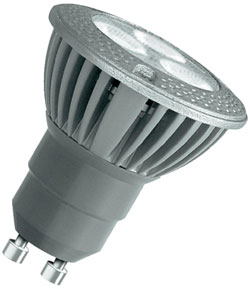
    A 220V Osram LED downlighter with GU10 base

    He says that for now the replacement of downlighters — both 220V and 12V installations — is the biggest market for LED solutions. But the technology could apply equally well in street lighting and general-purpose lighting.

    The money that big lighting companies are pouring into LED technology shows it will be the big growth area in lighting in the next decade. Osram, for example, invests 70% of its research and development budget in LED, with only 30% being spent on other, more traditional forms of lighting. This year, Osram will launch 1 000 new LED lighting products, Greenhill says.

    Of course, it’s not only energy savings that are propelling the LED market. Greenhill explains that the technology has a number of other advantages, including that it’s a “solid-state” lighting source in that it doesn’t have any moving parts — LED lamps don’t use a filament and gas — and therefore won’t easily break.

    Also, general ambient temperatures are not as hot and they don’t emit ultraviolet or infrared light, making them ideal for lighting sensitive artwork, for example, that can be damaged by more conventional light sources. LED is also free of the poisonous chemicals that are sometimes used in fluorescent lighting and have better design flexibility. Also, LED lamps have much longer useful lives, often stretching into decades, reducing cost of maintenance.

    But, says Greenhill, LED is not always the right solution for all applications. “Too many promises are being made in the market that everything must become LED,” he says. “That’s not necessarily correct as metal halide lamps in shopping centres and for security are a very good light source. Sodium is also a good light source.”

    He also maintains that halogen lamps remain a “fantastic” source of light, despite the fact that they consume much more electricity than LED and other low-power alternatives. “Halogen gives a beautiful sparkle and it’s a comfortable light, which is important in the home,” he says. “If it’s a more modern house, with square walls and white walls, some people prefer the cooler light that LED produces.”

    Another challenge facing consumers wanting to move to LED is that many downlighter installations use 12V transformers rather than drawing 220V directly from the grid. “There can be compatibility issues with the transformers in the ceiling because the electronics [in the LEDs and the transformer] are trying to talk to communicate with each other,” he explains. “That’s why 90% of manufacturers recommend a wire-wound transformer — your old, heavy transformers, not the electronic ones — so the LED lamps will work.”
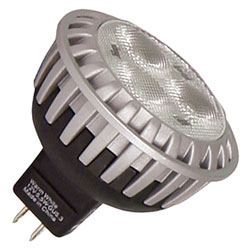
    A 12V Osram downlighter with MR16 base

    He says he advises most clients that they should change from 12V lamps (with MR16 bases) to 220V lamps (with GU10 bases) before switching to LED. This eliminates the transformers from the system. “What we are seeing is our higher wattage lamps are coming from the 220V base,” he says, so by switching from 12V systems consumers will future-proof their installations. “The market is moving to GU10 bases and it’s simpler for an electrician to install a GU10 system because of SA Bureau of Standards regulations.”

    Greenhill explains that there is a great deal of confusion in SA about the requirements of the law and different provincial inspectors have different intrepretations of legislation.

    For consumers with 12V systems who want to save electricity but don’t want to go through the effort of removing their transformers, another option is to consider moving from 50W to 35W halogen lamps that have a special infrared coating that ensures they produce the same amount of light as the higher-power option.

    “I personally prefer the light quality with a transformer — it gives better light and sparkle to the light, but, now that I know about LED, if I was building a house today I would put in GU10s so I am sure there will be no compatibility issues with transformers. Either that, or I’d make sure I’m prepared to remove the transformers at some future date.”

    There’s one further big issue that consumers need to consider before switching to LED and that concerns the use of dimmer systems. Again, this comes down to the compatibility of the electronics. In Osram’s experience, some dimmer systems work fine but others cause big problems with LEDs. “If a dimming product is required, we tend to push customers to GU10s. With 12V systems, you have to get the LED lamp’s electronics talking to the transformer’s electronics talking to the dimmer’s electronics.”

    Greenhill has no doubt that LED is the future of lighting. Eventually, organic light-emitting diode (OLED) technology will replace LED, ushering in an era of bendable lighting and other innovations, but that’s still many years away.

    “OLEDs won’t be a point light source but rather a surface area light source,” he explains. “With these, you can be very creative with lighting. It will be a flexible light source. You could replace a window pane, for example, so you would have roof structure in a building which would be panels of glass like a skylight. During the day, the skylight would allow in natural light and at nighttime these panels would light up and become your light source.”

    But, Greenhill says, it will be at least a decade before OLED takes off as an affordable light source. “OLED is where we are moving as an industry, but there’s still huge development to come in the current LED technology.”  — Duncan McLeod, TechCentral

    • Subscribe to our free daily newsletter
    • Follow us on Twitter or on Google+ or on Facebook
    • Visit our sister website, SportsCentral (still in beta)


    John Westermeyer Mark Greenhill Osram Philips
    Subscribe to TechCentral Subscribe to TechCentral
    Share. Facebook Twitter LinkedIn WhatsApp Telegram Email Copy Link
    Previous ArticleCloud computing could create SA jobs
    Next Article Inside the brain of Jeff Bezos

    Related Posts

    Philips seeks exit from appliances business

    22 July 2020

    The end of Edison’s light bulb

    18 November 2014

    Sony gets its mojo back

    7 July 2013
    Company News
    Beat the summer heat with Samsung's WindFree air conditioners

    Beat the summer heat with Samsung’s WindFree air conditioners

    5 December 2025
    AI is not a technology problem - iqbusiness

    AI is not a technology problem – iqbusiness

    5 December 2025
    Telcos are sitting on a data gold mine - but few know what do with it - Phillip du Plessis

    Telcos are sitting on a data gold mine – but few know what do with it

    4 December 2025
    Opinion
    Your data, your hardware: the DIY AI revolution is coming - Duncan McLeod

    Your data, your hardware: the DIY AI revolution is coming

    20 November 2025
    Zero Carbon Charge founder Joubert Roux

    The energy revolution South Africa can’t afford to miss

    20 November 2025
    It's time for a new approach to government IT spend in South Africa - Richard Firth

    It’s time for a new approach to government IT spend in South Africa

    19 November 2025

    Subscribe to Updates

    Get the best South African technology news and analysis delivered to your e-mail inbox every morning.

    Latest Posts
    Beat the summer heat with Samsung's WindFree air conditioners

    Beat the summer heat with Samsung’s WindFree air conditioners

    5 December 2025
    Netflix, Warner Bros talks raise fresh headaches for MultiChoice

    Netflix, Warner Bros talks raise fresh headaches for MultiChoice

    5 December 2025
    Big Microsoft 365 price increases coming next year

    Big Microsoft price increases coming next year

    5 December 2025
    AI is not a technology problem - iqbusiness

    AI is not a technology problem – iqbusiness

    5 December 2025
    © 2009 - 2025 NewsCentral Media
    • Cookie policy (ZA)
    • TechCentral – privacy and Popia

    Type above and press Enter to search. Press Esc to cancel.

    Manage consent

    TechCentral uses cookies to enhance its offerings. Consenting to these technologies allows us to serve you better. Not consenting or withdrawing consent may adversely affect certain features and functions of the website.

    Functional Always active
    The technical storage or access is strictly necessary for the legitimate purpose of enabling the use of a specific service explicitly requested by the subscriber or user, or for the sole purpose of carrying out the transmission of a communication over an electronic communications network.
    Preferences
    The technical storage or access is necessary for the legitimate purpose of storing preferences that are not requested by the subscriber or user.
    Statistics
    The technical storage or access that is used exclusively for statistical purposes. The technical storage or access that is used exclusively for anonymous statistical purposes. Without a subpoena, voluntary compliance on the part of your Internet Service Provider, or additional records from a third party, information stored or retrieved for this purpose alone cannot usually be used to identify you.
    Marketing
    The technical storage or access is required to create user profiles to send advertising, or to track the user on a website or across several websites for similar marketing purposes.
    • Manage options
    • Manage services
    • Manage {vendor_count} vendors
    • Read more about these purposes
    View preferences
    • {title}
    • {title}
    • {title}