Close Menu
TechCentralTechCentral

    Subscribe to the newsletter

    Get the best South African technology news and analysis delivered to your e-mail inbox every morning.

    Facebook X (Twitter) YouTube LinkedIn
    WhatsApp Facebook X (Twitter) LinkedIn YouTube
    TechCentralTechCentral
    • News
      Netflix, Warner Bros talks raise fresh headaches for MultiChoice

      Netflix, Warner Bros talks raise fresh headaches for MultiChoice

      5 December 2025
      Big Microsoft 365 price increases coming next year

      Big Microsoft price increases coming next year

      5 December 2025
      Vodacom to take control of Safaricom in R36-billion deal - Shameel Joosub

      Vodacom to take control of Safaricom in R36-billion deal

      4 December 2025
      Black Friday goes digital in South Africa as online spending surges to record high

      Black Friday goes digital in South Africa as online spending surges to record high

      4 December 2025
      BYD takes direct aim at Toyota with launch of sub-R500 000 Sealion 5 PHEV

      BYD takes direct aim at Toyota with launch of sub-R500 000 Sealion 5 PHEV

      4 December 2025
    • World
      Amazon and Google launch multi-cloud service for faster connectivity

      Amazon and Google launch multi-cloud service for faster connectivity

      1 December 2025
      Google makes final court plea to stop US breakup

      Google makes final court plea to stop US breakup

      21 November 2025
      Bezos unveils monster rocket: New Glenn 9x4 set to dwarf Saturn V

      Bezos unveils monster rocket: New Glenn 9×4 set to dwarf Saturn V

      21 November 2025
      Tech shares turbocharged by Nvidia's stellar earnings

      Tech shares turbocharged by stellar Nvidia earnings

      20 November 2025
      Config file blamed for Cloudflare meltdown that disrupted the web

      Config file blamed for Cloudflare meltdown that disrupted the web

      19 November 2025
    • In-depth
      Jensen Huang Nvidia

      So, will China really win the AI race?

      14 November 2025
      Valve's Linux console takes aim at Microsoft's gaming empire

      Valve’s Linux console takes aim at Microsoft’s gaming empire

      13 November 2025
      iOCO's extraordinary comeback plan - Rhys Summerton

      iOCO’s extraordinary comeback plan

      28 October 2025
      Why smart glasses keep failing - no, it's not the tech - Mark Zuckerberg

      Why smart glasses keep failing – it’s not the tech

      19 October 2025
      BYD to blanket South Africa with megawatt-scale EV charging network - Stella Li

      BYD to blanket South Africa with megawatt-scale EV charging network

      16 October 2025
    • TCS
      TCS+ | How Cloud on Demand helps partners thrive in the AWS ecosystem - Odwa Ndyaluvane and Xenia Rhode

      TCS+ | How Cloud On Demand helps partners thrive in the AWS ecosystem

      4 December 2025
      TCS | MTN Group CEO Ralph Mupita on competition, AI and the future of mobile

      TCS | Ralph Mupita on competition, AI and the future of mobile

      28 November 2025
      TCS | Dominic Cull on fixing South Africa's ICT policy bottlenecks

      TCS | Dominic Cull on fixing South Africa’s ICT policy bottlenecks

      21 November 2025
      TCS | BMW CEO Peter van Binsbergen on the future of South Africa's automotive industry

      TCS | BMW CEO Peter van Binsbergen on the future of South Africa’s automotive industry

      6 November 2025
      TCS | Why Altron is building an AI factory - Bongani Andy Mabaso

      TCS | Why Altron is building an AI factory in Johannesburg

      28 October 2025
    • Opinion
      Your data, your hardware: the DIY AI revolution is coming - Duncan McLeod

      Your data, your hardware: the DIY AI revolution is coming

      20 November 2025
      Zero Carbon Charge founder Joubert Roux

      The energy revolution South Africa can’t afford to miss

      20 November 2025
      It's time for a new approach to government IT spend in South Africa - Richard Firth

      It’s time for a new approach to government IT spend in South Africa

      19 November 2025
      How South Africa's broken Rica system fuels murder and mayhem - Farhad Khan

      How South Africa’s broken Rica system fuels murder and mayhem

      10 November 2025
      South Africa's AI data centre boom risks overloading a fragile grid - Paul Colmer

      South Africa’s AI data centre boom risks overloading a fragile grid

      30 October 2025
    • Company Hubs
      • Africa Data Centres
      • AfriGIS
      • Altron Digital Business
      • Altron Document Solutions
      • Altron Group
      • Arctic Wolf
      • AvertITD
      • Braintree
      • CallMiner
      • CambriLearn
      • CYBER1 Solutions
      • Digicloud Africa
      • Digimune
      • Domains.co.za
      • ESET
      • Euphoria Telecom
      • Incredible Business
      • iONLINE
      • IQbusiness
      • Iris Network Systems
      • LSD Open
      • NEC XON
      • Netstar
      • Network Platforms
      • Next DLP
      • Ovations
      • Paracon
      • Paratus
      • Q-KON
      • SevenC
      • SkyWire
      • Solid8 Technologies
      • Telit Cinterion
      • Tenable
      • Vertiv
      • Videri Digital
      • Vodacom Business
      • Wipro
      • Workday
      • XLink
    • Sections
      • AI and machine learning
      • Banking
      • Broadcasting and Media
      • Cloud services
      • Contact centres and CX
      • Cryptocurrencies
      • Education and skills
      • Electronics and hardware
      • Energy and sustainability
      • Enterprise software
      • Financial services
      • Information security
      • Internet and connectivity
      • Internet of Things
      • Investment
      • IT services
      • Lifestyle
      • Motoring
      • Public sector
      • Retail and e-commerce
      • Satellite communications
      • Science
      • SMEs and start-ups
      • Social media
      • Talent and leadership
      • Telecoms
    • Events
    • Advertise
    TechCentralTechCentral
    Home » Editor's pick » Magical Solar System discoveries of 2015

    Magical Solar System discoveries of 2015

    By The Conversation24 December 2015
    Twitter LinkedIn Facebook WhatsApp Email Telegram Copy Link
    News Alerts
    WhatsApp
    pluto-and-charon-640
    Composite image of Pluto and Charon. Nasa/JHUAPL/SwRI, CC BY-SA

    It has been a busy year for Solar System exploration — and particularly our galactic neighbourhood’s small icy bodies. Comets, asteroids, Kuiper Belt Objects and planetary satellites have all been in the news — from stunning images of comet 67P Churyumov-Gerasimenko at the start of the year, to the recent close-up of Saturn’s moon, Enceladus, via Ceres and Pluto.

    Early January was a continuation of the stream of data from Rosetta, as comet 67P drew closer to the sun. Images were released of jets emanating from the sun-facing surface, from which it could be seen that sublimation of water-ice increased during the daytime, and died down at night. But because the dark surface of the comet retained some heat, the comet was not completely inactive at night — it was possible that fluid might exist for very short periods, leading to sub-surface hydrous activity.

    comet-67p-640
    Activity on Comet 67P. ESA/Rosetta/MPS for Osiris Team MPS/UPD/LAM/IAA/SSO/INTA/UPM/DASP/IDA, CC BY-SA

    One of the other significant results from Rosetta was recognition from magnetic measurements that the two lobes of the comet had been separate bodies, presumably brought together by collision.

    Closest approach to the sun was in mid-August, a few weeks after the Philae lander signalled that it had woken up after its enforced hibernation. Unfortunately, communication between Rosetta and Philae could not be established reliably, leaving a certain amount of frustration that additional data could not be acquired from the surface.

    Welcome to Pluto (and Charon)
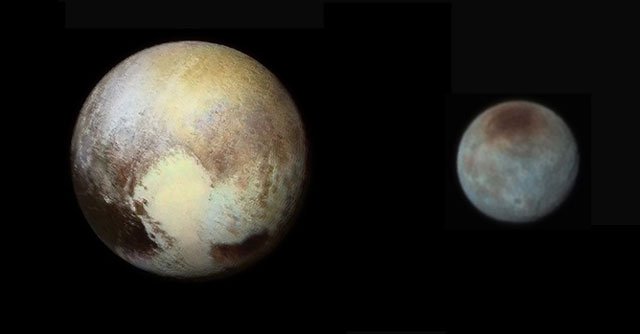
    July brought us a close-up of Pluto. The images have been tremendous, turning Pluto from a fuzzy grey blob into a fascinating body of mountains, plains and valleys. Pluto’s closest and largest moon, Charon, was also captured by the New Horizon mission cameras in similar detail. The two worlds are very different in their characteristics. Parts of Pluto’s icy surface are crumpled into mountains and ridges. The “heart” of Pluto, around 1 500km across, is a flat and featureless plain, presumably resurfaced relatively recently, showing that Pluto is more active than anticipated.

    Pluto, left, and Charon in slightly exaggerated colour. adapted from multiple datasets. Image: Nasa
    Pluto, left, and Charon in slightly exaggerated colour. adapted from multiple datasets. Image: Nasa

    Charon, with approximately half the diameter of Pluto, is also a world of contrasts. The southern hemisphere is flat, relatively smooth and low-lying, broken mainly by impact craters, while the northern regions are fractured with much more topography. Separating the two halves of the moon is an extensive system of canyons, perhaps akin to the Valles Marineris on Mars, probably caused by tectonic stress. Mission scientists have suggested that the southern region is younger than the northern, and has been resurfaced by cryovolcanism — instead of lava, cryovolcanos eject substances such as water, methane or ammonia — implying a frozen ocean below Charon’s crust.
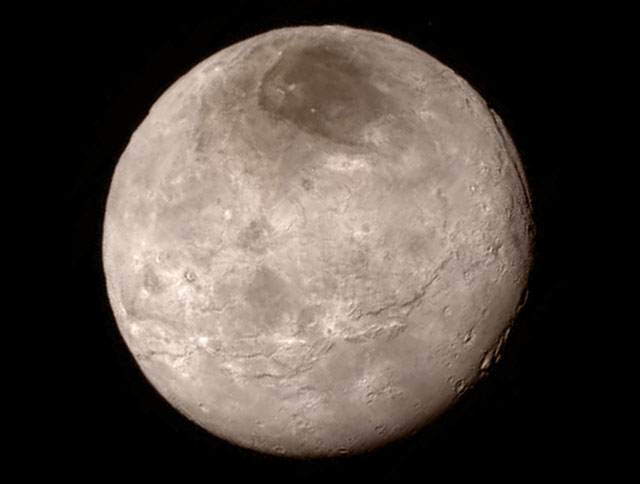
    Charon. Nasa/JHUAPL/SwRI, CC BY-SA
    Charon. Nasa/JHUAPL/SwRI, CC BY-SA

    It should be remembered that the wealth of data now returning to Earth from the New Horizon’s spacecraft was acquired during a fly-by of Pluto that lasted a mere 15 minutes. Imagine what could be learnt with an orbiter.

    A new dawn
    The Dawn mission to Asteroid (1) Ceres was a bright spot — literally — in the planetary exploration calendar. At the start of the year, the spacecraft began to orbit the dwarf planet, and images revealed several patches of highly reflective material.

    At first it was suggested that the patches may be of water-ice. This would be unexpected, since the surface of Ceres is too warm for water-ice to be stable at the surface. It is now thought that the bright spots might be salts remaining following evaporation (or sublimation of water).
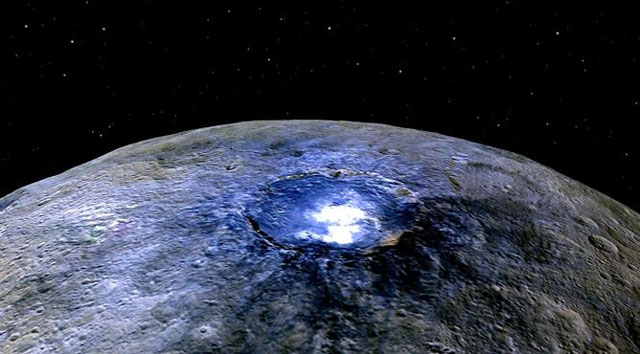
    Ceres from Dawn. Nasa/JPL-Caltech/UCLA/MPS/DLR/IDA, CC BY-SA
    Ceres from Dawn. Nasa/JPL-Caltech/UCLA/MPS/DLR/IDA, CC BY-SA

    Ceres is currently thought to be like a ball of compressed mud, possibly with a layer of water-rich slurry below a thin crust of mud — not an attractive description for the largest of the asteroids, but one which clearly shows that the minor planet has had a lengthy history of aqueous activity.

    This is important because, like comets, asteroids have played a significant role in the delivery of water and other volatile compounds to Earth. The Dawn spacecraft spent most of 2015 orbiting Ceres at gradually decreasing altitudes — settling, at the beginning of December, in its lowest orbit about 400km above the surface.

    Images have shown that Ceres is crossed by troughs and grooves reminiscent of those present on other (larger) planetary bodies. Some of the features are impact-related, but some seem to have been produced by stress fracturing of the crust, another example of Ceres’ puzzling and sometimes contradictory history.
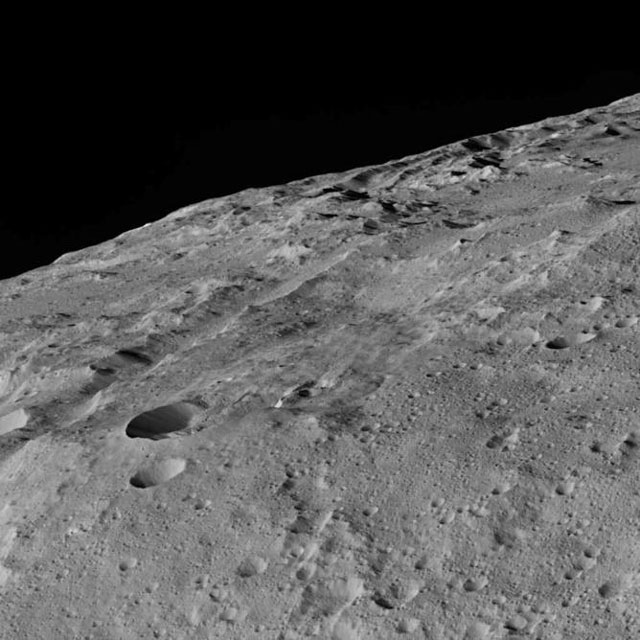
    Ceres, time for your close-up. Nasa/JPL-Caltech/UCLA/MPS/DLR/IDA, CC BY-SA
    Ceres, time for your close-up. Nasa/JPL-Caltech/UCLA/MPS/DLR/IDA, CC BY-SA

    The oceans of Enceladus
    Although the Cassini mission has been operational within the Saturnian system for over a decade, and is coming to the end of its life, it is still returning exciting data from the icy moon, Enceladus. In October, the spacecraft took a dive through the plume at the south pole, flying only about 50km above the surface. Then, only last week, Cassini completed its final close encounter with Enceladus, giving us pictures of frozen fractures and ridges. We know that Enceladus has a sub-surface global salty ocean – placing it with Jupiter’s moon, Europa, as a possible host to an ocean-floor ecosystem.

    The surface of Enceladus. Nasa/JPL-Caltech/Space Science Institute, CC BY-SA
    The surface of Enceladus. Nasa/JPL-Caltech/Space Science Institute, CC BY-SA

    What next?
    The amazing images that have come from the missions to icy bodies have generated a great increase in public interest in Solar System exploration. A quick trawl through social media sites such as Twitter shows how avidly the missions are followed and results discussed, almost in real time. If 2015 was a golden age for the exploration of small icy bodies, we can only hope that among the legacies of the missions is a generation of students enthused to continue investigation of our neighbourhood.

    But what may be in store for small icy bodies in 2016? Work has only just started for the cameras on board Dawn, as the spacecraft starts its mapping of Ceres. There will be more images and information from Pluto and its satellites, especially Charon. Cassini has made its final close fly-by of Enceladus, and the images will be returned throughout the coming year. Rosetta will watch 67P’s activity die down as the comet moves further and further away from the sun. But before we say a complete goodbye to comet Churyumov-Gerasimenko, maybe, just maybe, we will hear from Philae…The Conversation

    • Monica Grady is professor of planetary and space sciences at The Open University
    • This article was originally published on The Conversation


    Subscribe to TechCentral Subscribe to TechCentral
    Share. Facebook Twitter LinkedIn WhatsApp Telegram Email Copy Link
    Previous ArticleCell C set for ratings upgrade
    Next Article It’s a tech-filled Christmas

    Related Posts

    Beat the summer heat with Samsung's WindFree air conditioners

    Beat the summer heat with Samsung’s WindFree air conditioners

    5 December 2025
    Netflix, Warner Bros talks raise fresh headaches for MultiChoice

    Netflix, Warner Bros talks raise fresh headaches for MultiChoice

    5 December 2025
    Big Microsoft 365 price increases coming next year

    Big Microsoft price increases coming next year

    5 December 2025
    Company News
    Beat the summer heat with Samsung's WindFree air conditioners

    Beat the summer heat with Samsung’s WindFree air conditioners

    5 December 2025
    AI is not a technology problem - iqbusiness

    AI is not a technology problem – iqbusiness

    5 December 2025
    Telcos are sitting on a data gold mine - but few know what do with it - Phillip du Plessis

    Telcos are sitting on a data gold mine – but few know what do with it

    4 December 2025
    Opinion
    Your data, your hardware: the DIY AI revolution is coming - Duncan McLeod

    Your data, your hardware: the DIY AI revolution is coming

    20 November 2025
    Zero Carbon Charge founder Joubert Roux

    The energy revolution South Africa can’t afford to miss

    20 November 2025
    It's time for a new approach to government IT spend in South Africa - Richard Firth

    It’s time for a new approach to government IT spend in South Africa

    19 November 2025

    Subscribe to Updates

    Get the best South African technology news and analysis delivered to your e-mail inbox every morning.

    Latest Posts
    Beat the summer heat with Samsung's WindFree air conditioners

    Beat the summer heat with Samsung’s WindFree air conditioners

    5 December 2025
    Netflix, Warner Bros talks raise fresh headaches for MultiChoice

    Netflix, Warner Bros talks raise fresh headaches for MultiChoice

    5 December 2025
    Big Microsoft 365 price increases coming next year

    Big Microsoft price increases coming next year

    5 December 2025
    AI is not a technology problem - iqbusiness

    AI is not a technology problem – iqbusiness

    5 December 2025
    © 2009 - 2025 NewsCentral Media
    • Cookie policy (ZA)
    • TechCentral – privacy and Popia

    Type above and press Enter to search. Press Esc to cancel.

    Manage consent

    TechCentral uses cookies to enhance its offerings. Consenting to these technologies allows us to serve you better. Not consenting or withdrawing consent may adversely affect certain features and functions of the website.

    Functional Always active
    The technical storage or access is strictly necessary for the legitimate purpose of enabling the use of a specific service explicitly requested by the subscriber or user, or for the sole purpose of carrying out the transmission of a communication over an electronic communications network.
    Preferences
    The technical storage or access is necessary for the legitimate purpose of storing preferences that are not requested by the subscriber or user.
    Statistics
    The technical storage or access that is used exclusively for statistical purposes. The technical storage or access that is used exclusively for anonymous statistical purposes. Without a subpoena, voluntary compliance on the part of your Internet Service Provider, or additional records from a third party, information stored or retrieved for this purpose alone cannot usually be used to identify you.
    Marketing
    The technical storage or access is required to create user profiles to send advertising, or to track the user on a website or across several websites for similar marketing purposes.
    • Manage options
    • Manage services
    • Manage {vendor_count} vendors
    • Read more about these purposes
    View preferences
    • {title}
    • {title}
    • {title}