Close Menu
TechCentralTechCentral

    Subscribe to the newsletter

    Get the best South African technology news and analysis delivered to your e-mail inbox every morning.

    Facebook X (Twitter) YouTube LinkedIn
    WhatsApp Facebook X (Twitter) LinkedIn YouTube
    TechCentralTechCentral
    • News
      Toyota SA CEO: NEV inaction will cost South Africa its motoring industry - Andrew Kirby

      Toyota SA CEO: NEV inaction will cost South Africa its motoring industry

      12 February 2026
      Censorship-resistant internet from space - Spacecoin

      Censorship-resistant internet from space

      12 February 2026
      Chip shortage hits PCs as AI swallows the world's memory supply

      Chip shortage hits PCs as AI swallows the world’s memory supply

      12 February 2026
      Altron jumps after company flags strong earnings growth

      Altron jumps after company flags strong earnings growth

      12 February 2026
      Here comes the next wave of Chinese AI models

      Here comes the next wave of Chinese AI models

      12 February 2026
    • World
      Russia bans WhatsApp

      Russia bans WhatsApp

      12 February 2026
      EU regulators take aim at WhatsApp

      EU regulators take aim at WhatsApp

      9 February 2026
      Musk hits brakes on Mars mission

      Musk hits brakes on Mars mission

      9 February 2026
      Crypto firm accidentally sends R700-billion in bitcoin to its users

      Crypto firm accidentally sends R700-billion in bitcoin to its users

      8 February 2026
      AI won't replace software, says Nvidia CEO amid market rout - Jensen Huang

      AI won’t replace software, says Nvidia CEO amid market rout

      4 February 2026
    • In-depth
      How liberalisation is rewiring South Africa's power sector

      How liberalisation is rewiring South Africa’s power sector

      21 January 2026
      The top-performing South African tech shares of 2025

      The top-performing South African tech shares of 2025

      12 January 2026
      Digital authoritarianism grows as African states normalise internet blackouts

      Digital authoritarianism grows as African states normalise internet blackouts

      19 December 2025
      TechCentral's South African Newsmakers of 2025

      TechCentral’s South African Newsmakers of 2025

      18 December 2025
      Black Friday goes digital in South Africa as online spending surges to record high

      Black Friday goes digital in South Africa as online spending surges to record high

      4 December 2025
    • TCS
      Watts & Wheels S1E4: 'We drive an electric Uber'

      Watts & Wheels S1E4: ‘We drive an electric Uber’

      10 February 2026
      TCS+ | How Cloud On Demand is helping SA businesses succeed in the cloud - Xhenia Rhode, Dion Kalicharan

      TCS+ | Cloud On Demand and Consnet: inside a real-world AWS partner success story

      30 January 2026
      Watts & Wheels S1E4: 'We drive an electric Uber'

      Watts & Wheels S1E3: ‘BYD’s Corolla Cross challenger’

      30 January 2026
      Watts & Wheels S1E4: 'We drive an electric Uber'

      Watts & Wheels S1E2: ‘China attacks, BMW digs in, Toyota’s sublime supercar’

      23 January 2026

      TCS+ | Why cybersecurity is becoming a competitive advantage for SA businesses

      20 January 2026
    • Opinion
      South Africa's skills advantage is being overlooked at home - Richard Firth

      South Africa’s skills advantage is being overlooked at home

      29 January 2026
      Why Elon Musk's Starlink is a 'hard no' for me - Songezo Zibi

      Why Elon Musk’s Starlink is a ‘hard no’ for me

      26 January 2026
      South Africa's new fibre broadband battle - Duncan McLeod

      South Africa’s new fibre broadband battle

      20 January 2026
      AI moves from pilots to production in South African companies - Nazia Pillay SAP

      AI moves from pilots to production in South African companies

      20 January 2026
      South Africa's new fibre broadband battle - Duncan McLeod

      ANC’s attack on Solly Malatsi shows how BEE dogma trumps economic reality

      14 December 2025
    • Company Hubs
      • Africa Data Centres
      • AfriGIS
      • Altron Digital Business
      • Altron Document Solutions
      • Altron Group
      • Arctic Wolf
      • AvertITD
      • Braintree
      • CallMiner
      • CambriLearn
      • CYBER1 Solutions
      • Digicloud Africa
      • Digimune
      • Domains.co.za
      • ESET
      • Euphoria Telecom
      • Incredible Business
      • iONLINE
      • IQbusiness
      • Iris Network Systems
      • LSD Open
      • Mitel
      • NEC XON
      • Netstar
      • Network Platforms
      • Next DLP
      • Ovations
      • Paracon
      • Paratus
      • Q-KON
      • SevenC
      • SkyWire
      • Solid8 Technologies
      • Telit Cinterion
      • Tenable
      • Vertiv
      • Videri Digital
      • Vodacom Business
      • Wipro
      • Workday
      • XLink
    • Sections
      • AI and machine learning
      • Banking
      • Broadcasting and Media
      • Cloud services
      • Contact centres and CX
      • Cryptocurrencies
      • Education and skills
      • Electronics and hardware
      • Energy and sustainability
      • Enterprise software
      • Financial services
      • Information security
      • Internet and connectivity
      • Internet of Things
      • Investment
      • IT services
      • Lifestyle
      • Motoring
      • Public sector
      • Retail and e-commerce
      • Satellite communications
      • Science
      • SMEs and start-ups
      • Social media
      • Talent and leadership
      • Telecoms
    • Events
    • Advertise
    TechCentralTechCentral
    Home » Sections » Science » Microsoft just claimed a quantum breakthrough – here’s what it means
    Microsoft just claimed a quantum breakthrough - here's what it means

    Microsoft just claimed a quantum breakthrough – here’s what it means

    By The Conversation22 February 2025

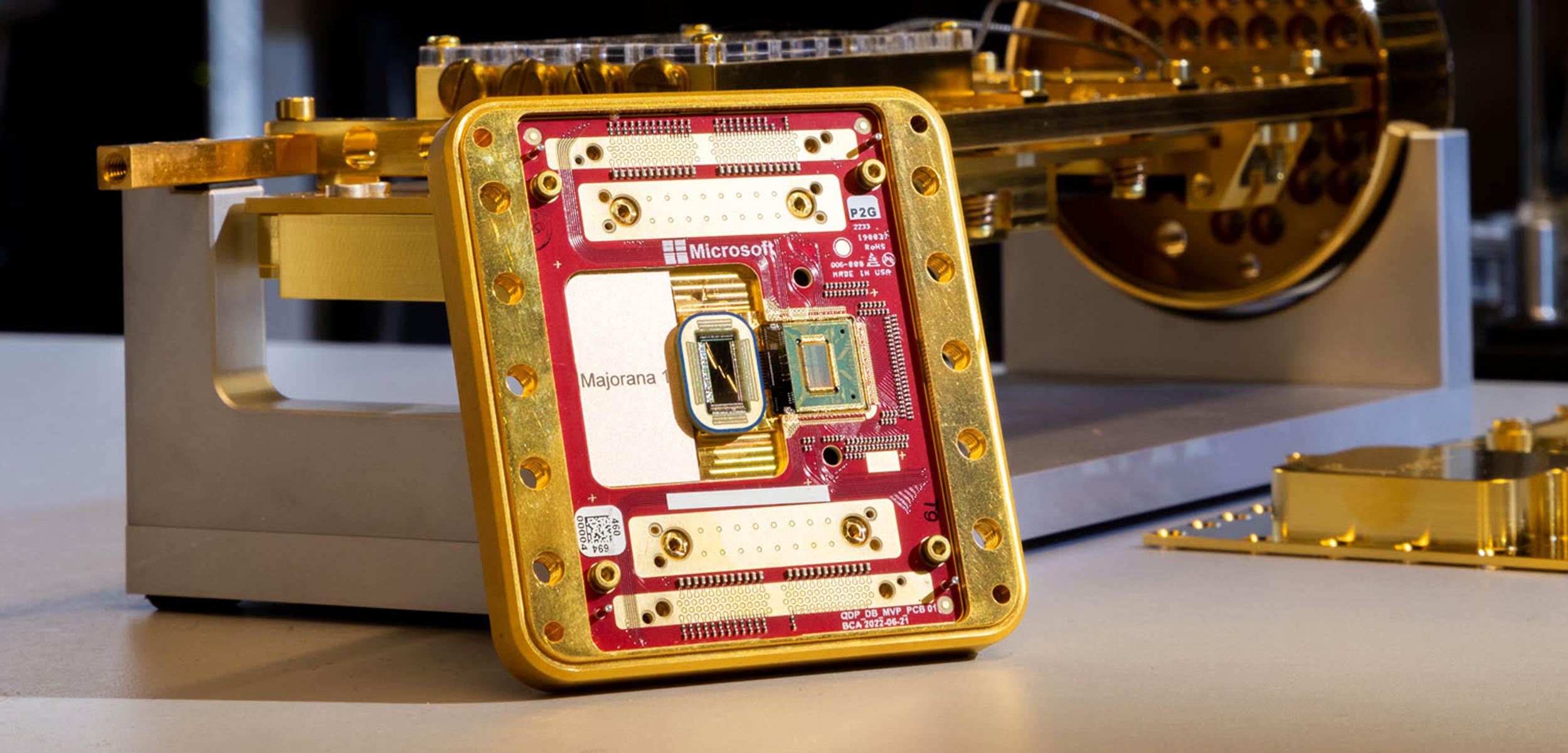
    Researchers at Microsoft have announced the creation of the first “topological qubits” in a device that stores information in an exotic state of matter, in what may be a significant breakthrough for quantum computing.

    At the same time, the researchers also published a paper in Nature and a “road map” for further work. The design of the Majorana 1 processor is supposed to fit up to a million qubits, which may be enough to realise many significant goals of quantum computing – such as cracking cryptographic codes and designing new drugs and materials faster.

    If Microsoft’s claims pan out, the company may have leapfrogged competitors such as IBM and Google, which currently appear to be leading the race to build a quantum computer.

    However, the peer-reviewed Nature paper only shows part of what the researchers have claimed, and the road map still includes many hurdles to be overcome. While the Microsoft press release shows off something that is supposed to be quantum computing hardware, we don’t have any independent confirmation of what it can do. Nevertheless, the news is very promising.

    By now you probably have some questions. What’s a topological qubit? What’s a qubit at all, for that matter? And why do people want quantum computers in the first place?

    Quantum bits are hard to build

    Quantum computers were first dreamed up in the 1980s. Where an ordinary computer stores information in bits, a quantum computer stores information in quantum bits – or qubits.

    An ordinary bit can have a value of 0 or 1, but a quantum bit (thanks to the laws of quantum mechanics, which govern very small particles) can have a combination of both. If you imagine an ordinary bit as an arrow that can point either up or down, a qubit is an arrow that can point in any direction (or what is called a “superposition” of up and down).

    This means a quantum computer would be much faster than an ordinary computer for certain kinds of calculations – particularly some to do with unpicking codes and simulating natural systems.

    So far, so good. But it turns out that building real qubits and getting information in and out of them is extremely difficult, because interactions with the outside world can destroy the delicate quantum states inside.

    Researchers have tried a lot of different technologies to make qubits, using things like atoms trapped in electric fields or eddies of current swirling in superconductors.

    Tiny wires and exotic particles

    Microsoft has taken a very different approach to build its “topological qubits”. They have used what are called Majorana particles, first theorised in 1937 by Italian physicist Ettore Majorana.

    Majoranas are not naturally occurring particles like electrons or protons. Instead, they only exist inside a rare kind of material called a topological superconductor (which requires advanced material design and must be cooled down to extremely low temperatures). Indeed, Majorana particles are so exotic they are usually only studied in universities – not used in practical applications.

    The Microsoft team say they have used a pair of tiny wires, each with a Majorana particle trapped at either end, to act as a qubit. They measure the value of the qubit – expressed by means of whether an electron is in one wire or the other – using microwaves.

    Braided bits

    Why has Microsoft put in all this effort? Because by swapping the positions of Majorana particles (or measuring them in a certain way), they can be “braided” so they can be measured without error and are resistant to outside interference. (This is the “topological” part of “topological qubits”.)

    In theory, a quantum computer made using Majorana particles can be completely free of the qubit errors that plague other designs.
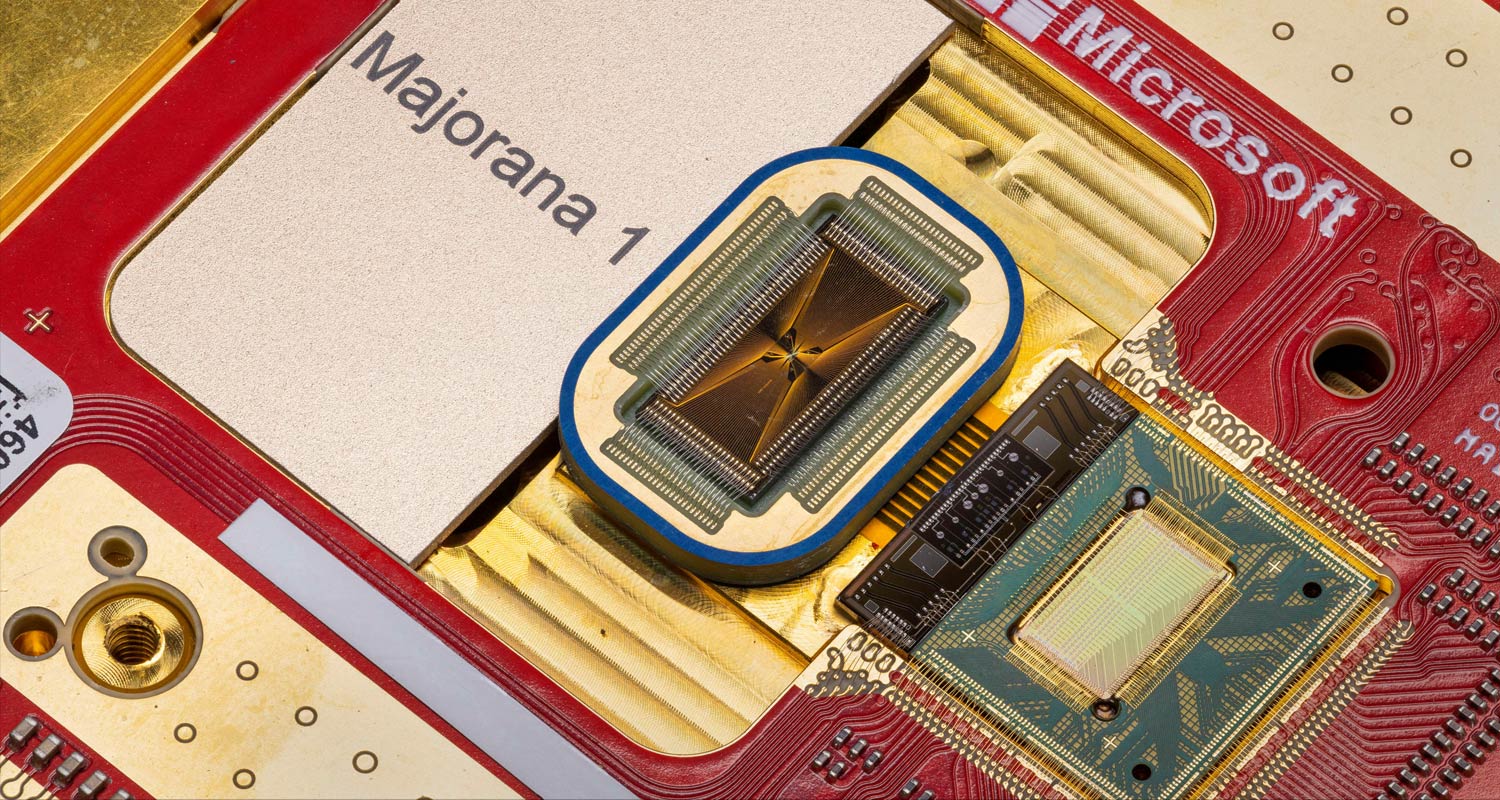
    Majorana 1This is why Microsoft has chosen such a seemingly laborious approach. Other technologies are more prone to errors, and hundreds of physical qubits may need to be combined together to produce a single reliable “logical qubit”.

    Microsoft has instead put its time and resources into developing Majorana-based qubits. While they are late to the big quantum party, they hope they will be able to catch up quickly.

    There’s always a catch

    As always, if something sounds too good to be true, there is a catch. Even for a Majorana-based quantum computer, such as the one announced by Microsoft, one operation – known as T-gate – won’t be achievable without errors.

    So, the Majorana-based quantum chip is only “almost error-free”. However, correcting for T-gate errors is much simpler than the general error correction of other quantum platforms.

    What now? Microsoft will try to move ahead with its road map, steadily building larger and larger collections of qubits.

    The scientific community will closely watch how Microsoft’s quantum computing processors operate, and how they perform in comparison to the other already established quantum computing processors.

    At the same time, research into the exotic and obscure behaviour of Majorana particles will continue at universities around the globe.The Conversation

    • The author, Stephan Rachel, is professor in the school of physics at the University of Melbourne
    • This article is republished from The Conversation under a Creative Commons licence. Read the original article


    Don’t miss:

    Microsoft claims new quantum computing breakthrough


    Google IBM Majorana Majorana 1 Microsoft
    WhatsApp YouTube Follow on Google News Add as preferred source on Google
    Share. Facebook Twitter LinkedIn WhatsApp Telegram Email Copy Link
    Previous ArticleJSE-listed Altvest to set up bitcoin treasury
    Next Article Load shedding is back – stage 3 with immediate effect

    Related Posts

    Dr Google, meet Dr Chatbot - neither is ready to see you now

    Dr Google, meet Dr Chatbot – neither is ready to see you now

    10 February 2026
    AI chatbots are coming to Apple CarPlay

    AI chatbots are coming to Apple CarPlay

    8 February 2026
    From stocks to crypto, markets reel as AI doubts grow

    From stocks to crypto, markets reel as AI doubts grow

    6 February 2026
    Company News
    How NEC XON tackled identity risk for a major telco - Michael de Neuilly Rice

    How NEC XON tackled identity risk for a major telco

    11 February 2026

    Why Acer is the strategic choice for South Africa’s educational future

    11 February 2026
    Fyndae is building Africa's human verification layer for community security and collaboration

    Fyndae wants to turn lost-item recovery into Africa’s trust infrastructure

    11 February 2026
    Opinion
    South Africa's skills advantage is being overlooked at home - Richard Firth

    South Africa’s skills advantage is being overlooked at home

    29 January 2026
    Why Elon Musk's Starlink is a 'hard no' for me - Songezo Zibi

    Why Elon Musk’s Starlink is a ‘hard no’ for me

    26 January 2026
    South Africa's new fibre broadband battle - Duncan McLeod

    South Africa’s new fibre broadband battle

    20 January 2026

    Subscribe to Updates

    Get the best South African technology news and analysis delivered to your e-mail inbox every morning.

    Latest Posts
    Toyota SA CEO: NEV inaction will cost South Africa its motoring industry - Andrew Kirby

    Toyota SA CEO: NEV inaction will cost South Africa its motoring industry

    12 February 2026
    Russia bans WhatsApp

    Russia bans WhatsApp

    12 February 2026
    Censorship-resistant internet from space - Spacecoin

    Censorship-resistant internet from space

    12 February 2026
    Chip shortage hits PCs as AI swallows the world's memory supply

    Chip shortage hits PCs as AI swallows the world’s memory supply

    12 February 2026
    © 2009 - 2026 NewsCentral Media
    • Cookie policy (ZA)
    • TechCentral – privacy and Popia

    Type above and press Enter to search. Press Esc to cancel.

    Manage consent

    TechCentral uses cookies to enhance its offerings. Consenting to these technologies allows us to serve you better. Not consenting or withdrawing consent may adversely affect certain features and functions of the website.

    Functional Always active
    The technical storage or access is strictly necessary for the legitimate purpose of enabling the use of a specific service explicitly requested by the subscriber or user, or for the sole purpose of carrying out the transmission of a communication over an electronic communications network.
    Preferences
    The technical storage or access is necessary for the legitimate purpose of storing preferences that are not requested by the subscriber or user.
    Statistics
    The technical storage or access that is used exclusively for statistical purposes. The technical storage or access that is used exclusively for anonymous statistical purposes. Without a subpoena, voluntary compliance on the part of your Internet Service Provider, or additional records from a third party, information stored or retrieved for this purpose alone cannot usually be used to identify you.
    Marketing
    The technical storage or access is required to create user profiles to send advertising, or to track the user on a website or across several websites for similar marketing purposes.
    • Manage options
    • Manage services
    • Manage {vendor_count} vendors
    • Read more about these purposes
    View preferences
    • {title}
    • {title}
    • {title}