Close Menu
TechCentralTechCentral

    Subscribe to the newsletter

    Get the best South African technology news and analysis delivered to your e-mail inbox every morning.

    Facebook X (Twitter) YouTube LinkedIn
    WhatsApp Facebook X (Twitter) LinkedIn YouTube
    TechCentralTechCentral
    • News
      Post Office wants R2.2-billion from government as it braces for another loss

      Post Office wants R2.2-billion from government as it braces for another loss

      19 October 2026
      AI music is here and the rulebook is blank - Justin Erasmus

      AI music is here and the South African rulebook is blank

      19 October 2026
      SA start-up wants to put a padlock on your phone calls

      SA start-up wants to put a padlock on your phone calls

      19 October 2026
      A software revolution is heading for South African driveways

      A software revolution is heading for South African driveways

      19 October 2026
      Ispa asks if government still cares about the cost to communicate

      Ispa asks if government still cares about the cost to communicate

      19 October 2026
    • World
      OpenAI turns the tables on Apple in trade secrets fight

      OpenAI turns the tables on Apple in trade secrets fight

      15 October 2026
      Google's Gemini 4 Argon is finally here

      Google’s Gemini 4 Argon is finally here

      14 October 2026
      Apple's new HomeView smart home hub

      Apple takes another shot at the smart home

      13 October 2026
      AI is now holding up the world economy, says IMF

      AI is now propping up the world economy, says IMF

      12 October 2026
      SpaceX takes aim at US wireless carriers with spectrum acquisition

      Starlink is coming for your mobile operator

      9 October 2026
    • In-depth

      10 days that changed the course of AI

      21 September 2026
      Meta to the AI industry: slow down without us - Mark Zuckerberg

      Meta to the AI industry: slow down without us

      16 September 2026
      Google DeepMind CEO Demis Hassabis. Image: John Sears

      The plan to stop AI from breaking the world

      16 July 2026
      The internet has a Strait of Hormuz problem

      The internet has a Strait of Hormuz problem

      15 July 2026
      AI boom sparks rally, frenzy and fear

      AI boom sparks rally, frenzy and fear

      11 June 2026
    • TCS
      W&W | LDV's Gerhard Moolman on electric bakkies, fleet orders and 'school fees'

      W&W | LDV’s Gerhard Moolman on electric bakkies and fleets

      9 October 2026
      TCS | Frogfoot sees bigger fibre deals coming - TechCentral Show guests Abraham van der Merwe and Shane Chorley

      TCS | Frogfoot sees bigger fibre deals coming

      8 October 2026
      Meet the CIO | Vodacom's Mohamed Sami on the agentic future

      Meet the CIO | Vodacom’s Mohamed Sami on the agentic future

      5 October 2026
      Lexi Novitske, general partner at Norrsken22, on the TechCentral Show

      TCS | Norrsken22’s Lexi Novitske on how China is winning African tech

      1 October 2026
      TCS | Dominic White and Adam Ely on AI agents going rogue

      TCS | Dominic White and Adam Ely on AI agents going rogue

      29 September 2026
    • Opinion
      Nonkqubela Thathakahle Jordan-Dyani

      Why cybersecurity is now a national security issue for South Africa

      15 October 2026
      When a machine can choose, who does it become? Fanie van Rooyen

      When a machine can choose, who does it become?

      9 October 2026
      Let South Africans jailbreak their way to digital sovereignty - Dirk de Vos

      Let South Africans jailbreak their way to digital sovereignty

      5 October 2026
      South Africa's next energy crisis is in the accounts department - Craig Holmes

      South Africa’s next energy crisis is in the accounts department

      29 September 2026
      The steam engine lesson AI doomsayers keep missing - Sam Clarke

      The steam engine lesson AI doomsayers keep missing

      28 September 2026
    • Company News
      • 1Stream
      • Africa Data Centres
      • AfriGIS
      • Altron Digital Business
      • Altron Document Solutions
      • Altron Group
      • Arctic Wolf
      • Ascent Technology
      • AvertITD
      • BBD
      • Braintree
      • CallMiner
      • CambriLearn
      • CM.com
      • Contactable
      • CYBER1 Solutions
      • Digicloud Africa
      • Digimune
      • Domains.co.za
      • ESET
      • Euphoria Telecom
      • HOSTAFRICA
      • Incredible Business
      • iONLINE
      • IQbusiness
      • Iris Network Systems
      • Kaspersky
      • LSD Open
      • Mitel
      • NEC XON
      • Netstar
      • Network Platforms
      • Next DLP
      • Ovations
      • Paracon
      • Paratus
      • Publishared
      • Q-KON
      • SevenC
      • SkyWire
      • Solid8 Technologies
      • Telit Cinterion
      • Telviva
      • Tenable
      • Vertiv
      • Videri Digital
      • Vodacom Business
      • Vox
      • Wipro
      • Workday
      • XLink
    • Sections
      • AI and machine learning
      • Banking
      • Broadcasting and media
      • Cloud services
      • Contact centres and CX
      • Cryptocurrencies
      • Education and skills
      • Electronics and hardware
      • Energy and sustainability
      • Enterprise software
      • Fintech and payments
      • HealthTech
      • Information security
      • Internet and connectivity
      • Internet of things
      • Investment
      • IT services
      • Lifestyle
      • Policy and regulation
      • Public sector
      • Retail and e-commerce
      • Satellite communications
      • Science
      • SMEs and start-ups
      • Social media
      • Talent and leadership
      • Telecoms
      • Watts & Wheels
    • Events
    • Advertise
    TechCentralTechCentral
    Home » Sections » Science » Microsoft claims new quantum computing breakthrough

    Microsoft claims new quantum computing breakthrough

    Microsoft has unveiled a new chip that it said showed quantum computing is "years, not decades" away.
    By Stephen Nellis20 February 2025
    Twitter LinkedIn Facebook WhatsApp Email Telegram Copy Link
    Get breaking news on WhatsApp

    Microsoft claims new quantum computing breakthroughMicrosoft has unveiled a new chip that it said showed quantum computing is “years, not decades” away, joining Google and IBM in predicting that a fundamental change in computing technology is much closer than recently believed.

    Quantum computing holds the promise of carrying out calculations that would take today’s systems millions of years and could unlock discoveries in medicine, chemistry and many other fields where near-infinite seas of possible combinations of molecules confound classical computers.

    Quantum computers also hold the danger of upending today’s cybersecurity systems, where most encryption relies on the assumption that it would take too long to brute force gain access.

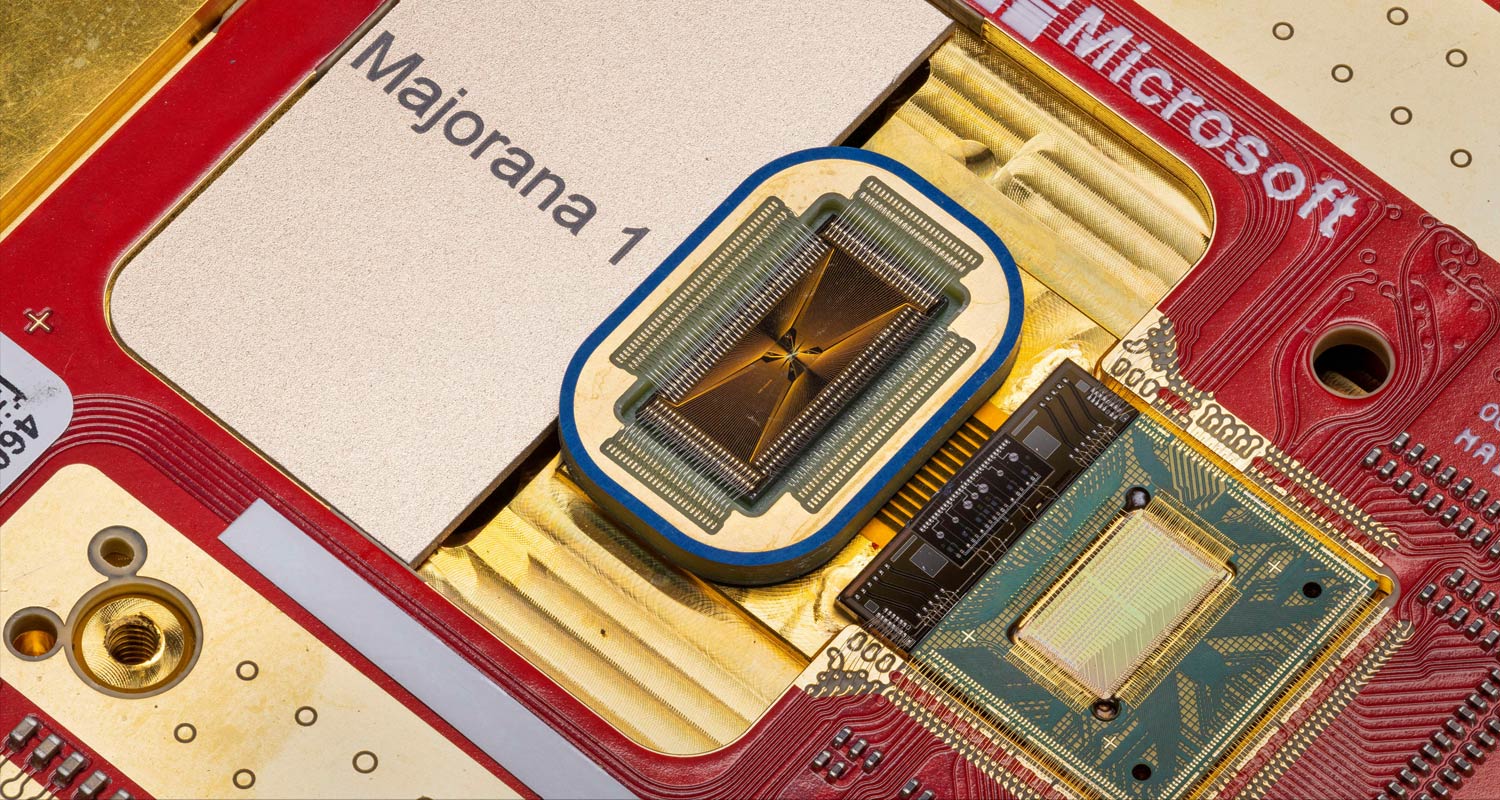
    Majorana 1 has been in the works for nearly two decades and relies on a subatomic particle called the Majorana fermion

    The biggest challenge of quantum computers is that a fundamental building block called a qubit, which is similar to a bit in classical computing, is incredibly fast but also extremely difficult to control and prone to errors. Microsoft said the Majorana 1 chip it has developed is less prone to those errors than rivals and provided as evidence a scientific paper set to be published in academic journal Nature.

    When useful quantum computers will arrive has become a topic of debate in the upper echelons of the tech industry. Nvidia CEO Jensen Huang said last month that the technology was two decades away from overtaking his company’s chips, the workhorses of artificial intelligence, reflecting broad scepticism.

    Those remarks prompted Google, which last year showed off its own new quantum chip, to say that commercial quantum computing applications are only five years away. IBM has said large-scale quantum computers will be online by 2033.

    Less error-prone

    Microsoft’s Majorana 1 has been in the works for nearly two decades and relies on a subatomic particle called the Majorana fermion whose existence was first theorised in the 1930s. That particle has properties that make it less prone to the errors that plague quantum computers, but it has been hard for physicists to find and control.

    Microsoft said it created the Majorana 1 chip with indium arsenide and aluminum. The device uses a superconducting nanowire to observe the particles and can be controlled with standard computing equipment.

    The chip Microsoft revealed on Wednesday has far fewer qubits than rival chips from Google and IBM, but Microsoft believes that far fewer of its Majorana-based qubits will be needed to make useful computers because the error rates are lower.

    Read: First quantum cyberattack expected by 2030s – IBM

    Microsoft did not give a timeline for when the chip would be scaled up to create quantum computers that can outstrip today’s machines, but the company said in a blog post that point was “years, not decades” away.

    Jason Zander, the Microsoft executive vice president who oversees the company’s long-term strategic bets, described Majorana 1 as a “high risk, high reward” strategy. The chip was fabricated at Microsoft labs in Washington state and Denmark.

    “The hardest part has been solving the physics. There is no textbook for this, and we had to invent it,” Zander said in an interview. “We literally have invented the ability to go create this thing, atom by atom, layer by layer.”

    Philip Kim, a professor of physics at Harvard University who was not involved in Microsoft’s research, said that Majorana fermions have been a hot topic among physicists for decades and called Microsoft’s work an “exciting development” that put the company at the forefront of quantum research.

    He also said that Microsoft’s use of a hybrid between traditional semiconductors and exotic superconductors appeared to be a good route toward chips that can be scaled up into more powerful chips.

    “Although there’s no demonstration [of this scaling up] yet, what they are doing is really successful,” Kim said.  — (c) 2025 Reuters

    Get breaking news from TechCentral on WhatsApp. Sign up here

    Don’t miss:

    Google says it has cracked a major challenge in quantum computing

    Add TechCentral as a preferred source on GoogleFollow TechCentral on Google NewsGet breaking news on WhatsApp


    Google IBM Jason Zander Jensen Huang Majorana Majorana 1 Majorana fermion Microsoft Nvidia
    WhatsApp YouTube
    Share. Facebook Twitter LinkedIn WhatsApp Telegram Email Copy Link
    Previous ArticleCredible technology news? Look no further than TechCentral
    Next Article Meet the iPhone 16e: Apple’s new ‘budget’ smartphone

    Related Posts

    Data sovereignty in South Africa is not an address - Ascent Technology, Johan Lamberts

    Data sovereignty in South Africa is not an address

    15 October 2026
    MIP attackers rank fourth on ransomware leak sites, says Microsoft

    MIP attackers rank fourth on ransomware leak sites, says Microsoft

    14 October 2026
    Google's Gemini 4 Argon is finally here

    Google’s Gemini 4 Argon is finally here

    14 October 2026
    Company News
    Winners, from left: Zandile Monaisa (Rand Refinery), Sibongakonke Kheswa (PSG Capital), Stefan Links (Forestry South Africa), Thabang Modiba (Mondelez International), Charmaine Ncube (Razor PR), Shaun Burger-Smal (Bestmed Medical Scheme), Nandipha Ngcobo (Transnet), Tracy Mulwela (Vodacom), Cheryl-Lynn Freeman (Mzansi Business Services), Yasheen Harrielall (Zutari), Valentine Mabaso (Taonga Business Group) and Thabang Thlaku (African Rainbow Minerals). Image: Rising Star Awards

    Celebrating South Africa’s rising stars: the leaders shaping what comes next

    19 October 2026
    Paratus Zambia delivers Starlink to thousands of children in Family Legacy schools

    Paratus Zambia delivers Starlink to thousands of children in Family Legacy schools

    15 October 2026
    Data sovereignty in South Africa is not an address - Ascent Technology, Johan Lamberts

    Data sovereignty in South Africa is not an address

    15 October 2026
    Opinion
    Nonkqubela Thathakahle Jordan-Dyani

    Why cybersecurity is now a national security issue for South Africa

    15 October 2026
    When a machine can choose, who does it become? Fanie van Rooyen

    When a machine can choose, who does it become?

    9 October 2026
    Let South Africans jailbreak their way to digital sovereignty - Dirk de Vos

    Let South Africans jailbreak their way to digital sovereignty

    5 October 2026

    Subscribe to Updates

    Get the best South African technology news and analysis delivered to your e-mail inbox every morning.

    Latest Posts
    Post Office wants R2.2-billion from government as it braces for another loss

    Post Office wants R2.2-billion from government as it braces for another loss

    19 October 2026
    AI music is here and the rulebook is blank - Justin Erasmus

    AI music is here and the South African rulebook is blank

    19 October 2026
    SA start-up wants to put a padlock on your phone calls

    SA start-up wants to put a padlock on your phone calls

    19 October 2026
    A software revolution is heading for South African driveways

    A software revolution is heading for South African driveways

    19 October 2026
    © 2009 - 2026 NewsCentral Media
    Built and maintained by Chronon
    • Cookie policy (ZA)
    • TechCentral – privacy and Popia

    Type above and press Enter to search. Press Esc to cancel.

    Manage consent

    TechCentral uses cookies to enhance its offerings. Consenting to these technologies allows us to serve you better. Not consenting or withdrawing consent may adversely affect certain features and functions of the website.

    Functional Always active
    The technical storage or access is strictly necessary for the legitimate purpose of enabling the use of a specific service explicitly requested by the subscriber or user, or for the sole purpose of carrying out the transmission of a communication over an electronic communications network.
    Preferences
    The technical storage or access is necessary for the legitimate purpose of storing preferences that are not requested by the subscriber or user.
    Statistics
    The technical storage or access that is used exclusively for statistical purposes. The technical storage or access that is used exclusively for anonymous statistical purposes. Without a subpoena, voluntary compliance on the part of your Internet Service Provider, or additional records from a third party, information stored or retrieved for this purpose alone cannot usually be used to identify you.
    Marketing
    The technical storage or access is required to create user profiles to send advertising, or to track the user on a website or across several websites for similar marketing purposes.
    • Manage options
    • Manage services
    • Manage {vendor_count} vendors
    • Read more about these purposes
    View preferences
    • {title}
    • {title}
    • {title}
    🇿🇦 Sign up to the TechCentral newsletter